
Team Building for Startups Explained: 2026 Guide
TL;DR:
- Effective startup team building focuses on operational design, emphasizing lean hiring, clear role definitions, and daily trust habits to reduce friction. Small core teams of two to six members outperform larger groups by enabling faster communication and lower coordination costs. Building trust through consistent daily habits and explicitly naming conflict patterns helps maintain high performance and resolve issues early.
Team building for startups is defined as the deliberate design of a lean, outcome-focused team that reduces operational friction and accelerates execution speed. Most founders treat it as a hiring problem. It is actually an operational design challenge. The goal is not to fill seats on an org chart. The goal is to assemble the smallest possible group of people who can deliver specific outcomes without coordination breaking down. This guide covers the core principles of successful startup team formation, from role clarity and hiring decisions to daily trust habits and conflict management, giving you a practical framework for 2026.
What is team building for startups, and why does it matter?
Team building for startups is the process of assembling and organizing a small group of people around clear outcomes, not titles or headcount. The standard industry term for this practice is organizational design, though in startup contexts it is more accurately described as operational team design. Both terms apply here, and understanding the difference matters because most startup failures trace back to poor team structure, not poor ideas.
Operational friction is the hidden tax on every startup. When roles overlap, when decision rights are unclear, or when communication breaks down, the team slows down. Funders recognize this directly. Resilient founding teams that function well under pressure are rated as a key risk factor when evaluating early-stage companies. That means your team structure is not just an internal concern. It affects your ability to raise capital.
The importance of team building in a startup is not about culture posters or quarterly offsites. It is about building a system where the right people make the right decisions fast, without constant escalation or confusion.
Why do lean, small core teams outperform larger ones early on?
Lean startup teams in 2026 optimally start with 2–6 core members, focusing on speed and financial flexibility. That number is not arbitrary. Smaller teams communicate faster, spend less time in alignment meetings, and burn less cash on coordination overhead. Every person you add before you have product-market fit increases the cost of changing direction.
The most common mistake founders make is hiring for comfort rather than capability gaps. You should only hire when a measurable, recurring bottleneck is slowing growth. If a task is happening once a month, a contractor handles it. If it is happening every week and blocking revenue, that is a hiring signal.
Here is what a lean founding team typically looks like in practice:
- Product or technical lead: Owns what gets built and how it works
- Commercial lead: Owns revenue, sales, and customer relationships
- Operations lead: Owns process, delivery, and team coordination
- Fractional specialists: Finance, legal, marketing brought in as needed
Pro Tip: Before posting a job description, write down the specific bottleneck the hire will solve and the metric that will confirm the problem is fixed. If you cannot name both, you are not ready to hire.
Premature hiring increases coordination cost without adding value to early startups. That is not a warning to ignore. Every unnecessary hire creates a new communication channel, a new expectation to manage, and a new salary to cover before you have proven your model.

How do you clarify roles and decision rights for your startup team?
Role clarity prevents coordination breakdown by defining behavioral expectations and decision rights over job titles. A job title tells someone what they are called. A role charter tells them what they own, what decisions they can make alone, and what outcomes they are accountable for. The difference is significant in a startup where speed depends on people acting without waiting for permission.
Writing a role charter takes less than an hour and prevents weeks of confusion. Here is a simple process:
- Name the outcome, not the activity. Write “owns customer revenue from $0 to $50,000 MRR” rather than “manages sales.”
- Define the decision boundary. List what this person decides alone, what requires input, and what requires approval.
- Set the success metric. One or two numbers that tell both parties whether the role is working.
- Agree on communication norms. How often do they report progress, and in what format?
- Review quarterly. Roles in early startups shift fast. Build in a scheduled reset.
Ambiguous responsibilities drive failures in high-pressure startup phases. That is the core finding from research on startup team dynamics, and it holds true whether you have two cofounders or twelve employees. The fix is not more meetings. It is clearer contracts between people.
Pro Tip: Apply role charters to part-time and fractional team members too. Unclear expectations with contractors create the same friction as unclear expectations with full-time hires.
Does trust really come from daily habits rather than team-building events?
One-off team-building events like escape rooms are ineffective for startup team performance. This finding challenges the conventional wisdom that a quarterly retreat or a fun afternoon activity builds lasting cohesion. It does not. What builds trust is repeated, predictable behavior over time.
The most effective daily habit for startup teams is what researchers call “connection before content.” At the start of every meeting, each person takes 60 seconds to share one thing about their current state, a win, a concern, or a challenge. This practice builds psychological safety faster than any structured event because it creates a consistent signal: this team pays attention to the whole person, not just the deliverable.
“High-performing teams build mutual investment through specific relational practices including candor, courage, and accountability as daily habits. Treat team development as ongoing practices rather than one-off events for sustained performance.”
Other daily habits that build team cohesion in startups include:
- Transparent progress updates: A short async message each morning on what you are working on and what is blocked
- Direct feedback loops: Naming problems as they arise rather than storing them for a review cycle
- Ally Mindset check-ins: Asking “what do you need from me this week?” before assuming you already know
High-performing teams practice an Ally Mindset that includes direct naming of problems and professional candor. This is not about being harsh. It is about being honest fast enough that small issues do not become structural conflicts. For team collaboration in startups, consistency beats intensity every time.
How do you manage cofounder conflict and early team dynamics?
Founding team conflicts often stem from recurring patterns like “Competence Wars” or “Pursuit-Distance Cycles.” Competence Wars happen when two founders both believe they are the more capable decision-maker and start competing for authority rather than collaborating on outcomes. Pursuit-Distance Cycles happen when one founder pushes for more communication and the other withdraws, creating a loop that escalates tension on both sides.
Naming these patterns is the first step toward resolving them. When you can say “we are in a Pursuit-Distance Cycle right now” rather than “you never communicate with me,” you create enough distance from the emotion to address the structure instead of the symptom.
Practical strategies for managing early team dynamics include:
- Name the pattern, not the person. Attack the dynamic, not the individual.
- Use perspective-taking questions. Ask “what does this situation look like from your side?” before defending your own position.
- Build accountability structures. Agree in advance on how you will handle disagreements, including who has final say in specific domains.
- Schedule conflict reviews. A monthly 30-minute conversation about team dynamics prevents issues from compounding.
Persistent conflict patterns must be explicitly named to reset dynamics rather than superficially solving task-based disagreements. This is one of the most underused tools in startup team management. Most founders try to solve the task. The real fix is addressing the relational pattern underneath it.
What are the practical steps for building your startup team system?
Effective startup team building combines the right hiring triggers, communication rhythms, and a lightweight operating system. These three elements work together. Hiring without a communication system creates chaos. A communication system without clear roles creates noise. The operating system ties everything together.
| Element | What it covers | Simple tool |
|---|---|---|
| Hiring trigger | Recurring bottleneck slowing revenue | Written bottleneck statement |
| Role charter | Outcomes, decisions, metrics per person | One-page document |
| Weekly cadence | Progress, blockers, priorities | Slack or Notion standup |
| Async updates | Daily transparency without meetings | Loom or written check-in |
| Quarterly review | Role reset and team health check | Calendar block |
Weekly and daily communication rhythms supported by lightweight tools like Slack, Notion, and Linear help maintain coordination without bureaucracy. Lean startup teams benefit from operating systems that prioritize transparency and fast feedback loops. The goal is not to create process for its own sake. The goal is to make it easy for everyone to know what is happening without asking.
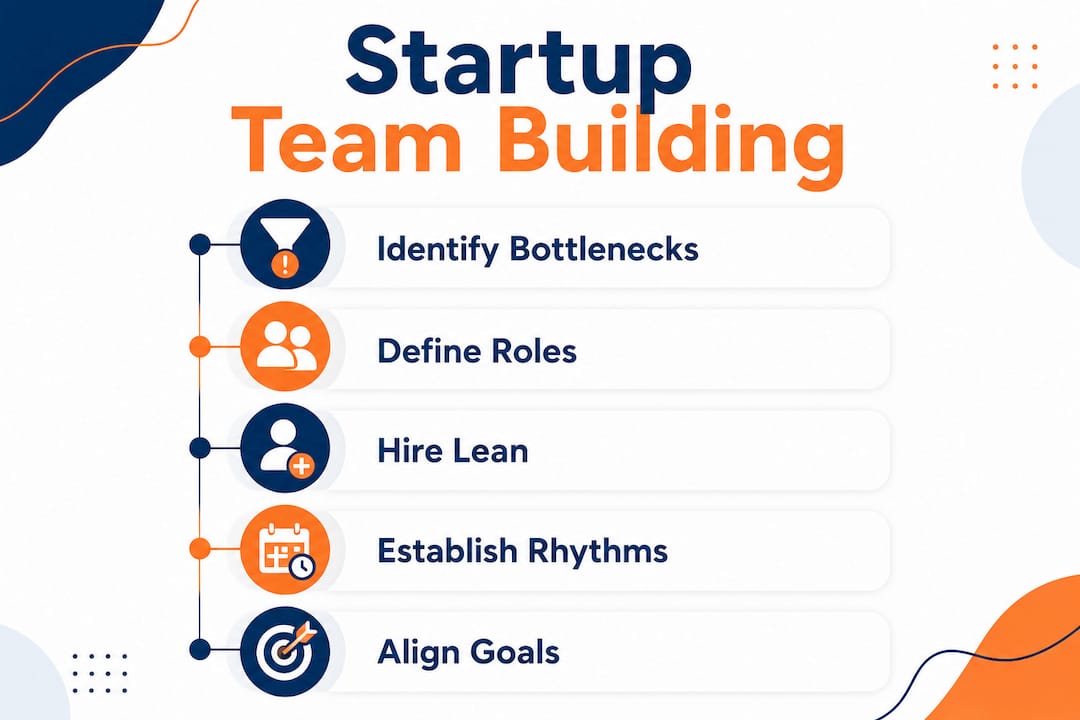
Use contractors and fractional leaders for specialist roles until the volume justifies a full-time hire. A fractional CFO, a part-time growth marketer, or a contract designer can deliver high-quality output at a fraction of the cost of a full-time employee. This keeps your core team lean while giving you access to senior-level capability.
Pro Tip: Set a startup goal-setting workflow at the start of each quarter. Align every role charter to the top three company priorities. This prevents individual contributors from optimizing for their own metrics at the expense of the team’s shared goals.
Key Takeaways
Effective startup team formation is an operational design challenge that requires lean hiring, clear role charters, daily trust habits, and named conflict patterns to sustain high performance.
| Point | Details |
|---|---|
| Start lean and stay lean | Build a 2–6 person core team and hire only when a measurable bottleneck appears. |
| Use role charters, not job titles | Define outcomes, decision rights, and success metrics for every team member. |
| Build trust through daily habits | Replace one-off events with 60-second check-ins and consistent async updates. |
| Name conflict patterns early | Identifying recurring dynamics like Competence Wars prevents escalation. |
| Match your operating system to your size | Use lightweight tools like Slack and Notion to maintain transparency without bureaucracy. |
Why I think most founders are solving the wrong team problem
The most common thing I see founders get wrong is treating team building as a people problem when it is almost always a systems problem. They bring in a coach, plan a retreat, or run a personality assessment. None of that fixes unclear decision rights or misaligned incentives. Those are structural issues, and they require structural solutions.
The founders who build the best early teams are the ones who treat every hire as a systems decision. They ask: what bottleneck does this person remove? What decision do they own? How will I know in 90 days whether this is working? That kind of thinking is rare, but it is the difference between a team that executes and a team that talks about executing.
I also think the emphasis on culture in early-stage startups is often misplaced. Culture is not what you put on a wall or say in an all-hands meeting. It is the sum of repeated behaviors. If you want a culture of accountability, build a system where accountability is visible and expected every week. If you want a culture of candor, model it yourself in every conversation. Rituals do not create culture. Repeated behavior does.
The founders who get this right also treat part-time and fractional team members with the same rigor as full-time hires. They write role charters for contractors. They include fractional leaders in weekly cadences. They give everyone a clear outcome to own. That consistency is what makes a lean team feel like a real team, even when half the people are not on payroll.
— Amichai
How Nomadexcel supports startup founders building high-performance teams
Nomadexcel runs immersive entrepreneurship bootcamps designed specifically for founders who want to build teams that execute, not just grow headcount. The programs combine hands-on operational frameworks with direct mentorship from experienced entrepreneurs, giving you the tools to design lean teams, clarify roles, and build the communication habits that sustain performance. For teams that need structured alignment and a reset on their working dynamics, Nomadexcel also designs company retreats that combine business impact with genuine connection. If you are building a startup team and want a structured environment to sharpen your approach, Nomadexcel is built for exactly that.
FAQ
What is team building for startups?
Team building for startups is the operational design of a lean, outcome-focused group that reduces coordination friction and accelerates execution. It centers on role clarity, hiring by bottleneck, and building trust through daily habits rather than one-off events.
How many people should a startup team have early on?
Lean startup teams in 2026 optimally start with 2–6 core members, prioritizing speed and financial flexibility. Hiring beyond that number before achieving product-market fit increases coordination costs without proportional output gains.
Why do one-off team-building activities fail in startups?
One-off events like escape rooms do not build lasting psychological safety because trust is built through repeated, predictable behavior. Daily habits such as 60-second check-ins at the start of meetings are more effective for sustained team cohesion.
How do you handle cofounder conflict in a startup?
Founding team conflicts often follow recurring patterns like Competence Wars or Pursuit-Distance Cycles. Naming these patterns explicitly creates the detachment needed to address the dynamic rather than the surface-level disagreement.
What tools do lean startup teams use to stay coordinated?
Lightweight tools like Slack, Notion, and Linear support weekly and daily communication rhythms without adding bureaucratic overhead. The goal is transparency and fast feedback loops, not process for its own sake.
Comments are closed.