
Startup Community Explained: What Entrepreneurs Must Know
TL;DR:
- A startup community is a structured, ongoing network of founders, investors, mentors, and operators that fosters growth through recurring interactions. These communities outperform large, open groups by building trust, generating referrals, and providing valuable resources for early-stage startups. Engaging consistently, contributing actively, and choosing communities aligned with your stage accelerates entrepreneurial success and access to opportunities.
A startup community is defined as a structured, recurring network of founders, investors, mentors, and operators who gather around shared goals of growth, learning, and mutual support. Unlike a one-time networking event or a LinkedIn connection request, a startup community creates ongoing touchpoints that compound in value over time. Platforms like Startup Grind, accelerators like Y Combinator, and curated Slack channels all represent different expressions of this model. For aspiring entrepreneurs and remote professionals, understanding startup communities is not optional background knowledge. It is a core operating advantage that shapes who funds you, who buys from you, and who helps you survive the hardest stretches of building a company.
Startup community explained: structure, members, and what sets it apart
A startup community is best understood as a structured founder network built on recurring interaction rather than one-time contact. The distinction matters enormously. A conference badge swap resets to zero the next morning. A community compounds.

The core members of any functioning startup ecosystem fall into four categories: founders who bring problems and ambition, investors who bring capital and pattern recognition, mentors who bring hard-won experience, and operators who bring functional expertise in areas like marketing, legal, or product. Each group needs the others. The ecosystem only works when all four are present and engaged.
Community size is a critical design variable. Curated circles of 10–20 members consistently outperform larger, open-access groups in terms of trust, depth of conversation, and actionable outcomes. That number is not arbitrary. It reflects the cognitive limit of how many meaningful professional relationships a person can actively maintain at one time.
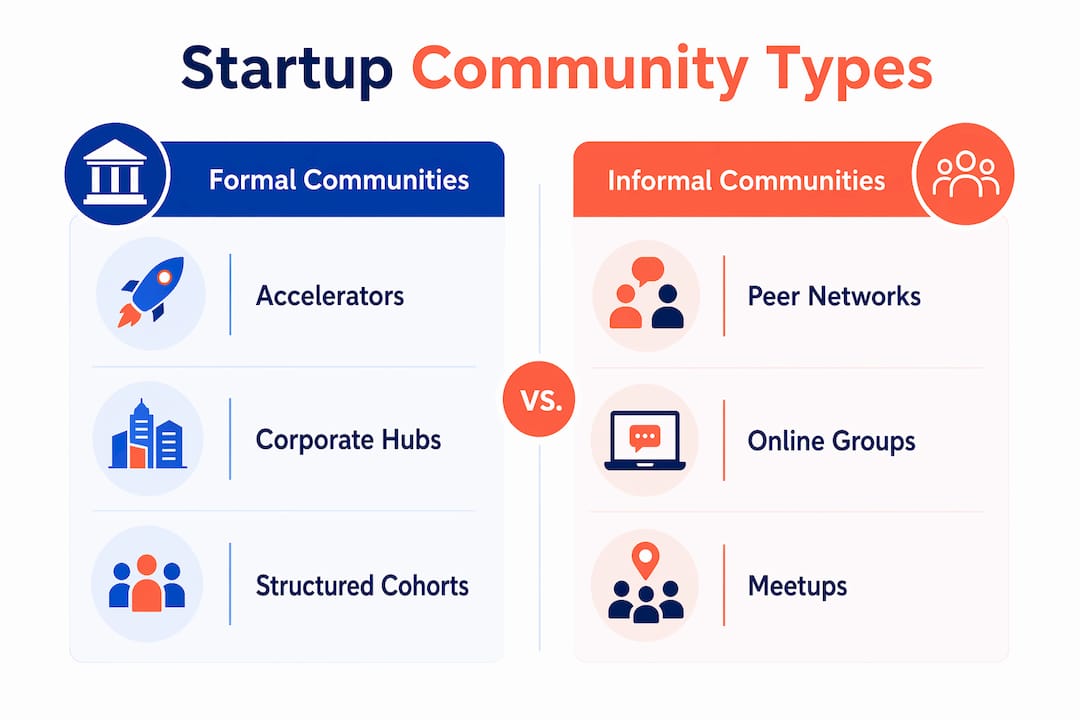
Startup communities also split into two broad structural models. Formal communities include accelerators like Techstars and Y Combinator, fellowship programs, and university incubators. These offer structured curricula, defined cohort timelines, and institutional credibility. Informal communities include founder meetups, Discord servers, and peer-led masterminds. These offer flexibility, lower barriers to entry, and often more candid conversation.
Pro Tip: When evaluating a community, ask how often the group meets and whether there is a defined membership process. Recurring cadence and intentional curation are the two clearest signals of a community that will actually move your business forward.
| Community Type | Structure | Typical Size | Best For |
|---|---|---|---|
| Accelerator cohort | Formal, time-bound | 10–30 founders | Seed-stage startups seeking funding |
| Peer-led mastermind | Informal, recurring | 6–15 members | Founders wanting candid peer feedback |
| Online Slack or Discord group | Informal, open | 50–5,000+ members | Remote professionals building broad networks |
| Corporate innovation hub | Formal, sponsored | 20–50 participants | Entrepreneurs seeking enterprise partnerships |
How does a startup community benefit entrepreneurs and remote professionals?
The benefits of startup communities are measurable, not theoretical. 70% of early-stage startups attribute their first paying customers or investors directly to networking activities. That statistic reframes community participation from a nice-to-have into a revenue-generating practice.
The referral effect inside communities is particularly powerful. Customers acquired through community referrals show a 37% higher retention rate and a 16% higher lifetime value than those acquired through cold outreach or paid advertising. Retention and lifetime value are the two metrics that determine whether a startup survives its first three years.
Beyond revenue, startup communities provide access to resources that would otherwise require significant time or money to find independently:
- Mentorship: Direct access to operators and founders who have solved the exact problems you are facing right now.
- Funding introductions: Warm investor introductions through trusted community members convert at significantly higher rates than cold outreach. Membership in a respected program signals quality before you say a word.
- Talent acquisition: Communities surface pre-vetted candidates who already understand the startup context and culture.
- Skill development: Workshops, roundtables, and peer teaching inside communities accelerate learning faster than solo study.
- Market credibility: Being associated with a recognized community or accelerator signals legitimacy to customers, partners, and press.
Communities also reduce the uncertainty that kills early-stage companies. Community-led growth moves members from passive consumption to active participation, turning the group into a real-time feedback loop for your product, pricing, and positioning. You get honest signal from people who want you to succeed, which is far more useful than anonymous survey data.
For remote professionals specifically, the community benefit is even more pronounced. Without a physical office or local professional network, a well-chosen online community becomes the primary source of accountability, collaboration, and opportunity.
How do you find and join the right startup community?
Finding the right community requires intention, not luck. The platforms that surface the most relevant options include LinkedIn Groups, Meetup.com, Eventbrite, Slack, and Discord. Each serves a different discovery purpose. LinkedIn surfaces professional and industry-specific groups. Meetup.com and Eventbrite surface local and recurring events. Slack and Discord host real-time, text-based communities organized around specific topics, stages, or geographies.
The most important filter when choosing a community is alignment, not size. A community of 15 focused founders at your stage will deliver more value than a group of 500 loosely connected professionals. Intentional networking within curated groups with systematic follow-ups is the highest-leverage use of your networking time. Collecting contacts is not the goal. Cultivating relationships is.
Here is a practical sequence for joining and contributing to a startup community:
- Identify your stage and goal. Are you pre-revenue and seeking validation? Post-product and seeking distribution? Your stage determines which community type serves you best.
- Search by specificity. Use LinkedIn and Meetup.com to search for communities organized around your industry, geography, or founder stage rather than generic “startup” groups.
- Attend recurring events first. Before committing to a paid membership or formal program, attend two or three recurring sessions to assess the quality of conversation and the caliber of members.
- Contribute before you ask. Share a relevant insight, make an introduction, or offer feedback on another founder’s pitch. Communities reward contributors with trust, and trust is the currency that unlocks real opportunities.
- Follow up with specificity. After each session, send a brief, specific message to one or two people you connected with. Reference the exact conversation you had. Generic follow-ups are forgotten within 24 hours.
- Commit to consistency. Recurring weekly or monthly meetings create the continuity that turns acquaintances into durable professional assets. One-off attendance resets the relationship clock every time.
Pro Tip: Look for communities that practice what researchers call Serendipity Engineering: intentionally pairing attendees before events, providing conversation openers, and keeping group sizes small enough for real dialogue. These design choices signal a community that takes connection seriously.
You can also explore startup community examples from around the world to identify models that match your goals and working style.
Which type of startup community fits your entrepreneurial stage?
Not every community model serves every founder equally well. The right fit depends on your current stage, your primary goal, and how you prefer to learn and connect.
Accelerator cohorts like those run by Techstars or Y Combinator offer the most structured experience. They provide curriculum, mentorship, and investor access within a defined timeline, typically three to six months. The trade-off is selectivity and time commitment. These programs are competitive to enter and demand full engagement.
Peer-led networks and masterminds operate on a different principle. Members self-select based on shared stage or industry, meet regularly, and hold each other accountable without a formal curriculum. The value is candor. Founders speak more honestly in peer groups than in formal programs where reputation is on the line.
Corporate innovation hubs, run by companies like Google, Microsoft, or large financial institutions, offer access to enterprise resources, distribution channels, and co-investment opportunities. They work best for startups whose product has a clear enterprise application.
Informal meetups and online communities serve a different function. They are the widest net and the lowest barrier. They work well for early discovery, building a broad professional surface area, and staying current on industry trends. They rarely replace the depth of a curated cohort.
Entrepreneur communities thrive when members share a sense of identity and purpose beyond just professional networking. The communities that last are the ones where members genuinely care about each other’s outcomes. That quality is visible within two or three sessions if you know what to look for.
For a deeper look at how to build one of these models from the ground up, Nomadexcel’s guide to building a startup community walks through the foundational principles that make communities durable rather than disposable.
Key takeaways
A startup community is the most reliable accelerant for early-stage growth because it combines mentorship, warm referrals, and accountability into a single recurring structure that compounds in value over time.
| Point | Details |
|---|---|
| Definition matters | A startup community is a recurring, structured network, not a one-time event or passive group. |
| Size drives quality | Curated groups of 10–20 members consistently outperform large, open-access communities for trust and outcomes. |
| Community drives revenue | 70% of early-stage startups find their first customers or investors through community networking. |
| Contribution unlocks access | Active, contributive participation builds the trust that converts peers into partners, clients, and advocates. |
| Match type to stage | Accelerators, peer masterminds, and online groups each serve different founder stages and goals. |
Why most founders underuse the most powerful tool they have
I have watched hundreds of founders treat community as a background activity, something they will invest in once the product is ready or the revenue is stable. That logic is exactly backward. The community is what gets you to stable revenue faster.
The insight that changed how I think about this comes from the concept of Serendipity Engineering. The best communities do not leave connection to chance. They design for it. They pair people intentionally, keep groups small, and create recurring contexts where trust can build over months rather than minutes. That design philosophy is what separates a community that changes careers from one that fills a calendar.
What I have also observed is that the founders who get the most from community are almost never the loudest voices in the room. They are the ones who show up consistently, ask sharp questions, and make introductions without keeping score. Vulnerability in those settings, admitting what you do not know, is not a weakness. It is the fastest path to the kind of help that actually moves the needle.
The networking for founders mindset shift is simple but hard to execute: stop attending communities and start contributing to them. The return on that shift is not incremental. It is transformational.
— Amichai
Build your network through nomadexcel’s entrepreneurship bootcamp
Understanding startup communities is the first step. Experiencing one changes everything. Nomadexcel’s Online Entrepreneurship Bootcamp places you inside a curated cohort of driven founders, guided by experienced mentors and operators who have built real businesses. You get structured learning, daily accountability, and a peer network that stays active long after the program ends. This is not passive content consumption. It is the kind of high-trust, recurring community that the research consistently shows produces the best outcomes for early-stage entrepreneurs. If you are ready to move from understanding to action, the bootcamp is where that shift happens.
FAQ
What is a startup community?
A startup community is a structured, recurring network of founders, investors, mentors, and operators who meet regularly to share resources, knowledge, and connections. It differs from one-time networking events by creating ongoing relationships that compound in value.
How do i join a startup community as a beginner?
Start by searching LinkedIn Groups, Meetup.com, and Eventbrite for communities aligned with your industry and founder stage. Attend two or three recurring sessions before committing, and focus on contributing value before making requests.
What size startup community is most effective?
Research shows that curated groups of 10–20 members consistently outperform larger open-access communities in trust, depth of conversation, and actionable outcomes.
Why do startup communities matter for remote professionals?
Remote professionals lack the organic networking that comes from a physical office or local business scene. A well-chosen online startup community replaces that infrastructure by providing accountability, collaboration, and access to opportunities that would otherwise require geographic proximity.
What is serendipity engineering in a startup community context?
Serendipity Engineering is a systematic approach to creating meaningful connections by curating attendee lists, providing conversation openers, and maintaining small group sizes. It is the design philosophy behind the most effective startup communities.
Comments are closed.