
Defining Growth Strategy for Startups: 2026 Guide
TL;DR:
- A growth strategy involves deliberate decisions that help a business create and capture value over time. It focuses on defining where to compete, how to allocate resources, and which markets or products to prioritize. Effective strategies layer clear goals, measure progress with KPIs and OKRs, and adapt based on validated customer value hypotheses.
A growth strategy is defined as the deliberate set of choices a business makes to create and capture value as it expands over time. Harvard Business School frames growth strategy as structured decisions rather than a list of tactics, tailored to each firm’s unique situation. Defining growth strategy means deciding where to compete, how to allocate resources, and which markets or products to prioritize. The Ansoff Matrix, OKRs, and KPI frameworks are the most widely used tools for translating that intent into a working plan. For entrepreneurs and business leaders, getting this definition right from the start separates businesses that scale with purpose from those that grow chaotically and stall.

What is defining growth strategy, and why does it matter?
Growth strategy is not a revenue target or a marketing plan. Growth strategy development is the process of identifying how your business will create value for customers and capture enough of that value to fund continued expansion. Harvard Business School professor Felix Oberholzer-Gee argues that effective growth strategies diagnose changes in value creation and the trade-offs a company must perform as it scales. That framing matters because it forces you to ask a harder question than “how do we grow?” It asks, “why would customers pay more, stay longer, or refer others as we grow?”
BCG’s 2026 analysis confirms that revenue growth drives total shareholder return more than any other factor at both three-year and ten-year horizons. That finding applies equally to private startups: the businesses that define their growth logic early build compounding advantages that are hard to replicate. Without a clear growth strategy, you end up reacting to opportunities rather than selecting them. Reaction is expensive. Selection is profitable.
What are the main types of growth strategies?
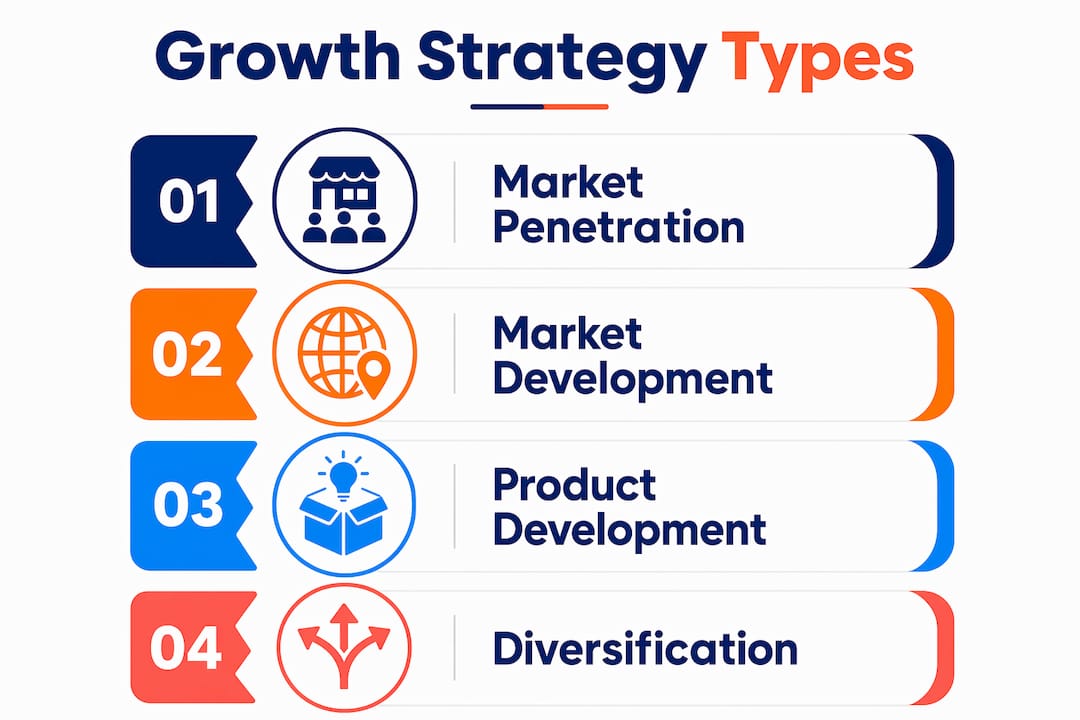
The Ansoff Matrix is the most practical framework for categorizing business growth approaches. Shopify explains that the matrix organizes growth into four strategies ordered by rising risk: market penetration, market development, product development, and diversification.
| Strategy | Definition | Risk Level | Best For |
|---|---|---|---|
| Market Penetration | Sell more of existing products to existing customers | Low | Early-stage startups with proven product-market fit |
| Market Development | Enter new markets with existing products | Medium | Businesses with a replicable model ready to expand geographically |
| Product Development | Create new products for existing customers | Medium-High | Companies with strong customer relationships and R&D capacity |
| Diversification | New products for new markets | High | Established businesses with capital and risk tolerance |
Startups almost always benefit from starting at the low-risk end of this spectrum. Market penetration builds unit economics and customer insight before you commit capital to higher-uncertainty bets. A SaaS company that deepens usage among its current user base before launching a second product line is practicing this discipline. Diversification, by contrast, is the strategy that has destroyed more startups than any competitor ever could. It splits focus, dilutes resources, and multiplies execution risk simultaneously.
Pro Tip: Before moving up the Ansoff risk ladder, write down your current customer acquisition cost and lifetime value. If those numbers are not yet favorable, market penetration is still your job.
How do you set clear, measurable growth goals?
Wells Fargo recommends tailoring growth goals to revenue targets, market share, or customer value, always grounded in your business mission and risk tolerance. That advice sounds simple, but most founders skip the alignment step and set goals that feel ambitious without connecting to the underlying business model.
Three distinct goal types drive most growth strategies:
- Revenue growth goals measure top-line expansion. Examples include reaching $1 million in annual recurring revenue or growing monthly revenue by 15% quarter over quarter.
- Customer acquisition goals track new buyers entering your funnel. A useful metric here is the ratio of customer acquisition cost to lifetime value, which should exceed 3:1 for a healthy growth model.
- Customer value expansion goals measure how much existing customers spend over time. Net revenue retention above 100% means your existing base is growing without adding a single new customer.
Entrepreneurs often treat growth as a single number when it actually requires layered goals matched to specific growth drivers. A business growing through acquisition needs different metrics than one growing through expansion of existing accounts. Conflating the two leads to misallocated budgets and misleading dashboards.
The distinction between KPIs and OKRs matters here. KPIs measure the ongoing health of your business, things like churn rate, gross margin, and conversion rate. OKRs are time-bound change goals: “Increase trial-to-paid conversion from 12% to 20% by Q3.” Both layers are necessary. KPIs tell you if the engine is running. OKRs tell you if you are building a better engine.
Pro Tip: Write your top three growth goals on a single page alongside the specific driver each goal targets. If you cannot connect a goal to a driver, the goal is a wish, not a strategy.
What strategic choices drive an effective growth strategy?
Growth strategy is fundamentally about trade-offs. Harvard Business School uses the “value stick” concept to measure the gap between a customer’s willingness to pay and the cost to serve them. Widening that gap is the core logic of every sound growth strategy. You can widen it by raising willingness to pay through better product quality or brand strength, or by lowering cost through operational efficiency. Both paths are valid. Trying to pursue both simultaneously without adequate resources is not.
The four strategic choices that underlie most effective growth strategies are:
- Where to compete. Which customer segments, geographies, or channels will you prioritize? Saying yes to one market means saying no to another.
- How to win. What gives your business a defensible advantage in that market? Price, speed, quality, and network effects are the most common answers.
- What to build or buy. Organic growth through product and team development moves slower but builds deeper capability. Inorganic growth through partnerships or acquisitions moves faster but introduces integration risk.
- How to test assumptions. BCG advises treating growth like capital deployment, with scenario planning and stress testing before committing budgets.
“Write one sentence that connects how your customer’s life improves to the specific lever that scales that improvement. If you cannot write that sentence, you do not yet have a growth strategy.” — Harvard Business School practitioner insight
The most common failure in strategic growth planning is disconnecting the value logic from the growth lever. A company that knows customers love its speed but then invests in adding features rather than improving delivery time has broken that connection. Validating assumptions before budgeting is the discipline that separates high-performing growth teams from those that spend confidently and learn slowly.
How do you operationalize and measure your growth strategy?
Translating a growth strategy into daily execution requires three aligned layers. Perdoo identifies these as the strategic choice itself, KPIs that monitor business health, and OKRs that drive time-bound change. When these layers are misaligned, teams measure activity without changing outcomes, or chase change goals without monitoring whether the business stays healthy in the process.
A practical scoreboard for a scaling startup might look like this:
| Layer | Example | Review Cadence |
|---|---|---|
| Strategic Choice | Grow through market penetration in the U.S. mid-market | Quarterly |
| KPI | Monthly recurring revenue, churn rate, gross margin | Weekly |
| OKR | Increase MRR from $80K to $120K by end of Q2 | Monthly |
The scoreboard works only if the right people review it on the right schedule. Weekly KPI reviews catch problems early. Monthly OKR check-ins keep teams accountable to change goals. Quarterly strategy reviews ask whether the original strategic choice still fits the market reality.
- Set a baseline first. Before tracking progress, document where you are today across every metric on your scoreboard.
- Assign ownership. Every KPI and OKR needs a named owner, not a team or department. Shared ownership is no ownership.
- Build in revision windows. Markets shift. A growth strategy workflow that has no scheduled revision point becomes a document rather than a living plan.
- Connect metrics to decisions. Every metric on your dashboard should trigger a specific action if it moves outside its target range. If a metric does not drive a decision, remove it.
Pro Tip: Limit your active OKRs to three per quarter. More than three signals that you have not made the hard prioritization choices that a real growth strategy requires.
Key takeaways
A well-defined growth strategy is the single most important structural decision an early-stage business can make, because it determines which resources get deployed, which markets get prioritized, and which metrics actually matter.
| Point | Details |
|---|---|
| Start with value creation logic | Define how your business improves customer outcomes before selecting a growth lever. |
| Use the Ansoff Matrix to sequence risk | Begin with market penetration to stabilize unit economics before pursuing higher-risk strategies. |
| Layer goals across KPIs and OKRs | KPIs monitor business health; OKRs drive time-bound change. Both layers must align. |
| Test assumptions before budgeting | Write the connection between customer value and growth lever, then stress test it with scenario planning. |
| Build a living scoreboard | Assign metric ownership, set review cadences, and schedule quarterly strategy revision windows. |
The part most entrepreneurs skip
I have worked with hundreds of founders across bootcamps and retreats, and the pattern is consistent: most entrepreneurs can describe their growth ambitions in vivid detail, but very few can articulate the value logic behind them. They know they want to double revenue. They cannot always explain why a customer would pay more, stay longer, or refer a friend as the business scales. That gap is where growth strategies collapse.
The Ansoff Matrix and OKR frameworks are genuinely useful, but they are tools, not substitutes for thinking. I have seen teams build beautiful dashboards tracking twenty metrics while the core product was losing relevance with its best customers. The scoreboard looked healthy. The strategy was quietly failing.
What actually works is the discipline of writing one sentence that connects customer value to a specific growth lever, then testing that sentence against real data before spending a dollar. BCG calls this treating growth like capital deployment. I call it the minimum viable strategy. You do not need a 40-page plan. You need one clear sentence and the honesty to revise it when the evidence says you are wrong.
The entrepreneurs who grow with the most consistency are not the ones with the most ambitious targets. They are the ones who set business goals with precision, track the right metrics, and stay willing to change their assumptions faster than their competitors do.
— Amichai
How Nomadexcel helps you build a growth strategy that works
Defining a growth strategy on your own is possible. Doing it inside a room of experienced mentors and driven peers is faster and more effective. Nomadexcel’s online entrepreneurship bootcamp gives founders the frameworks, feedback, and accountability to move from vague growth ambitions to a clear, executable plan. Each program combines hands-on strategy workshops, direct mentorship from experienced operators, and a peer community that continues long after the program ends. If you are ready to stop reacting to growth and start designing it, explore Nomadexcel’s programs and find the format that fits your stage and goals.
FAQ
What is a growth strategy in simple terms?
A growth strategy is a deliberate plan that defines how a business will expand its revenue, customers, or market reach over time. It answers where to compete, how to win, and how to measure progress.
What are the four types of growth strategies?
The Ansoff Matrix defines the four types as market penetration, market development, product development, and diversification, ordered from lowest to highest risk.
How is a KPI different from an OKR in growth strategy?
KPIs measure ongoing business health, such as churn rate or gross margin, while OKRs are time-bound goals designed to drive specific change, such as increasing conversion rate by a set deadline.
How do startups choose the right growth strategy?
Startups should begin with market penetration to validate unit economics before moving to higher-risk strategies like diversification. The Ansoff Matrix provides a practical sequencing framework for this decision.
How often should you revise your growth strategy?
A growth strategy should be reviewed quarterly at minimum. BCG recommends treating growth like capital deployment, which means revisiting assumptions whenever market data or performance metrics shift materially.
Comments are closed.