
What Is Entrepreneurial Alignment and Why It Matters
TL;DR:
- Entrepreneurial alignment is the consistent coherence between a founder’s personal values, leadership decisions, business strategy, and team execution towards shared, measurable goals. It begins with the founder’s internal integrity and extends to organizational processes, requiring continuous attention to prevent growth stalls and strategic failures. Building and maintaining alignment through clear purpose, incentives, decision rights, and governance rhythms is essential for sustainable business success.
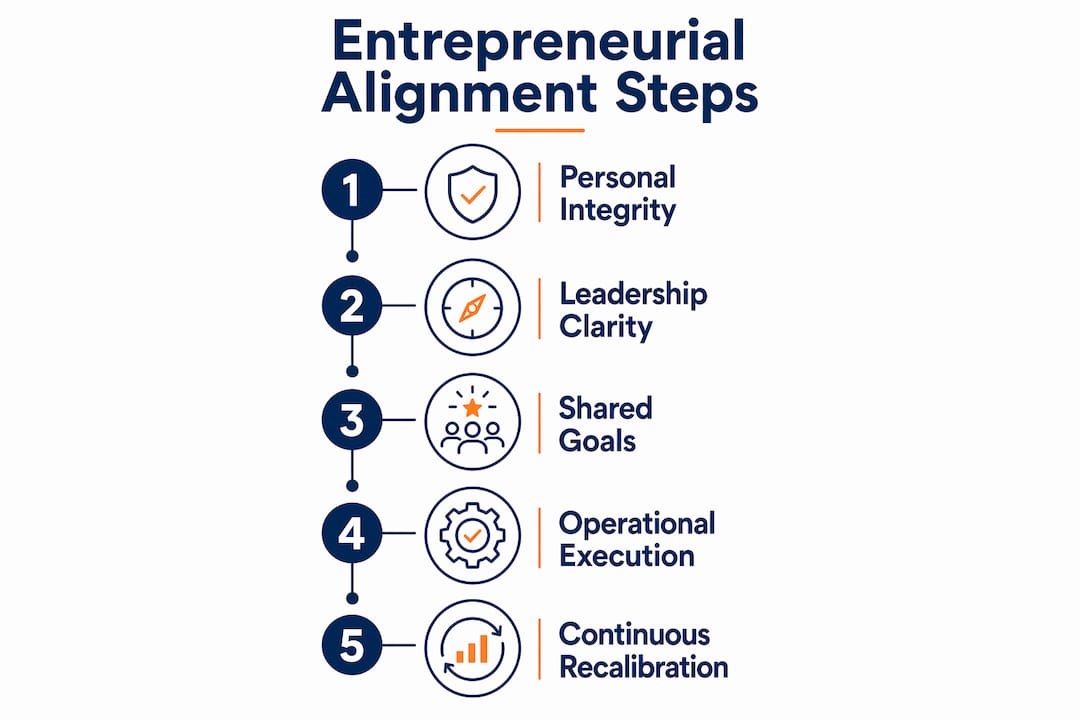
Entrepreneurial alignment is defined as the consistent coherence between a founder’s personal values, leadership decisions, business strategy, and team execution toward shared, measurable goals. This concept goes far beyond organizational charts or mission statements. It operates at two levels simultaneously: the internal integrity of the leader and the external coordination of the business. When these two levels are out of sync, growth stalls, talent leaves, and strategy fails to translate into results. Understanding what entrepreneurial alignment means, and how to build it, is one of the most practical investments any aspiring entrepreneur can make.
What is entrepreneurial alignment, exactly?
Entrepreneurial alignment is the practice of ensuring that every leadership decision, team behavior, and operational process consistently reflects your authentic purpose and strategic direction, not just comfort or external pressure. The standard industry term for the organizational dimension of this concept is strategic alignment, but entrepreneurial alignment extends that definition inward to include the founder’s own identity and values as the starting point.

Alignment in entrepreneurship is integrity: matching decisions and actions to what you know to be true, especially when it challenges your habits or ego. That distinction matters because many founders confuse alignment with agreement or comfort. A decision can feel comfortable and still be deeply misaligned with your actual purpose. The reverse is also true: a difficult decision made with full integrity is a sign of strong alignment, even when it creates short-term friction.
The core elements of entrepreneurial alignment include leadership clarity, execution efficiency, shared goals across teams, and a governance structure that keeps strategy connected to daily operations. Named frameworks from organizations like BMO Wealth Management and SIG (Software Improvement Group) both emphasize that alignment is not a one-time event. It requires continuous attention, measurement, and recalibration as the business evolves.
How personal leadership and integrity shape alignment
Alignment begins with the founder. Before any team can move in a coherent direction, the person leading the venture must be operating from a place of internal consistency. This is what the Entrepreneurial Excellence Podcast describes as vertical alignment: leading from your ideal self rather than from external pressures or reactive habits. When founders skip this step, the misalignment shows up downstream in confused teams, inconsistent priorities, and decisions that contradict the stated strategy.
Several specific behaviors signal personal misalignment in leadership:
- Making decisions based on what others expect rather than what the business actually needs
- Avoiding difficult conversations because they feel uncomfortable, not because they are unnecessary
- Pursuing opportunities that look good externally but conflict with your core purpose
- Confusing busyness with progress, and activity with execution
- Allowing ego to override evidence when evaluating strategy
The role of emotional intelligence here is significant. Leaders who cannot distinguish between discomfort and misalignment will consistently make reactive choices that erode team trust and strategic coherence. Purpose-driven entrepreneurship research consistently shows that founders who operate from a clearly defined internal purpose make faster, more confident decisions because they have a reliable internal reference point.
Pro Tip: Run a weekly five-minute self-audit. Ask yourself: “Did my decisions this week reflect my stated values and strategy, or did I default to comfort and habit?” Honest answers to that question reveal your actual alignment score faster than any framework.
What entrepreneurial alignment means in business operations
Once personal alignment is established, the concept expands into the organizational dimension. Business alignment frameworks define alignment as coordinated coherence among strategy, operating models, teams, and investments working toward shared, measurable goals. SIG’s business-IT alignment model and Monday.com’s business alignment definitions both emphasize continuous governance and shared KPIs as the mechanisms that keep alignment active rather than theoretical.
The rowing team analogy captures this well. Twelve people in a boat with different ideas about direction, pace, or priority do not just slow down. They actively work against each other. The same dynamic plays out in startups where sales, product, and operations teams each optimize for their own metrics without a shared framework connecting those metrics to the company’s strategic goals.
| Alignment dimension | What it looks like in practice |
|---|---|
| Strategy to operations | Daily decisions reflect the stated strategic priorities, not departmental convenience |
| Leadership to team | Founders communicate purpose in ways that translate into team-level decision rules |
| Incentives to goals | Compensation and recognition reinforce the behaviors the strategy actually requires |
| Technology to process | Tools and systems support the operating model rather than creating workarounds |
BMO Wealth Management explains that embedding your venture’s deeper purpose into business activities creates accountable, mission-driven strategies that employees and partners can genuinely rally behind. This means purpose cannot live only in a slide deck. It must show up in hiring criteria, budget decisions, product roadmaps, and the questions asked in weekly team meetings.
Pro Tip: Convert your purpose statement into three to five operational decision rules. For example: “We prioritize long-term client relationships over short-term revenue” becomes a rule that guides pricing, sales tactics, and contract terms simultaneously.
The costs and consequences of misalignment in entrepreneurial ventures
Misalignment is not just a leadership philosophy problem. It carries direct economic costs that compound over time. Midstage startups operating at 65 to 75% efficiency due to misalignment can boost productivity 25 to 40% by correcting systemic alignment problems, often within two quarters and without adding resources. That is a significant performance gap that most founders attribute to talent, market conditions, or funding rather than internal coherence.
The most dangerous form of misalignment is what Entrepreneur.com calls execution drift: teams appear aligned during meetings but privately renegotiate urgency, ownership, and risk after the meeting ends. Everyone leaves the room nodding. Then each person quietly adjusts their interpretation of what was decided, what the deadline really means, and who is actually accountable. The result is process breakdown that looks like a communication problem but is actually a structural alignment failure.
“Your team left the meeting aligned. Execution fell apart anyway.” This pattern is not a personality issue. It is a system design issue, and it costs founders weeks of rework, delayed launches, and eroded team trust on every cycle it repeats.
Common signals that misalignment is costing your business include:
- Repeated rework on deliverables that were supposedly finalized
- Team members citing different priorities when asked what the company is focused on
- High performer attrition within the first 18 months of joining
- Strategy documents that no one references in daily decisions
- Meetings that produce consensus but not consistent follow-through
Identifying these signals early allows founders to address alignment at the system level rather than managing individual performance problems that are actually symptoms of a deeper structural issue.
How to achieve and sustain entrepreneurial alignment in your business
Achieving alignment requires more than communicating strategy clearly. The European Business Review identifies four organizational levers that must work together for alignment to hold: goals, incentives, decision rights, and ways of working. When any one of these is out of sync with the others, the strategy fails at the execution level regardless of how well it was designed.
Here is a practical sequence for building and sustaining entrepreneurial alignment:
- Define your purpose in operational terms. Translate your mission into three to five decision rules that apply to real business situations, not just aspirational language.
- Audit your incentive structures. Check whether your compensation, recognition, and advancement systems reward the behaviors your strategy actually requires, or behaviors that feel productive but contradict your goals.
- Clarify decision rights. Specify who makes which decisions, at what level, and with what information. Ambiguity in decision rights is one of the most common sources of execution drift.
- Establish governance rhythms. Weekly tactical check-ins, monthly strategic syncs, and quarterly alignment reviews create the recurring touchpoints that keep strategy connected to execution over time.
- Measure alignment, not just activity. Track whether teams are making consistent assumptions and following through on commitments, not just whether they are busy or attending meetings.
Strategic alignment for startups research reinforces that the gap between strategy and execution is almost always a system design problem, not a motivation problem. Founders who redesign their organizational systems around the four levers above see faster execution, lower rework rates, and stronger team cohesion within two to three months.
Pro Tip: After every major decision, ask your team: “What does this mean for your priorities this week?” The answers will immediately reveal whether your strategic intent translated into aligned execution or whether each person heard something different.
Common misunderstandings about entrepreneurial alignment
Several persistent myths prevent founders from treating alignment as the practical discipline it actually is.
The first misunderstanding is that alignment means everyone agrees. Real alignment means everyone operates from consistent assumptions and follows through on shared commitments, even when they have different opinions about the approach. Disagreement within an aligned team is healthy. Private renegotiation of decisions after meetings is not.
The second misunderstanding is that alignment is a one-time achievement. SIG’s governance model treats alignment as an ongoing practice requiring regular metrics review and responsiveness to shifting priorities. A startup that aligned perfectly at launch will drift within six months if it does not build recalibration into its operating rhythm.
The third misunderstanding is that alignment becomes less important as AI tools take over more knowledge work. The opposite is true. When AI makes knowledge abundant, judgment based on aligned purpose becomes a critical competitive advantage. The founders who can make fast, confident decisions in ambiguous situations are the ones whose internal alignment gives them a reliable compass when data alone cannot resolve the question.
Finally, many founders confuse activity alignment with execution alignment. Activity alignment means everyone is busy and attending the same meetings. Execution alignment means consistent assumptions, clear ownership, and follow-through that matches the original intent. The difference between these two states is where most startup execution failures actually live.
Key takeaways
Entrepreneurial alignment requires consistent coherence between personal integrity, organizational strategy, team incentives, and execution systems to drive sustainable business growth.
| Point | Details |
|---|---|
| Alignment starts internally | Founders must operate from personal integrity before organizational alignment can hold. |
| Four levers drive execution | Goals, incentives, decision rights, and ways of working must all point in the same direction. |
| Misalignment has real costs | Startups operating misaligned lose 25 to 35% of execution efficiency, recoverable within two quarters. |
| Activity is not alignment | Teams can appear aligned in meetings while privately renegotiating decisions that cause execution drift. |
| Alignment is an ongoing practice | Regular governance rhythms and metrics reviews keep strategy connected to daily execution over time. |
Why alignment is the entrepreneurial skill nobody talks about enough
I have worked with hundreds of founders across bootcamps and retreats, and the pattern I see most consistently is this: the founders who struggle to scale are almost never short on ideas, ambition, or even talent. They are short on alignment. Their strategy says one thing, their incentives reward another, and their personal decisions reflect a third priority entirely. The gap between those three things is where growth goes to die.
What changed my own thinking on this was realizing that alignment is not a state you achieve and then maintain passively. It is a discipline you practice daily, like physical training. The days you skip the practice are the days the drift starts. And drift compounds quietly until it becomes a crisis that looks sudden but was actually months in the making.
The most encouraging thing I can tell you is that alignment is correctable at any stage. I have seen teams go from chronic execution failure to genuine momentum in under 90 days simply by redesigning their decision rights and governance rhythms. The work is not glamorous. It does not make for exciting founder stories. But it is the work that actually moves the needle.
If you take one thing from this article, make it this: alignment is not a buzzword or a leadership philosophy. It is the operating system underneath every business decision you make. Build it deliberately, and your strategy will finally start executing the way you designed it to.
— Amichai
Build your entrepreneurial alignment with Nomadexcel
Understanding alignment in theory is the starting point. Putting it into practice requires the right environment, the right frameworks, and a community of founders who are doing the same work alongside you. Nomadexcel’s Online Entrepreneurship Bootcamp is built specifically to help aspiring and early-stage entrepreneurs develop the leadership clarity and strategic coherence that alignment requires. The program combines purpose-to-strategy frameworks, daily accountability structures, and direct mentorship from experienced operators. If you are ready to move from knowing what alignment means to actually living it in your business, explore why joining a bootcamp accelerates that process faster than going it alone.
FAQ
What is the entrepreneurial alignment definition?
Entrepreneurial alignment is the consistent coherence between a founder’s personal values, leadership decisions, business strategy, and team execution. It combines internal integrity with external organizational coordination to drive sustainable growth.
How does misalignment affect a startup’s performance?
Misalignment reduces execution efficiency by 25 to 35%, with teams privately renegotiating decisions after meetings in ways that cause process breakdown, rework, and delayed launches. Correcting systemic alignment problems can recover that efficiency within two quarters.
What are the four levers for achieving entrepreneurial alignment?
The European Business Review identifies goals, incentives, decision rights, and ways of working as the four organizational levers that must align for strategy to translate into consistent execution.
Is entrepreneurial alignment the same as business alignment?
Entrepreneurial alignment includes business alignment but extends it inward to the founder’s personal integrity and identity. Business alignment focuses on coordinating strategy, operations, and teams. Entrepreneurial alignment adds the founder’s own values and purpose as the foundational layer beneath that coordination.
How often should founders recalibrate their alignment?
Alignment requires ongoing governance rather than one-time setup. Weekly tactical check-ins, monthly strategic syncs, and quarterly strategy reviews create the rhythm needed to keep personal purpose, team behavior, and business strategy consistently connected.