
Why Early Stage Mentorship Matters for Startup Success
TL;DR:
- Structured mentorship provides founders with decision support, skill enhancement, and network expansion that drive faster growth. Evidence shows that goal-driven, multi-mentor programs significantly improve business performance and psychological resilience, unlike casual advice. To maximize benefits, founders should pursue ongoing, organized mentorship with aligned experts, clear goals, and deliberate network leverage.
Most founders assume mentorship is motivational at best and optional at worst. The reality is sharply different. Understanding why early stage mentorship matters means recognizing that structured guidance does far more than keep you inspired. It sharpens your decision-making, accelerates skill development, expands your network, and directly improves your odds of generating revenue and acquiring customers faster than founders who go it alone. This article walks through the evidence, the psychology, and the practical steps that make early-stage mentorship one of the highest-leverage investments you can make as a founder.
Key Takeaways
| Point | Details |
|---|---|
| Mentorship is decision-support | Structured mentorship reduces costly founder errors through real-time expert guidance across business functions. |
| Research confirms outcomes | Mentored founders show significant gains in business planning, decision-making, revenue, and customer acquisition. |
| Psychology matters as much as knowledge | Mentorship improves self-efficacy and locus of control, building the mental resilience that sustains founders through uncertainty. |
| Fit and structure determine results | Mentor-mentee mismatches undermine progress; aligned, structured programs with multiple experts outperform ad hoc advice. |
| Ecosystem benefits reach beyond you | Mentorship programs improve the overall performance of entrepreneurial ecosystems, not just individual startups. |
Why early stage mentorship matters more than casual advice
Early-stage mentorship, as a concept, gets used loosely. Someone connecting you with a contact, a panel speaker answering a question after a pitch event, a friend who sold a company once — these are all called “mentorship,” but they are not the same thing. What the research actually examines, and what produces measurable results, is structured mentorship. This means goal-driven, repeated engagement with experienced guides who have no conflict of interest and a genuine stake in your development.

The distinction matters a great deal. A single conversation with a well-connected founder can be valuable, but it lacks the continuity, confidentiality, and breadth that early-stage founders actually need. Structured programs fill that gap deliberately.
The MIT Venture Mentoring Service is one of the most cited models in this space. Since 2000, MIT VMS has mentored over 4,400 entrepreneurs using a team mentoring approach that assigns multiple mentors to each founder. Those mentors cover product development, marketing, finance, HR, and founder psychology. They operate in a confidential, conflict-free environment. This is not a coffee chat. It is expert guidance on demand, repeated over time, across the full range of decisions a startup founder faces.
This is what separates early-stage mentorship from incidental advice:
- Structured engagement: Regular sessions with clear goals and progress tracking
- Multiple expert perspectives: Different mentors covering distinct functional areas
- Confidentiality: Founders share real problems without fear of reputational risk
- Conflict-free guidance: Mentors have no financial stake in the startup’s decisions
- Continuity: Repeated interactions that build context and trust over time
Pro Tip: When evaluating a mentorship program, ask whether mentors are assigned by domain expertise or simply by availability. Domain-matched mentors produce better outcomes because they address the specific decision types you face at your current stage.
What the research actually shows about mentorship outcomes
The evidence for the importance of mentorship is no longer anecdotal. Multiple studies across different contexts now point to consistent, measurable gains for founders who participate in structured mentorship programs.
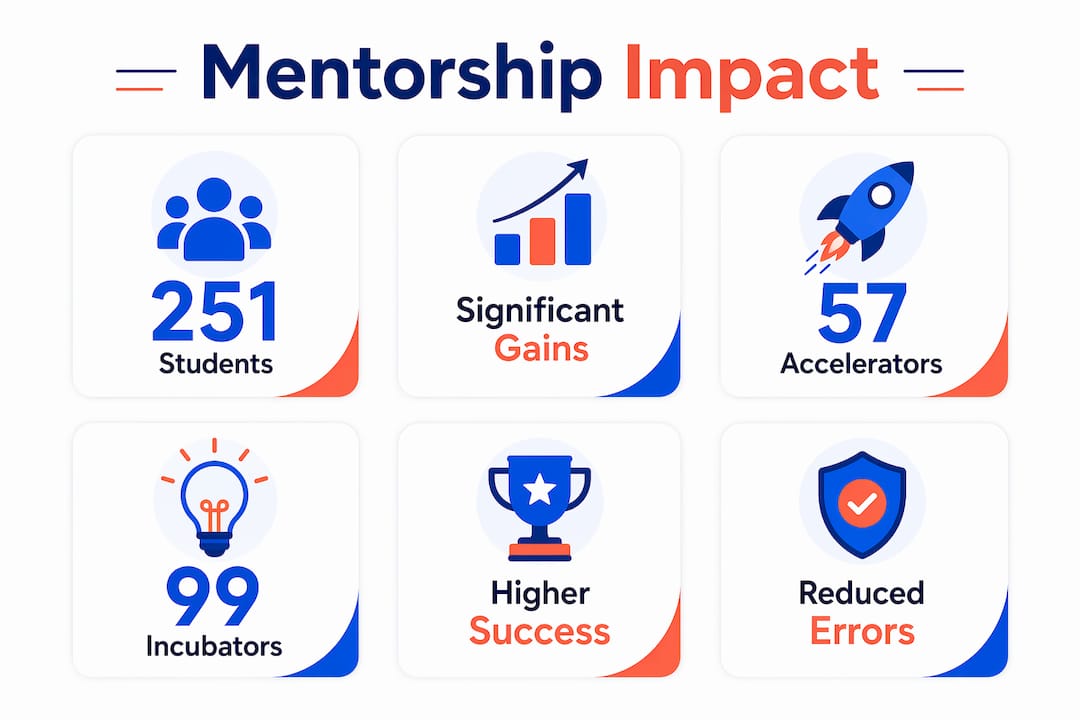
A 2024 to 2025 study at QCU involving 251 students found that mentored participants showed significant gains (p < 0.001) in business planning and decision-making. More importantly, those participants also achieved higher revenue generation and customer acquisition compared to non-participants. This is not a soft outcome. It is real business performance, tracked and verified.
A separate study examining 57 accelerators and 99 incubators in Spain found that ecosystems with mentoring programs performed measurably better than those without them. The type of mentoring mattered too. Not all program designs produced the same results, which reinforces the argument that structure and fit are non-negotiable.
The psychological dimension of mentorship is equally compelling. Research published in F1000Research found that business coaching improves locus of control and self-efficacy in founders, while also shaping entrepreneurial orientation toward proactiveness, risk tolerance, and innovation. These are the cognitive and behavioral traits that separate founders who push through hard phases from those who stall or quit.
| Study | Key Finding |
|---|---|
| QCU 2024–2025 (n=251) | Significant gains in business planning, decision-making, revenue, and customer acquisition |
| Spain ecosystem study (57 accelerators, 99 incubators) | Mentored ecosystems outperformed; mentoring type influenced results |
| F1000Research coaching study | Coaching improved locus of control, self-efficacy, and entrepreneurial orientation |
| Systematic review on early exposure programs | Mentorship was most frequently cited positive factor in career self-efficacy and network development |
“Mentorship isn’t just nice to have. It meaningfully shapes entrepreneurial ecosystem performance and founder success.” — Shaping mentoring for entrepreneurs
The last row in that table is worth unpacking. A systematic review on early exposure programs found that mentorship was the most frequently reported positive component across programs designed to build career self-efficacy and professional networks. The mechanism is clear: mentors model what success looks like, create pathways into networks, and confirm that growth is both possible and achievable.
The psychology behind why mentorship accelerates growth
The benefits of early mentorship do not stop at tactics and contacts. The deeper impact happens inside the founder’s mind, and understanding this changes how you think about mentorship as a resource.
Social Cognitive Theory, developed by Albert Bandura, explains the mechanism precisely. Founders build confidence through two pathways: mastery experiences (doing something hard and succeeding) and social modeling (watching someone credible succeed at something similar). Mentorship delivers both. Your mentor provides frameworks that increase your odds of early wins, and their own track record gives you evidence that the goal is achievable.
Business coaching shapes entrepreneurial posture by building psychological readiness for uncertainty. When founders develop a stronger internal locus of control, meaning they believe their actions genuinely drive outcomes, they make better strategic decisions, take calculated risks more confidently, and recover from setbacks faster. These are not personality traits you either have or do not have. They are psychological skills that mentorship actively develops.
The practical side reinforces the psychological side. Mentors help founders avoid expensive mistakes by providing real-time decision-support before a bad call gets made. A mentor who has already burned cash on a premature product launch, a misaligned hire, or a poorly scoped partnership can redirect you before you repeat those errors.
Pro Tip: Treat your mentor conversations as pre-mortems, not post-mortems. Before a major decision, walk your mentor through your reasoning and ask what could go wrong. You will surface blind spots that would otherwise cost you months and money.
The cumulative effect of these benefits creates compounding returns. Better decisions mean fewer setbacks. Fewer setbacks mean more momentum. More momentum builds the confidence to take the next right risk. Mentorship does not just help you solve today’s problem. It rewires how you approach every problem that follows.
Common mentorship challenges and how to avoid them
Mentorship does not automatically work. The QCU study identified mentor-mentee mismatches as one of the primary reasons structured programs underperform. When a mentor’s expertise does not align with a founder’s current stage or domain, the guidance loses specificity. Generic wisdom is less useful than precise, contextual advice from someone who has navigated similar territory.
Here are the most common challenges founders face, and what to do about each:
Misaligned expertise. A mentor who scaled a consumer app may not be the right fit for a B2B SaaS founder in the validation phase. Seek mentors whose background matches your industry and current stage, not just their overall success level.
Inconsistent engagement. Ad hoc advice does not compound. Structured programs that build context over multiple sessions consistently outperform one-time conversations. Establish a regular cadence from the start.
Over-reliance on a single mentor. No one person covers every business function. Following the MIT VMS team model, build access to multiple mentors with complementary expertise across marketing, finance, product, and operations.
Lack of clear goals. Mentorship without defined objectives drifts into general conversation. Before each session, bring a specific decision you are facing or a concrete challenge you want to work through.
Treating mentorship as passive learning. The most effective mentoring relationships are ones where the founder drives the agenda, implements feedback between sessions, and returns with results to discuss. Show up as an active participant, not an audience member.
How to apply mentorship strategically in your startup phase
Knowing the research is one thing. Putting mentorship to work in your own startup phase requires a clear plan. The role of mentorship in development is most powerful when it is treated as an ongoing strategic input rather than an occasional resource.
Here is how to build that into your approach:
Map your mentorship gaps. Identify the two or three business areas where you face the most uncertainty or the costliest potential mistakes. These are your highest-priority mentorship needs, whether that is go-to-market strategy, unit economics, hiring, or founder psychology.
Explore formal programs first. Incubators, accelerators, and structured bootcamps provide curated mentor networks with accountability built in. Look for programs that offer multiple mentorship touchpoints rather than single-session events.
Build a mentorship team, not a mentorship relationship. You need breadth. One generalist mentor who checks in monthly cannot replace a team of specialists who engage with specific decisions as they arise.
Set expectations upfront. In your first session, clarify what you need, how often you want to meet, and what kind of feedback helps you most. Mentors invest more deeply when they understand what success looks like for you.
Track what you learn and what you apply. Keep a brief log of each mentoring session, the key insight, the decision it informed, and the outcome. This makes your development visible and helps you recognize which mentors and formats deliver the most value.
Leverage your mentor’s network deliberately. A warm introduction from a respected mentor is often worth more than a cold outreach campaign. Ask your mentor to connect you with two or three contacts who could accelerate a specific goal, not everyone they know.
For a structured approach to maximizing these relationships, the mentorship process for entrepreneurs at Nomadexcel offers a detailed step-by-step framework worth reviewing.
My perspective on why early mentorship reshapes everything
I have watched a lot of founders underestimate what mentorship actually is, and I have seen what that costs them. The ones who treat it as an optional motivational add-on tend to learn everything the hard way. The ones who engage with it as a structured, multi-expert input from the beginning operate at a completely different level.
What strikes me most is the psychological shift. When I see founders working with strong mentors consistently, the way they talk about their decisions changes. They stop asking “what should I do?” and start asking “here is my reasoning, what am I missing?” That shift from dependency to confident, collaborative thinking is what healthy mentorship actually produces.
The research on locus of control explains exactly what I observe. Founders who build stronger agency through mentorship take smarter risks and recover faster when things go wrong. They are not more fearless. They are more calibrated. That calibration is what separates founders who hit growth inflection points from those who plateau.
My honest take: structured, multi-expert mentorship in the earliest phase of your startup is not a luxury. It is the highest-return investment you can make before you have revenue to spend on anything else. The cost of a wrong decision at the idea or early validation stage can set you back a year. A mentor who has seen that mistake three times can save you that year with a single conversation.
Treat mentorship as a strategic, ongoing relationship. Start early. Build a team of mentors. Engage with discipline. The compounding effect is real.
— Amichai
Build your startup with mentorship at the center
If this article has clarified why early-stage mentorship belongs at the core of your growth strategy, the next question is where to find programs that actually deliver on that promise. Nomadexcel’s online entrepreneurship bootcamp is built around exactly the kind of structured, multi-mentor, execution-focused environment the research supports. Participants work directly with experienced entrepreneurs, marketers, and operators, and they leave with more than strategy. They leave with a network and the psychological confidence that mentorship builds.
For founders who want to understand the full range of mentorship options available to them, Nomadexcel’s guide on why mentorship programs work offers a research-grounded overview of what to look for and how to evaluate fit. The right program, at the right stage, with the right mentors changes the trajectory of your startup.
FAQ
What is early-stage mentorship for startups?
Early-stage mentorship is structured, goal-driven guidance provided by experienced mentors during the startup’s founding and initial growth phases. It goes beyond casual advice to include repeated, confidential engagement that supports key business decisions and founder development.
How does mentorship improve startup success rates?
Research shows that mentored founders achieve significantly higher rates of revenue generation and customer acquisition compared to non-mentored peers, with measurable gains in business planning and decision-making skills.
Why do startups need multiple mentors instead of just one?
Different business functions require different expertise. Programs like MIT’s VMS assign teams of mentors covering product, finance, marketing, and HR so founders receive specific, relevant guidance across all the decisions they face simultaneously.
Can mentorship help with founder confidence, not just strategy?
Yes. Business coaching and structured mentorship improve founders’ self-efficacy and locus of control, building the psychological resilience and strategic confidence that drive better decisions under uncertainty.
What makes a mentorship program effective versus ineffective?
The most effective programs offer domain-aligned mentors, structured engagement over time, multi-expert teams, and confidentiality. The biggest risk factor for poor outcomes is mentor-mentee mismatch in stage or domain expertise.
Comments are closed.