
Why Leadership Bootcamps Accelerate Your Growth
TL;DR:
- Leadership is a skill that can be developed rapidly through structured, immersive bootcamps. These programs focus on real-time practice, feedback, and application, leading to measurable improvements in leadership effectiveness and confidence. Attending during key transition points ensures maximum impact and lasting growth when combined with follow-up coaching and accountability.
Most professionals assume leadership ability arrives naturally over time, accumulated through years of experience and trial. That assumption is exactly why so many capable people plateau. The truth is that leadership is a learnable skill, and the pace at which you develop it depends heavily on the quality and structure of your environment. That is precisely why leadership bootcamps have become one of the most sought-after tools for serious professionals who want results faster than a traditional training calendar will deliver. They compress months of gradual development into days of focused, high-stakes practice.
Table of Contents
- Key takeaways
- Why leadership bootcamps outperform traditional training
- What a leadership bootcamp actually looks like
- The evidence behind leadership bootcamp effectiveness
- How bootcamps create transformational growth
- Best practices for maximizing bootcamp results
- When a leadership bootcamp is the right move
- My perspective on what bootcamps actually do
- Take your next step with Nomadexcel
- FAQ
Key takeaways
| Point | Details |
|---|---|
| Leadership is a trainable skill | Structured bootcamps accelerate development far faster than experience alone. |
| Bootcamps deliver measurable ROI | Leadership training returns average $7 for every $1 invested. |
| Transformation requires application | Bootcamps work because they build real-time practice into the learning design. |
| Timing amplifies impact | Bootcamps produce the most value at inflection points like growth, transition, or leadership strain. |
| Sustained change needs follow-through | Embedding bootcamp learning into daily habits and accountability systems drives lasting results. |
Why leadership bootcamps outperform traditional training
The case for leadership bootcamps starts with a simple observation: most conventional leadership programs teach people what to do without ever giving them space to practice it under pressure. A two-day workshop might deliver strong frameworks. A webinar might share compelling research. But neither creates the conditions for genuine behavioral change, because behavioral change requires repetition, feedback, and discomfort. Bootcamps are built on all three.
What actually separates a bootcamp from a seminar is the immersive design. Participants do not sit in rows and absorb content. They move through structured experiences that surface real patterns: how they handle ambiguity, how they respond when authority is challenged, how they lead when they are tired or uncertain. These are the exact conditions leaders face at work, and most programs never recreate them.
The importance of leadership bootcamps also shows up in what they remove. When you step outside your normal environment, the usual distractions, default behaviors, and protective habits lose their grip. That creates an opening for honest reflection that is genuinely rare in day-to-day professional life.
What a leadership bootcamp actually looks like
A leadership bootcamp is an intensive, time-compressed program designed to accelerate leadership development through structured experiences, peer feedback, and real-time application. It typically runs anywhere from two days to four weeks, depending on the depth and audience. The format varies, but the design principles stay consistent: active participation, meaningful challenge, and continuous reflection.
Typical activities inside a well-designed bootcamp include:
- Behavioral simulations that recreate high-stakes leadership scenarios without real-world consequences
- Self-awareness exercises such as 360-degree feedback, journaling prompts, and guided reflection sessions
- Peer coaching circles where participants give and receive candid developmental feedback
- Physical or experiential challenges that reveal leadership patterns under pressure
- Real-time experiments where participants apply a new behavior and debrief the results immediately
What makes these activities different from standard training is their sequence and intensity. The goal is not to fill participants with information but to generate insight through direct experience. The best programs customize content to participant needs, so a first-time manager and a senior executive are not working through the same curriculum.
Pro Tip: Before committing to a bootcamp, ask the organizer how the program is customized to participant needs. Generic curricula are a red flag. Look for programs that begin with some form of diagnostic or needs assessment.

The strongest bootcamps also build what practitioners call “fieldwork” between sessions, requiring participants to apply skills between sessions in real work contexts. That bridge between learning and application is where the actual change happens.
The evidence behind leadership bootcamp effectiveness
If you are weighing the investment, the data makes a compelling case. Leadership training programs return an average of $7 for every $1 invested, and first-time manager programs specifically can generate up to 415% annual ROI. These are not abstract projections. They reflect measurable improvements in productivity, team retention, and decision-making speed.
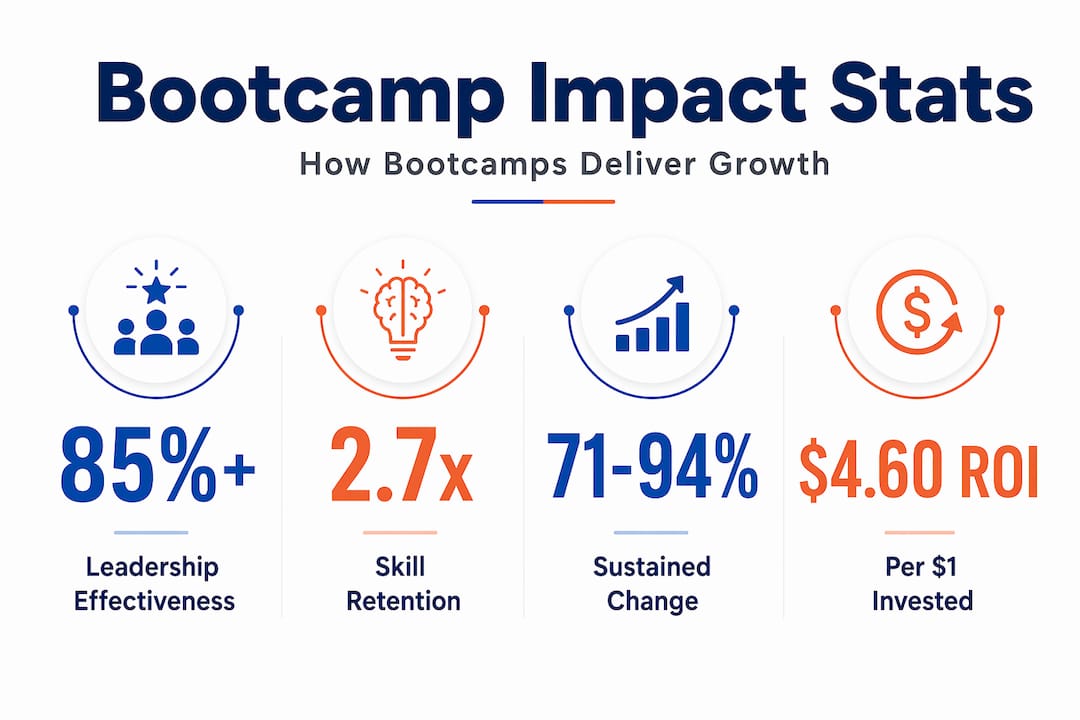
The participant-level outcomes are equally clear. More than 85% of executive education participants report enhanced leadership effectiveness, and over 70% experience increased confidence and decision-making ability within one year of completing a program.
| Outcome | Reported Impact |
|---|---|
| Leadership effectiveness | 85%+ participants report improvement |
| Decision-making confidence | 70%+ show gains within 12 months |
| ROI on first-time manager training | Up to 415% annually |
| Average return on leadership investment | $7 per $1 spent |
| Sustained behavior change with coaching | 71–94% when coaching accompanies programs |
What drives those numbers is not the content itself but the design. Research shows that needs analysis and multi-modal delivery predict significantly stronger skill transfer to the job. Programs that combine practice, feedback, and spaced learning outperform single-event training at every measurable level.
The business case for organizations is equally strong. When you link bootcamp outcomes to measurable outcomes like turnover reduction and productivity gains, the investment becomes much easier to justify internally. Leadership development is not an HR line item. It is an operational asset.
How bootcamps create transformational growth
There is a difference between learning leadership skills and becoming a more effective leader. The first is a knowledge problem. The second is an identity problem. And this is where leadership bootcamps genuinely earn their reputation.
Most programs teach techniques. Bootcamps go deeper. They create conditions where participants confront the internal patterns driving their external behavior. How do you respond when someone challenges your judgment in front of a group? What happens to your clarity when you are overwhelmed and under-resourced? These are not hypothetical questions inside a bootcamp. They are live experiences that surface real data about how you actually lead.
“The real breakthrough in leadership comes from confronting internal friction and emotional patterns, not from receiving ready-made answers.” This framing, drawn from leadership transformation research, captures what separates a bootcamp from a workshop.
The immersive environment also creates psychological safety that is rarely available inside organizations. When participants are away from their teams, titles, and performance reviews, they can engage honestly without worrying about protecting their professional image. That openness is what makes the self-awareness work stick.
Pro Tip: Go into a bootcamp with a specific leadership challenge you are actively navigating, not a generic development goal. The more concrete your focus, the more targeted the insights you will extract from the experience.
Coaching combined with leadership programs sustains that transformation after the bootcamp ends, showing 71 to 94% sustained behavior change with up to 788% ROI. The bootcamp creates the breakthrough. Ongoing coaching and accountability systems lock it in.
Best practices for maximizing bootcamp results
Attending a leadership bootcamp is the beginning of the process, not the whole process. How you prepare, engage, and follow through determines whether the experience produces lasting change or fades within a month. Here are the practices that separate participants who transform from those who simply attend.
Start with a real diagnostic. Before the program begins, complete a thorough self-assessment or 360-degree feedback process. Programs incorporating needs analysis consistently produce stronger skill transfer than those that skip this step. Knowing your specific gaps going in sharpens everything.
Engage with discomfort deliberately. The moments when you feel exposed, uncertain, or challenged are not problems to manage. They are the curriculum. Leaders who stay guarded during bootcamp activities take home less than those who lean into the friction.
Apply learning in real time. The best bootcamp outcomes come from applying skills in real-time environments between sessions, not just during them. Treat every interaction during the program as a field test.
Build a feedback loop with peers. The cohort around you is one of the most underutilized resources in any bootcamp. Exchange contact information on day one, set up accountability check-ins, and plan to debrief your post-bootcamp progress together.
Design a 90-day follow-through plan before you leave. Most development stalls because participants return to work without a structured plan for embedding new behaviors. Identify two or three specific practices you will hold yourself to, name an accountability partner, and schedule a review.
The most effective programs are built on what researchers call the five Cs framework: clarity, contextualization, challenge, connection, and continuity. When a bootcamp delivers on all five, and you show up ready to engage, the results compound quickly.
When a leadership bootcamp is the right move
Not every stage of a leadership career calls for a bootcamp, but there are specific moments when the investment pays back at an accelerated rate. Recognizing those moments is part of leading yourself well.
Bootcamps tend to create the most value in these situations:
- Rapid organizational growth where your team, scope, or responsibility has expanded faster than your skills have caught up
- Role transitions such as moving from individual contributor to manager, or from director to executive, where identity and behavior need to shift together
- Leadership strain where decision fatigue, misalignment with your team, or loss of clarity signals that your current approach is no longer sufficient
- Executive misalignment or board pressure where recalibration around strategy and communication is urgent
- Stagnation in personal growth where you have not been seriously challenged or given meaningful developmental feedback in more than a year
Leaders at inflection points consistently report the highest impact from bootcamp participation because the stakes are real. Growth pressure makes the learning land differently.
The important reframe is that bootcamps are not remedial. They are precision-designed interventions for leaders who are ready to operate at a higher level. Attending one is not an admission that something is broken. It is a signal that you are serious about your next chapter.
My perspective on what bootcamps actually do
I have seen a lot of leadership development programs come and go, and the pattern is consistent: professionals leave inspired and return to work unchanged. The content was good. The speaker was credible. Nothing transferred.
What I have come to understand is that the knowledge was never the problem. Most leaders already know what they should be doing. The gap is in how they show up when it matters, and that is not a knowledge problem. It is a practice problem, an identity problem, and sometimes an emotional regulation problem.
What I find genuinely different about well-designed bootcamps is that they create rare space to reconnect with why you lead in the first place. The daily noise of management strips that away over time. A bootcamp, at its best, removes the noise and puts you back in direct contact with your own patterns.
I want to be clear that a bootcamp is not a quick fix. I have seen people leave powerful programs and slide back to old behaviors within weeks because they had no structure to sustain the change. The breakthrough matters. The follow-through matters more. What turns a bootcamp experience into lasting leadership evolution is what you choose to practice every single day after you walk out. You can explore past program outcomes to see how this plays out across different professional contexts.
— Amichai
Take your next step with Nomadexcel
If this article has clarified why leadership bootcamps deserve serious consideration, Nomadexcel makes the path forward concrete. Nomadexcel designs immersive bootcamp experiences that bring together aspiring entrepreneurs and emerging leaders in curated, high-accountability cohorts built for real growth, not just inspiration.
Each program combines peer community, expert mentorship, and structured execution sprints that force you to apply what you are learning in real time. The cohort model means you are not just gaining skills. You are building a network of peers who will challenge and support you long after the program ends.
Whether you are an individual ready to accelerate your leadership trajectory or a team seeking alignment and renewed direction, Nomadexcel has a format designed for your stage. Start with the online entrepreneurship bootcamp to get a sense of the depth and structure Nomadexcel brings to every program. If you want to understand what the experience involves before committing, the bootcamp essentials guide walks you through everything you need to know.
FAQ
What is a leadership bootcamp?
A leadership bootcamp is an intensive, immersive program designed to accelerate leadership development through hands-on practice, real-time feedback, and peer engagement, typically spanning two days to several weeks.
Are leadership bootcamps effective?
Yes. Over 85% of participants in executive education programs report improved leadership effectiveness, and well-designed bootcamps generate average returns of $7 for every $1 invested.
What should I expect from a leadership bootcamp?
Expect a mix of behavioral simulations, self-awareness exercises, peer coaching, and real-time application activities, all designed to surface personal leadership patterns and shift how you perform under pressure.
When is the best time to attend a leadership bootcamp?
Inflection points such as rapid role growth, leadership transitions, or organizational change produce the strongest bootcamp results, because the stakes make the learning land with greater urgency.
How do I sustain the outcomes of a leadership bootcamp?
Pair the bootcamp with ongoing coaching and a structured 90-day follow-through plan. Coaching combined with leadership programs shows 71 to 94% sustained behavior change, far outperforming bootcamp attendance alone.
Comments are closed.