
Entrepreneurial execution: Transform ideas into real results
TL;DR:
- Execution is the discipline of transforming a founder’s strategy into measurable, outcome-driven work that progresses the business. Strong entrepreneurial execution relies on intentional planning, alignment, feedback, and adaptive responses to prevent drift and ensure resource efficiency. Building a continuous operating rhythm and accountability system enables founders to execute consistently and achieve lasting growth.
Most founders work incredibly hard. They fill their calendars, respond to every message, attend every meeting, and somehow end the week feeling like nothing truly moved forward. The uncomfortable truth is that busyness is not the same as progress. Entrepreneurial execution is the discipline of turning a founder’s strategy and decisions into day-to-day, measurable work that produces outcomes. It is the connective tissue between your boldest ideas and your actual business results. If you want to stop spinning your wheels and start building something real, mastering execution is where that journey begins.
Table of Contents
- Defining entrepreneurial execution: More than just effort
- Strategy versus execution: Alignment and the risk of drift
- Building your entrepreneurial execution system
- Common pitfalls and how to course-correct early
- Why execution is where founders win (or lose): Our perspective
- Take your execution to the next level with community and support
- Frequently asked questions
Key Takeaways
| Point | Details |
|---|---|
| Clear execution definition | Execution is more than effort—it’s translating strategy into consistent, measurable progress. |
| Alignment prevents drift | Keeping strategy and daily work connected is essential to avoid wasted energy and missed results. |
| Systems drive success | Simple frameworks like OKRs and founder operating rhythms make execution repeatable and adaptable. |
| Feedback is vital | Regular reviews and mid-cycle resets help detect execution drift and empower quick course corrections. |
Defining entrepreneurial execution: More than just effort
Hard work is necessary, but it is far from sufficient. Many early-stage founders operate with enormous energy and genuine passion, yet still fail to hit the milestones that matter. Why? Because effort without structure, clarity, and feedback is just motion. Understanding why execution matters as a distinct skill set is the first step toward changing that pattern.
At its core, entrepreneurial execution is the discipline of turning a founder’s strategy and decisions into day-to-day, measurable work that produces real outcomes. This definition contains several important ideas worth unpacking. First, execution is about measurable work, not just activity. You are not executing if you cannot point to specific, trackable progress. Second, execution is tied directly to strategy. Random effort, however intense, is not execution.
Strong execution is supported by four interconnected habits:
- Planning with intention: Breaking quarterly goals into weekly and daily priorities so your team knows exactly what to focus on at any given moment.
- Alignment across people: Making sure every team member understands how their work connects to the larger goal, reducing wasted effort caused by misaligned priorities.
- Feedback loops: Building in regular check-ins, metrics reviews, and structured retrospectives so you know when things are working and when they are not.
- Adaptive response: Using what you learn from feedback to course-correct quickly, rather than waiting until the end of a cycle to discover you went in the wrong direction.
“Most execution failures are not strategy failures. They are alignment failures. The plan was fine. The follow-through was fractured.” This kind of drift is precisely what execution-focused entrepreneurship is designed to prevent.
The distinction matters enormously for early-stage founders who have limited resources and zero room for prolonged missteps. Every week spent on misaligned activity is a week your runway shrinks without proportional progress.
Strategy versus execution: Alignment and the risk of drift
With a clear definition in place, it is critical to understand how execution interacts with and can sometimes drift away from your actual business strategy. Many founders treat these two disciplines as one and the same. They are not.
Strategic planning asks “what should we do?” while execution strategy answers “how will we make it happen?” and requires alignment, accountability, measurement, and resource allocation. Strategy sets direction. Execution delivers results. Both are essential, but they operate at different levels, and the gap between them is where startups most often lose momentum.
The most dangerous scenario for a growing startup is not a bad strategy. It is a good strategy that never gets executed properly because nobody built the bridge between the vision and the daily work. Execution quality depends on the feedback loop between strategy and operations; when they fall out of sync, performance breaks down in ways that are often invisible until significant damage is already done.
Here is a look at common points where strategy and execution disconnect, along with the consequences:
| Disconnection point | What it looks like | Consequence |
|---|---|---|
| Vague goal setting | “We want to grow revenue” without specifics | Teams pursue conflicting tactics |
| No owner assigned | Multiple people responsible = no one responsible | Tasks stall or duplicate |
| Infrequent reviews | Quarterly check-ins only | Drift compounds without detection |
| Metrics not tracked | Progress measured by feel | Decisions made on anecdotes |
| Strategy changes silently | Leadership pivots without communicating | Execution effort misaligned overnight |
The table above reveals a pattern worth recognizing. Most execution breakdowns are not dramatic failures. They are quiet, incremental drifts that compound over time. Each missed review, each vague goal, each unassigned owner adds another layer of misalignment until the gap between strategy and reality becomes significant. Understanding strategic alignment for growth as an active, ongoing practice rather than a one-time exercise is what separates founders who scale from those who stay stuck.
“Alignment is not a meeting you have once. It is a condition you maintain continuously through structure, communication, and accountability.”
Pro Tip: Schedule a 30-minute “alignment audit” at the start of every month. Ask three questions: Are our current priorities still tied to our core strategy? Does each team member know their exact role this month? Are our metrics reflecting real progress? This simple ritual can prevent weeks of misaligned effort.
Building your entrepreneurial execution system
To prevent drift and keep everyone moving toward measurable success, let us break down step-by-step systems for consistently strong execution.
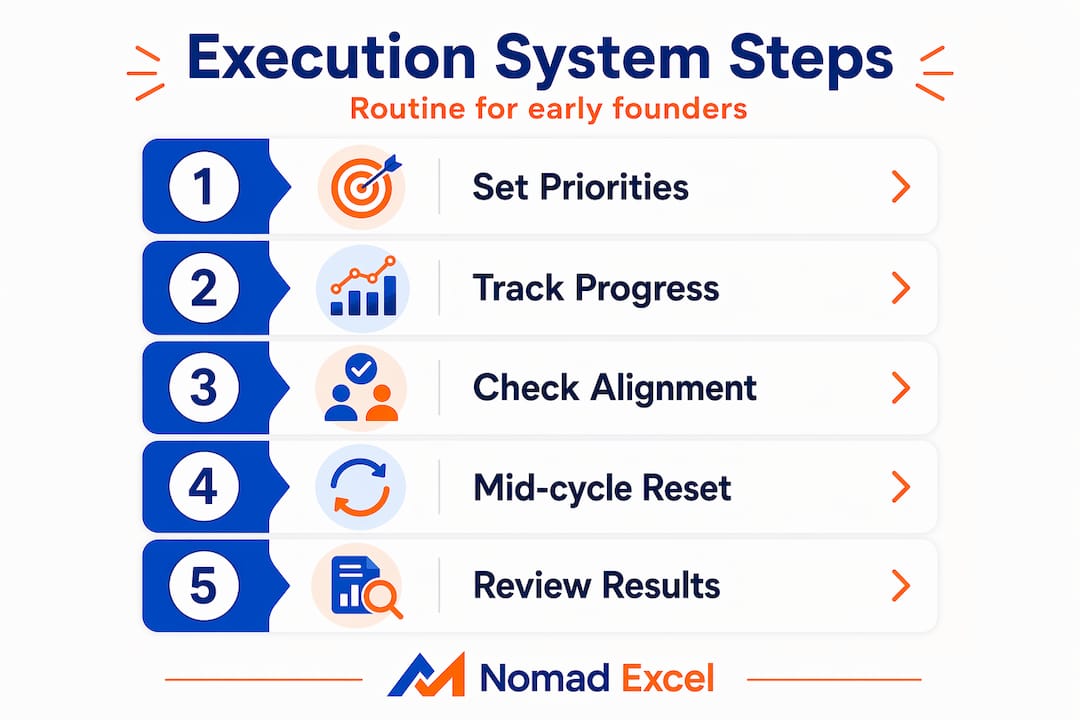
For early-stage founders, a practical execution system is often implemented as goal and priority setting plus a regular review cadence for clarity and course correction, rather than a one-time plan. This distinction is important. A plan is static. An execution system is dynamic. It breathes and adjusts with your business.
One of the most widely adopted frameworks for building this kind of system is OKRs (Objectives and Key Results). An Objective is a qualitative, inspiring goal. Key Results are specific, measurable outcomes that define what success looks like. Together, they give founders a clear target and a way to know whether they are hitting it.
Here is how to set up your own operating rhythm as a solo founder or early-stage team:
- Set annual objectives: Identify two to three major outcomes you want your business to achieve this year. Keep them ambitious but realistic. These become your north star.
- Break into quarterly key results: For each annual objective, define three to five measurable outcomes that would confirm meaningful progress within 90 days.
- Plan weekly priorities: Every Monday, identify the three to five tasks that will most directly move your quarterly key results forward. Nothing else gets priority attention.
- Run weekly check-ins: If you have a team, hold a 30 to 45 minute weekly sync focused purely on progress against key results. Identify blockers early and adapt.
- Conduct quarterly reviews: At the end of each quarter, score your key results honestly, identify what worked and what did not, and use those learnings to shape the next quarter.
- Celebrate and reset: Acknowledge wins, document lessons, and begin the next cycle with fresh energy and informed priorities.
Entrepreneurs can improve execution by designing an operating system that is built on founder and team routines, tools, and agreements that create predictable work rhythms and reduce friction. The goal is to make good execution habits the path of least resistance.
Here is a comparison of static planning versus an ongoing operating rhythm:
| Static planning | Ongoing operating rhythm |
|---|---|
| Created once, rarely revisited | Reviewed and adjusted regularly |
| Success measured at year-end | Progress tracked weekly and monthly |
| Reactive to problems | Proactive through early detection |
| Owner unclear or rotational | Clear ownership at every level |
| Disconnected from daily work | Integrated into daily and weekly habits |

The contrast is stark. Many startup investing advantages are only realized when the underlying business can demonstrate reliable, measurable execution to investors. A static plan impresses no one; a functioning operating rhythm signals organizational maturity.
Pro Tip: As a solo founder, your “operating system” can be as simple as a weekly 90-minute planning session every Monday and a 30-minute review every Friday. Consistency matters far more than complexity. Start small and add structure as your team grows.
Helpful resources for goal setting for entrepreneurs and setting business goals can give you additional frameworks to customize your system for your specific business context.
Common pitfalls and how to course-correct early
Even with strong systems, founders can get tripped up. Here is where execution most often falters, and how you can detect and fix it quickly before small problems become expensive detours.
The four most common execution pitfalls for founders are:
- Activity drift: You and your team are busy, but the work has gradually shifted away from the priorities that actually matter. This happens slowly, often without anyone noticing until a quarterly review reveals the drift.
- Unclear metrics: Goals exist but are not tied to specific, trackable numbers. Without clear metrics, it is impossible to know whether you are making progress or just staying busy.
- Slow feedback loops: Problems are identified weeks or months after they begin. By the time drift is detected, significant momentum has been lost and course-correcting becomes costly.
- Accountability gaps: Work is assigned but not owned. Multiple people are nominally responsible for the same outcome, which in practice means nobody is truly responsible.
Recurring check-ins, ownership clarity, and mid-cycle resets are used to detect drift early and correct course. This is not an abstract recommendation but a proven operational pattern used by high-performing startups and growth teams worldwide. The importance of goal setting extends beyond the initial planning session; it is an ongoing practice that requires active maintenance.
Research consistently shows that teams with structured review rituals complete significantly more of their planned work than teams operating on ad hoc check-ins. The reason is straightforward: regular reviews create gentle, built-in accountability. You know you will need to report on progress, so you protect your priorities more deliberately throughout the week.
Here are early warning signs that your execution is drifting:
- Weekly priorities keep rolling over to the following week without completion
- Team members cannot articulate the top three company priorities without looking them up
- Metrics are not being tracked or reviewed consistently
- Meetings feel productive but produce no documented outcomes or action items
When you spot these signs, a mid-quarter reset is often the fastest path back to momentum. A reset involves pausing for a half-day, reviewing your key results honestly, identifying the single biggest blocker, and recommitting to a simplified set of priorities for the remaining weeks of the quarter.
Pro Tip: Use mid-quarter “resets” strategically. Do not wait for a quarter to end in disappointment. At the six-week mark, run a 90-minute reset session: score current key results, identify the one change that would have the greatest impact, and realign your weekly priorities accordingly.
Why execution is where founders win (or lose): Our perspective
After working with founders across many industries and stages, we have arrived at a perspective that runs counter to a lot of popular startup advice: the real edge is almost never in the strategy. It is in your ability to execute, adjust, and stay disciplined when the initial excitement fades and the real work begins.
Most startup content glorifies the big vision, the clever business model, and the bold pivot. These things matter. But they matter far less than your ability to show up consistently, measure what matters, and follow through on commitments week after week. The founders who build companies that last are not necessarily the most brilliant strategists in the room. They are the most relentlessly consistent executors.
Execution can fail even if the strategy is good because strategy-to-operations alignment and measurement and accountability mechanisms are missing, letting work drift into activity rather than outcomes. This is not a theoretical concern. It is one of the most common causes of startup stagnation, and it happens to founders at every experience level.
What separates high-performing founders is not their tolerance for hard work. It is their relationship with accountability. The best founders build systems that make accountability structural rather than motivational. They do not rely on willpower to stay on track; they create conditions where staying on track is simply the natural way work flows.
This is why experiential entrepreneurship works so powerfully. When you learn execution inside a structured, immersive environment alongside other driven founders, accountability becomes communal. Peers notice when you drift. Mentors ask the uncomfortable questions. Progress is visible and shared.
The hard truth is that execution discipline is a skill, not a personality trait. It can be learned, practiced, and strengthened with the right environment and systems. Stop waiting for the perfect plan and start building the habits that turn today’s imperfect plan into next quarter’s real results.
Take your execution to the next level with community and support
If you are ready to build genuine execution muscle inside a network of like-minded founders, structured programs can accelerate that growth significantly. Nomad Excel’s online entrepreneurship bootcamp is designed specifically for aspiring and early-stage entrepreneurs who want to move from ideas to measurable action. Through daily accountability, expert mentorship, and a community of driven peers, you will build the execution habits and frameworks that produce real business outcomes. Learning why joining an entrepreneurship bootcamp accelerates growth for founders at every stage is a worthwhile first step toward committing to the kind of structured, supported execution environment that changes trajectories.
Frequently asked questions
What is the main difference between strategy and execution for entrepreneurs?
Strategy asks what to do and why, while execution is the process of making it happen through concrete actions and measurable outcomes. As strategic planning frameworks make clear, strategy sets direction while execution delivers results through alignment, accountability, and measurement.
How do OKRs help with entrepreneurial execution?
OKRs (Objectives and Key Results) provide a repeatable framework for setting priorities, tracking progress, and regularly reviewing results, which keeps founders and teams aligned throughout the quarter. An OKR-based operating rhythm typically follows an annual to quarterly to weekly cadence, using structured check-ins to prevent drift before it compounds.
Can execution fail even if a startup has a great strategy?
Yes, execution can fail when there is poor alignment, unclear metrics, or a lack of accountability, even if the core strategy is solid. Alignment and accountability gaps are among the most common and least-discussed causes of startup stagnation.
What is a founder operating system?
A founder operating system is a set of routines, agreements, and tools that create predictable work habits and clarify how priorities are turned into results. Designing this system around your specific team size and stage dramatically reduces friction and increases the consistency of execution over time.
Comments are closed.