
How support networks drive startup growth and survival
TL;DR:
- Entrepreneurial support networks significantly improve business survival, growth, and capital raising.
- Formal ESOs like accelerators and incubators provide structured resources and mentorship tailored to business stages.
- Building layered, evolving support systems and nurturing relationships are key to entrepreneurial success.
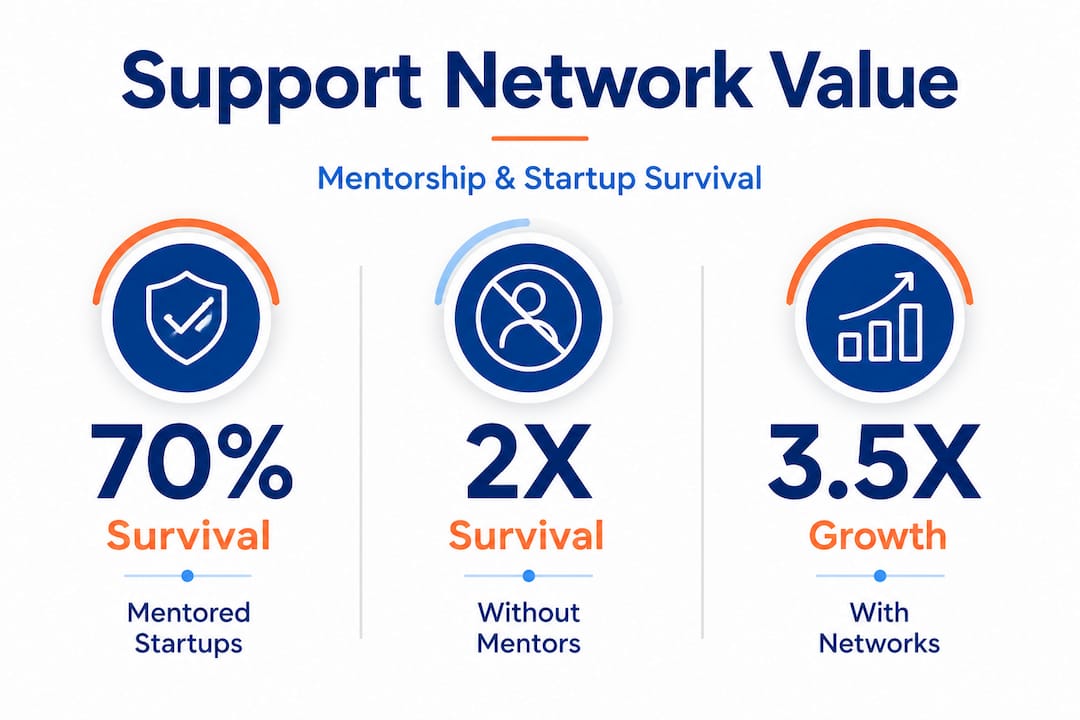
Most entrepreneurs assume that grit and a great idea are enough to build a successful business. The data tells a very different story. Mentored startups grow 3.5x faster and raise 7x more capital than those without mentors, while mentored small businesses reach a 70% five-year survival rate compared to roughly 35% for those going it alone. The gap is not about hustle. It is about the ecosystems, relationships, and structured support that surround a founder at every stage. This guide breaks down what entrepreneurial support networks actually are, how they work, and how you can use them to build a business that lasts.
Table of Contents
- What are entrepreneurial support networks?
- Types of entrepreneurial support organizations (ESOs)
- How entrepreneurial support networks drive growth and survival
- Navigating challenges: Nuances and barriers to access
- Applying support networks: Practical strategies for entrepreneurs
- The truth most entrepreneurs miss about support networks
- How Nomad Excel empowers your next step
- Frequently asked questions
Key Takeaways
| Point | Details |
|---|---|
| Support networks boost success | Entrepreneurs with strong support networks achieve higher survival and faster growth. |
| Blend formal and informal help | Combining structured programs with ongoing peer advice gives the best outcomes. |
| Inclusive networks matter | Mentorship and support tailored to diverse founders multiply skills, access, and confidence. |
| Overcome common barriers | Resource gaps and access issues exist, but strategic navigation and collaboration can solve them. |
| Apply networks for real value | Practical steps—mapping needs, targeting fit, nurturing connections—unlock network benefits. |
What are entrepreneurial support networks?
The phrase “support network” gets thrown around a lot, but most early-stage founders have a fuzzy picture of what it actually includes. A support network is far more than a list of contacts or a LinkedIn following. According to foundational research, entrepreneurial support networks are comprehensive ecosystems comprising both tangible resources and intangible elements that together help aspiring and early-stage entrepreneurs build businesses.
Tangible resources include things you can point to directly: funding access, coworking spaces, legal and accounting support, structured training programs, and technology infrastructure. Intangible elements are harder to quantify but often more powerful: mentorship, emotional encouragement during rough patches, warm introductions to investors or clients, and the credibility that comes from being vouched for by someone respected in your industry.
Think of it this way. Two founders launch competing businesses in the same month. One has a mentor who has built and sold two companies, a peer group that meets weekly, and access to a coworking space with regular investor events. The other works alone from home, Googling answers and relying on occasional advice from friends. The first founder is not smarter or more driven. She simply has better infrastructure around her.
Understanding community support for entrepreneurs means recognizing that these ecosystems are not passive. They require active participation, relationship building, and intentional use. The good news is that once you understand the components, you can start assembling them deliberately.
| Support element | Type | Primary benefit |
|---|---|---|
| Mentorship | Intangible | Faster decision-making, fewer costly mistakes |
| Funding access | Tangible | Capital to launch and scale |
| Coworking space | Tangible | Infrastructure, networking proximity |
| Peer community | Intangible | Accountability, emotional resilience |
| Training programs | Tangible | Skill development, frameworks |
| Warm introductions | Intangible | Credibility, faster relationship building |
| Legal/accounting support | Tangible | Risk reduction, compliance |
Strong building marketing communities practices also show that the most effective networks are built around shared goals and mutual value exchange, not just transactional connections.
Types of entrepreneurial support organizations (ESOs)
Once you grasp the major parts of the network, it is crucial to know the organizational structures behind them. Entrepreneur Support Organizations, commonly called ESOs, are the formal institutions that deliver much of this support in a structured way.
ESOs include accelerators, incubators, entrepreneurship centers, and small business development centers, each providing structured programming, resources, mentorship, funding opportunities, and community networks. Understanding the differences between them helps you choose the right fit for your current stage.

Accelerators are typically short, intensive programs (three to six months) designed for startups that already have a product or early traction. They focus on rapid growth, often culminating in a demo day where founders pitch to investors. Y Combinator and Techstars are well-known examples. Incubators, by contrast, are longer-term environments that support founders who are still in early development. They offer workspace, mentorship, and resources without the same time pressure or equity requirements. Small Business Development Centers (SBDCs) are government-supported organizations offering free or low-cost consulting, training, and technical assistance to small business owners across the country. University entrepreneurship centers connect students and alumni with resources, mentors, and funding networks tied to academic research and innovation.
Formal structures like incubators and accelerators have fixed program lengths and scopes, while flexible advisory services adapt to a founder’s evolving needs. ESOs also vary significantly in the resources they offer, from coworking and legal support to direct investor connections. Research on incubator vs accelerator effectiveness confirms that program fit matters more than prestige when it comes to actual founder outcomes.
When evaluating an ESO, look for these qualities:
- Clear alignment with your industry or business model
- Experienced mentors with relevant domain knowledge, not just general business advice
- Active alumni networks that provide ongoing value after the program ends
- Transparent terms around equity, fees, and time commitments
- Diversity of resources beyond just funding, including legal, marketing, and operational support
- Track record of outcomes such as survival rates, revenue growth, and capital raised
Understanding the mentorship program benefits available through structured ESOs can help you evaluate whether a formal program or a more flexible incubator resource arrangement fits your current needs.
Pro Tip: Do not overlook informal peer and mentor connections. The relationships you build inside a formal program often outlast the program itself, and those ongoing connections frequently deliver more value over time than any single curriculum or workshop.
How entrepreneurial support networks drive growth and survival
Understanding the structure is good, but seeing the impact makes the case undeniable. The numbers behind mentored and network-supported entrepreneurs are striking enough to change how you think about where to invest your time and energy.
Mentored small businesses achieve a 70% five-year survival rate, double the rate of non-mentored businesses. They also report an 83% increase in revenue compared to peers without mentors. These are not marginal improvements. They represent the difference between a business that thrives and one that quietly closes.
Real-world programs reinforce this. Embarc Collective members achieve a 96% survival rate, have created more than 1,200 jobs, and have collectively raised over $600 million in funding. SCORE, the national nonprofit mentorship network, consistently shows that entrepreneurs who receive mentoring report stronger revenue growth and hire more employees than those who do not.
Here are the key business outcomes that improve when founders plug into strong support networks:
- Survival rates increase dramatically, particularly in the critical first five years when most businesses fail.
- Capital raised multiplies, because mentors and networks provide warm introductions and credibility with investors.
- Revenue growth accelerates through better strategy, faster iteration, and access to proven frameworks.
- Job creation expands as businesses scale more confidently with expert guidance.
- Decision quality improves because founders can stress-test ideas with experienced advisors before committing resources.
- Resilience strengthens through peer communities that provide emotional support during setbacks.
“Success in entrepreneurship is rarely solo. The founders who grow fastest are almost always surrounded by people who have done it before, peers who challenge them, and systems that hold them accountable.”
Research on mentorship business survival data and the broader role of mentorship in entrepreneurship consistently point to the same conclusion: structured support is not a luxury. It is a growth multiplier. Studies on inclusive mentorship data also show that when mentorship reaches underrepresented founders, the benefits multiply further across communities and local economies.
Navigating challenges: Nuances and barriers to access
While the data is promising, real-life founders face hurdles and need to navigate the landscape smartly. Not every entrepreneur has equal access to these networks, and understanding the barriers is just as important as understanding the benefits.
In nascent ecosystems, ESOs face resource constraints. Some adapt and transform through what researchers call “ecosystem work,” which is the active collaboration between networks, institutions, and community organizations to build stronger support infrastructure. Others stagnate, leaving founders in those regions with far fewer options. Women and minority entrepreneurs consistently face greater access barriers to both funding and networks, even when strong ESOs exist nearby.
Common challenges early-stage founders encounter include:
- Funding gaps for businesses that do not fit the traditional venture capital mold, including lifestyle businesses, service providers, and non-tech startups
- Geographic limitations in regions where ESOs are sparse or underfunded
- Exclusionary networks that default to warm introductions within homogeneous circles, making it harder for first-generation entrepreneurs to break in
- Time constraints for founders who are balancing their business with full-time employment or caregiving responsibilities
- Program misalignment where available ESOs focus on industries or stages that do not match a founder’s current situation
- Information gaps where founders simply do not know what resources exist or how to access them
The solution is not to wait for the perfect program to appear. It is to proactively seek out organizations and mentors that prioritize inclusion and adaptability. Many of the most effective support relationships happen outside formal programs, through effective networking at industry events, online communities, and peer introductions.
Understanding the advantages of social networking for business growth can help founders in resource-limited environments build meaningful connections even without access to a formal ESO.
Pro Tip: When evaluating a support organization, ask directly about their outcomes for founders who look like you. Organizations serious about inclusion will have data. Those that cannot answer the question clearly may not be the right fit.
Applying support networks: Practical strategies for entrepreneurs
Now that you know what to ask and where to look, here is how to make these networks work for your business. The most effective founders treat network building as an ongoing practice, not a one-time task.
Modern support emphasizes ongoing practical tools beyond just funding and advice, including flexible scheduling, digital communities, and real-time operational guidance. Even founders who are bootstrapping, intentionally delaying outside funding to preserve equity and achieve a 35 to 50% valuation premium, benefit enormously from the mentorship and strategic clarity that strong networks provide.
Follow these steps to build a support network that actually moves the needle:
- Map your current needs. Are you struggling with product validation, sales, hiring, or funding? Identify the specific gaps before seeking support, so you target the right resources.
- Research ESOs in your area and online. Look at SBDCs, local accelerators, university programs, and industry-specific organizations. Many now offer virtual participation.
- Apply to programs that match your stage. An early-stage founder applying to a growth-stage accelerator wastes time. Fit matters more than prestige.
- Nurture relationships beyond the program. The most valuable connections come from consistent follow-up, sharing updates, and offering value in return, not just asking for help.
- Combine formal and informal support. Use ESO programs for structure and accountability, but build informal mentor relationships for ongoing, candid guidance.
- Seek warm introductions intentionally. Ask mentors and peers to connect you with specific people who have relevant experience. A warm introduction carries far more weight than a cold outreach.
- Recalibrate regularly. As your business evolves, your network needs change. Reassess every six months and adjust your support ecosystem accordingly.
Understanding the essential mentorship benefits available to early-stage founders can help you prioritize which relationships to invest in first. For founders exploring funding options, resources on networking for seed funding offer practical frameworks for building investor relationships before you need capital.
Pro Tip: Quality beats quantity every time when it comes to support networks. Three deeply engaged mentors who know your business well will outperform thirty casual connections who barely remember your name.
The truth most entrepreneurs miss about support networks
Bringing all these threads together, it is time to get honest about what founders actually need from support networks, and where most people get it wrong.
The biggest mistake early-stage entrepreneurs make is treating support networks like a checkbox. They join one accelerator, attend a few events, and assume they have “done the networking thing.” Real support is not a program you complete. It is a living system you build, tend, and evolve alongside your business.
Many founders chase prestige over fit. They apply to the most well-known accelerator in their city even when the program focuses on a completely different industry or stage. They collect business cards from high-profile people who will never remember the conversation. Meanwhile, the peer founder two years ahead of them in the same niche, who would happily answer a direct question over coffee, goes uncontacted.
The founders who grow fastest are not always the ones in the most prestigious programs. They are the ones who build layered support, combining a structured program for accountability, a mentor for strategic depth, a peer group for emotional resilience, and an industry community for ongoing learning. Each layer serves a different function. None of them alone is sufficient.
Exploring the types of mentorship programs available reveals just how much variety exists in how support can be structured. The right combination looks different for every founder, and it changes as the business grows. The key is staying curious, staying connected, and never assuming your current network is enough.
“Success comes from layers of support that evolve with you. Never static, never solo.”
How Nomad Excel empowers your next step
Ready to activate your network? Here is where you can get structured, hands-on support tailored to your journey. Nomad Excel’s online entrepreneurship bootcamp brings together driven founders for immersive, execution-focused programs that combine expert mentorship, peer community, and real business-building frameworks. Every element of the experience is designed to give you the clarity, accountability, and connections that make support networks actually work. If you want to go deeper on the mentorship side, the mentorship program guide walks you through how to find and leverage the right guidance for your stage. And if you are still deciding whether a structured program is right for you, the guide to entrepreneurship bootcamps answers the most common questions founders ask before taking that step.
Frequently asked questions
What is the difference between a formal and informal entrepreneurial support network?
Formal networks are structured programs like accelerators and incubators with fixed program lengths and defined scopes, while informal networks are ongoing relationships such as peer mentoring, warm introductions, and advisory conversations that adapt flexibly to a founder’s needs.
How much does mentorship impact a startup’s survival and growth?
Mentored startups have a 70% five-year survival rate and grow 3.5x faster than those without mentors, while also raising 7x more capital on average.
What barriers exist for women and minority entrepreneurs in accessing support networks?
Women and minorities face access barriers to funding and networks, particularly in emerging or resource-limited ecosystems where ESOs may lack the capacity or intentionality to serve underrepresented founders effectively.
Can support networks help if I’m bootstrapping my business?
Yes, because modern support goes beyond funding and advice to include mentorship, validation, and strategic introductions that help bootstrapping founders grow smarter while preserving equity for a stronger future valuation.
What are some quick ways to start building a support network?
Attend local ESO events and industry meetups, build genuine relationships with peers at your stage, and ask existing mentors for specific warm introductions to people who have solved the problems you are currently facing.
Recommended
- Why Community Supports Entrepreneurs’ Growth and Success
- Why entrepreneurs need networks for growth and success
- Networking for Founders Workflow: Build Strong Business Connections
- 7 startup community examples every entrepreneur should study
- 7 Essential Networking Tips for Small Business Growth | Ibrandmedia
- Business networking strategies for real SME growth|BM
Comments are closed.