
Cross-cultural entrepreneurship: strategies for global success
TL;DR:
- Cultural intelligence significantly influences entrepreneurial success more than product quality alone.
- Effective cross-cultural entrepreneurship requires adapting strategies through design-thinking, diverse teams, and local market insights.
- Understanding cultural dimensions like Hofstede’s model helps founders tailor their approach and navigate multicultural markets effectively.
Many aspiring founders believe a strong product will win anywhere. That assumption gets tested fast when you step into a new cultural market and realize that what works in San Francisco can fall completely flat in Seoul or São Paulo. Cultural factors shape how people perceive risk, trust strangers, make decisions, and define success itself. Research increasingly confirms that cultural intelligence is not a soft skill you develop later. It is a core driver of entrepreneurial outcomes, often more decisive than the quality of the product you are selling.
Table of Contents
- Defining cross-cultural entrepreneurship
- Key methodologies and frameworks
- Cultural dimensions and their impact on entrepreneurship
- Challenges and opportunities in multicultural markets
- What most founders miss about cross-cultural entrepreneurship
- Where to build your cross-cultural entrepreneurship skills
- Frequently asked questions
Key Takeaways
| Point | Details |
|---|---|
| Culture shapes success | Cultural understanding directly impacts entrepreneurial outcomes in global markets. |
| Adapt frameworks | Design-thinking, cultural intelligence, and market adaptation help founders thrive across borders. |
| Hofstede insights matter | Individualism and long-term orientation boost entrepreneurship, while high uncertainty avoidance creates barriers. |
| Peer and policy support | Leveraging networks, mentorship, and policy can ease cultural challenges for founders. |
| Action through education | Bootcamps and retreats accelerate skills for aspiring cross-cultural entrepreneurs. |
Defining cross-cultural entrepreneurship
Cross-cultural entrepreneurship is not simply “going global.” Many founders make the mistake of treating international expansion as a logistics challenge, focusing on shipping, legal compliance, and currency conversion, while ignoring the cultural layer underneath every business interaction. That cultural layer is where deals are won or lost.
According to the Journal of Global Entrepreneurship Research, “cross-cultural entrepreneurship involves entrepreneurial activities in culturally diverse environments, where entrepreneurs navigate cultural differences to innovate, adapt strategies, and succeed in international or multicultural markets.” That definition carries real weight. It means the entrepreneur is not just selling across borders. They are actively reading, interpreting, and responding to cultural signals in real time.
It helps to distinguish between three related but distinct concepts:
- International entrepreneurship focuses on the geographic expansion of a business into foreign markets, often without deep cultural adaptation.
- Multicultural entrepreneurship involves building teams or customer bases that include people from multiple cultural backgrounds, typically within one country.
- Cross-cultural entrepreneurship sits at the intersection of both, requiring founders to navigate cultural differences as a strategic capability, not just a communication challenge.
The environments where cross-cultural entrepreneurs operate vary widely. Expat founders build businesses in countries where they were not born. Returnee entrepreneurs bring overseas experience back to their home markets. Transnational founders operate simultaneously across multiple countries, often maintaining ties to two or more cultural ecosystems. Each of these paths demands a different set of cultural skills and a different approach to global business growth.
| Type of entrepreneur | Primary environment | Key cultural challenge |
|---|---|---|
| Expat founder | Foreign market | Building trust outside home culture |
| Returnee entrepreneur | Home market | Bridging overseas and local norms |
| Transnational founder | Multiple markets | Managing competing cultural expectations |
One of the most persistent myths in global entrepreneurship is that business principles are universal. They are not. Negotiation styles, risk tolerance, hierarchy expectations, and even the meaning of a handshake vary dramatically across cultures. Founders who recognize this early gain a significant competitive edge over those who assume their home-market playbook will translate without modification.
Key methodologies and frameworks
Once you understand what cross-cultural entrepreneurship actually is, the next question is practical: how do you build the skills to do it well? Fortunately, researchers and experienced founders have identified specific methodologies that work. The Journal of Global Entrepreneurship Research identifies the core methodologies as design-thinking integration, cultural diversity collaboration, market-oriented adaptation, and leveraging cultural intelligence for strategy development.
These are not abstract concepts. Here is how they apply in practice:
- Design-thinking integration means involving local users in your product development process from the very beginning, not after you have already built something. When you co-create with people from the target culture, you surface assumptions you did not know you were making.
- Cultural diversity collaboration means actively building teams that include people from the cultures you are entering. Diverse teams generate better solutions to culturally specific problems because they bring lived experience, not just research.
- Market-oriented adaptation means adjusting your offer, your messaging, and sometimes your entire business model to fit local expectations. This goes beyond translation. It means rethinking what value looks like in a different context.
- Cultural intelligence (CQ) is the ability to function effectively across cultural settings. It includes four components: motivation to engage with other cultures, knowledge of cultural norms, strategy for planning cross-cultural interactions, and behavioral flexibility to act differently when the situation calls for it.
Hofstede’s cultural dimensions provide a useful analytical lens for applying these methodologies. Geert Hofstede identified six dimensions that describe how cultures differ: power distance, individualism vs. collectivism, masculinity vs. femininity, uncertainty avoidance, long-term orientation, and indulgence vs. restraint. For founders, the most immediately relevant are power distance (how much hierarchy is expected in relationships), individualism (whether people prioritize personal or group goals), and uncertainty avoidance (how comfortable people are with ambiguity and risk).
These dimensions directly affect how you pitch, how you hire, how you negotiate, and how you build trust with customers. You can explore how these ideas connect to broader innovation strategies for startups and how mental frameworks for founders shape decision-making under pressure.
| Hofstede dimension | High-scoring example countries | Entrepreneurial implication |
|---|---|---|
| Individualism | USA, Australia, UK | Solo ventures, personal branding work well |
| Uncertainty avoidance | Greece, Portugal, Japan | Detailed contracts and risk mitigation matter more |
| Power distance | Malaysia, Philippines, Mexico | Hierarchical pitching and formal introductions expected |
| Long-term orientation | China, South Korea, Japan | Patience in relationship-building is rewarded |
Pro Tip: Before entering a new market, score your target country on Hofstede’s dimensions using publicly available data and map those scores to your go-to-market strategy. Adjust your pitch style, team structure, and partnership approach accordingly.
Cultural dimensions and their impact on entrepreneurship
Hofstede’s dimensions are not just theoretical. They predict measurable differences in entrepreneurial behavior across countries, and the data is striking.
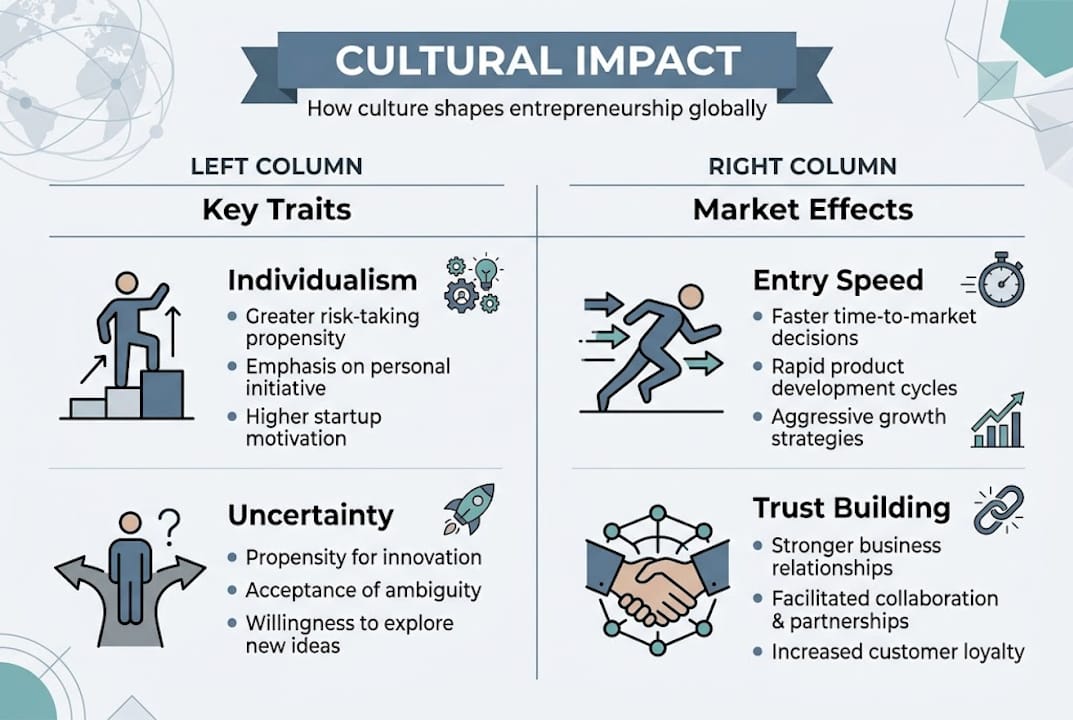
Research published in the Academy of Entrepreneurship Journal confirms that Hofstede’s dimensions like individualism, uncertainty avoidance, and power distance directly influence entrepreneurial intentions and risk perception across cultures. This means that the same business opportunity will look attractive to a founder from one cultural background and genuinely threatening to a founder from another.
Consider uncertainty avoidance. In cultures that score high on this dimension, such as Japan or Greece, people tend to prefer structured environments, clear rules, and predictable outcomes. Entrepreneurship, by its nature, involves ambiguity. Founders operating in high uncertainty avoidance cultures often need to present more detailed plans, offer stronger guarantees, and build more trust before customers or partners will commit.
Empirical data shows that cultures high in individualism, long-term orientation, and indulgence support higher entrepreneurship rates, while masculinity as a cultural trait tends to hinder entrepreneurial activity by reinforcing rigid social roles and discouraging deviation from established career paths.
This finding from the Global Entrepreneurship Index has real implications for market entry strategy. If you are launching in a high-masculinity culture, you may need to reframe entrepreneurship as a path to status and achievement rather than freedom and creativity. The emotional hook changes completely.
Here is what this means for you as a founder:
- In high individualism cultures (USA, UK, Australia): Lead with personal achievement, autonomy, and competitive advantage in your messaging.
- In high collectivism cultures (China, Indonesia, Colombia): Emphasize community benefit, group success, and long-term relationships.
- In high uncertainty avoidance cultures: Provide more social proof, detailed documentation, and risk mitigation language.
- In low power distance cultures (Denmark, Sweden, Netherlands): Flat team structures and collaborative decision-making signal credibility.
- In high power distance cultures: Formal titles, seniority, and top-down endorsements carry more weight.
Understanding these patterns before market entry is what separates founders who adapt quickly from those who spend months wondering why their strategy is not gaining traction. The future of entrepreneurship education increasingly includes cultural intelligence as a core curriculum component, and for good reason.
Challenges and opportunities in multicultural markets
Knowing the theory is one thing. Operating in a multicultural market is another. Founders who enter diverse markets face a specific set of challenges that are easy to underestimate from the outside.
The most common barriers include:
- Cultural distance: The greater the difference between your home culture and the target market, the harder it is to build trust, communicate value, and form partnerships. Research on firm internationalization shows that cultural distance negatively impacts subsidiary performance, and firms tend to prefer greenfield investments (building from scratch) over acquisitions when entering culturally distant markets.
- Dense social networks: In many cultures, business relationships are built within tight, pre-existing networks. Outsiders are not automatically welcomed. Breaking into these networks requires patience, referrals, and sustained presence.
- High uncertainty avoidance: As noted earlier, cultures that resist ambiguity can slow down deal cycles significantly, requiring more relationship-building time before any transaction occurs.
At the same time, multicultural markets offer genuine advantages for founders who approach them with curiosity and flexibility. The Journal of Global Entrepreneurship Research notes that while cultural diversity boosts innovation through expanded cognitive resources, dense networks can also constrain autonomy, creating a tension that founders must manage actively.
One compelling example comes from Asian expat entrepreneurs operating in the Middle East. Research shows that social cohesion within expat communities creates a strong foundation for business activity, with social capital contributing significantly to venture success (β=0.579). Expat founders leverage shared cultural identity, mutual trust, and community networks to access resources and customers that would otherwise be difficult to reach.
Returnee entrepreneurs represent another powerful opportunity. Founders who have lived and worked abroad bring back something rare: the ability to see their home market through an outside lens while still understanding its cultural logic from the inside. This dual perspective is a genuine competitive advantage in markets that are opening up to international ideas but still value local cultural fluency.
Pro Tip: Actively seek out policy support programs and entrepreneurship education initiatives in your target market. Many governments offer grants, accelerators, and mentorship specifically for cross-cultural founders. These resources can significantly offset the early costs of cultural adaptation. Strong peer collaboration for entrepreneurs and experiential entrepreneurship programs are particularly effective at accelerating this learning curve.
What most founders miss about cross-cultural entrepreneurship
Here is the uncomfortable truth: most founders treat cultural adaptation as a checkbox, not a capability. They hire a local translator, adjust their website copy, and assume the hard work is done. It rarely is.
What actually drives success in cross-cultural ventures is something deeper. It is the ability to recognize that your assumptions about how business works, what motivates people, and what constitutes a fair deal are themselves cultural products. They are not universal truths. They are the water you have been swimming in your entire life.

Founders consistently underestimate the role of power structures and stakeholder expectations. In many markets, the decision-maker you are pitching is not the person who actually controls the outcome. Understanding who holds informal authority, and how to earn their trust, is often the real key to closing a deal.
The hidden driver behind many successful cross-cultural ventures is social cohesion and knowledge transfer, particularly among returnee entrepreneurs. These founders do not just bring capital or skills. They bring a bridge between two cultural worlds, and that bridge is worth more than most business plans account for.
Invest in global business experiences and cultural intelligence early, before you enter a market, not after you have already stumbled. The founders who do this consistently outperform those who try to learn on the fly.
Where to build your cross-cultural entrepreneurship skills
Understanding cross-cultural entrepreneurship intellectually is a solid starting point. Building the actual skills requires practice, feedback, and community. That is exactly what Nomad Excel is designed to provide. Through our online entrepreneurship bootcamp, aspiring and early-stage founders gain hands-on experience with the frameworks, strategies, and real-world challenges covered in this article. You work alongside a curated cohort of driven founders from diverse backgrounds, which itself becomes a live laboratory for developing cultural intelligence. Our startup mentorship guide also outlines how structured mentorship accelerates the kind of adaptive thinking that cross-cultural markets demand. If you are serious about building a global venture, the learning environment you choose matters enormously.
Frequently asked questions
How is cross-cultural entrepreneurship different from international business?
Cross-cultural entrepreneurship emphasizes adapting business strategies to diverse cultural environments, not just expanding geographically. As the Journal of Global Entrepreneurship Research defines it, it involves navigating cultural differences to innovate and succeed in multicultural markets, which goes well beyond logistics or market access.
What are the main challenges for founders in cross-cultural markets?
Key challenges include cultural distance, high uncertainty avoidance, and dense networks that restrict autonomy, all of which require founders to adapt strategies rather than transplant them. Research on firm internationalization confirms that cultural distance negatively impacts subsidiary performance, making cultural adaptation a strategic priority.
What frameworks help entrepreneurs navigate cultural differences?
Design-thinking, cultural intelligence, and market adaptation are the core frameworks that help founders succeed in multicultural environments. The Journal of Global Entrepreneurship Research identifies these methodologies as central to cross-cultural entrepreneurial success.
How do Hofstede’s cultural dimensions affect entrepreneurship rates?
Higher individualism, long-term orientation, and indulgence increase entrepreneurship rates, while masculinity as a cultural trait can hinder them. The Global Entrepreneurship Index provides empirical support for these patterns across multiple countries and regions.
Can expats and returnee entrepreneurs provide unique advantages?
Yes. Expat entrepreneurs benefit from social cohesion within their communities, while returnees leverage overseas knowledge to bridge cultural gaps in their home markets. Research from Cogent Business and Management highlights expat social capital as a significant driver of venture success in multicultural environments.
Comments are closed.