
Why entrepreneurs need networks for growth and success
TL;DR:
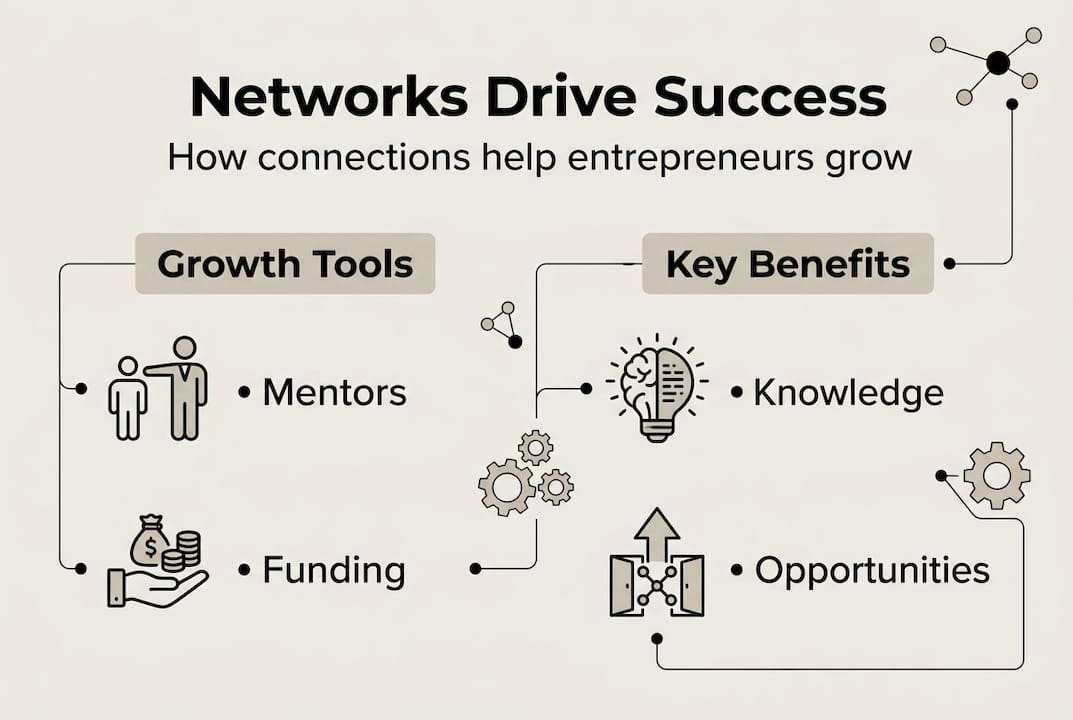
- Networks are essential for early-stage entrepreneurs, providing mentorship, funding, and knowledge. Building quality, targeted relationships is more effective than expanding contact lists. Diversifying networks and focusing on meaningful exchanges accelerate growth and prevent echo chambers.
Most early-stage entrepreneurs pour personal savings into their ventures before they ever tap outside resources. In fact, 83% of business owners rely on personal assets or credit cards to fund their startups. Yet the founders who scale fastest rarely do it on savings alone. They do it through relationships. The right network can open doors to mentorship, capital introductions, and knowledge that no amount of bootstrapping can buy. This guide breaks down why networks are non-negotiable for entrepreneurial growth and, more importantly, how to build one that actually moves the needle.
Table of Contents
- The pivotal role of networks in entrepreneurship
- Networks as engines for growth: evidence and outcomes
- Unlocking opportunities: how to build networks that work
- Potential pitfalls: when networks help and when they hurt
- Our perspective: the overlooked reality of entrepreneurial networks
- Accelerate your journey with the right network
- Frequently asked questions
Key Takeaways
| Point | Details |
|---|---|
| Networks bridge critical gaps | Professional networks connect entrepreneurs to mentors, funding, and vital knowledge resources. |
| Quality trumps quantity | Meaningful, diverse relationships matter more than sheer number of connections. |
| Events accelerate growth | Participating in targeted entrepreneurial events mediates performance and expands opportunities. |
| Recognize network limits | Over-reliance and exclusion can harm entrepreneurs, so regular reassessment is essential. |
The pivotal role of networks in entrepreneurship
Networks are often described as vital lifelines for early-stage founders, and the data backs that up. They provide access to mentorship, funding introductions, and knowledge transfer that would otherwise take years to accumulate alone. But the impact is not evenly distributed, and understanding why matters for how you approach relationship-building from day one.
One of the starkest examples involves women entrepreneurs. Women receive less than 2% of VC funding and 63% lack formal mentors, creating a compounding disadvantage that strong networks can help bridge. When community supports entrepreneurs through intentional relationship-building, those systemic gaps narrow meaningfully.
Research also confirms that network type shapes which outcomes improve. A study on SME performance found that social networks boost customer perspective, while business and supporting networks strengthen internal processes and fuel learning and growth. In other words, different connections serve different functions, and a well-rounded network covers all three.
“Your network is not just who you know. It is what those relationships make possible for your business.”
Here is a quick snapshot of how network types map to entrepreneurial outcomes:
| Network type | Primary benefit | Key outcome |
|---|---|---|
| Social networks | Relationship trust | Stronger customer perspective |
| Business networks | Industry knowledge | Improved processes |
| Supporting networks | Mentorship and guidance | Learning and growth |
| Funding networks | Capital introductions | Access to investors |
The benefits of connecting with experienced guides are well documented. Founders who engage with top mentorship networks report sharper decision-making and faster iteration cycles. Key advantages include:
- Access to hard-won experience without paying the tuition of repeated mistakes
- Warm introductions to investors, partners, and early customers
- Accountability structures that keep momentum alive during slow periods
- Diverse perspectives that challenge assumptions and surface blind spots
With the importance outlined, let’s break down the tangible ways networks serve as a lever for entrepreneurial growth.
Networks as engines for growth: evidence and outcomes
Not all growth is created equal, and neither are all networks. Research on early-stage firms reveals a striking pattern: a small subset of high-output businesses drives a disproportionate share of results. Emerging gazelles, the top 10 to 20% of nascent firms, account for 89% of new hires and 91% of revenues among early-stage companies. What is surprising is that network size alone does not explain their success. Quality of connection, not quantity, is what separates them.
This distinction matters enormously for how you invest your time. Chasing follower counts or collecting business cards at every event is a low-return strategy. Instead, focus on cultivating a smaller set of high-value relationships that offer genuine knowledge exchange and warm access to capital.
Here is how different connection types compare in their practical impact:
| Connection type | Growth lever | Time to value |
|---|---|---|
| Mentors | Strategy refinement, error avoidance | Medium term |
| Customers | Revenue, product feedback | Short term |
| Investors | Capital, credibility signals | Long term |
| Peers and partners | Collaboration, referrals | Short to medium term |
Pro Tip: Before your next networking event, write down three specific outcomes you want from new connections, whether that is a warm intro to an investor, a potential co-founder, or a customer referral. Specificity turns casual conversations into purposeful ones.
Warm introductions via your network remain one of the most reliable paths to capital, even when overall VC and grant success rates are low. The benefits of having a business mentor extend well beyond advice, often including direct referrals to investors who trust the mentor’s judgment.
Here is a practical sequence for prioritizing your networking energy:
- Identify your single most pressing growth constraint, whether funding, customers, or expertise.
- Map which connection type addresses that constraint most directly.
- Seek three to five high-quality relationships in that category before expanding.
- Nurture those relationships with consistent, value-first communication.
- Revisit your constraint list quarterly and adjust your networking focus accordingly.
Following a clear networking workflow for founders transforms networking from a vague aspiration into a repeatable system. The entrepreneurs networking guide offers additional frameworks for structuring this process.
Unlocking opportunities: how to build networks that work
Knowing that networks matter is one thing. Building one that actually delivers results requires a deliberate, structured approach. The good news is that you do not need to start from scratch. You already have a network. The question is whether it is the right one.

Begin with an honest audit. List your current contacts and categorize them by type: mentors, peers, potential customers, investors, and connectors. Then identify the gaps. If you have plenty of peers but no mentors, or strong local ties but no industry-specific contacts, those gaps are your starting point.
Here is a step-by-step approach to building a network that supports your specific goals:
- Audit your current network. Map who you know and what each relationship offers. Look for missing categories and underutilized connections.
- Join structured groups. Alumni networks, professional associations, and affinity groups provide built-in trust and shared context that accelerates relationship-building.
- Attend events with intention. Event participation enables network brokerage, meaning events help you connect people across otherwise separate networks, which is a powerful lever for influence and opportunity.
- Diversify your ties. Seek connections outside your immediate industry or geography. Diverse networks surface unexpected opportunities and prevent the echo chamber effect.
- Lead with value exchange. Every outreach should offer something useful, whether that is an introduction, a resource, or a relevant insight.
Pro Tip: The most memorable networkers are not the best talkers. They are the best listeners who follow up with something specific and useful within 48 hours of meeting someone new.
For women founders and underrepresented entrepreneurs, joining a dedicated female entrepreneurs network can provide both community and targeted access to resources that general networks may not offer. Reviewing effective networking examples for entrepreneurs can also spark ideas for approaches that fit your style and context.
Finally, consider the long-term return on investing in business education as a networking strategy. Structured learning environments naturally create high-quality peer networks because everyone in the room is committed to growth.
Potential pitfalls: when networks help and when they hurt
Networks are powerful, but they are not universally beneficial. There is a real and often overlooked downside to networking that early-stage entrepreneurs need to understand before they over-invest in connections at the expense of execution.
The most common risk is the echo chamber. When your network is filled with people who think like you, share your background, and validate your assumptions, you lose access to the friction that sharpens ideas. Exclusion and echo chambers represent the dark side of entrepreneurial networks, and over-reliance on them can actually hinder bootstrapping and undermine unique local advantages you might otherwise leverage.
Here are the key pitfalls to watch for:
- Homogeneous networks that reinforce existing beliefs rather than challenging them
- Status-driven networking where socioeconomic background (SES) shapes access and limits diverse perspectives
- Over-reliance on introductions that delays direct outreach and independent hustle
- Passive participation in groups without contributing value, which erodes trust and limits reciprocity
- Confusing activity with progress, attending events without clear goals or follow-through
“A network that only reflects your own worldview is not a network. It is a mirror.”
Social context also shapes how entrepreneurs use their networks, particularly under threat. Founders from lower socioeconomic backgrounds often face structural barriers that limit the quality of connections available to them, making intentional outreach to mentors and sponsors even more critical. The complete guide to networking addresses how to navigate these dynamics thoughtfully.
For a broader look at how entrepreneurial networks can go wrong, the dark side of entrepreneurial networks offers a candid perspective worth reading. The takeaway is not to avoid networking but to approach it with clear eyes and realistic expectations.
Our perspective: the overlooked reality of entrepreneurial networks
Here is something most networking advice will not tell you: having a large network and building a successful business are not the same thing. We have seen founders with hundreds of LinkedIn connections and zero traction, and we have seen founders with five deep relationships who scaled quickly because those five people opened the right doors at the right time.
The myth that more connections equal more success is one of the most persistent and damaging beliefs in entrepreneurship. It leads founders to spend time collecting contacts instead of cultivating relationships, attending events instead of executing on their core business, and seeking validation instead of honest feedback.
The entrepreneurs who use networks most effectively are intentional about it. They know what they need, they ask for it clearly, and they give generously in return. They treat relationships as long-term investments, not short-term transactions. And they regularly audit their networks to ensure they are surrounded by people who challenge, not just affirm, their thinking.
Our experience working with early-stage founders confirms this consistently. The full networking guide we have developed reflects this philosophy: quality, intention, and reciprocity over volume.
Accelerate your journey with the right network
Building a network that genuinely supports your growth takes structure, intention, and access to the right people. That is exactly what Nomad Excel is designed to provide. Our Online Entrepreneurship Bootcamp connects you with a curated cohort of driven founders, experienced mentors, and practical frameworks that translate directly into business results. If you are wondering whether joining entrepreneurship bootcamps is worth it, the short answer is yes, especially when the program is built around execution and community. Explore the full Nomad Excel program to see how we help early-stage entrepreneurs go from isolated to connected, and from stalled to scaling.
Frequently asked questions
How do entrepreneurial networks directly impact business growth?
Entrepreneurial networks boost SME performance by improving access to knowledge, warm funding introductions, and mentorship, all of which influence both financial and nonfinancial outcomes positively. The type of network determines which dimension of performance improves most.
What is the biggest mistake entrepreneurs make about networking?
Overvaluing the number of contacts and undervaluing genuine relationships is the most common and costly mistake. Network size is not significantly associated with early-stage growth, meaning depth consistently outperforms breadth.
Are there drawbacks to relying too much on networks?
Yes. Networks can become echo chambers or reinforce exclusion, and over-reliance hinders bootstrapping and independent hustle. Entrepreneurs must actively seek diverse voices and avoid letting networking substitute for execution.
How can new entrepreneurs start building a network?
Start by attending entrepreneurial events with a specific goal, joining alumni or professional groups for built-in trust, and seeking experienced mentors who can provide both guidance and introductions. Event participation supports network brokerage, making events one of the most efficient early-stage networking strategies available.
Comments are closed.