
Grow your small business with marketing strategies that work
Most new entrepreneurs don’t fail because they lack passion or a good idea. They fail because they pour time and money into marketing that goes nowhere. Scattered social posts, random ads, and copying competitors without a clear plan leads to frustration and wasted budget. Businesses with structured marketing plans are 6.7x more likely to succeed, yet most founders skip the planning stage entirely. This article walks you through a practical, step-by-step approach to building marketing that actually drives growth, from choosing the right channels to measuring what matters and using AI to scale smarter.
Table of Contents
- Why a structured marketing plan is your first step
- Picking high-impact marketing channels for small business growth
- Winning locally: Harnessing local SEO and Google Business Profile
- Entrepreneurial marketing: Scrappy, relationship-first tactics
- Smart metrics and budgets: Measure what matters and invest right
- Accelerate growth with AI-powered marketing efficiencies
- Blending traditional and digital: Create trust, maximize reach
- Next steps: Expert guidance and community support for entrepreneurs
- Frequently asked questions
Key Takeaways
| Point | Details |
|---|---|
| Start with a plan | Businesses with structured marketing plans are far more likely to achieve growth. |
| Focus channel selection | Choose 2–3 high-ROI channels and master them for predictable results. |
| Leverage local and community | Use local SEO and relationship-driven tactics to activate loyal customers and drive referrals. |
| Track metrics and scale | Measure key metrics, allocate smart budgets, and scale high-performing campaigns. |
| Adopt AI and hybrid approaches | Integrate AI tools and combine online with offline marketing to maximize your business’s reach and trust. |
Why a structured marketing plan is your first step
Marketing without a plan is like driving without a destination. You burn fuel, cover ground, and end up nowhere useful. A structured plan gives you clarity on who you’re targeting, what makes your offer different, and which channels deserve your attention.
Every solid marketing plan starts with four core elements:
- Target audience: Who are your ideal customers, and what problems do they need solved?
- Value proposition: Why should someone choose you over every other option available?
- Brand identity: What tone, visuals, and messaging represent your business consistently?
- Core channels: Which two or three platforms will you commit to and execute well?
Investing in business education for entrepreneurs before you start spending on ads can save you thousands. Understanding your market deeply is what separates businesses that grow from those that stall.
| Without a plan | With a plan |
|---|---|
| Scattered spending | Focused budget allocation |
| Unclear messaging | Consistent brand voice |
| Random channel choices | Strategic channel selection |
| Hard to measure results | Clear KPIs and benchmarks |
Pro Tip: Before you write a business plan, spend one week interviewing five potential customers. Their exact words will shape your messaging better than any marketing template.
Start small and focused. Clarity and structure beat scattered effort every single time.
Picking high-impact marketing channels for small business growth
With your plan in place, it’s time to choose the channels that will drive the greatest results for your small business. The biggest mistake early-stage entrepreneurs make is trying to be everywhere at once. Pick two or three channels, master them, and then expand.
Email marketing returns $36 for every dollar spent, making it one of the highest-ROI tools available to small businesses. SEO delivers compounding long-term returns that paid ads simply can’t match over time.
Here’s a quick comparison of inbound versus outbound approaches:
| Channel type | Examples | Best for |
|---|---|---|
| Inbound | SEO, content, email | Long-term, sustainable growth |
| Outbound | Paid ads, cold outreach | Fast visibility, seasonal spikes |
Understanding inbound vs outbound marketing helps you balance short-term wins with long-term brand equity. For seasonal businesses, short bursts of paid advertising can boost traffic by up to 96% during peak periods.
- SEO: Builds authority and drives organic traffic over months and years
- Email marketing: Nurtures leads and converts existing audiences at low cost
- Content marketing: Establishes expertise and supports every other channel
- Paid social: Delivers fast reach for product launches or seasonal promotions
- Organic social: Builds community and trust without ad spend
Pro Tip: If you want to master social media without burning out, batch-create content one day per week and schedule it in advance. Consistency beats frequency every time.
If you’re unsure where to start, an entrepreneurship bootcamp can help you identify the right channels for your specific business model and audience.
Winning locally: Harnessing local SEO and Google Business Profile
Beyond broad digital channels, your next growth lever is targeting and standing out in your local market. For location-based businesses, local SEO is one of the most cost-effective tools available.

Local SEO prioritizes relevant search intent and reduces wasted marketing budget by connecting you with customers who are already looking for what you offer nearby.
Here’s how to optimize your local presence effectively:
- Claim and fully complete your Google Business Profile with accurate hours, address, and photos
- Use location-specific keywords throughout your website and profile description
- Actively request reviews from satisfied customers after every transaction
- Respond to every review, positive or negative, to show you’re engaged
- Update your profile regularly with posts, offers, and seasonal announcements
“The businesses that show up first in local search aren’t always the biggest. They’re the ones that have taken the time to optimize their presence and earn community trust.”
For entrepreneurs exploring growth strategies for startups, local SEO is often the fastest path to early traction without a large advertising budget.
Pro Tip: Add a short video tour of your business or workspace to your Google Business Profile. Profiles with video content receive significantly more engagement than those with photos alone.
Entrepreneurial marketing: Scrappy, relationship-first tactics
Once you’re visible and relevant locally, it’s time to activate relationship-first strategies that drive word-of-mouth and community support. Big budgets aren’t required. Genuine connection is.
38% of small businesses use just one marketing channel, which limits their reach and resilience. Diversifying with relationship-based approaches creates multiple touchpoints without multiplying your costs.
Here’s a simple system for building referrals and social proof:
- Ask for reviews immediately after a positive customer experience while the emotion is fresh
- Create a referral incentive that rewards existing customers for bringing in new ones
- Share customer stories on social media with permission to build authentic credibility
- Follow up consistently with past clients to stay top of mind and invite repeat business
88% of customers trust reviews as much as personal recommendations, which means your review strategy is essentially a word-of-mouth engine running on autopilot.
“Your best marketing asset isn’t your logo or your website. It’s what your customers say about you when you’re not in the room.”
Additional scrappy tactics worth testing:
- Partner with complementary local businesses for cross-promotions
- Host a free workshop or Q&A session to demonstrate expertise
- Start a simple email newsletter with practical tips for your audience
- Test $10 to $20 daily ad budgets on one platform before scaling spend
Exploring types of growth strategies can help you identify which relationship-first approaches align best with your business model and customer base.
Smart metrics and budgets: Measure what matters and invest right
Scrappy efforts begin showing results, but without tracking and intentional budget allocation, scaling becomes guesswork. Here’s how to measure and invest wisely.
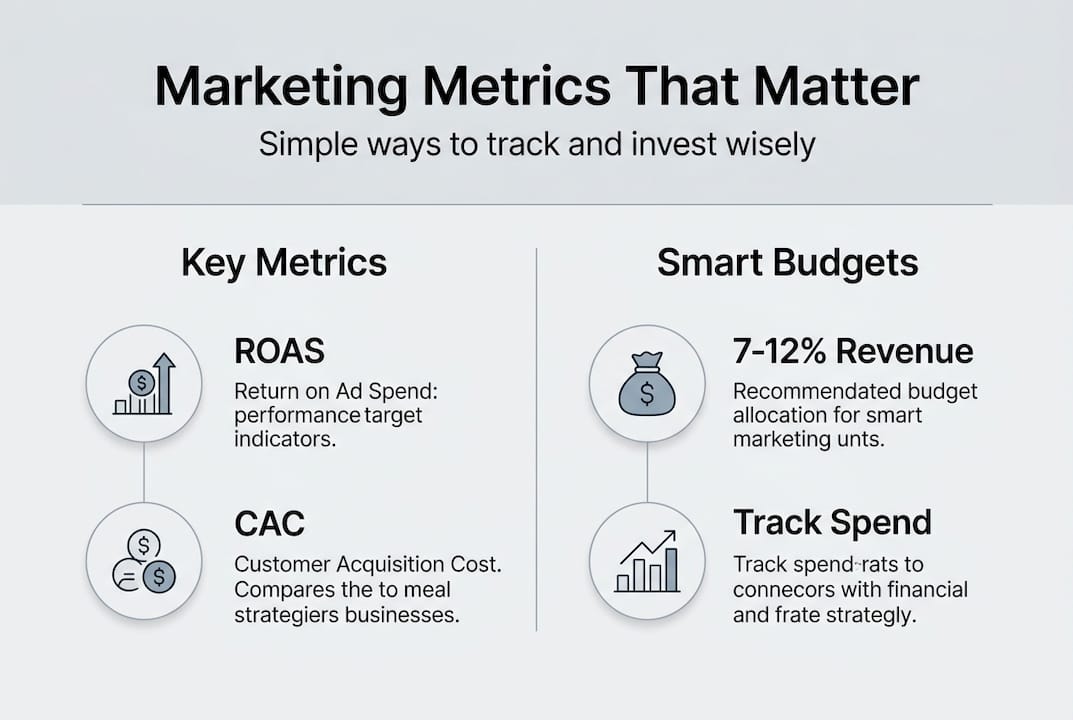
Four metrics every entrepreneur should monitor:
- ROAS (Return on Ad Spend): How much revenue you generate for every dollar spent on ads
- CAC (Customer Acquisition Cost): The total cost to acquire one new paying customer
- Conversion rate: The percentage of visitors or leads who take a desired action
- CPL (Cost Per Lead): How much you spend to generate each new lead
| Metric | SMB benchmark (2026) |
|---|---|
| Google Ads ROAS | 5:1 to 10:1 median |
| Email marketing ROI | 4x to 8x return |
| Average marketing spend | 8.11% of revenue |
“What gets measured gets managed. Entrepreneurs who track their marketing metrics consistently make smarter decisions and waste far less money.”
Most small and medium-sized businesses allocate 7 to 12% of annual revenue to marketing. Start at the lower end, track your results carefully, and increase spend only on channels that demonstrate clear returns. Avoid the temptation to test everything at once.
Accelerate growth with AI-powered marketing efficiencies
As you optimize your efforts, you can multiply your impact by incorporating advanced tools and approaches. AI makes marketing accessible and scalable for businesses of every size.
59% of SMBs use AI in their marketing, and those businesses are 5.7x more likely to see strong marketing ROI. That’s not a marginal advantage. It’s a structural one.
Here’s where AI delivers the most value for small business marketing:
- Content creation: Generate blog drafts, email copy, and social captions in minutes
- Ad optimization: AI tools automatically adjust bids and targeting to improve performance
- Email automation: Trigger personalized sequences based on customer behavior
- Data analysis: Identify patterns in your metrics that would take hours to find manually
- Social scheduling: Plan and publish content across platforms without daily manual effort
| Task | DIY time | With AI tools |
|---|---|---|
| Writing a blog post | 3 to 4 hours | 45 to 60 minutes |
| Analyzing ad performance | 2 hours | 15 minutes |
| Building email sequences | 1 to 2 days | 2 to 3 hours |
Pro Tip: Keep your strategy in-house and outsource execution. Use AI or freelancers for tasks like SEO content and ad management, but make sure you understand the strategy driving those decisions.
If you want to build real fluency with these tools, programs like the AI bootcamp for marketing or the learn AI for entrepreneurs course offer hands-on training. For businesses ready to integrate AI at a deeper level, AI consulting for SMEs provides tailored guidance.
Blending traditional and digital: Create trust, maximize reach
By now you have momentum. Here’s how to ensure your marketing feels authentic, builds trust, and covers every growth opportunity available to you.
78% of businesses with social selling outperform those that rely on a single channel. Combining offline and online tactics creates layered visibility that no single approach can replicate.
Practical hybrid marketing tactics:
- Sponsor a local event and promote your involvement across your digital channels
- Add QR codes to flyers and printed materials that link to your website or review page
- Host an in-person workshop and capture email addresses for your digital follow-up sequence
- Request reviews in person immediately after a positive customer interaction
“The businesses that earn the deepest community trust are the ones that show up both online and in person. Presence builds credibility that ads alone cannot buy.”
A numbered approach to blending channels effectively:
- Choose one offline tactic (event, flyer, sponsorship) and pair it with one digital follow-up
- Track which combinations drive the most leads or conversions over 30 days
- Double down on what works and retire what doesn’t
For entrepreneurs building layered visibility, reviewing startup growth strategies can help you identify the right mix of traditional and digital approaches for your market.
Next steps: Expert guidance and community support for entrepreneurs
You’ve worked through the key tactics, from building a structured plan to using AI and blending traditional with digital marketing. The next step is putting it all into motion with the right support around you. Marketing knowledge is powerful, but mentorship and community accelerate results in ways that self-study rarely can. The Online Entrepreneurship Bootcamp by Nomad Excel gives you step-by-step frameworks, direct access to experienced mentors, and a community of driven founders who hold you accountable. If you’re weighing your options, exploring joining entrepreneurship bootcamps can help clarify the value. And if you want to understand how expert guidance shapes business outcomes, the business mentorship benefits resource is a strong starting point.
Frequently asked questions
How much should I spend on marketing as a small business?
Small businesses typically allocate 7 to 12% of annual revenue to marketing, with the average sitting at 8.11%. Starting at the lower end and scaling based on results is a smart approach for early-stage businesses.
What are the best first marketing channels for new entrepreneurs?
Start with SEO, email marketing, and content creation. Email delivers $36 ROI per dollar spent, and SEO builds compounding returns that grow over time without ongoing ad spend.
How can I quickly grow my local business with marketing?
Claim and optimize your Google Business Profile, use location-specific keywords, and actively collect customer reviews. Local SEO improves visibility and reduces wasted budget by connecting you with nearby customers who are already searching for your services.
What marketing metrics should I track to measure success?
Focus on ROAS, CAC, conversion rate, and cost per lead. These four core marketing metrics give you a clear picture of what’s working and where to adjust your spending.
Can I use AI tools if my budget is limited?
Absolutely. Many AI tools are affordable or free at the entry level. 59% of SMBs use AI to automate content, optimize ads, and analyze performance, making it one of the most accessible ways to stretch a limited marketing budget.
Comments are closed.