
Guide to private funding for startup business: options
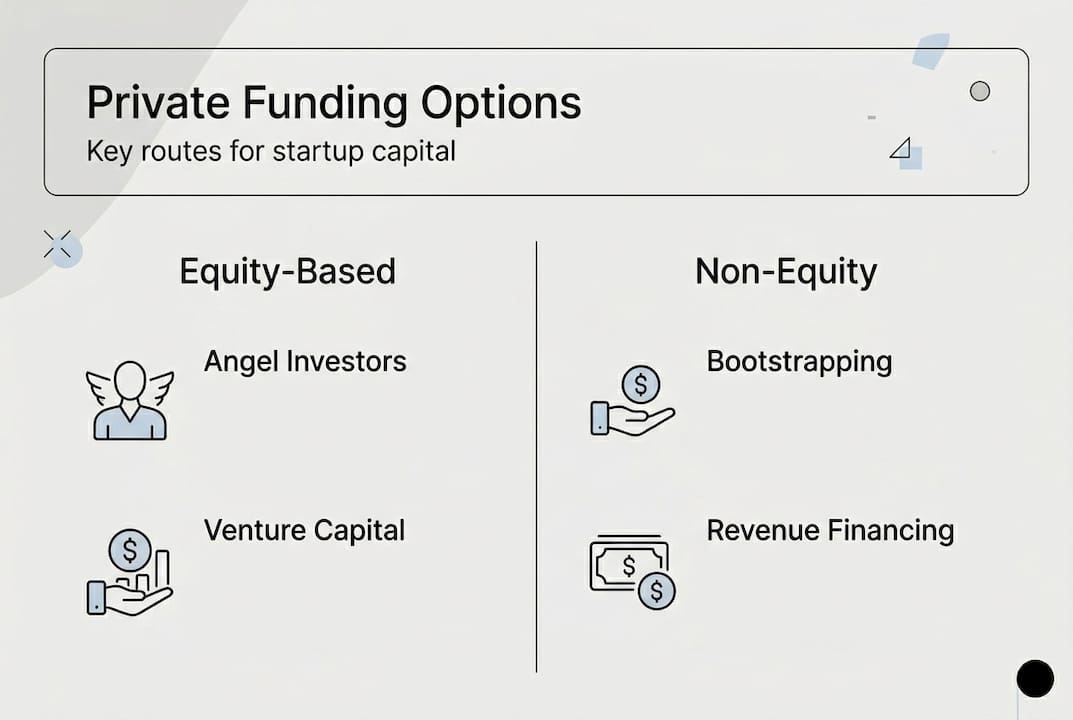
Most founders assume their only real options are maxing out personal savings or pitching to venture capitalists. That assumption leaves a lot of money on the table. Private funding options for startups actually span bootstrapping, friends and family, angel investors, venture capital, revenue-based financing, grants, and crowdfunding. Each route has its own logic, timeline, and trade-offs. This guide breaks down every major private funding path so you can move from confusion to a clear, confident strategy for your specific stage and goals.
Table of Contents
- Mapping the private funding landscape for startups
- Bootstrapping, friends and family, and early traction capital
- Understanding angel investors and syndicates
- Venture capital: Is it the right fit for your startup?
- Revenue-based financing: A growth-friendly alternative
- Strategic funding tips: Metrics, patents, and time management
- Choosing the right funding path for your business
- Accelerate your funding journey with expert guidance and community
- Frequently asked questions
Key Takeaways
| Point | Details |
|---|---|
| Multiple funding routes | Startups can access a wide range of private funding options beyond just venture capital. |
| Traction and metrics matter | Strong early traction and critical business metrics significantly increase funding odds. |
| Non-dilutive strategies exist | Bootstrapping, grants, and RBF offer capital without giving up equity. |
| Prepare for a long process | Expect fundraising to take 6-9 months, so plan timelines carefully. |
| Community accelerates success | Joining founder communities and mentorship programs makes the funding journey less daunting. |
Mapping the private funding landscape for startups
Now that you know there’s more out there than just VC, let’s break down each private funding approach available to new founders. Understanding the full landscape first saves you from chasing the wrong capital at the wrong time.
Here’s a quick comparison of the most common private funding methods:
| Funding type | Typical amount | Equity required | Speed | Best for |
|---|---|---|---|---|
| Bootstrapping | Variable | None | Immediate | Pre-revenue founders |
| Friends and family | $10K–$150K | Optional | Fast | Idea/MVP stage |
| Angel investors | $25K–$500K | 5–20% | Moderate | Early traction |
| Venture capital | $500K–$20M+ | 15–30% | Slow | High-growth startups |
| Revenue-based financing | $50K–$5M | None | Fast | Recurring revenue businesses |
| Crowdfunding | $10K–$1M+ | Optional | Moderate | Consumer products/communities |
| Grants | $5K–$500K | None | Slow | Research, social impact, deep tech |
Each method fits a different founder profile. Crowdfunding for startups works especially well when you have a community or consumer product that people can rally behind. Grants suit founders in regulated or research-heavy sectors. Business education for entrepreneurs can sharpen your ability to evaluate which route fits your current stage.
Key considerations when scanning your options:
- Dilution: Equity-based funding reduces your ownership stake permanently.
- Speed: Some routes close in weeks; others take six months or more.
- Control: Institutional investors often require board seats or approval rights.
- Stage fit: Certain funding types are only accessible once you have traction or revenue.
If you’re exploring structured support, an incubator resource for startups can help you identify which funding path aligns with your business model.
Bootstrapping, friends and family, and early traction capital
Let’s start with the funding levers you already control, and why early traction can unlock every next stage.
Bootstrapping means funding your startup entirely from personal savings or early revenue. It’s slow, sometimes uncomfortable, but it forces discipline. Founders who bootstrap to traction before raising typically secure better terms because they negotiate from a position of proof, not promise. A booted strategy that prioritizes non-dilutive capital like grants and SBIR awards first can preserve equity for later, higher-value rounds.
Friends and family capital is often the first outside money a founder raises. Keep it structured. Use a simple loan agreement or a SAFE note (Simple Agreement for Future Equity) to protect the relationship and set clear expectations. Never accept informal handshakes on financial commitments, no matter how close the relationship.
Early traction is your most powerful fundraising asset. Startups with strong CLTV metrics are 3.2 times more likely to secure funding than those without. Even modest proof, like 50 paying customers or $5,000 in monthly recurring revenue, signals that your idea has real-world demand.
Pro Tip: Apply to startup competitions and government grant programs before approaching any investor. Winning even a small grant adds credibility and non-dilutive cash that strengthens your pitch.
Three bootstrapping pitfalls new founders overlook:
- Underpricing early: Charging too little to win customers destroys your unit economics before you even start.
- Skipping legal setup: Operating without proper entity structure creates tax and liability problems that cost more to fix later.
- Ignoring the entrepreneurship bootcamp advantage: Structured programs accelerate your learning curve and connect you with mentors who’ve already solved the problems you’re facing.
Understanding the bootcamp structure can help you decide whether an immersive program fits your current stage. The importance of business education becomes especially clear when you’re navigating early funding decisions without a roadmap.
Understanding angel investors and syndicates
Once you’ve nailed the basics, individual backers can help take your ideas further.
Angel investors are high-net-worth individuals who invest their own money into early-stage startups, typically in exchange for equity or convertible instruments. Solo angels write checks ranging from $25,000 to $250,000. Syndicates pool capital from multiple angels, often led by one experienced investor, and can deploy $250,000 to $1 million or more in a single round.

Most angel deals use a SAFE note or convertible note rather than priced equity. These instruments delay valuation negotiations until a later, larger round, which keeps early deals simpler and faster to close.
What angels actually look for:
- Founder conviction: Can you articulate why you are the right person to solve this problem?
- Market size: Angels want to see a credible path to a large outcome.
- Early signals: Revenue, waitlists, letters of intent, or strong user engagement all count.
- Warm introductions: Cold outreach rarely works. A referral from a mutual connection dramatically increases response rates.
How to get a warm intro and stand out:
- Map your existing network to identify second-degree connections to target angels.
- Attend founder events, demo days, and accelerator showcases where angels actively scout.
- Build a relationship before you need money. Share updates, ask for advice, and demonstrate momentum.
- Use platforms like AngelList or Visible to maintain a clean, professional investor presence.
“Startups with strong customer lifetime value metrics are 3.2x more likely to secure funding. Traction isn’t just helpful, it’s the single most persuasive signal you can send to an angel.”
A solid guide to startup mentorship can help you build the relationships that lead to warm introductions. Refining your pitch with a strong PPT guide for startup success also makes a measurable difference when you finally get in the room.
Venture capital: Is it the right fit for your startup?
For high-growth ambitions, VC can be a powerful lever, if your goals and traction match what investors need.
VC funding moves in stages. Each stage has distinct expectations:
| Stage | Typical raise | Dilution | Key requirement |
|---|---|---|---|
| Pre-seed | $250K–$1M | 10–20% | Idea, team, early MVP |
| Seed | $500K–$5M | 15–25% | Product, early users, some revenue |
| Series A | $5M–$20M | 20–30% | Proven model, 3x YoY growth |
VC is not for every founder. Only 17% of solo founders secure VC backing, partly because investors favor co-founder teams that reduce key-person risk. US VC funds delivered a pooled horizon IRR of roughly 14–15% net as of Q2 2024, which explains why fund managers are selective about portfolio companies.
Steps to prepare for a VC process:
- Define your raise: Know exactly how much you need and what milestones it funds.
- Build your target list: Research investor-market fit before outreach. A VC focused on fintech won’t fund a consumer wellness app.
- Prepare your data room: Financials, cap table, product roadmap, and key metrics, all organized and ready.
- Create urgency: Identify your FOMO window, the moment when your traction is strongest and your story is most compelling.
- Run a tight process: Aim to get multiple term sheets within the same two-to-three week window to create competitive tension.
Pro Tip: Targeting investor-market fit beats a spray-and-pray approach every time. Ten highly relevant investors will outperform one hundred cold emails to mismatched funds. Investing in business education before you start the process helps you walk into those conversations with confidence.
Revenue-based financing: A growth-friendly alternative
Not every high-growth company wants heavy dilution. Here’s how RBF is reshaping startup funding.
Revenue-based financing (RBF) provides upfront capital in exchange for a percentage of your monthly revenue until you repay a capped multiple, typically 1.5x to 3x the original amount. No equity changes hands. Payments flex with your revenue, so a slow month means a smaller payment.
RBF fits businesses with predictable, recurring revenue. SaaS companies, e-commerce brands, and subscription services are ideal candidates. The RBF market reached $12 billion in 2025 and is projected to grow to $432 billion by 2034, reflecting how quickly founders are embracing this model.
RBF pros and cons compared to equity VC:
- Pro: No dilution, no board seats, no loss of control.
- Pro: Faster approval process, often two to four weeks.
- Pro: Payments scale with revenue, reducing cash flow pressure.
- Con: Only works if you have consistent monthly revenue to repay against.
- Con: The repayment cap can be expensive compared to a bank loan if your revenue grows quickly.
- Con: Not suitable for pre-revenue or very early-stage startups.
Pro Tip: Run a simple break-even analysis before accepting RBF. If your gross margin is below 40%, the repayment structure may squeeze cash flow more than equity dilution would. Understanding how to start a bootcamp or education-based business, for example, often reveals strong recurring revenue potential that makes RBF a natural fit.
Strategic funding tips: Metrics, patents, and time management
Whichever route you choose, startup funding now demands a metrics- and process-driven approach.
One of the most overlooked funding accelerators is intellectual property. Patents boost VC funding probability by 47%, and patented startups show 55% stronger employment growth and 80% higher sales. The effect is strongest in deep tech, biotech, and hardware, but even software patents can signal defensibility to investors.
Your metrics tell your story before you open your mouth. CLTV (customer lifetime value), ARR (annual recurring revenue), and month-over-month growth rates are the numbers investors scrutinize most. Know them cold, and be ready to explain the drivers behind each one.
Three time management tips for fundraising:
- Set a hard timeline: Give yourself a defined fundraising window, typically 90 days of active outreach, so it doesn’t bleed into operations indefinitely.
- Build your data room early: Waiting until an investor asks for documents costs you momentum. Have everything ready before your first meeting.
- Tie outreach to milestones: Reach out to investors right after hitting a meaningful milestone, like crossing $10K MRR or launching a key partnership. Timing matters.
“In 2026, expect 6 to 9 months to close a round. Start earlier than you think, and treat fundraising like a full-time sales process with clear pipeline stages.”
Working with a startup mentor during this phase can help you prioritize the right metrics and avoid the common mistake of optimizing for vanity numbers that investors don’t actually care about.
Choosing the right funding path for your business
You’re now equipped with the landscape. Let’s get practical about choosing your best next move.
Every funding route has a founder profile it fits best. VC suits founders chasing a $100 million or larger outcome who are comfortable with dilution and board oversight. RBF suits revenue-generating founders who want to grow without giving up equity. Bootstrapping suits founders who prioritize control and are willing to grow more slowly. Solo founders are rarer in VC, with only 17% securing backing, which makes alternative routes especially worth exploring.
How to evaluate which funding route to pursue next:
- Assess your stage: Do you have revenue, users, or just an idea? Your answer narrows the field immediately.
- Define your growth ambition: Are you building a lifestyle business or a venture-scale company? Be honest.
- Calculate your dilution tolerance: How much ownership are you willing to trade for capital?
- Map your timeline: How urgently do you need capital, and how long can you sustain operations without it?
- Seek community input: Talk to founders who’ve raised at your stage. Their lived experience is more valuable than any framework.
Building the right network accelerates every step of this process. Learning how to build a business community gives you access to warm introductions, honest feedback, and accountability partners who keep you moving forward.
Accelerate your funding journey with expert guidance and community
With your strategy forming, here’s how you can go further, faster, surrounded by fellow founders and expert mentors.
Nomad Excel’s entrepreneurship bootcamp brings together driven founders for immersive, hands-on programs designed to sharpen your strategy, refine your pitch, and connect you with a community that accelerates real results. You’ll work through funding frameworks, get direct feedback from experienced operators, and leave with an actionable plan rather than a stack of theory. Pair that with structured startup mentorship and you gain the kind of guidance that compresses years of trial and error into weeks. If you’re serious about raising capital in 2026, surrounding yourself with the right people is one of the highest-leverage moves you can make.
Frequently asked questions
What are the best private funding options for startups in 2026?
The best option depends on your stage and goals. Private funding options include bootstrapping, friends and family, angel investors, venture capital, revenue-based financing, crowdfunding, and grants, each suited to different founder profiles.
How long does it take to secure private funding for a startup?
Plan for a 6 to 9 month process from preparation through close, and start outreach earlier than feels necessary to avoid running out of runway mid-raise.
Does having patents increase my chance of getting funded?
Yes. Patents raise VC funding probability by 47% and are especially impactful in deep tech, biotech, and hardware sectors where defensibility is a core investor concern.
Which funding types don’t require giving up equity?
Grants, revenue-based financing, bootstrapping, and most debt instruments provide capital without equity dilution, making them attractive for founders who want to retain full ownership.
What can I do to improve my chances of getting startup funding?
Build measurable traction, track strong customer metrics like CLTV, and protect your intellectual property. Startups with strong CLTV metrics are 3.2 times more likely to secure funding than those without clear proof of demand.
Comments are closed.