
Crowdfunding for business startup: launch and succeed
Most early-stage founders believe raising capital is the hardest part of starting a business. They picture pitch decks, venture capitalists, and years of networking before seeing a single dollar. But community-driven funding has quietly rewritten those rules. Crowdfunding gives you access to real capital, real customers, and real validation before you ever open your doors. This guide breaks down every model, strategy, and risk you need to know to run a campaign that actually works.
Table of Contents
- Why crowdfunding for business startups is gaining momentum
- Crowdfunding models: Reward vs equity explained
- What drives crowdfunding success: Key strategies that work
- Risks, pitfalls, and what every founder must know
- Beyond funding: Crowdfunding as validation, community, and growth engine
- Ready to launch your startup with real support behind you?
- Frequently asked questions
Key Takeaways
| Point | Details |
|---|---|
| Crowdfunding opens access | Crowdfunding offers startups a way to raise capital and validate ideas without traditional VC gatekeeping. |
| Choose your model wisely | Reward crowdfunding suits products, while equity works for startups seeking investment—each has unique rules. |
| Success demands strategy | Effective crowdfunding requires audience-building, early momentum, and marketing skill—not just a great idea. |
| Beware key risks | Founders should vet platforms, watch for fraud, plan for fulfillment, and understand investor obligations. |
| Funding and community | Crowdfunding builds early customer communities that can help drive long-term startup survival and validation. |
Why crowdfunding for business startups is gaining momentum
Most founders hit the same wall early on: banks want revenue history, VCs want traction, and angel investors want warm introductions. Crowdfunding sidesteps all of that. Instead of convincing one gatekeeper, you convince hundreds of people who already care about your idea.
This shift matters because it democratizes who gets funded. You don’t need an Ivy League network or a Silicon Valley zip code. You need a compelling idea, a clear audience, and the willingness to execute publicly.
Crowdfunding works especially well for certain types of businesses:
- Consumer product startups (gadgets, apparel, food)
- Hardware and tech devices where backers can see a physical prototype
- Creative projects like games, films, and books
- Mission-driven brands with a strong community angle
- First-time founders who lack traditional investor access
Consumer products and hardware attract roughly 40% of all crowdfunding capital, making them the dominant category by far. The same data shows crowdfunding actively supports diverse founders who face structural barriers in traditional finance.
Crowdfunding also operates through two main structures. Reward and equity models dominate the space, with Regulation CF (Reg CF) allowing startups to raise up to $5 million through SEC-registered portals. That’s a meaningful ceiling for early-stage companies.
The real edge of crowdfunding isn’t just the money. It’s the proof. A funded campaign tells the market, your future investors, and yourself that people will pay for what you’re building.
Founders who want to sharpen their pitch and strategy before launching a campaign often benefit from startup success tips that go beyond the basics. And if you’re still deciding whether entrepreneurship is the right path, joining an entrepreneurship bootcamp can fast-track your clarity before you go public with a campaign.
Crowdfunding models: Reward vs equity explained
Not all crowdfunding is the same. The model you choose shapes your legal obligations, your relationship with backers, and how much you can raise. Getting this wrong early is costly.
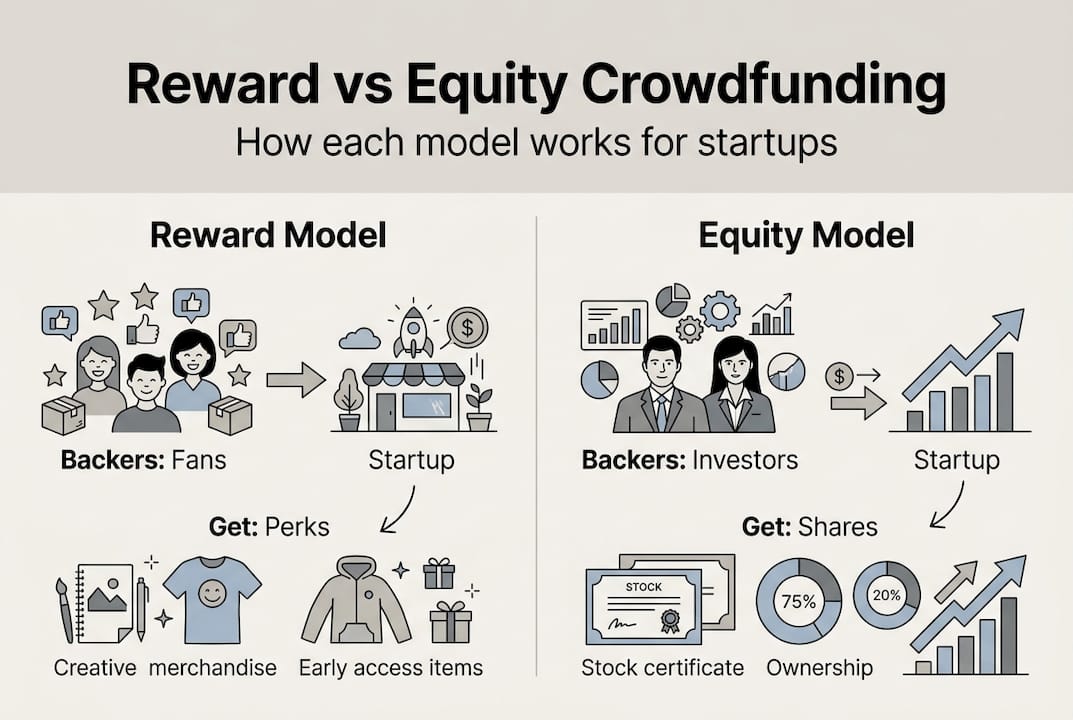
Reward crowdfunding is the most familiar model. Backers pledge money in exchange for a product, perk, or experience. No equity changes hands. Kickstarter and Indiegogo are the dominant platforms here. Kickstarter uses all-or-nothing funding (you only get paid if you hit your goal), while Indiegogo offers flexible funding (you keep what you raise regardless). Kickstarter’s success rate sits around 37 to 40%, which is actually strong for a public fundraising format.
Equity crowdfunding is more complex. You’re selling actual shares in your company to a crowd of investors. This is regulated by the SEC. Reg CF allows raises up to $5M in a rolling 12-month period, requires a filed Form C with the SEC, and mandates ongoing investor reporting after a successful raise.
Here’s a quick comparison to help you decide:
| Feature | Reward crowdfunding | Equity crowdfunding |
|---|---|---|
| What backers get | Product or perk | Equity stake in your company |
| Raise limit | No legal cap | Up to $5M (Reg CF) |
| SEC regulation | No | Yes (Form C required) |
| Best for | Product launches, creative projects | Scalable startups seeking investment |
| Platforms | Kickstarter, Indiegogo | Wefunder, Republic, StartEngine |
| Dilution risk | None | Yes |
| Ongoing obligations | Fulfill rewards | Annual SEC reports |
Choosing the right model is one of the most important early decisions you’ll make. A step by step business launch framework can help you map this decision to your broader funding strategy. If you want to launch and scale fast, understanding which model fits your business type is non-negotiable.
Quick breakdown of which businesses suit each model:
- Reward: Physical products, food and beverage brands, games, apparel, creative content
- Equity: SaaS startups, marketplaces, scalable tech, companies with long-term growth potential
What drives crowdfunding success: Key strategies that work
Here’s a hard truth: most campaigns fail not because the idea is bad, but because the founder treated the campaign like a passive fundraise. It’s not. It’s a retail event. You need to market it like one.

Only 37 to 40% of Kickstarter campaigns succeed, and Indiegogo’s rate is lower. The difference between winning and losing campaigns almost always comes down to preparation and execution, not luck.
Here are six proven factors that separate funded campaigns from failed ones:
- Build a pre-launch waitlist. Aim for 200 to 500 warm leads before you go live. These are people who already said yes.
- Hit 30% of your goal in week one. Early funding momentum signals credibility to the platform algorithm and new visitors.
- Use tiered reward structures. Give backers multiple price points. Early bird tiers create urgency and reward loyal supporters.
- Post consistent campaign updates. Backers who feel informed stay engaged and share your campaign with others.
- Tell a story, not a spec sheet. Show the problem you solve and why you’re the right person to solve it.
- Treat marketing as the campaign itself. Pre-launch hype and outreach drive more results than any platform algorithm ever will.
Statistic callout: Campaigns that secure 200 to 500 pre-launch leads and hit 30% of their funding goal in the first week are dramatically more likely to reach full funding. That first week is everything.
Pro Tip: Don’t launch until you have a committed audience. Send your campaign link to at least 50 people who have already told you they’ll back it on day one. A strong launch day tells the platform your campaign is worth promoting.
Your launch guide should include a content calendar, email sequences, and a social media plan that starts at least four weeks before your campaign goes live. Founders who skip this step almost always regret it.
Risks, pitfalls, and what every founder must know
Crowdfunding has a real dark side that most guides skip over. Knowing these risks before you launch protects both you and your backers.
The most common problems founders face:
- Investor ghosting: Some equity-funded startups stop communicating with backers entirely after raising. Crowdfunded companies ghosting investors is a documented and growing problem, and it damages trust across the entire ecosystem.
- Fulfillment failures: Reward campaigns that can’t deliver on promises leave backers angry and founders exposed to reputational damage.
- Fraud: Fake campaigns exist on every major platform. Crowdfunding scams are a real risk, especially on platforms with weaker vetting. Success rates of 22 to 40% mean many campaigns fail, and some were never legitimate.
- Cap table dilution: Equity campaigns add many small investors to your cap table, which can complicate future funding rounds.
- Illiquidity: Equity backers often can’t sell their shares easily, which creates frustration and legal complexity down the road.
Pro Tip: Before backing any equity campaign (or modeling your own after one), check for a working prototype, a filed SEC Form C, and at least three campaign updates posted after the raise closed. These three signals separate serious founders from those who disappear.
For founders running campaigns, due diligence means being the kind of operator you’d want to back. Set realistic timelines, over-communicate with backers, and build your fulfillment plan before you launch, not after. Founders who want to boost startup survival treat transparency as a competitive advantage, not a burden.
Beyond funding: Crowdfunding as validation, community, and growth engine
Here’s what most people miss about crowdfunding: the money is almost secondary. What you’re really building is proof.
A successful campaign tells future investors that real people paid real money for your idea before it existed. That’s more powerful than any pitch deck. It also builds a community of early adopters who are emotionally invested in your success and will evangelize your brand for free.
The survival data is striking. Crowdfunded startups show an 85% survival rate, which outperforms the widely cited 90% failure norm for traditional startups. That’s not a small difference. That’s a structural advantage.
| Metric | Crowdfunded startups | Traditional startups |
|---|---|---|
| Survival rate | ~85% | ~10% (5-year average) |
| Early customer validation | Built into campaign | Often post-launch |
| Community at launch | Yes (backers) | Rarely |
| Investor access post-raise | Easier with proof | Harder without traction |
The market is also growing fast. Annual equity crowdfunding hit $925M in 2025, a 58% increase year-on-year. That’s not a niche anymore. That’s a mainstream funding channel.
“The future of startup funding is hybrid. Campaigns that combine community backers with professional anchor investors are seeing better outcomes, faster closes, and stronger post-raise momentum.” Equity crowdfunding trends 2026
If you want to build that kind of community before and during your campaign, an entrepreneurship bootcamp gives you the network, the frameworks, and the accountability to do it right.
Ready to launch your startup with real support behind you?
Crowdfunding is one of the most powerful tools available to early-stage founders today. But a great campaign doesn’t happen in isolation. It takes strategy, community, and execution skills that most founders are still building when they launch. At Nomad Excel, our entrepreneurship bootcamps are designed specifically for founders like you: people who are serious about launching, scaling, and building something real. You’ll work alongside experienced mentors, build your strategy in real time, and leave with the clarity and confidence to run a campaign that converts. If you’re ready to stop planning and start building, explore what’s possible at Nomad Excel.
Frequently asked questions
How much can I raise through crowdfunding for my startup?
Under Reg CF limits, you can raise up to $5 million in a rolling 12-month period through SEC-registered portals. Reward-based campaigns have no legal raise cap.
What factors most influence crowdfunding campaign success?
Pre-launch audience building, hitting 30% of your goal in week one, and strong storytelling are the top success drivers across all major platforms.
What’s the main difference between reward and equity crowdfunding?
Reward vs equity crowdfunding comes down to what backers receive: perks and products for reward campaigns, actual company shares for equity campaigns.
Are there risks to founders or backers with startup crowdfunding?
Yes. Investor ghosting, fraud, and fulfillment failures are the most common risks, and equity deals add illiquidity concerns for backers.
What is required after a successful equity crowdfunding raise?
Founders must file annual SEC reports and maintain ongoing investor communication, obligations that many first-time founders underestimate significantly.
Comments are closed.