
How to make small business grow: proven strategies
Growing a small business is harder than starting one. Most entrepreneurs hit a wall where revenue stalls, operations become chaotic, and growth feels impossible without burning out. The difference between businesses that scale and those that struggle comes down to a few critical elements: scalable systems, laser focus on customer acquisition, smart financial planning, and access to mentorship. This guide walks you through the exact preparation steps, marketing strategies, team-building tactics, and growth balance principles you need to accelerate your business expansion without sacrificing quality or profitability.
Table of Contents
- Key takeaways
- Understanding your business growth stage and preparation steps
- Effective customer acquisition and retention strategies for growth
- Building a strong team and leveraging mentorship for accelerated growth
- Avoiding pitfalls: balancing growth with quality and profitability
- Unlock your business growth potential with Nomad Excel
- Frequently asked questions
Key Takeaways
| Point | Details |
|---|---|
| Product market fit | Before scaling, validate that your offering solves a real problem for a specific audience willing to pay, using repeat purchases and referrals to gauge fit. |
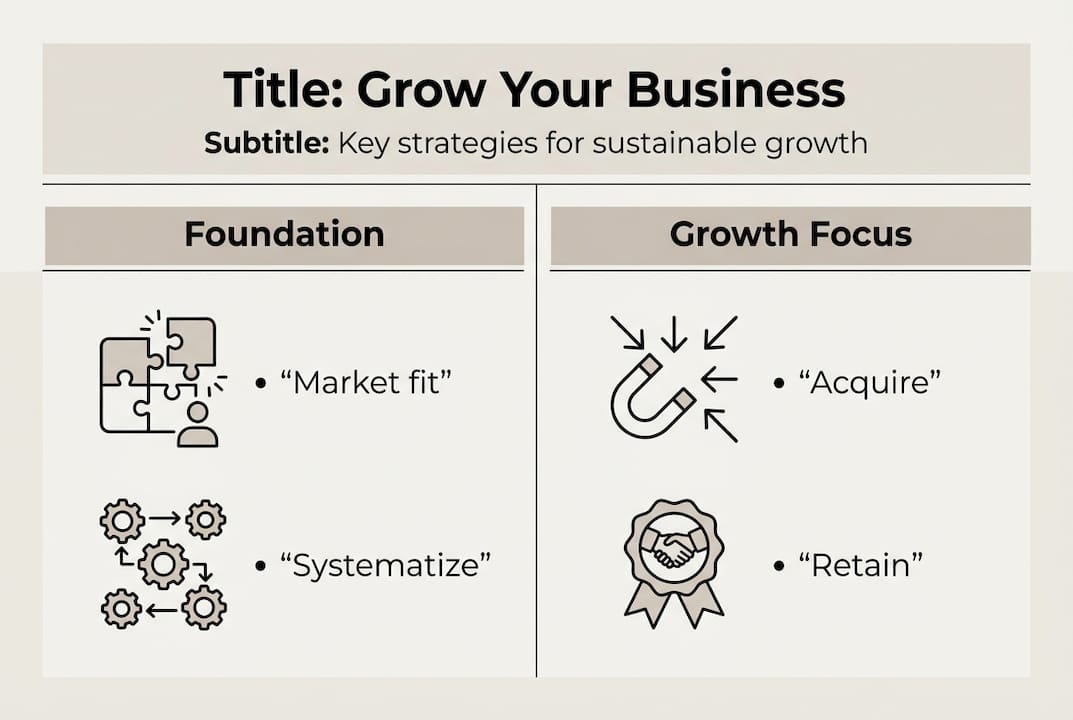
| Systematize operations | Document core processes for sales, delivery, support, and finance with standard operating procedures so growth happens without constant supervision. |
| Growth stage readiness | Audit your readiness quarterly to ensure your foundation remains solid as you move from startup to expansion. |
| Master one to two channels | Identify the most effective customer acquisition channels for your audience, test with small budgets, and double down on the winner. |
| Track CAC and LTV | Keep CAC and LTV in balance with LTV at least three times CAC to ensure sustainable growth. |
Understanding your business growth stage and preparation steps
You cannot scale what you have not systematized. Before pursuing aggressive growth, you need to understand where your business stands and what foundation must be in place. Most small businesses fall into one of four stages: Startup (proving concept), Survival (achieving cash flow stability), Growth (expanding market share), or Expansion (diversifying offerings). Each stage requires different priorities and preparation.
The most critical prerequisite is product-market fit. This means your offering solves a real problem for a specific audience willing to pay for it. Without this validation, scaling amplifies the wrong product to the wrong people. Test your fit by tracking repeat purchase rates, customer feedback quality, and referral frequency. If customers are not coming back or recommending you, pause growth plans and refine your offer first.
Next, systematize your operations to handle increased volume without chaos. Document core processes for sales, delivery, customer service, and financial management. Create standard operating procedures that new team members can follow without constant supervision. This groundwork allows you to scale efficiently rather than just adding complexity.
Financial planning is equally vital. Growth requires upfront investment in inventory, marketing, and talent before revenue catches up. Build scalable systems that include cash flow projections for at least six months ahead, accounting for seasonal fluctuations and growth expenses. Establish a financial buffer to weather unexpected costs or revenue dips during expansion.
Pro Tip: Audit your business against these preparation criteria quarterly. Growth readiness is not a one-time achievement but an ongoing state that requires regular assessment and adjustment.
Here is a quick preparation checklist by growth stage:
| Growth stage | Key preparation focus | Success indicator |
|---|---|---|
| Startup | Product-market fit validation | Repeat customers and referrals |
| Survival | Cash flow stability and basic systems | Consistent monthly profitability |
| Growth | Scalable operations and marketing | Revenue growth without proportional cost increase |
| Expansion | Diversification and team building | Multiple revenue streams and autonomous teams |
Effective customer acquisition and retention strategies for growth
Once your foundation is solid, growth depends on efficiently attracting and keeping customers. The biggest mistake aspiring entrepreneurs make is trying to be everywhere at once. Instead, identify one or two customer acquisition channels where your ideal customers already spend time and master those before expanding.

For B2C businesses, this might be Instagram and email marketing. For B2B, LinkedIn outreach and content marketing often deliver better returns. Test each channel with small budgets, track conversion rates rigorously, and double down on what works. Mastery of one channel beats mediocrity across five.
Track your customer acquisition cost (CAC) and lifetime value (LTV) religiously. CAC is the total marketing and sales expense divided by new customers acquired. LTV is the total revenue a customer generates over their relationship with your business. For sustainable growth, your LTV should be at least three times your CAC. If this ratio is lower, either your marketing is too expensive or your retention is too weak.
Retention strategies often deliver better ROI than acquisition. Implement loyalty programs that reward repeat purchases, personalized email campaigns that re-engage past customers, and proactive customer service that solves problems before they escalate. A 5% increase in retention can boost profits by 25% to 95% because existing customers cost less to serve and buy more over time.
Pro Tip: Prioritize quality leads over volume. Ten highly qualified prospects who match your ideal customer profile will generate more revenue than 100 random contacts. Refine your targeting continuously based on which customer segments have the highest LTV and lowest CAC.
Here are proven tactics for each acquisition phase:
- Awareness: Content marketing, social media presence, strategic partnerships
- Consideration: Case studies, free trials, educational webinars
- Decision: Limited-time offers, testimonials, money-back guarantees
- Retention: Loyalty rewards, exclusive content, personalized outreach
For retention specifically, follow this sequence:
- Deliver exceptional onboarding that ensures customers get value quickly
- Create regular touchpoints through email, SMS, or community engagement
- Solicit feedback proactively and act on it visibly
- Reward loyalty with exclusive perks, early access, or special pricing
- Build a community where customers connect with each other, not just your brand
Explore more small business marketing strategies that align with your specific industry and customer profile.
Building a strong team and leveraging mentorship for accelerated growth
You cannot grow alone. As your business expands, strategic hiring and expert guidance become critical success factors. The key is recruiting selectively to fill specific skill gaps rather than hiring generalists who add overhead without solving bottlenecks.
Identify your three biggest operational constraints. Maybe you excel at product development but struggle with sales. Perhaps marketing is your strength but operations are chaotic. Hire or contract specialists who can own these areas completely, freeing you to focus on strategy and vision. Early hires should be versatile problem-solvers who thrive in ambiguity and can wear multiple hats as needs evolve.
Equally powerful is tapping into structured mentorship programs. Research shows that businesses with mentors are three times more likely to achieve significant growth compared to those without guidance. Mentors provide accountability, strategic advice, and access to networks that would take years to build independently.
Programs like the International Council for Small Business Certified Consultant (ICCC) and the National Veteran Business Development Council Small Business Mentoring Program (NVBDC SMP) offer structured frameworks connecting entrepreneurs with experienced advisors. These relationships go beyond casual advice, providing regular check-ins, goal-setting frameworks, and honest feedback that keeps you on track.
“Mentorship can triple your business’s growth likelihood by providing the accountability, expertise, and network access that most entrepreneurs lack.”
The benefits extend beyond tactical advice. Mentors help you see blind spots, challenge assumptions, and avoid expensive mistakes. They have navigated the exact challenges you face and can shortcut your learning curve dramatically. Many also open doors to funding, partnerships, and talent that would otherwise remain inaccessible.
Pro Tip: When seeking mentorship, look for advisors who have built businesses similar to yours in scale and model. Industry-specific experience matters less than understanding the growth mechanics you are trying to master.
Learn more about why mentorship programs accelerate growth, explore a comprehensive mentorship program guide, or review examples of mentorship programs that match your business stage.
Key qualities to seek in team members and mentors:
- Proven track record in the specific skill area you need
- Ability to work autonomously with minimal supervision
- Cultural alignment with your business values and mission
- Growth mindset that embraces experimentation and learning
- Strong communication skills for remote or distributed work
Avoiding pitfalls: balancing growth with quality and profitability
Rapid expansion sounds exciting until it destroys your business. Premature scaling is the leading cause of startup failure, creating operational strain, cash flow crises, and plummeting customer satisfaction. The antidote is growing deliberately while maintaining the quality and profitability that made you successful initially.
Many entrepreneurs confuse revenue growth with business health. You can double sales while halving profit margins if expansion costs spiral out of control. Sustainable growth means increasing revenue while maintaining or improving profitability, not sacrificing margins for vanity metrics. Small, focused businesses often outperform larger competitors because they stay nimble, maintain quality, and serve customers with precision.
Consider two paths: aggressive scaling versus sustainable growth. Aggressive scaling prioritizes speed, accepts lower margins temporarily, and invests heavily in infrastructure before demand justifies it. This works if you have substantial funding and a proven playbook. Sustainable growth prioritizes profitability at each stage, expands capacity in response to demand, and maintains quality throughout. This approach takes longer but carries far less risk.
| Approach | Pros | Cons | Best for |
|---|---|---|---|
| Aggressive scaling | Fast market capture, competitive advantage | High cash burn, operational chaos, quality risks | Funded startups in winner-take-all markets |
| Sustainable growth | Lower risk, maintained quality, profitability focus | Slower expansion, may miss market windows | Bootstrapped businesses prioritizing stability |
The psychological toll of premature scaling is equally damaging. Entrepreneurs who scale too fast report significantly lower life satisfaction, higher stress, and more frequent burnout. Growth should enhance your life and business, not destroy both.
Pro Tip: Conduct quarterly growth audits where you assess whether expansion is improving or degrading key metrics like profit margin, customer satisfaction scores, employee retention, and your personal well-being. If any are declining, pause growth initiatives and fix the foundation first.
Warning signs you are scaling too fast:
- Customer complaints increasing faster than customer count
- Profit margins shrinking despite revenue growth
- Team members consistently overwhelmed and missing deadlines
- Cash flow negative for multiple consecutive months
- You are working more hours but feeling less effective
Consider enrolling in an online entrepreneurship bootcamp that teaches sustainable growth frameworks and connects you with peers navigating similar challenges.
Unlock your business growth potential with Nomad Excel
You have learned the strategies, but implementing them alone is where most entrepreneurs stall. Nomad Excel offers immersive entrepreneurship bootcamps and mentorship programs designed specifically to help aspiring and early-stage entrepreneurs accelerate growth through clarity, execution, and community.
Our programs combine step-by-step frameworks for building scalable systems, expert guidance from experienced entrepreneurs who have grown successful businesses, and a powerful peer network that provides accountability and support long after the program ends. You will learn to validate ideas, refine offers, optimize marketing channels, and build teams that execute without constant supervision.
The difference is our execution focus. Rather than theory-heavy courses, Nomad Excel emphasizes daily accountability, structured sprints, and real-world results. Participants leave with sharper strategy, new revenue-driving skills, and an active community that accelerates both personal and business growth. Discover why entrepreneurs join bootcamps and how they transform growth trajectories.
Frequently asked questions
What are the initial steps to start growing my small business?
Focus first on achieving product-market fit by validating that your offering solves a real problem for customers willing to pay. Next, create scalable systems for your core operations so growth does not create chaos. Begin with one or two customer acquisition channels where your ideal customers already spend time, and track key metrics like CAC and LTV rigorously. Seek mentorship early to guide your growth decisions and help you avoid common pitfalls that derail expansion.
How can mentorship accelerate my business growth?
Mentorship brings strategic guidance, accountability, and network access that most entrepreneurs lack when growing alone. Businesses with mentors are three times more likely to achieve significant growth because advisors help you see blind spots, challenge assumptions, and avoid expensive mistakes. Mentors provide regular check-ins, goal-setting frameworks, and honest feedback that keeps you on track while opening doors to funding, partnerships, and talent. Learn more about business mentor benefits and how they transform growth trajectories.
What common mistakes should I avoid when scaling my business?
Avoid premature scaling before your systems and market fit are solid, as this is the leading cause of startup failure. Do not sacrifice profitability for revenue growth, as expanding with negative margins creates unsustainable businesses. Balance growth with your personal well-being, since entrepreneurs who scale too fast report significantly lower life satisfaction and higher burnout rates. Seek expert guidance through programs like entrepreneurship bootcamps to navigate scaling mistakes successfully.
How do I know if my business is ready to scale?
Your business is ready to scale when you have consistent product-market fit demonstrated by repeat customers and referrals, documented systems that new team members can follow independently, and positive cash flow that can support growth investments. You should also have identified one or two customer acquisition channels that deliver a healthy LTV to CAC ratio of at least 3:1. If any of these elements are missing, focus on strengthening your foundation before pursuing aggressive expansion.
What metrics should I track to measure healthy business growth?
Track customer acquisition cost (CAC) and lifetime value (LTV) to ensure your growth is profitable, aiming for an LTV to CAC ratio of at least 3:1. Monitor monthly recurring revenue or sales growth rate to measure expansion velocity, and watch profit margin closely to ensure growth is not destroying profitability. Also track customer retention rate, employee satisfaction scores, and your personal work-life balance, as declines in any of these signal unsustainable growth that needs correction.
Comments are closed.