
Creativity and innovation for entrepreneurial growth 2026
Imagine boosting your opportunity identification by over 60% simply by sharpening one skill: entrepreneurial alertness. Most aspiring entrepreneurs struggle to turn creative ideas into profitable ventures because they lack systematic strategies for channeling creativity into innovation. This guide reveals how to cultivate and apply these essential capabilities to build sustainable businesses in 2026, transforming confusion into actionable clarity.
Table of Contents
- Understanding Creativity And Innovation In Entrepreneurship
- How Creativity Drives Opportunity Recognition And Innovation
- Applying Creativity And Innovation To Business Models
- Fostering Creativity Through Education, Mentorship, And Community
- Common Misconceptions About Creativity And Innovation In Entrepreneurship
- Bringing It All Together: Strategies For Sustainable Growth
- Unlock Your Entrepreneurial Creativity And Innovation With Nomad Excel
- FAQ
Key takeaways
| Point | Details |
|---|---|
| Creativity generates ideas; innovation implements them | Creativity is the foundation for new concepts, while innovation transforms those concepts into market value. |
| Entrepreneurial alertness bridges creativity and opportunity | Alertness acts as the cognitive mechanism that converts creative thinking into recognizable business opportunities. |
| Mentorship and community accelerate innovation | Structured support systems provide guidance, feedback, and collaboration that sharpen creative execution. |
| Business model innovation drives survival and growth | Adapting business models through creativity significantly improves competitive positioning and longevity. |
| Execution matters as much as ideation | Successful entrepreneurship requires balancing creative thinking with disciplined implementation and customer feedback. |
Understanding creativity and innovation in entrepreneurship
Creativity and innovation play distinct yet interconnected roles in building successful ventures. Creativity is the ability to generate novel ideas, spot patterns others miss, and envision new possibilities. Innovation takes those ideas and transforms them into tangible products, services, or processes that create market value.
The bridge between these two concepts is entrepreneurial alertness. This cognitive capability enables you to recognize opportunities hidden in plain sight, turning abstract creative thinking into concrete business strategies. Research confirms that creativity and innovation critically enable entrepreneurs to identify new opportunities, create unique offerings, and stand apart from competitors.
What makes alertness so powerful? It combines environmental scanning with creative pattern recognition. You notice gaps in the market, changing customer behaviors, or emerging technologies that others overlook. This awareness becomes your competitive edge.
Consider how innovation in entrepreneurship drives 30% higher growth for startups that master execution. The difference between struggling and thriving often comes down to how effectively you convert creative insights into implemented solutions.
Key distinction to remember:
- Creativity asks: What could exist?
- Innovation asks: How do we make it real?
- Alertness asks: Where is the opportunity?
These three capabilities work together to form your entrepreneurial toolkit. Without creativity, you lack original ideas. Without innovation, ideas remain worthless dreams. Without alertness, opportunities pass you by while you focus elsewhere.
“The entrepreneur always searches for change, responds to it, and exploits it as an opportunity.”
This quote captures the essence of entrepreneurial alertness. You’re not passively waiting for inspiration. You actively scan your environment, question assumptions, and connect dots that create value for customers.
How creativity drives opportunity recognition and innovation
Entrepreneurial alertness transforms creative thinking into actionable opportunities through a systematic process. When you develop this skill, your opportunity recognition likelihood increases considerably, giving you a measurable advantage in competitive markets.
The mechanism works through three cognitive channels. First, you scan your environment constantly, noticing customer pain points, market inefficiencies, and emerging trends. Second, you connect disparate information in novel ways, seeing relationships others miss. Third, you evaluate opportunities quickly, separating viable concepts from distractions.
Real entrepreneurs demonstrate this process daily. A founder notices remote workers struggling with collaboration tools, connects this pain with her technical expertise, and launches a new platform. Another spots sustainability concerns among millennial consumers, links this trend with supply chain innovations, and creates an eco-friendly brand.
You can develop entrepreneurial alertness systematically:
- Cultivate curiosity: Question everything you encounter. Why do customers behave this way? What problems remain unsolved? Where do current solutions fall short?
- Expand your knowledge: Learn across disciplines. The best opportunities often emerge at the intersection of different fields.
- Practice pattern recognition: Train yourself to spot trends before they become obvious. Look for weak signals in customer feedback, market data, and competitor moves.
- Test assumptions rapidly: Don’t wait for perfect clarity. Run small experiments to validate creative hunches quickly.
- Engage with diverse perspectives: Surround yourself with people who think differently. Their viewpoints sharpen your alertness.
Environmental factors also influence how effectively you recognize opportunities. Market volatility creates openings for innovative solutions. Technological advances enable new business models. Regulatory changes reshape competitive landscapes. Your alertness helps you spot these shifts early.
Community and mentorship play crucial roles in developing alertness. When you join an entrepreneurship bootcamp, you gain exposure to experienced founders who have honed their opportunity recognition skills. They share frameworks, challenge your assumptions, and help you see what you’re missing.
Pro Tip: Set aside 30 minutes weekly for structured opportunity scanning. Review industry news, customer feedback, and competitor activities specifically looking for patterns and gaps. This deliberate practice trains your alertness muscle.
Implementing 7 innovation strategies for startups becomes easier when you’ve developed strong alertness. You know which opportunities deserve your limited resources and which to ignore.
“Opportunities don’t happen. You create them.”
This mindset shift is essential. Alertness isn’t about luck or timing. It’s a learnable skill that converts your creative capacity into business value through systematic observation and rapid action.
Applying creativity and innovation to business models
Business model innovation separates thriving startups from those that struggle to gain traction. Empirical data from SMEs affirm that business model innovation improves survival and growth rates significantly, making it a critical focus for early stage entrepreneurs.
Creativity enables you to reimagine how your business creates, delivers, and captures value. Instead of accepting industry norms, you question every assumption about pricing, distribution, customer relationships, and revenue streams.

| Aspect | Creativity-Driven Approach | Efficiency-Driven Approach |
|---|---|---|
| Revenue Model | Explores subscription, freemium, marketplace, or hybrid models | Focuses on traditional transactional sales |
| Customer Acquisition | Tests unconventional channels and partnership strategies | Relies on established marketing playbooks |
| Value Proposition | Redefines customer problems and solutions creatively | Optimizes existing value propositions incrementally |
| Resource Allocation | Experiments with new capabilities and partnerships | Maximizes efficiency of current resources |
| Competitive Strategy | Seeks differentiation through innovation | Competes primarily on price or quality |
Both approaches have merit, but creativity-driven innovation opens doors that efficiency alone cannot unlock. You discover new markets, attract underserved customers, and build defensible competitive positions.
Frameworks help you integrate creativity into business design systematically. Start with the Business Model Canvas, but use it creatively. For each component, ask: What if we did the opposite? What would this look like in a different industry? How could technology transform this element?
Practical strategies for business model innovation entrepreneurs can implement immediately:
- Unbundle or rebundle offerings: Separate components customers currently buy together, or combine elements from different categories into new packages.
- Change the revenue timing: Shift from upfront payments to subscriptions, or from subscriptions to usage-based pricing.
- Flip the customer: Identify who currently pays and explore models where different stakeholders become your revenue source.
- Platform thinking: Transform your product into a platform that enables third-party value creation.
- Sustainability innovation: Build environmental or social impact directly into your business model as a competitive advantage.
Pro Tip: When experimenting with business model innovation, start with limited scope pilots that protect your brand reputation. Test new models with a subset of customers before rolling out broadly. This approach balances creative exploration with risk management.
Running innovation workshop examples for entrepreneurs can help your team generate and evaluate business model alternatives systematically. These structured sessions prevent groupthink and surface breakthrough ideas.
Understanding what makes a company innovative in 2026 reveals common patterns. Innovative companies treat business models as hypotheses to test rather than fixed strategies. They allocate resources for experimentation. They learn from failures quickly and pivot based on evidence.
Your business model should evolve as you learn about customers, markets, and your own capabilities. The initial model you launch rarely resembles what ultimately succeeds. Creativity gives you the flexibility to adapt, while innovation discipline ensures you implement changes effectively.
Fostering creativity through education, mentorship, and community
Structured support systems amplify your creative and innovative capabilities far beyond what you can achieve alone. Research shows that entrepreneurship education and mentorship significantly improve innovation and product development outcomes for early stage founders.
Entrepreneurship education builds your innovation toolkit systematically. You learn frameworks for idea generation, validation methodologies, and execution strategies. More importantly, you develop the mindset shifts necessary for sustained creative output.
Online entrepreneurship bootcamps provide concentrated learning experiences that accelerate your growth. These programs compress years of trial and error into weeks of guided discovery, helping you avoid common pitfalls while maximizing creative output.
Mentorship offers critical guidance that transforms how you approach innovation. Experienced entrepreneurs have navigated the challenges you face. They share hard-won insights about what works, what fails, and why. This knowledge dramatically shortens your learning curve.
| Support Type | Impact on Product Innovation | Impact on Business Growth | Impact on Founder Confidence |
|---|---|---|---|
| Formal Education | Moderate to High | Moderate | Moderate |
| Active Mentorship | High | High | High |
| Peer Community | Moderate to High | Moderate to High | Very High |
| Combined Approach | Very High | Very High | Very High |
The data reveals a clear pattern. While each support type delivers value independently, combining education, mentorship, and community creates exponential returns on your creative efforts.
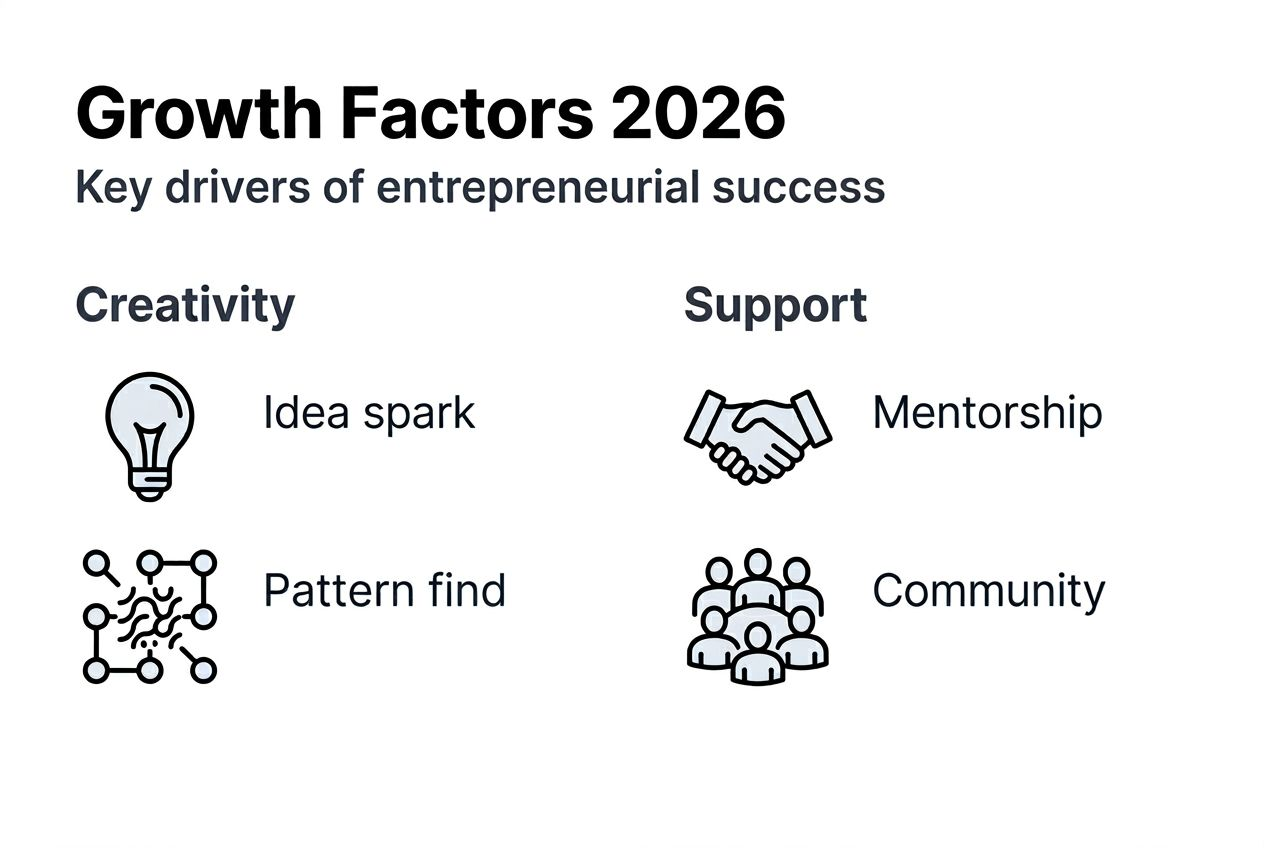
Community collaboration sustains creativity over the long term. Building a business tests your resilience daily. When you connect with peers facing similar challenges, you gain motivation, fresh perspectives, and accountability that fuel continued innovation.
The essential guide to joining entrepreneurship bootcamps highlights how these immersive experiences create transformative growth. You work alongside driven founders, receive expert feedback, and build relationships that support your journey long after the program ends.
Digital collaboration tools enable global communities to support each other’s creative ventures. You can access mentorship and peer learning regardless of location, democratizing access to the resources that accelerate innovation.
Pro Tip: Choose mentors and communities aligned with your current stage and goals. Early stage founders benefit from mentors who remember recent startup challenges. Growth stage entrepreneurs need advisors with scaling experience. Match your support network to your specific needs for maximum impact.
Understanding the structure of startup bootcamps helps you evaluate programs effectively. Look for curricula balancing theory with hands-on execution, opportunities for peer collaboration, and ongoing support beyond the initial program.
Key elements to seek in educational programs:
- Action-oriented learning: Theory matters, but you need to practice applying concepts to your actual business.
- Expert facilitation: Instructors with real entrepreneurial experience provide insights textbooks cannot.
- Cohort dynamics: Learning alongside peers creates accountability and networking opportunities.
- Iterative feedback: Regular input helps you refine ideas before investing significant resources.
- Post-program community: The relationships you build should extend far beyond the formal program.
Investing in education, mentorship, and community pays dividends throughout your entrepreneurial journey. These support systems don’t just teach you about creativity and innovation. They help you internalize practices that become your competitive advantage in dynamic markets.
Common misconceptions about creativity and innovation in entrepreneurship
False beliefs about creativity and innovation sabotage many promising ventures. Understanding these misconceptions about creativity and innovation helps you avoid common traps that derail early stage entrepreneurs.
The biggest myth? Creativity equals ideation. Many founders believe generating novel ideas is sufficient for success. In reality, idea generation represents only the starting point. Innovation requires implementation, testing, refinement, and scaling. Your ability to execute matters far more than your capacity to brainstorm.
Another dangerous misconception suggests innovation delivers instant results. Founders expect breakthrough success immediately after launching creative solutions. The truth is messier. Innovation unfolds through iterations, failures, pivots, and gradual improvements. Patience and persistence separate successful innovators from those who quit prematurely.
Common false beliefs to challenge:
- Creativity is innate, not learnable: Everyone can develop creative capabilities through practice and the right techniques.
- Innovation requires genius-level intelligence: Systematic frameworks and disciplined execution matter more than raw intellect.
- Solo entrepreneurs innovate better: Collaboration and diverse perspectives consistently generate superior creative outcomes.
- First-mover advantage guarantees success: Execution quality and market fit matter far more than being first.
- Innovation means starting from scratch: Most successful innovations adapt or combine existing ideas in novel ways.
- Creativity and structure are opposites: The most innovative companies balance creative freedom with execution discipline.
The relationship between creativity and execution deserves special attention. Some entrepreneurs swing too far toward ideation, constantly chasing new concepts without implementing any fully. Others focus exclusively on execution, missing opportunities to innovate their approach.
You need both. Creativity identifies possibilities. Execution converts possibilities into results. Alertness guides you toward the opportunities worth pursuing. The mentorship process for entrepreneurs helps you maintain this balance by providing outside perspective on where to focus your energy.
Many founders also underestimate the role of community support in sustaining innovation. They view entrepreneurship as a solitary journey, believing they must figure everything out independently. This isolation kills creativity and increases failure risk unnecessarily.
Realistic expectations set you up for sustainable success. Innovation takes time. You will face setbacks. Some creative ideas will fail. These outcomes don’t reflect your potential. They represent the normal path toward breakthrough results.
Recognize that creativity flourishes within constraints. Limited resources force innovative thinking. Tight deadlines spark creative problem solving. Customer feedback channels creativity toward market needs. Embrace constraints as creativity catalysts rather than obstacles.
Bringing it all together: strategies for sustainable growth
Integrating creativity and innovation into your daily entrepreneurial practice requires systematic approaches that balance inspiration with execution. Follow this proven method to embed creative thinking throughout your venture:
- Cultivate creative habits: Dedicate time for unstructured exploration, cross-industry learning, and questioning assumptions. Make creativity a daily practice, not an occasional event.
- Develop entrepreneurial alertness: Train yourself to spot opportunities by actively scanning your environment, connecting disparate information, and evaluating market gaps systematically.
- Validate ideas rapidly: Test creative concepts quickly through minimum viable products, customer interviews, and small-scale experiments before committing major resources.
- Build collaborative networks: Surround yourself with mentors, peers, and advisors who challenge your thinking and provide diverse perspectives on your innovations.
- Implement with discipline: Convert validated ideas into execution plans with clear milestones, accountability mechanisms, and feedback loops that ensure continuous improvement.
Essential startup mentorship benefits include accelerated learning, expanded networks, and the confidence boost that comes from expert validation of your creative direction.
Leveraging community and mentorship as critical success factors means actively seeking guidance rather than waiting for it to appear. Join programs, attend events, and reach out to experienced founders who can shorten your path to sustainable growth.
Balancing innovation efforts with execution discipline prevents the common trap of endless ideation without results. Set innovation budgets that allocate specific time and resources for experimentation while protecting core business operations. This approach lets you explore creative opportunities without jeopardizing existing revenue streams.
Customer feedback serves as your north star for innovation. Creative ideas matter only when they solve real problems for real people willing to pay. Build tight feedback loops that inform which innovations to pursue and which to abandon.
Pro Tip: Sustain creative momentum through iterative growth cycles. Set quarterly innovation goals, experiment throughout the period, evaluate results honestly, and apply learnings to the next cycle. This rhythm prevents burnout while maintaining forward progress.
Strategies to accelerate business growth fast include focusing your creative energy on high-impact opportunities, eliminating low-value activities, and scaling what already works before inventing entirely new approaches.
Daily application checklist for entrepreneurs:
- Did I scan my environment for new opportunities today?
- Have I tested any assumptions about customer needs this week?
- Am I learning from diverse sources outside my industry?
- Have I sought feedback on my latest innovation ideas?
- Are my creative experiments balanced with execution on core priorities?
- Have I connected with mentors or peers for fresh perspectives recently?
- Am I iterating based on evidence or stubbornly pursuing unvalidated ideas?
Sustainable growth emerges when you systematically apply creativity and innovation while maintaining execution discipline. You don’t need breakthrough genius. You need consistent practice, supportive relationships, and the willingness to learn from both successes and failures.
Unlock your entrepreneurial creativity and innovation with Nomad Excel
Ready to transform your creative ideas into a thriving business? Nomad Excel’s online entrepreneurship bootcamp provides the structured learning, expert mentorship, and supportive community you need to accelerate your growth in 2026.
Our immersive programs bring together driven founders for hands-on learning that goes far beyond theory. You’ll work directly with experienced entrepreneurs who have built successful ventures, gaining practical frameworks for channeling creativity into executable strategies. The mentorship process connects you with advisors who understand your challenges and can guide you past common obstacles.
Discover why joining an entrepreneurship bootcamp accelerates your journey. You’ll gain clarity on your business model, build revenue-driving skills, and join a global network of peers who support your continued innovation long after the program ends.
FAQ
What are the key differences between creativity and innovation in entrepreneurship?
Creativity involves generating novel ideas and recognizing patterns that others miss. Innovation takes those creative ideas and implements them to create tangible market value. Both capabilities are essential, but they serve different functions in building successful businesses.
How can mentorship and community support enhance my entrepreneurial creativity?
Mentors provide experienced guidance, honest feedback, and proven frameworks that sharpen your creative ideas into executable strategies. Community collaboration exposes you to diverse perspectives and maintains motivation during challenging phases. Together, these support systems accelerate innovation far beyond what you can achieve alone.
What common mistakes should I avoid when trying to innovate my startup?
Avoid focusing solely on idea generation without structured execution plans and measurable milestones. Don’t neglect feedback loops or give up on innovations prematurely before gathering sufficient market data. Ignoring community and mentorship support that could accelerate your learning represents another critical mistake that slows growth unnecessarily.
How long does it typically take to see results from innovation efforts in entrepreneurship?
Innovation unfolds gradually through testing, refinement, and adaptation rather than delivering instant breakthroughs. Timeline varies based on market dynamics, execution quality, and resource availability. Consistent effort combined with rapid iteration and evidence-based pivoting increases your likelihood of achieving meaningful results within reasonable timeframes.
Comments are closed.