
Lead Generation Workflow 2026: Boost Leads by 30% Fast
Converting website visitors into paying customers remains one of the hardest challenges for early-stage entrepreneurs. Without a structured lead generation workflow, you lose potential customers who never return. This guide walks you through the exact prerequisites, step-by-step process, and common pitfalls to build a scalable, measurable funnel that consistently delivers qualified leads.
Table of Contents
- Prerequisites For Lead Generation Workflow
- Step-By-Step Lead Generation Workflow
- Common Lead Generation Mistakes And Troubleshooting
- Alternative Approaches And Tradeoffs
- Expected Results And Outcomes
- Boost Your Lead Generation With Nomad Excel Programs
- Frequently Asked Questions About Lead Generation Workflow
Key Takeaways
| Point | Details |
|---|---|
| Buyer personas boost conversions | Defining buyer personas improves conversion rates by up to 73%. |
| Multi-channel increases pipeline | Using multiple channels grows lead pipeline by 30% compared to single-channel approaches. |
| Automation reduces costs | Automated nurturing with continuous testing lowers cost per lead by at least 10%. |
| Compliance is non-negotiable | Ignoring GDPR risks fines up to €20 million or 4% of global turnover. |
| Results appear quickly | Qualified leads typically begin flowing within 2-4 weeks of launching your workflow. |
Prerequisites for Lead Generation Workflow
Before you build any lead generation workflow, you need a solid foundation. Skipping these prerequisites wastes time and money on leads that never convert.
Start by creating detailed buyer personas. Businesses with clear buyer personas improve lead conversion by up to 73%. Your personas should include demographics, pain points, goals, and buying behavior. The more specific you get, the better your targeting becomes.
Compliance matters more than most entrepreneurs realize. GDPR violations can cost you up to €20 million or 4% of your global turnover, whichever is higher. Even if you operate outside Europe, you must comply if you handle EU citizen data. Set up proper consent mechanisms, privacy policies, and data handling procedures before collecting a single lead.
Your tech stack needs four core tools:
- CRM system to manage and track all lead interactions
- Email automation platform for nurturing sequences
- Landing page builder with A/B testing capabilities
- Analytics platform to measure performance and ROI
Understand your baseline metrics before launching. Track cost per lead (CPL) and conversion rates from the start. Without these numbers, you cannot measure improvement or identify problems quickly.
Pro Tip: Start with free or low-cost tools like HubSpot CRM and Mailchimp to validate your workflow before investing in enterprise solutions.
Preparing these prerequisites reduces costly mistakes. You avoid wasting ad spend on the wrong audience, prevent legal issues, and build measurement into your process from day one.
Step-by-Step Lead Generation Workflow
Building an effective lead generation workflow requires five sequential steps that work together to capture, nurture, and convert prospects.
Step 1: Define Your Ideal Customer
Create detailed buyer personas based on real data from customer interviews and market research. Include specific demographics, challenges they face, solutions they seek, and where they spend time online. This precision helps you craft messaging that resonates and choose channels where your audience actually exists.
Step 2: Build Conversion-Optimized Landing Pages
Landing page optimization can increase lead capture by 20-50%. Your landing page needs a clear headline addressing one specific pain point, compelling offer that delivers immediate value, and a single call-to-action button. Remove navigation menus and unnecessary links that distract from conversion. Test different headlines, images, and button colors weekly to find what converts best.

Step 3: Set Up Automated Email Sequences
Create email marketing automation sequences that nurture leads based on their behavior. Your welcome email should deliver the promised lead magnet immediately. Follow up with value-driven content that educates rather than sells. Send 5-7 emails over 2-3 weeks, spacing them 2-4 days apart. Each email should move the prospect closer to understanding how you solve their problem.
Step 4: Implement Multi-Channel Strategies
Relying on one channel limits your reach. Use social media ads to drive traffic to your landing pages, retargeting pixels to re-engage visitors who did not convert, and content marketing to build organic traffic. Our business launch guide shows how multi-channel approaches create multiple touchpoints that build trust faster.
Step 5: Test, Measure, and Optimize Continuously
Run A/B tests on every element weekly. Test subject lines, email copy, landing page headlines, call-to-action buttons, and ad creative. Change only one variable at a time so you know what drives improvement. Review your analytics every Friday and make data-driven decisions for the next week.
Pro Tip: Use UTM parameters on all links to track which channels and campaigns generate the highest quality leads, not just the most leads.
| Workflow Step | Primary Tools | Expected Impact | Timeline |
|---|---|---|---|
| Buyer Personas | Customer interviews, surveys | 73% better conversion | 1 week |
| Landing Pages | Unbounce, Leadpages | 20-50% more captures | 3-5 days |
| Email Nurturing | Mailchimp, ActiveCampaign | 15-20% conversion lift | 1 week setup |
| Multi-Channel | Facebook Ads, LinkedIn | 30% larger pipeline | Ongoing |
| Testing & Optimization | Google Analytics, Hotjar | 10% CPL reduction | Weekly |
Automation reduces manual tasks by 80% and cuts response time from hours to seconds. Leads receive immediate follow-up, which dramatically improves engagement rates. Our growth strategies for startups expand on these automation principles for scaling quickly.
Common Lead Generation Mistakes and Troubleshooting
Even with a solid workflow, entrepreneurs make predictable mistakes that tank lead generation results.
Neglecting lead nurturing causes up to 50% of potential leads to disappear. Many entrepreneurs capture leads but never follow up consistently. Set up automated sequences that deliver value over time. Without nurturing, your leads forget about you or buy from competitors who stay in touch.
Cold outreach without personalization produces reply rates under 5%. Generic messages get ignored or deleted immediately. Personalize every outreach with specific references to the prospect’s business, recent activities, or shared connections. Mention a specific pain point you noticed and how you solve it.
Skipping lead scoring wastes time on low-quality prospects. Not all leads deserve equal attention. Assign point values based on engagement level, demographic fit, and buying signals. Focus your energy on leads scoring above your threshold. This prioritization improves conversion rates and reduces sales cycle length.
Ignoring GDPR and privacy regulations risks massive fines and reputation damage. Always obtain explicit consent before adding anyone to your email list. Include clear unsubscribe options in every message. Store customer data securely and delete it when requested.
Pro Tip: Review your entire workflow quarterly for personalization gaps. Add custom fields to your CRM that trigger specific messaging based on industry, company size, or stated challenges.
“Companies that excel at lead nurturing generate 50% more sales-ready leads at 33% lower cost.” – Marketing automation research
Troubleshoot poor performance by auditing three areas. First, check if your messaging addresses actual customer pain points or just features you think matter. Second, verify lead scoring criteria align with behaviors that predict purchases. Third, confirm all touchpoints comply with data protection laws in every market you serve.
Our goal setting for entrepreneurs resource helps you establish clear benchmarks for each workflow stage. This clarity makes troubleshooting faster because you know exactly which metrics should improve and by how much.
Alternative Approaches and Tradeoffs
Different lead generation strategies offer distinct advantages depending on your resources, timeline, and business model.
Single-channel strategies focus all effort on one platform. This approach is simpler to manage and cheaper to execute. You become expert at that channel quickly. However, you limit your reach and depend entirely on one platform’s algorithm and policies. If that channel changes or your account gets suspended, your lead flow stops completely.
Multi-channel approaches increase lead pipeline size by 30% because you reach prospects where they prefer to engage. Some people respond to LinkedIn messages while others prefer email or Instagram. The downside is higher complexity, more tools to manage, and increased costs across multiple platforms.
Manual lead response provides personalized, thoughtful replies that build stronger relationships. You can adapt messaging based on each conversation’s nuance. This approach works well when you have few leads and high ticket prices. The limitation is speed. You cannot respond instantly to leads arriving at 2 AM, and you risk losing them to faster competitors.
Automated lead response ensures every lead gets immediate, consistent follow-up 24/7. Your conversion rates improve because response time directly correlates with close rates. You can scale infinitely without hiring more salespeople. The tradeoff is setup time and potential for impersonal messaging if done poorly.
Pros and Cons Summary:
- Single-channel: Easy to master, lower cost, but limited reach and risky dependence
- Multi-channel: Broader reach, 30% more leads, but complex and resource-intensive
- Manual response: Personal touch, relationship building, but slow and not scalable
- Automated response: Fast, scalable, consistent, but requires setup and can feel robotic
| Approach | Lead Volume | Cost | Complexity | Scalability |
|---|---|---|---|---|
| Single-channel | Low to Medium | Low | Low | Limited |
| Multi-channel | High | Medium to High | High | Excellent |
| Manual Response | Low | Low | Low | Very Limited |
| Automated Response | High | Medium | Medium | Excellent |
The best strategy combines elements based on your stage. Start with one or two channels and automation, then expand as you validate what works. Our mentorship program guide helps you make these strategic decisions with expert feedback.
Expected Results and Outcomes
Setting realistic expectations prevents frustration and helps you stay committed long enough to see results.
Qualified leads typically appear within 2-4 weeks of launching your workflow. The first week focuses on setup and initial traffic. Week two brings your first conversions as people move through your nurture sequence. By week four, you should see a predictable pattern of daily or weekly lead flow.
Cost per lead decreases by at least 10% with continuous optimization. Your initial CPL will be higher as you test messaging and targeting. As you eliminate underperforming ads and landing page elements, your efficiency improves. By month three, expect CPL to drop 20-30% from your starting point.
Lead conversion rates improve 15-20% through automation and nurturing. Immediate follow-up and consistent value delivery keeps prospects engaged. Without automation, you lose leads who need multiple touchpoints before buying.
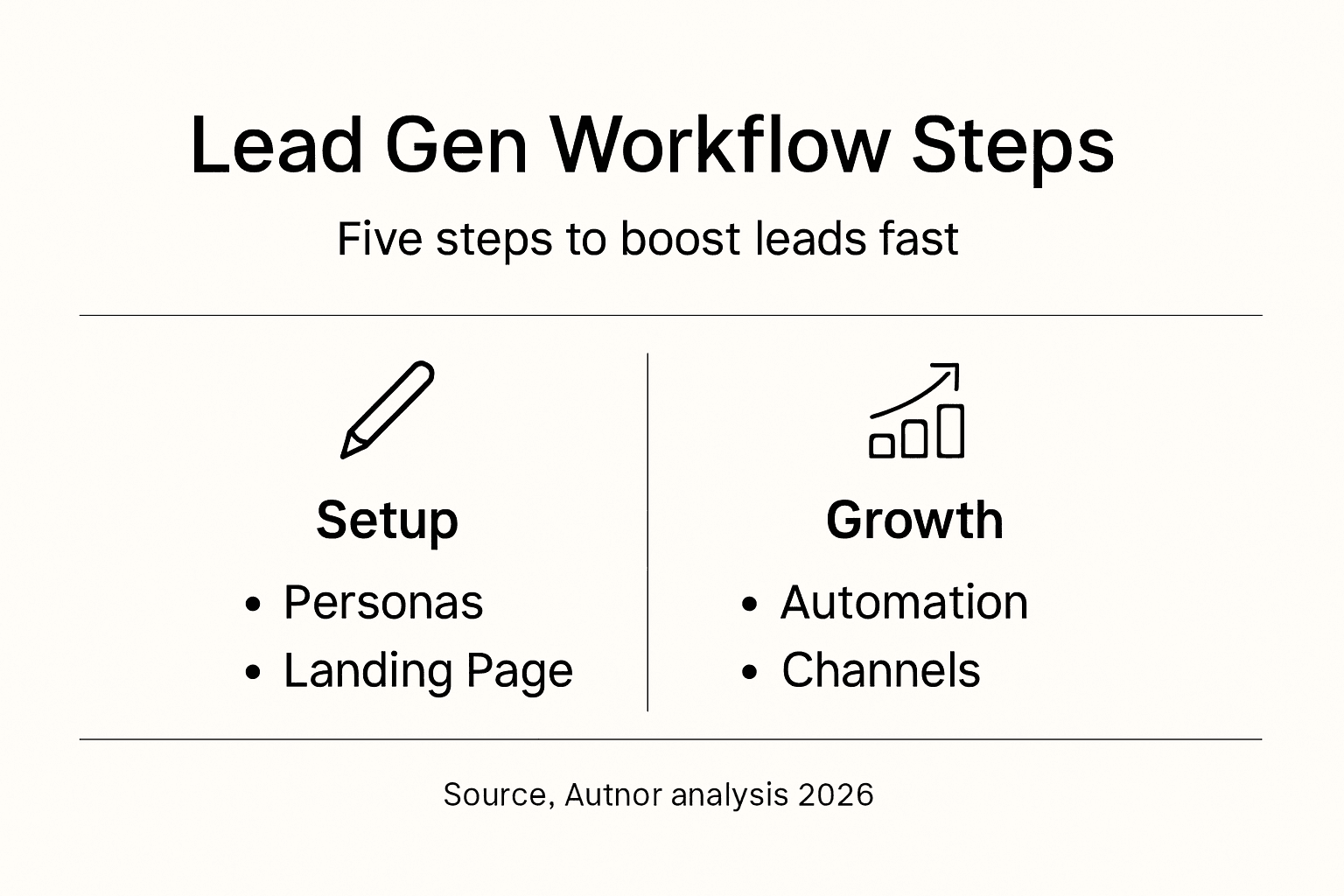
Multi-channel workflows increase pipeline size by 30% compared to single-channel approaches. More touchpoints across different platforms builds trust and catches prospects wherever they spend time.
Key Performance Metrics to Track:
- Landing page conversion rate (target: 10-15% for B2B, 20-25% for B2C)
- Email open rates (target: 20-25%) and click rates (target: 3-5%)
- Cost per lead trending downward month over month
- Lead-to-customer conversion rate (target: 2-5% for most businesses)
- Time from lead capture to first purchase (track average and reduce it)
Most entrepreneurs see measurable improvement in lead quality and quantity within 6-8 weeks of implementing a structured workflow. The key is consistent execution and weekly optimization.
Boost Your Lead Generation with Nomad Excel Programs
Building a lead generation workflow is easier with expert guidance and a community of entrepreneurs solving similar challenges.
Nomad Excel’s online entrepreneurship bootcamp provides structured frameworks for validating offers, building scalable systems, and implementing workflows that actually convert. You get direct mentorship from experienced marketers who have built successful lead generation systems across industries.
Our programs focus on execution over theory. You build your workflow during the bootcamp with daily accountability and feedback. Learn why joining an entrepreneurship bootcamp accelerates results compared to learning alone.
The community you join becomes your long-term support network. Connect with peers testing similar strategies, share results, and troubleshoot challenges together. This collaboration speeds up your learning curve dramatically.
Explore our business growth strategy workflow to see how lead generation fits into your broader growth plan.
Frequently Asked Questions about Lead Generation Workflow
What is a lead generation workflow and why is it essential?
A lead generation workflow is a systematic process for attracting, capturing, nurturing, and converting prospects into customers. It is essential because consistent revenue requires predictable lead flow, and manual processes cannot scale. Workflows automate repetitive tasks while personalizing engagement based on prospect behavior.
How long does it take to see results from a new workflow?
Most entrepreneurs see their first qualified leads within 2-4 weeks of launching a properly structured workflow. Meaningful results like consistent daily leads and improved conversion rates typically appear by weeks 6-8. Your timeline depends on traffic volume, offer quality, and how quickly you optimize based on data.
Can I start lead generation with a limited budget?
Yes, you can start with free tools like HubSpot CRM, Mailchimp’s free tier, and organic social media content. Focus on one channel where your audience gathers and create high-value content that attracts them naturally. As you generate revenue, reinvest in paid ads and premium tools to scale faster.
How important is GDPR compliance in global lead generation?
GDPR compliance is critical if you collect data from anyone in the EU, regardless of where your business operates. Violations can result in fines up to €20 million or 4% of global revenue. Beyond fines, non-compliance damages trust and reputation, making future lead generation harder.
What tools are best for beginner entrepreneurs?
Start with HubSpot CRM for contact management, Mailchimp for email automation, Google Analytics for tracking, and Carrd or Leadpages for simple landing pages. These tools offer free or low-cost tiers that handle thousands of leads. Upgrade to platforms like ActiveCampaign or Salesforce only after validating your workflow generates consistent revenue.
Comments are closed.