
Master Leadership Development Steps for Entrepreneur Success
Building a strong remote team demands more than ambition and a good business plan. Aspiring entrepreneurs often discover that real progress begins with self-awareness and a willingness to recognize both strengths and blind spots. Strategic leadership assessment and targeted skill-building create the foundation for effective team growth, especially in a fast-changing global environment. Explore a practical approach to mastering self-reflection, clear vision, dynamic communication, collaborative problem-solving, and long-term growth that fits the realities of flexible work.
Table of Contents
- Step 1: Assess Core Leadership Strengths and Blind Spots
- Step 2: Define Clear Vision and Team Expectations
- Step 3: Cultivate Essential Communication Skills
- Step 4: Implement Collaborative Problem-Solving Systems
- Step 5: Track Growth and Adapt Leadership Approaches
Quick Summary
| Key Insight | Explanation |
|---|---|
| 1. Conduct Comprehensive Self-Assessments | Use validated frameworks to evaluate strengths and blind spots for personal growth as a leader. |
| 2. Establish a Clear Team Vision | Create a compelling mission and measurable performance objectives to guide your team toward shared goals. |
| 3. Enhance Communication Skills | Develop active listening and emotional intelligence to foster connections, trust, and collaboration within your team. |
| 4. Implement Collaborative Problem-Solving | Create structured systems that encourage team contributions to turn challenges into innovative solutions. |
| 5. Regularly Track and Adapt Leadership | Use a monitoring framework to reflect on progress and adjust leadership approaches based on real-world feedback. |
Step 1: Assess Core Leadership Strengths and Blind Spots
Developing exceptional leadership requires a strategic and introspective approach to understanding your capabilities and potential growth areas. In this step, you will systematically evaluate your leadership profile to identify both your remarkable strengths and critical areas for development.
Begin by conducting a comprehensive self-assessment using validated leadership capability frameworks. This process involves several strategic methods to gain deep insights into your leadership potential.
Key assessment strategies include:
- Utilize 360-degree feedback mechanisms
- Complete standardized leadership personality assessments
- Conduct honest self-reflection exercises
- Request detailed input from peers, mentors, and team members
Professional leadership assessments help uncover nuanced insights about your leadership style. Organizational development research emphasizes the importance of understanding both your inherent strengths and potential blind spots to drive meaningful personal growth.
Successful entrepreneurs recognize that leadership development is an ongoing journey of self-discovery and continuous improvement. By systematically assessing your leadership capabilities, you create a roadmap for targeted skill enhancement and strategic personal development.
Pro tip: Create a personal leadership development journal to track your insights, progress, and reflections throughout your assessment journey.
Here’s how popular leadership assessment methods differ in their focus and outcomes:
| Assessment Type | Primary Goal | Typical Outcome |
|---|---|---|
| 360-Degree Feedback | Gather perspectives from all levels | Comprehensive, varied insights |
| Personality Assessments | Reveal behavioral tendencies | Profiles of strengths/blind spots |
| Peer Input | Discover team dynamic perceptions | Targeted suggestions for growth |
| Self-Reflection | Deepen personal awareness | Actionable self-improvement steps |
Step 2: Define Clear Vision and Team Expectations
Successful entrepreneurial leadership hinges on establishing a crystal-clear vision and setting explicit expectations that align and motivate your team. This crucial step transforms abstract goals into tangible, actionable strategies that drive collective performance and individual commitment.
To define your vision and team expectations effectively, focus on creating a comprehensive framework that communicates purpose, direction, and specific outcomes. Your approach should encompass several key elements:
- Articulate a compelling mission statement
- Establish measurable performance objectives
- Define individual and collective responsibilities
- Create transparent communication channels
- Design accountability mechanisms
Break down your vision into strategic implementation stages that make abstract goals concrete and achievable. This involves translating high-level aspirations into granular, actionable performance benchmarks that each team member can understand and pursue.
A clear vision acts as a navigational compass, guiding your team through challenges and uncertainties while maintaining focus on collective goals.
By methodically defining expectations, you create a robust organizational structure that empowers team members to take ownership, make autonomous decisions, and contribute meaningfully to your entrepreneurial vision.

Pro tip: Conduct quarterly vision alignment meetings to ensure your team remains synchronized and motivated by revisiting and refining collective goals.
Step 3: Cultivate Essential Communication Skills
Mastering communication is the cornerstone of exceptional leadership, transforming potential misunderstandings into powerful collaboration and driving your entrepreneurial vision forward. In this critical step, you will develop the communication skills that distinguish great leaders from good managers.
Professional leaders understand that effective communication strategies extend far beyond simple information exchange. Your communication toolkit should encompass multiple dimensions:
- Active and empathetic listening
- Clear and concise verbal expression
- Nonverbal communication awareness
- Adaptable communication styles
- Emotional intelligence
The science of leadership communication reveals that successful entrepreneurs leverage both verbal and non-verbal communication channels. This means developing a nuanced approach that goes beyond words to include tone, body language, and contextual understanding.
Exceptional communication is not about speaking more, but about creating meaningful connections that inspire trust and mutual understanding.
By intentionally practicing these skills, you transform communication from a basic necessity into a strategic leadership tool that motivates teams, resolves conflicts, and drives organizational success.
Pro tip: Record and review your communication interactions periodically to identify areas for improvement and refine your interpersonal approach.
For a quick reference, see how strong communication skills impact team performance:
| Communication Skill | Organizational Benefit | Leadership Outcome |
|---|---|---|
| Empathetic Listening | Boosts trust and loyalty | Enhanced conflict resolution |
| Clear Expression | Reduces misunderstandings | Faster decision-making |
| Emotional Intelligence | Improves team morale | Stronger relationships |
| Adaptability | Fosters team inclusivity | Greater collaboration |
Step 4: Implement Collaborative Problem-Solving Systems
Transforming complex challenges into opportunities requires a systematic approach to collaborative problem-solving that empowers your entire team to contribute innovative solutions. This step will guide you in creating a robust framework that turns collective intelligence into your organization’s most powerful strategic asset.
Developing an effective collaborative problem-solving system involves implementing structured yet flexible mechanisms that encourage open dialogue and creative thinking. Your approach should focus on:
- Establishing transparent decision-making processes
- Creating safe spaces for idea generation
- Developing cross-functional collaboration channels
- Implementing iterative problem-solving frameworks
- Encouraging psychological safety within teams
Structured problem-solving techniques break down complex challenges into manageable components. This means creating a repeatable process where team members can:
- Clearly define the problem
- Generate multiple potential solutions
- Evaluate options collaboratively
- Select and implement the most promising approach
- Review and learn from outcomes
Effective problem-solving is less about finding perfect solutions and more about creating a culture of continuous learning and adaptive thinking.
By institutionalizing these collaborative approaches, you transform problem-solving from an individual effort into a dynamic, collective intelligence system that drives organizational resilience and innovation.
Pro tip: Rotate problem-solving leadership among team members to diversify perspectives and build collective ownership of challenges.
Step 5: Track Growth and Adapt Leadership Approaches
Successful entrepreneurial leadership demands continuous self-reflection and strategic adaptation. This critical step focuses on developing a dynamic system for measuring leadership development progress that allows you to evolve your approach based on real-world performance and feedback.
To effectively track and adapt your leadership approach, implement a comprehensive monitoring framework that goes beyond traditional performance metrics:
- Conduct regular self-assessment reviews
- Gather 360-degree feedback from team members
- Analyze performance against strategic objectives
- Identify emerging leadership strengths and gaps
- Create personalized development action plans
The future of leadership development requires a proactive and flexible approach. This means developing a systematic process for:
- Documenting leadership experiences
- Reflecting on team and individual outcomes
- Identifying patterns in your leadership effectiveness
- Adjusting strategies based on insights
- Continuously learning and refining your approach
Leadership growth is not a destination, but a continuous journey of adaptation and self-improvement.
By institutionalizing a robust tracking and adaptation mechanism, you transform leadership development from a static process into a dynamic, responsive system that evolves with your entrepreneurial journey.
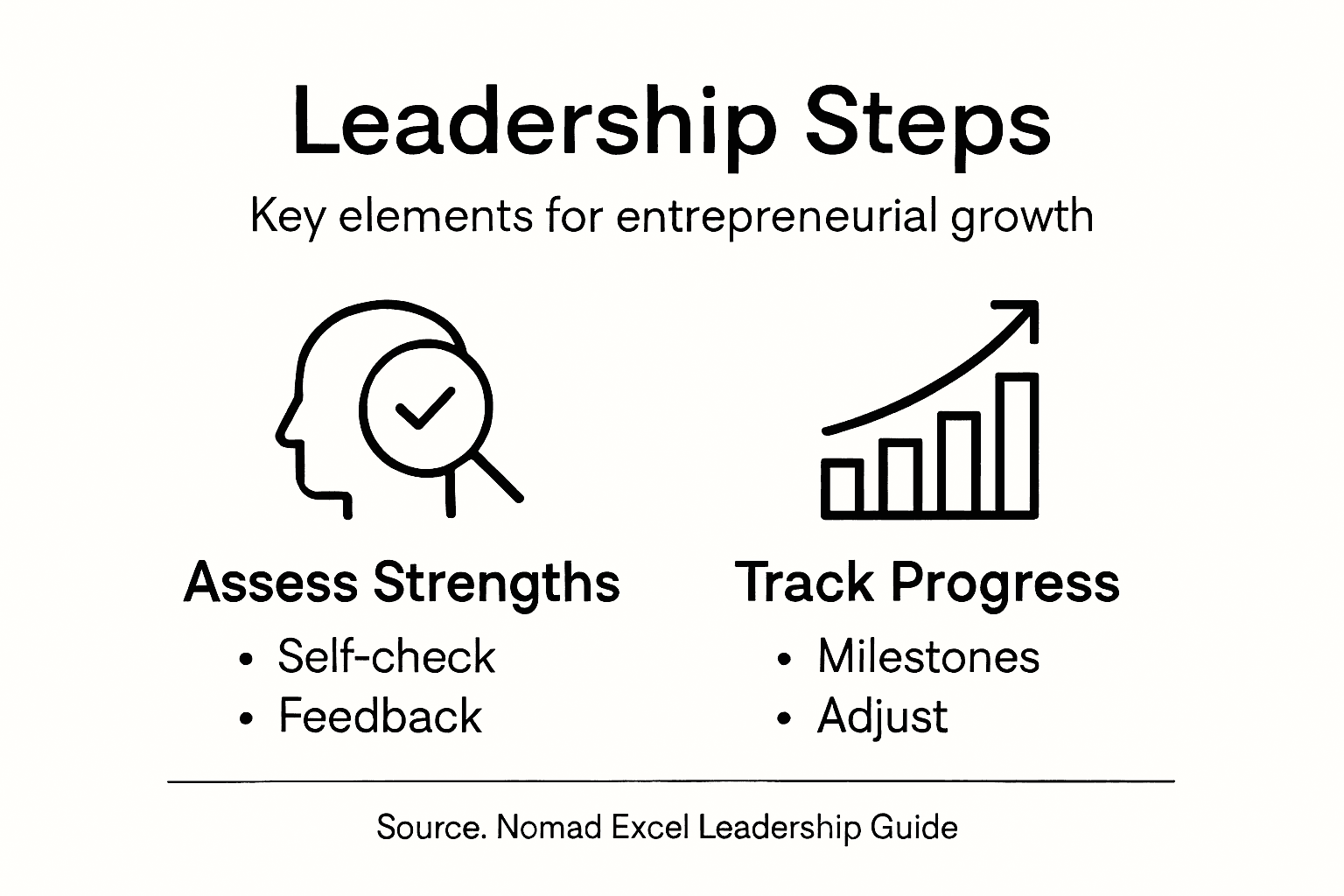
Pro tip: Maintain a leadership development journal to track insights, challenges, and growth milestones systematically.
Accelerate Your Leadership Journey with Nomad Excel
Mastering leadership development steps is essential to overcome the challenges of assessing your strengths, defining clear vision, and cultivating communication skills that drive entrepreneurial success. If you are ready to move beyond theory and develop actionable strategies that bring clarity, accountability, and collaboration to your leadership style, Nomad Excel offers immersive experiences designed precisely for this growth.
Join our Entrepreneurship Archives to connect with a community committed to leadership excellence. Through hands-on bootcamps and expert mentorship, you will gain frameworks and tools to track your progress, adapt your leadership approach, and lead with confidence. Do not wait to transform your leadership potential into tangible results. Visit Nomad Excel today and start your journey towards becoming the entrepreneurial leader your team deserves. Also, explore our Program Archives to discover the right immersive experience tailored for your leadership growth.
Frequently Asked Questions
What are the first steps to assess my leadership strengths and weaknesses?
Begin by conducting a self-assessment using leadership capability frameworks. Utilize methods like 360-degree feedback, peer input, and personal reflection to gain insights into your capabilities and areas for improvement.
How can I define a clear vision for my team?
To create a clear vision, articulate a compelling mission statement and establish measurable performance objectives. Break down your vision into actionable benchmarks that each team member can understand and pursue within the next few weeks.
What essential communication skills should I develop as a leader?
Focus on active listening, clear expression, and emotional intelligence. Incorporate these skills into your daily interactions, aiming to enhance team collaboration and trust within 30 days.
How do I implement collaborative problem-solving in my team?
Establish transparent decision-making processes and create safe spaces for idea generation to foster open dialogue. Develop structured problem-solving techniques that allow your team to collaboratively identify and evaluate solutions within each project.
What methods can I use to track my leadership development progress?
Implement a comprehensive monitoring framework that includes regular self-assessments and gathering feedback from your team. Set specific intervals, like every quarter, to review your growth and adjust your leadership strategies accordingly.
How can I cultivate a culture of continuous learning within my organization?
Encourage a mindset of adaptability by allowing team members to lead problem-solving efforts and share their insights. Create themes for quarterly discussions where your team reflects on challenges and solutions to enhance collective learning.
Comments are closed.