
Why Business Community Matters for Entrepreneurs
Over sixty percent of American entrepreneurs report feeling isolated at some point in their journey, and many startup founders worldwide experience similar struggles. The search for genuine connection and reliable mentorship can make or break early-stage business growth. Discover how building the right business community not only provides hands-on support but also transforms isolation into collaborative momentum for aspiring entrepreneurs and ambitious founders.
Table of Contents
- Defining Business Community for Entrepreneurs
- Key Types and Structures of Business Communities
- Core Benefits: Growth, Support, and Collaboration
- How Community Accelerates Learning and Execution
- Risks, Common Pitfalls, and How to Avoid Them
Key Takeaways
| Point | Details |
|---|---|
| Business communities foster collaboration. | These networks enable entrepreneurs to exchange knowledge, support, and resources, enhancing individual and collective entrepreneurial success. |
| Active participation is essential. | Engaging meaningfully within communities leads to reciprocal relationships, maximizing the value gained from connections. |
| Diverse structures cater to different needs. | Professionals can choose from various types of communities, such as associations, mastermind groups, and online platforms, depending on their development goals. |
| Risk management is crucial. | Entrepreneurs should proactively address potential challenges, ensuring sustainable growth through strong networks and financial planning. |
Defining Business Community for Entrepreneurs
A business community represents a strategic network of entrepreneurs, professionals, and organizations connected by shared goals, collaborative interests, and mutual growth opportunities. Unlike casual social networks, these communities are structured ecosystems designed to support, challenge, and elevate entrepreneurial endeavors. Entrepreneurial activity research emphasizes the dynamic nature of these interconnected groups, highlighting their critical role in driving economic innovation.
At its core, a business community functions as an interdependent ecosystem where entrepreneurs exchange knowledge, resources, and support. These networks transcend traditional networking by creating purposeful environments where members can access mentorship, professional development, potential partnerships, and collective problem-solving strategies. Successful business communities are characterized by genuine engagement, reciprocal value creation, and a commitment to collective advancement.
Effective business communities typically integrate multiple interaction channels, including in-person meetups, online platforms, mastermind groups, and specialized forums. They enable entrepreneurs to move beyond isolated working experiences, providing structured opportunities for learning, collaboration, and professional growth. These communities serve as critical infrastructure for entrepreneurial success, offering emotional support, practical insights, and expansive professional networks that individual entrepreneurs cannot easily develop independently.
Pro tip: When joining a business community, prioritize active participation over passive membership, focusing on providing value to others as much as receiving support from the network.
Key Types and Structures of Business Communities
Business communities encompass diverse structures designed to support entrepreneurial growth and collaboration. Entrepreneurial network frameworks reveal multiple organizational models ranging from informal networks to structured professional associations. These communities can be categorized into several primary types, each serving unique strategic purposes for entrepreneurs seeking connection and development.
The primary categories of business communities include professional associations, industry-specific networks, mastermind groups, online platforms, and local entrepreneurial ecosystems. Professional associations typically offer formal membership structures with structured networking opportunities, certification programs, and industry-specific resources. Industry-specific networks focus on connecting entrepreneurs within particular sectors, enabling targeted knowledge exchange and collaborative opportunities. Mastermind groups represent smaller, more intimate circles where entrepreneurs engage in direct peer-to-peer mentorship and strategic planning.

Collaborative business community roles demonstrate complex internal dynamics where members fulfill different functions such as leaders, knowledge advisors, experts, and active participants. These roles create dynamic interaction patterns that facilitate collective learning and support. Online platforms have emerged as particularly powerful community structures, offering global connectivity, scalable interaction models, and flexible engagement opportunities for entrepreneurs across geographic boundaries.
Pro tip: When exploring business communities, assess multiple structures and choose platforms that align with your specific professional development goals and learning preferences.
Here’s an overview of major business community types and how they support entrepreneurs:
| Community Type | Typical Structure | Unique Benefit | Ideal Use Case |
|---|---|---|---|
| Professional Association | Formal membership, events | Access to industry resources | Advancing credentials |
| Industry Network | Sector-focused groups | Targeted connections | Sector innovation |
| Mastermind Group | Small, close-knit circle | Intensive peer mentorship | Strategic business growth |
| Online Platform | Virtual global network | Scalable, flexible interactions | Remote collaboration |
| Local Ecosystem | Geographic clustering | Local economic impact | Place-based partnerships |
Core Benefits: Growth, Support, and Collaboration
Business communities offer transformative advantages that extend far beyond simple networking. Entrepreneurial community research demonstrates that collaborative networks fundamentally accelerate individual and collective business growth. These communities create dynamic ecosystems where entrepreneurs can access critical resources, knowledge, and support mechanisms that dramatically enhance their chances of success.
The core benefits of business communities can be categorized into three primary dimensions: professional growth, emotional support, and collaborative opportunities. Professional growth emerges through knowledge sharing, skill development workshops, and exposure to diverse perspectives that challenge existing thinking patterns. Entrepreneurs gain insights from peers who have navigated similar challenges, receiving practical advice that textbooks and traditional training cannot provide. Emotional support represents another crucial dimension, offering a psychological safety net that helps entrepreneurs manage the inherent stress and uncertainty of building businesses.
Collaboration within these communities transforms individual potential into collective power. Members can form strategic partnerships, cross-promote services, share resources, and even develop joint ventures that would be impossible to achieve in isolation. These interactions create multiplicative effects where entrepreneurs not only grow their individual businesses but also contribute to broader economic ecosystems. By fostering an environment of mutual support and shared learning, business communities become powerful catalysts for innovation, resilience, and sustainable entrepreneurial success.
Pro tip: Actively engage in your business community by offering help and expertise before seeking assistance, as reciprocal relationships create the most meaningful professional connections.
How Community Accelerates Learning and Execution
Entrepreneurial ecosystem research reveals that business communities dramatically accelerate learning and execution through structured knowledge exchange and collaborative environments. These networks create powerful mechanisms for rapid skill development, idea validation, and strategic implementation that traditional learning methods cannot replicate. Entrepreneurs gain unprecedented access to real-world insights, practical strategies, and immediate feedback loops that compress learning timelines and reduce potential business risks.
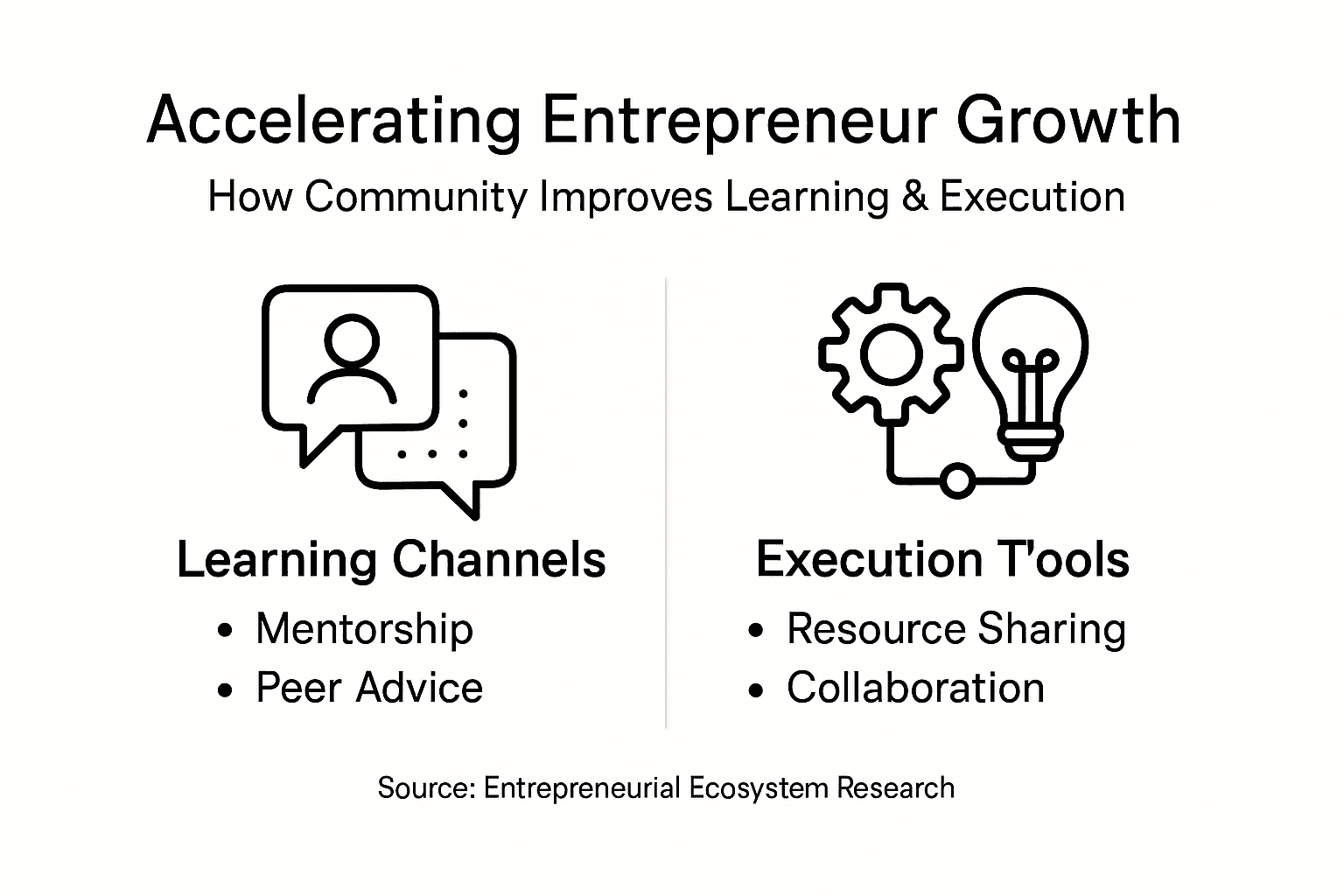
The acceleration of learning occurs through multiple interconnected channels. Peer-to-peer mentorship allows entrepreneurs to learn directly from others who have navigated similar challenges, providing nuanced understanding beyond theoretical knowledge. Communities of Practice frameworks systematically assign roles that facilitate knowledge transfer, creating structured environments where learning becomes an active, dynamic process. Experienced members serve as technical advisors, community managers, and mentors who curate content, guide discussions, and help newer entrepreneurs rapidly acquire critical business skills.
Execution acceleration emerges from the collaborative culture inherent in strong business communities. Members benefit from accountability mechanisms, shared resources, and collective problem-solving approaches that transform individual potential into collective momentum. These communities provide psychological safety, practical support, and strategic networking opportunities that enable entrepreneurs to move faster, make more informed decisions, and overcome obstacles more efficiently than they could in isolation. The synergy created through these interactions turns individual entrepreneurial efforts into powerful, mutually reinforcing growth strategies.
Pro tip: Prioritize active participation in your business community by consistently sharing your own experiences and seeking constructive feedback to maximize learning and execution opportunities.
Risks, Common Pitfalls, and How to Avoid Them
Entrepreneurial financing research reveals that business communities face significant risks stemming from inadequate planning, poor network management, and limited financial strategies. These challenges can derail entrepreneurial efforts if not proactively addressed. Understanding and anticipating potential pitfalls becomes crucial for sustainable business development, requiring entrepreneurs to develop robust risk mitigation approaches that leverage collective wisdom and strategic foresight.
Common risks within business communities include overexpansion, disconnection from market signals, and insufficient mentorship infrastructure. Entrepreneurs often fall into traps of scaling too quickly without proper foundational support, misinterpreting market demands, or failing to establish meaningful connections that provide genuine strategic guidance. Local entrepreneurship research emphasizes the importance of ‘scaling deep’ instead of scaling rapidly, which means building strong community ties and ensuring alignment with local economic realities before aggressive expansion.
Effective risk management within business communities requires a multifaceted approach. Entrepreneurs should prioritize comprehensive financial planning, seek diverse mentorship perspectives, and cultivate adaptive strategies that allow continuous learning and quick course correction. This involves developing strong communication channels within the community, maintaining financial discipline, regularly reassessing business models, and creating robust support networks that provide honest, constructive feedback. By implementing these strategies, entrepreneurs can transform potential risks into opportunities for growth and innovation.
Below is a summary of key risks and proactive solutions in business communities:
| Common Risk | Impact on Entrepreneurs | Proactive Solution |
|---|---|---|
| Overexpansion | Weak foundations, wasted resources | Prioritize steady, deep growth |
| Poor Market Alignment | Missed opportunities | Regular market signal reviews |
| Limited Mentorship | Missed strategic guidance | Encourage diverse advisor network |
| Financial Gaps | Reduced sustainability | Build robust financial strategies |
| Weak Communication | Collaboration breakdown | Implement open feedback channels |
Pro tip: Conduct quarterly risk assessments with trusted community members to identify potential blind spots and develop proactive mitigation strategies before challenges escalate.
Unlock Your Entrepreneurial Potential with Community and Expertise
Building a successful business today means surrounding yourself with more than just ideas. The article highlights how a business community provides essential support through mentorship, accountability, and strategic collaboration — key elements that help entrepreneurs accelerate growth and avoid common pitfalls like overexpansion and poor market alignment. If you are striving to move beyond isolation, cultivate meaningful connections, and gain practical knowledge to execute your vision faster, you understand the power of a vibrant entrepreneurial network.
Nomad Excel offers immersive Entrepreneurship Bootcamps designed to bring these principles to life. Join a curated group of driven founders who work together through hands-on learning, mentorship from experienced operators, and a tightly knit community that remains active well beyond the program. Whether you want to validate your ideas, sharpen revenue-driving skills, or build scalable systems, our bootcamps provide structure and support that mirror the dynamic business communities described in the article. Discover how embracing community through Nomad Excel can transform your entrepreneurial journey.
Ready to engage with a community that not only supports but challenges and elevates you? Explore our Entrepreneurship Bootcamps now and take the next step toward accelerated business growth and lasting connections.
Frequently Asked Questions
What is a business community for entrepreneurs?
A business community is a strategic network of entrepreneurs, professionals, and organizations that share goals and collaborate for mutual growth. Unlike social networks, these communities are structured ecosystems that provide support, mentorship, and resources for entrepreneurs.
How can joining a business community benefit my entrepreneurial journey?
Joining a business community can enhance your entrepreneurial journey by providing access to mentorship, knowledge sharing, emotional support, and collaboration opportunities. These benefits can lead to accelerated business growth and innovation.
What types of business communities should entrepreneurs consider?
Entrepreneurs can consider various types of business communities, including professional associations, industry-specific networks, mastermind groups, online platforms, and local entrepreneurial ecosystems, each offering unique resources and networking opportunities.
How can I effectively engage in a business community?
To effectively engage in a business community, prioritize active participation by sharing your experiences, seeking feedback, and offering assistance to others. This reciprocal relationship fosters meaningful connections and maximizes the benefits of the community.
Comments are closed.