
Growth Hacking Strategies for Rapid Startup Success
Almost every American founder faces costly setbacks when launching a startup, yet over 60 percent of early-stage companies fail because of poor growth strategies. For aspiring entrepreneurs at Nomad Excel bootcamps, knowing the truth behind growth hacking can mean the difference between rapid expansion and needless frustration. This guide unpacks practical tactics, debunks myths, and shows you how to avoid common pitfalls, helping you accelerate your business launch and scale with confidence.
Table of Contents
- Growth Hacking Defined And Common Myths
- How Growth Hacking Differs From Marketing
- Key Growth Hacking Models And Tactics
- Proven Strategies For Startup Acceleration
- Biggest Pitfalls And How To Avoid Them
Key Takeaways
| Point | Details |
|---|---|
| Growth Hacking Emphasizes Experimentation | Focus on rapid, data-driven testing to enhance user acquisition and retention. Utilize techniques like A/B testing for continual improvement. |
| Integration of Skills is Essential | Successful growth hacking requires cross-functional collaboration among marketing, product development, and engineering teams. |
| Avoid Common Pitfalls | Continuously obtain customer feedback and maintain financial discipline to prevent missteps that can hinder growth. |
| Focus on Metrics | Identify specific growth metrics to target and experiment with, rather than attempting broad, uncoordinated changes. |
Growth Hacking Defined and Common Myths
Growth hacking represents a cutting-edge approach to startup expansion that goes far beyond traditional marketing techniques. Pioneered by startup experts, growth hacking focuses on rapid, scalable company growth through innovative, data-driven strategies that leverage technology and creative problem-solving.
At its core, growth hacking is a cross-functional discipline that combines skills from marketing, product development, and engineering. Unlike conventional marketing approaches that rely on broad campaigns, growth hackers seek high-leverage tactics that can dramatically accelerate user acquisition and retention with minimal resources. The methodology emphasizes continuous experimentation, using techniques like A/B testing, funnel optimization, and viral marketing mechanics to drive exponential business growth.
Common myths about growth hacking often misrepresent its true nature. Many entrepreneurs mistakenly believe growth hacking is a magical shortcut or a single revolutionary technique. In reality, it’s a systematic approach requiring rigorous testing, deep user understanding, and relentless iteration. Successful growth hacking demands a combination of technical skills, analytical thinking, and creative problem-solving.
Pro tip: Start by identifying one specific metric you want to improve and design targeted experiments to optimize that single growth lever, rather than trying to transform everything simultaneously.
How Growth Hacking Differs From Marketing
Traditional marketing and growth hacking might seem similar on the surface, but they represent fundamentally different approaches to business expansion. Digital skill integration is the primary distinguishing factor, with growth hacking leveraging technical capabilities that traditional marketing often overlooks. While conventional marketing focuses on broad brand awareness and general campaign metrics, growth hackers drill down into specific, measurable user acquisition and retention strategies.
The core distinction lies in methodology and team composition. Traditional marketing typically operates within siloed departments, with limited cross-functional collaboration. Growth hacking, by contrast, requires integrated team efforts that blend skills from marketing, product development, engineering, and data analysis. This approach enables rapid experimentation and iterative improvements based on real-time user data, allowing startups to optimize their growth mechanisms continuously.
Another critical difference is the measurement and optimization approach. Traditional marketing often relies on long-term campaign evaluations and generalized metrics like reach and impressions. Growth hacking embraces a more granular, scientific method of evaluation. Growth hackers use advanced analytics, A/B testing, and precise funnel tracking to understand exactly how users interact with a product, identifying and eliminating friction points that might prevent user acquisition or retention.
Pro tip: Create a cross-functional team that includes members from marketing, product, and engineering to develop integrated growth strategies that can be quickly tested and scaled.
Here’s how growth hacking and traditional marketing differ in key aspects:
| Aspect | Growth Hacking | Traditional Marketing |
|---|---|---|
| Team Structure | Cross-functional and integrated | Departmental and siloed |
| Experimentation Speed | Rapid, real-time testing and iterations | Slow, campaign-based changes |
| Focus | Precise user acquisition and retention metrics | Broad brand awareness and visibility goals |
| Use of Technology | Heavy reliance on analytics and automation | Limited technical integration |
| Approach to Data | Data-driven, granular funnel tracking | Generalized campaign metrics |
Key Growth Hacking Models and Tactics
Growth hacking encompasses a diverse set of strategic models designed to accelerate startup expansion through innovative and data-driven approaches. Systematic testing frameworks form the backbone of effective growth hacking, enabling entrepreneurs to rapidly experiment and optimize their user acquisition and retention strategies.
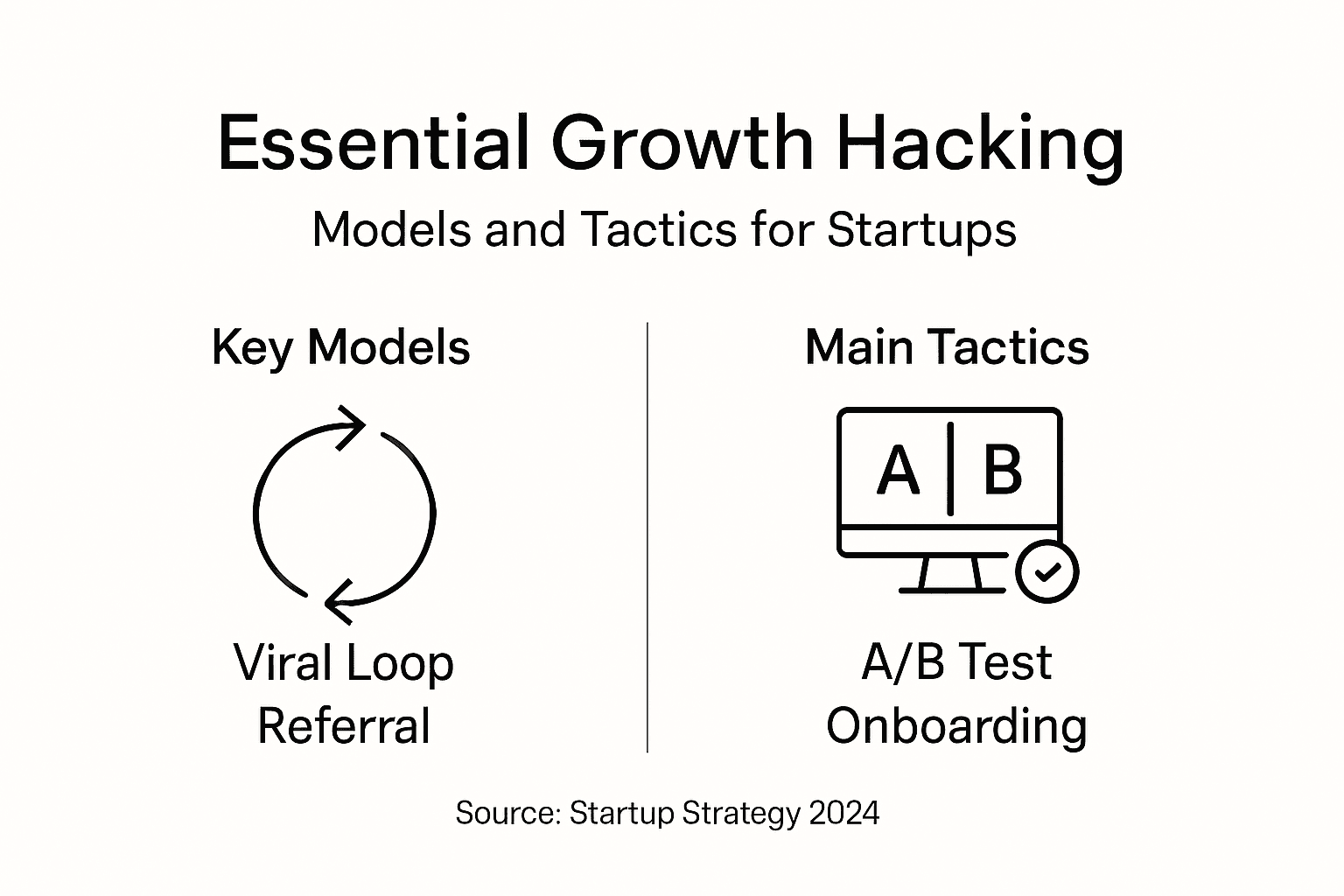
One powerful growth hacking model involves creating viral loops and referral systems that leverage existing user networks. These strategies transform customers into active product ambassadors by incentivizing sharing and creating seamless referral mechanisms. By designing products with built-in network effects, startups can exponentially increase their user base without traditional marketing expenditures. Tactical growth frameworks encourage a methodical approach to identifying and eliminating barriers that prevent user conversion and engagement.
Successful growth hacking models typically incorporate multiple tactics simultaneously, including conversion rate optimization, user onboarding improvements, and data-driven product iterations. Entrepreneurs must develop a comprehensive understanding of their user journey, meticulously tracking each interaction point to identify opportunities for optimization. This requires advanced analytics, continuous experimentation, and a willingness to pivot quickly based on real-world performance data.
Pro tip: Develop a structured experimentation process that allows you to test multiple growth hypotheses simultaneously, prioritizing tactics with the highest potential impact and lowest implementation complexity.
Proven Strategies for Startup Acceleration
Successful startup acceleration requires a multifaceted approach that goes beyond traditional business development methods. Strategic mentorship and compressed learning provide critical frameworks for entrepreneurs seeking rapid growth, enabling them to navigate complex business challenges with unprecedented speed and precision.
Key strategies for startup acceleration include forming strategic collaborations that create mutual value and leverage complementary capabilities. By identifying potential partners who can fill critical skill or resource gaps, startups can dramatically expand their potential for market penetration. Hybrid talent acquisition models allow entrepreneurs to access specialized expertise without the overhead of traditional hiring, creating flexible and dynamic organizational structures that can quickly adapt to changing market conditions.
The most effective acceleration strategies emphasize continuous experimentation and data-driven iteration. Successful startups develop robust feedback mechanisms that allow them to rapidly test hypotheses, measure performance, and pivot when necessary. This approach requires maintaining a culture of intellectual curiosity, where failure is viewed as a learning opportunity rather than a setback. Entrepreneurs must cultivate resilience, build adaptable systems, and maintain a laser focus on solving genuine market problems with innovative solutions.
Pro tip: Create a quarterly review process that systematically evaluates your startup’s key performance indicators, allowing you to quickly identify and double down on strategies generating the most significant growth.
Biggest Pitfalls and How to Avoid Them
Startup founders frequently encounter hidden obstacles that can derail their entrepreneurial journey, making it crucial to identify and navigate potential pitfalls proactively. User-centered strategy development represents a fundamental approach to minimizing risks and creating more resilient business models.
One of the most significant startup pitfalls involves misunderstanding market needs and overestimating product-market fit. Entrepreneurs often fall into the trap of building solutions in isolation, without continuous customer feedback and validation. Effective communication strategies can help founders avoid this critical error by establishing robust channels for user interaction, incorporating feedback loops, and maintaining flexibility in product development.

Financial mismanagement represents another critical pitfall that can quickly sink promising startups. Many founders underestimate burn rates, fail to establish clear financial controls, or prematurely scale operations before achieving sustainable revenue. Successful entrepreneurs develop disciplined financial practices, maintain lean operations, create detailed financial projections, and build sufficient cash reserves to weather unexpected challenges. They understand that conserving resources and maintaining financial discipline are as important as generating revenue.
Below is a summary of common startup pitfalls and proven avoidance strategies:
| Pitfall | Impact on Startup | Prevention Strategy |
|---|---|---|
| Misreading Market Needs | Low adoption, wasted resources | Continuous customer feedback |
| Overestimating Product Fit | Poor market traction | Validation through testing and iteration |
| Financial Mismanagement | Cash shortages or premature scaling | Monthly financial reviews, strict controls |
| Lack of User-Centered Focus | Weak product-market fit | Active user engagement, feedback loops |
Pro tip: Create a monthly financial review process that includes cash flow analysis, burn rate tracking, and strategic resource allocation to maintain financial health and prevent unexpected setbacks.
Accelerate Your Startup Growth with Proven Strategies and Expert Support
Growth hacking demands focused experimentation, rapid iteration, and a deep understanding of your target users to drive meaningful startup acceleration. If you are struggling to translate complex growth models into actionable steps or overcoming common pitfalls like misreading market needs and financial mismanagement, you are not alone. Success requires more than theory — it needs hands-on guidance, real-world application, and a supportive community that keeps you accountable and inspired.
At Nomad Excel, we specialize in helping entrepreneurs like you move from ideas to impactful results with immersive Entrepreneurship Bootcamps and tailored growth experiences. Our programs combine mentorship from experienced founders, step-by-step frameworks for refining your offer and scaling systems, and a vibrant network to challenge and support your journey. Whether you want to master growth hacking tactics or develop cross-functional strategies that integrate marketing, product, and engineering insights, Nomad Excel is your partner in gaining clarity, execution speed, and sustainable growth.
Discover how to design and test targeted growth experiments, avoid costly startup traps, and unlock rapid acceleration by joining our transformative community. Take the next step to revolutionize your business growth and explore the full range of solutions at Nomad Excel. For inspiring stories and practical insights, visit our Inspiration Archives and get ready to level up your entrepreneurial adventure today.
Frequently Asked Questions
What is growth hacking?
Growth hacking is a strategic approach to rapid startup growth that combines marketing, product development, and engineering to optimize user acquisition and retention through innovative, data-driven tactics.
How does growth hacking differ from traditional marketing?
Growth hacking focuses on precise metrics, rapid experimentation, and cross-functional collaboration, while traditional marketing relies on broad campaigns and siloed departmental structures.
What are some effective growth hacking tactics for startups?
Effective growth hacking tactics include creating viral loops, optimizing conversion rates, improving user onboarding, and utilizing data-driven product iterations to enhance the user journey.
How can startups avoid common pitfalls in growth hacking?
Startups can avoid pitfalls by continuously gathering customer feedback, validating product-market fit, maintaining strict financial controls, and fostering active user engagement to adapt their strategies effectively.
Comments are closed.