
Why Community Matters for Entrepreneur Success
Most american founders discover that nearly 80 percent of startup failures involve a lack of community or reliable support networks. As you move through bootcamp programs worldwide, the difference between fleeting business contacts and thriving entrepreneurial communities becomes clear. Understanding exactly what makes a genuine entrepreneurial community can help you connect with mentors, peers, and resources that drive accountability and lasting business growth.
Table of Contents
- Defining Community for Entrepreneurs
- Types of Entrepreneurial Communities Worldwide
- Key Benefits of Community Support
- How Community Drives Accountability
- Risks of Isolation and Missed Connections
- Real-World Impact on Startup Growth
Key Takeaways
| Point | Details |
|---|---|
| Value of Community | Entrepreneurs thrive in dynamic communities that foster collaboration and support rather than mere networking. |
| Types of Ecosystems | Domestically-oriented communities focus on local growth, while transnationally-oriented networks leverage global connections for broader opportunities. |
| Importance of Accountability | Structured accountability within communities enhances commitment and drives entrepreneurial success through shared goals and progress tracking. |
| Risks of Isolation | Isolation can hinder creativity, increase stress, and limit business growth; proactive community engagement is crucial for overcoming these challenges. |
Defining Community for Entrepreneurs
For entrepreneurs, community represents far more than a casual network of contacts. It is a dynamic ecosystem of interconnected professionals who actively support, challenge, and propel each other’s business growth. Entrepreneurial ecosystems are defined as communities of entrepreneurs engaged in reciprocal social and economic exchanges amid a complex landscape of organizations, mentors, and resources.
At its core, an entrepreneurial community functions like a living organism where each member contributes unique skills, perspectives, and connections. Unlike traditional professional networks that remain transactional, these communities thrive on genuine collaboration and mutual investment in each other’s success. The ecosystem includes not just fellow entrepreneurs, but also mentors, investors, local business leaders, academic institutions, and support organizations that collectively create an environment conducive to innovation and business development.
Research reveals that successful entrepreneurial communities share several key characteristics. They prioritize knowledge sharing, provide emotional support during challenging business phases, offer practical resources like funding introductions or skill workshops, and create accountability structures that push members toward consistent growth. These communities are fundamentally about creating reciprocal social and economic exchanges that transform individual potential into collective achievement.
Pro tip: When seeking an entrepreneurial community, prioritize groups that demonstrate active participation, tangible skill exchanges, and a commitment to member growth over mere networking opportunities.
Types of Entrepreneurial Communities Worldwide
Entrepreneurial communities around the world exhibit remarkable diversity, reflecting unique regional characteristics and economic landscapes. Global research reveals two primary ecosystem orientations: domestically-focused and transnationally-oriented entrepreneurial networks, each with distinctive development strategies and interaction patterns.
Domestically-oriented entrepreneurial communities, such as those in Tokyo, primarily concentrate on local market dynamics and regional economic development. These communities emphasize strong internal connections, localized knowledge transfer, and supporting businesses deeply rooted in their immediate economic environment. They typically feature tight-knit networks of local entrepreneurs, regional investors, government agencies, and educational institutions working collaboratively to stimulate economic growth.
In contrast, transnationally-oriented entrepreneurial ecosystems like those in Bangalore represent more globally interconnected networks. These communities transcend geographical boundaries, leveraging international connections, cross-border collaborations, and digital platforms to facilitate knowledge exchange, attract global talent, and create opportunities that extend beyond traditional local constraints. Such communities are characterized by their ability to attract international investments, support multicultural entrepreneurial teams, and rapidly scale businesses across different markets.
Here’s a comparison of domestically-oriented and transnationally-oriented entrepreneurial communities:
| Characteristic | Domestically-Oriented Communities | Transnationally-Oriented Networks |
|---|---|---|
| Market Focus | Local and regional | Global and cross-border |
| Networking | Tight-knit, internal partnerships | Diverse, international connections |
| Resource Access | Regional funding, local mentors | Global capital, international talent |
| Growth Opportunities | Strong regional support | Rapid scaling across markets |
Pro tip: Evaluate potential entrepreneurial communities not just by their local reputation, but by their demonstrated ability to facilitate meaningful connections and provide actionable resources for business growth.
Key Benefits of Community Support
Entrepreneurial communities provide far more than casual networking opportunities. These communities contribute critically to sustainable development by addressing economic, social, and environmental objectives through strategic networking and innovation leadership, creating transformative support systems for emerging business leaders.
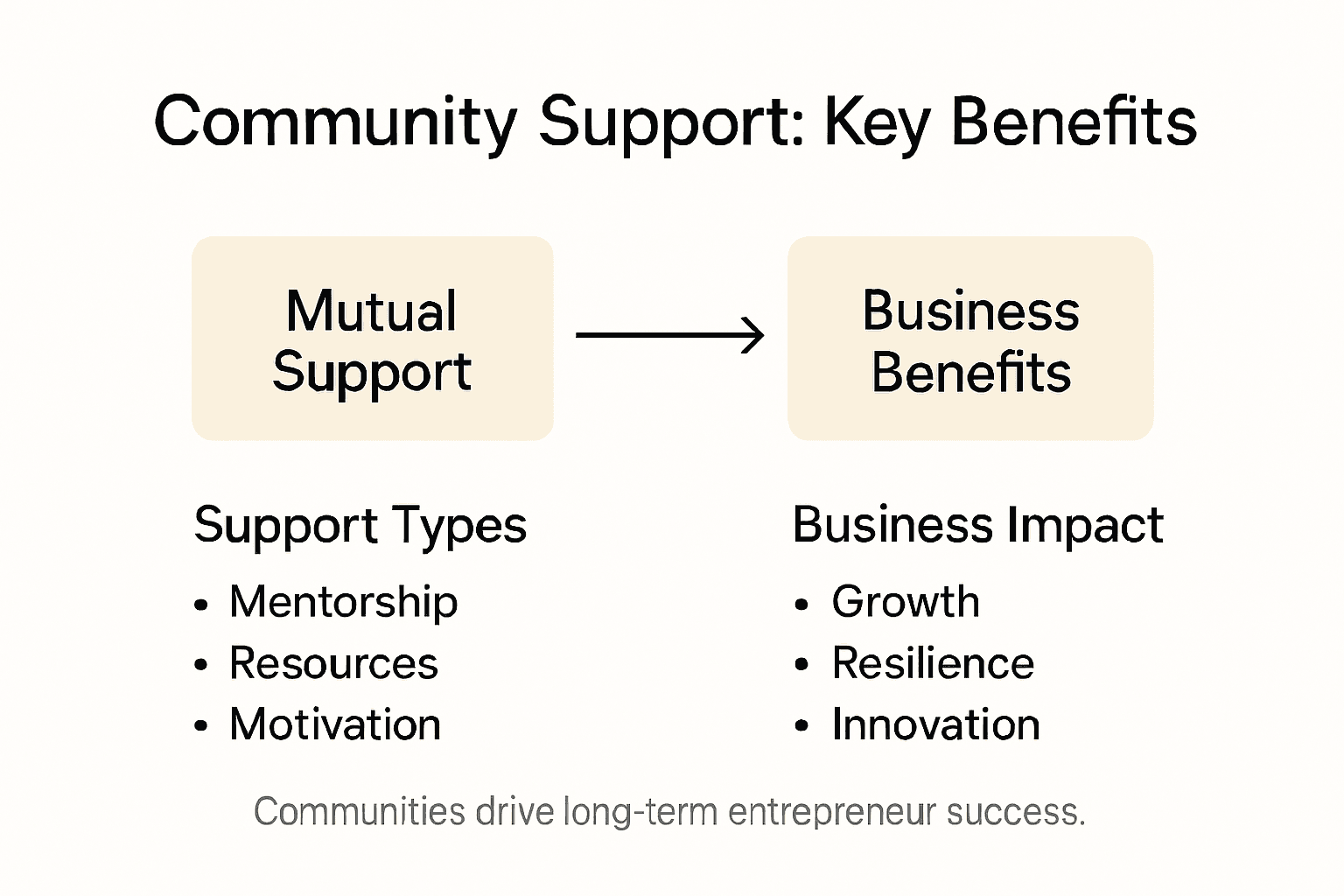
At the individual level, community support offers entrepreneurs unprecedented access to collective knowledge, resources, and emotional resilience. Members gain mentorship, receive candid feedback, discover potential collaboration opportunities, and develop critical skills through shared experiences. These interactions help entrepreneurs navigate complex business challenges, avoid common mistakes, and accelerate their learning curves by leveraging the collective wisdom of experienced professionals.

Higher education institutions and community engagement initiatives play a pivotal role in enhancing entrepreneurial activity, especially in underrepresented communities. By creating inclusive platforms that address social inequalities, these communities help entrepreneurs from diverse backgrounds access critical resources, develop enterprise behaviors, and create value beyond traditional economic metrics. The support extends beyond individual growth, contributing to broader economic and social inclusion by empowering entrepreneurs who might otherwise face systemic barriers.
Pro tip: Actively seek entrepreneurial communities that offer tangible resources, demonstrate a commitment to diverse participation, and provide structured opportunities for meaningful skill exchange and collaboration.
The following summary highlights key ways community support transforms entrepreneurial outcomes:
| Community Function | Direct Impact on Entrepreneurs | Long-Term Business Benefit |
|---|---|---|
| Mentorship | Accelerates skill development | Enhances decision-making |
| Emotional Support | Increases resilience | Reduces burnout rates |
| Knowledge Sharing | Expands expertise and perspectives | Fosters innovation |
| Accountability Structures | Promotes goal achievement | Sustains consistent progress |
How Community Drives Accountability
Accountability represents the critical engine that transforms entrepreneurial potential into tangible progress. Founder communities emphasize structured interactions like weekly check-ins and mentoring sessions that build a culture of transparent growth and continuous problem-solving, creating powerful mechanisms for consistent performance and goal achievement.
These accountability frameworks operate through multiple strategic channels. Members commit to sharing specific milestones, publicly declaring goals, and providing regular updates that create social pressure and psychological motivation. When entrepreneurs articulate their objectives within a supportive community, they experience heightened commitment levels. The public nature of these declarations transforms abstract intentions into concrete action plans, with peers ready to offer constructive feedback, challenge assumptions, and celebrate incremental achievements.
Strong entrepreneurial support networks provide an intricate system of guidance, emotional reinforcement, and mutual accountability that ensures entrepreneurs remain focused and resilient. Unlike solitary pursuits, these communities create an ecosystem where individual goals are interconnected with collective success. By establishing shared expectations, regular progress reviews, and peer-to-peer mentoring, entrepreneurs develop robust accountability mechanisms that transcend traditional performance management approaches.
Pro tip: Design your personal accountability strategy by selecting community platforms that offer structured check-ins, transparent goal-tracking mechanisms, and a culture of supportive yet rigorous peer evaluation.
Risks of Isolation and Missed Connections
Entrepreneurial isolation represents a profound challenge that extends far beyond simple loneliness. Loneliness among entrepreneurs is a complex phenomenon integrating individual, social, and work-related dimensions that significantly impact mental health and professional performance, creating a silent barrier to sustainable business growth.
The consequences of professional disconnection are multifaceted and deeply consequential. Isolated entrepreneurs often experience increased stress, diminished creativity, and reduced problem-solving capabilities. Without external perspectives and collaborative interactions, business leaders become trapped in echo chambers of their own thinking, missing critical insights, potential partnerships, and innovative approaches that could transform their entrepreneurial trajectory. The absence of meaningful professional connections leads to decreased motivation, higher burnout rates, and a narrowed understanding of market dynamics.
Entrepreneurs face unique social disconnection challenges stemming from long working hours, solitary work environments, and unpredictable schedules. These professional isolation patterns not only impact mental well-being but also create significant barriers to business expansion. The lack of diverse interactions limits exposure to new ideas, reduces networking opportunities, and prevents the cross-pollination of insights that typically drive breakthrough innovations. Without intentional strategies to counteract these isolation risks, entrepreneurs can find themselves professionally stagnant, regardless of their individual talent or initial business potential.
Pro tip: Proactively schedule regular networking events, virtual meetups, and professional community engagements to systematically break your isolation patterns and expand your entrepreneurial perspective.
Real-World Impact on Startup Growth
Startup ecosystems transform from theoretical concepts to powerful growth engines through strategic community engagement. Universities and entrepreneurial ecosystems play a crucial role in supporting startup development through comprehensive capacity building, organizational structures, and interdisciplinary collaborations, creating dynamic environments that accelerate innovative business models.
Successful startup growth depends on more than individual brilliance. Community networks provide critical resources that bridge knowledge gaps, connect entrepreneurs with mentors, investors, and potential partners, and create momentum through shared learning experiences. These ecosystems function as living laboratories where entrepreneurs test ideas, receive real-time feedback, and rapidly iterate their business strategies. By participating in robust community networks, founders gain access to collective intelligence that significantly reduces traditional startup risks and accelerates potential breakthrough moments.
The tangible impact of community support manifests through multiple channels. Startup communities offer structured mentorship programs, facilitate investor connections, provide skill development workshops, and create platforms for peer-to-peer learning. These interactions go beyond mere networking, generating measurable outcomes like improved business model validation, faster funding cycles, and more resilient entrepreneurial approaches. Founders embedded in strong community networks demonstrate higher survival rates, faster growth trajectories, and more adaptable business models compared to isolated entrepreneurs.
Pro tip: Actively map and engage with multiple layers of your local and digital entrepreneurial ecosystem, treating community participation as a strategic investment in your startup’s potential growth.
Harness the Power of Community to Accelerate Your Entrepreneurial Success
Entrepreneurs often face the challenge of isolation and lack of accountability that can stall growth and dim motivation. The article highlights the critical role that dynamic entrepreneurial communities play in offering mentorship, emotional support, and structured accountability to keep founders progressing consistently. If you are striving to break free from solitude and want to connect with peers who share your drive and ambition, tapping into a vibrant ecosystem is essential.
Nomad Excel is designed to bridge this exact gap by providing immersive entrepreneurship bootcamps that combine expert mentorship, actionable frameworks, and a supportive network primed for collaboration and innovation. Whether you are an early-stage founder seeking clarity or a team aiming to align around growth, our programs and company retreats foster the kind of accountability and connection that transforms potential into measurable outcomes. Take charge of your journey today by exploring how Nomad Excel can boost your business with clarity, community, and real execution at https://nomadexcel.co. Don’t wait to experience the momentum that comes from surrounded by peers who challenge and empower you.
Frequently Asked Questions
What is the role of community in entrepreneurial success?
Community plays a vital role in entrepreneurial success by providing support, resources, mentorship, and accountability among interconnected professionals, enhancing business growth and innovation.
How do accountability structures within communities benefit entrepreneurs?
Accountability structures encourage consistent goal achievement by promoting transparency, regular progress reviews, and peer support, ensuring entrepreneurs remain focused and committed to their objectives.
What are the key characteristics of successful entrepreneurial communities?
Successful entrepreneurial communities prioritize knowledge sharing, offer emotional support, provide practical resources, and establish accountability structures to facilitate mutual growth among members.
How does isolation impact entrepreneurs and their business growth?
Isolation can lead to increased stress, decreased creativity, and reduced problem-solving abilities in entrepreneurs, hindering their motivation and limiting exposure to new ideas that could boost business growth.
Comments are closed.