
Digital Nomad Lifestyle: Freedom, Community, Reality
Starting a business while planning your next trip across Europe or Southeast Asia sounds thrilling until the realities of balancing work, travel, and legal rules set in. For aspiring entrepreneurs in their late twenties or thirties, pursuing the digital nomad lifestyle means embracing more than freedom—it demands a shift to intentional mobility and resilience. This guide unpacks the modern digital nomad mindset, highlights key skills for success, and shows how strategic community support transforms solo ventures into sustainable, scalable businesses.
Table of Contents
- Defining Digital Nomad Lifestyle And Mindset
- Major Variations And Evolving Trends In 2026
- Essential Skills And Success Factors For Nomads
- Legal, Financial, And Safety Considerations
- Navigating Challenges And Building Sustainable Community
Key Takeaways
| Point | Details |
|---|---|
| Embrace Intentional Mobility | Digital nomadism thrives on the concept of intentional mobility, allowing individuals to choose their work locations strategically to foster growth and avoid burnout. |
| Cultivate a Resilient Mindset | Adapting a nomadic mindset, which prioritizes autonomy, adaptability, and community, is essential for balancing work with personal well-being while traveling. |
| Focus on Necessary Skills | Mastering both hard and soft skills is crucial for succeeding as a digital nomad; technical abilities provide income, while soft skills ensure sustainability and resilience. |
| Understand Legal and Financial Obligations | Knowledge of visa requirements, tax obligations, and contractual safety is imperative for maintaining a sustainable and legally compliant nomadic lifestyle. |
Defining Digital Nomad Lifestyle and Mindset
The digital nomad lifestyle represents far more than just working from a coffee shop in Bangkok. It’s a deliberate choice to decouple income generation from physical location, enabling autonomous work while traveling globally.
At its core, a digital nomad is someone who uses technology to earn income while living a location-independent existence. Unlike traditional remote workers who maintain a single home base, digital nomads actively move between cities, countries, or continents—sometimes staying weeks, sometimes months.
The definition has expanded significantly. Research identifying five distinct nomad types—freelancers, business owners, salaried remote workers, experimenters, and armchair nomads—reveals the lifestyle isn’t monolithic. Your neighbor might be a software developer earning six figures, while another nomad runs a bootstrapped service business on $2,000 monthly revenue.
What separates digital nomads from remote workers is intentional mobility. The nomad mindset embraces movement as a feature, not a bug.
The Nomad Mindset: What Actually Matters
Your mindset determines whether digital nomadism becomes liberation or chaos. The right mental framework separates those who thrive from those who burn out after three months.
The nomad mindset includes:
- Autonomy-first thinking: You own your decisions about where, when, and how you work—no corporate office dictating your schedule
- Adaptability as a superpower: Change is constant; flexibility becomes your competitive advantage
- Community over isolation: Recognizing that balancing work with social connection prevents loneliness and burnout
- Resourcefulness in uncertainty: Problems get solved creatively because there’s no IT department to call
- Long-term vision with short-term flexibility: You’re building something real, not just running away
Many aspiring nomads romanticize freedom but underestimate the discipline required. Working across time zones, managing unstable internet, and handling visa logistics demands a mentally resilient approach that casual travelers simply don’t possess.
The nomad lifestyle isn’t freedom from responsibility—it’s freedom to choose your responsibilities and how you execute them.
The post-COVID era transformed digital nomadism. Remote work shifted from exception to expectation, making the infrastructure for location-independent work accessible to millions. However, this accessibility created a crucial distinction: not everyone working remotely is a true digital nomad.
A true nomad actively builds business systems that function regardless of geography. You’re not just displaced—you’re strategically mobile, moving intentionally to accelerate growth, reduce costs, or access specific communities.
For aspiring entrepreneurs in this space, the mindset shift is profound. Instead of climbing a corporate ladder, you’re building multiple revenue streams and controlling your destiny. This requires trading job security for ownership, predictable paychecks for scalable income potential.
Pro tip: Clarify your “why” before going nomadic. Are you escaping something or building toward something? The difference determines whether your lifestyle sustains long-term business growth or becomes an expensive distraction.
Major Variations and Evolving Trends in 2026
Digital nomadism in 2026 looks radically different from the backpacker stereotype of ten years ago. The lifestyle has matured into a structured, intentional choice attracting entrepreneurs, remote employees, and families seeking life design around their values.
The participant diversity has expanded dramatically. You’re no longer just competing for coworking space with twenty-something freelancers—you’re sharing it with startup founders, corporate executives on sabbaticals, and multi-generational families building education around travel.
Who’s Becoming a Nomad Now
The demographic shift is significant. The average nomad age has moved into the thirties and forties, reflecting a maturation from spontaneous travel to intentional mobility. Career accelerators and sabbatical programs now actively recruit high-earning professionals to go nomadic.
Three distinct nomad archetypes dominate in 2026:
- Startup founders and entrepreneurs: Building companies with zero geographic constraints, treating movement as a growth strategy
- Remote corporate employees: Taking advantage of location independence while maintaining stable salaries, often combining sabbaticals with work
- Digital professionals with portable expertise: Consultants, coaches, and creators leveraging global markets and lower living costs
Families represent the fastest-growing segment. Parents now design education around travel rather than choosing between career and family stability—a shift that was nearly impossible pre-2020.

Here’s a concise overview of the evolving digital nomad archetypes in 2026:
| Archetype | Core Motivation | Typical Income Source | Mobility Level |
|---|---|---|---|
| Startup Founders & Entrepreneurs | Business growth through global presence | Running scalable online businesses | High, frequent relocation |
| Remote Corporate Employees | Work-life flexibility, stable income | Salaried remote work for companies | Moderate, planned movement |
| Digital Professionals & Experts | Maximizing value of portable skills | Consulting, coaching, creative work | Flexible, opportunistic |
| Families | Life-design and education for children | Mixed: remote jobs, self-employment | Lower, longer stays per location |
The Reality Check: New Obstacles in 2026
Freedom comes with friction. Stricter visa regulations now require nomads to prove financial stability before entry. Many countries introduced digital nomad visas with income thresholds ($2,000-$3,500 monthly), creating gatekeeping effects.
Housing pressures are real. Long-term rental shortages in popular nomad hubs drive costs upward, eliminating the cost-of-living advantage that initially attracted nomads to places like Chiang Mai or Lisbon.
Mental health emerges as a central concern. The lifestyle’s loneliness factor, once romanticized as “freedom,” is now recognized as a serious challenge requiring intentional community building and structured support systems.
The 2026 digital nomad isn’t escaping responsibility—they’re architecting their life around professional ambition and personal values simultaneously.
Technology and Infrastructure Shifts
Artificial intelligence integration is transforming nomadic work. AI tools handle routine tasks, allowing nomads to focus on strategic, creative work that commands premium pricing.
Fintech solutions tailored specifically to nomads address a real gap: multi-currency accounts, international tax compliance, and payment systems that work across borders without punitive fees.
Coworking infrastructure professionalization means remote work reliability has improved significantly. Nomads can now depend on consistent internet speeds, productive work environments, and professional community—not just cheap coffee.
Pro tip: Before going nomadic, evaluate your skills and income potential against 2026 realities: visa income requirements, housing costs in your target cities, and whether your business model scales across time zones. The lifestyle succeeds when built intentionally, not as an escape plan.
Essential Skills and Success Factors for Nomads
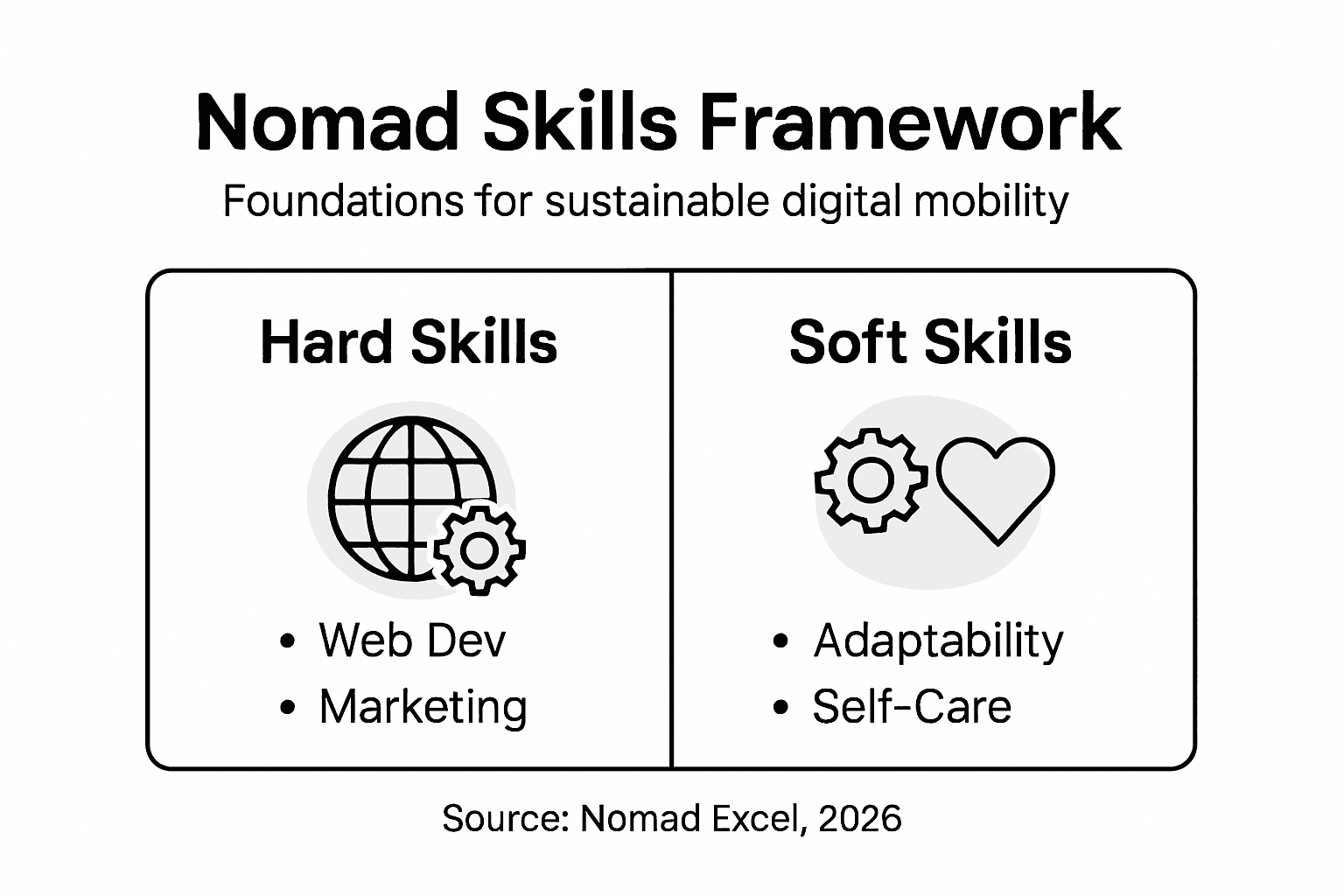
Nomadic entrepreneurship isn’t about talent alone—it’s about deliberate skill stacking. You need both hard technical abilities and soft skills that keep you functional across changing environments, time zones, and cultures.
The difference between nomads who build thriving businesses and those who struggle for six months and quit comes down to skill mastery. Success requires intentional development across multiple competency areas.
Hard Skills: Your Income Foundation
Technical proficiency determines your earning potential. Without marketable hard skills, you’re competing on price in oversaturated markets rather than value in niche categories.
Core technical skills for nomadic income include:
- Web development and coding: Building products, apps, or software solutions that scale globally
- Digital marketing: SEO, content strategy, paid advertising, email funnels that drive consistent revenue
- Copywriting and content creation: Converting audiences into customers through persuasive messaging
- Graphic design and UI/UX: Creating visual assets that command premium pricing
- Data analysis and automation: Building systems that reduce manual work as you scale
Each skill directly translates to pricing power. A nomad with web development expertise commands $75-150 hourly rates; someone offering vague “social media help” struggles at $25 per hour.
The key is depth over breadth. Master one technical domain that solves specific client problems rather than spreading yourself thin across five mediocre skills.
Soft Skills: The Hidden Advantage
Technical skills get you hired; soft skills keep you profitable and sane. Research on required soft skills for nomads emphasizes self-discipline, adaptability, and resilience as foundational.
Critical soft skills include:
- Self-discipline and focus: Working effectively without office structure or external accountability
- Time management across zones: Scheduling client calls, content creation, and admin work across multiple time zones
- Financial literacy: Managing taxes, invoicing, currency conversion, and business accounting from anywhere
- Cultural adaptability: Navigating different countries, visa requirements, and work norms gracefully
- Emotional resilience: Managing isolation, setbacks, and the uncertainty inherent in location independence
- Communication excellence: Conveying ideas clearly via email, video, and asynchronous channels
Nomads with weak soft skills work harder for less money; nomads with strong soft skills build sustainable income while traveling intentionally.
Self-care separates burnout victims from long-term nomads. This means intentional routines, community building, and honest assessment of your mental health as your business grows.
The Success Framework
Nomadic success depends on continuous learning. You’re not just executing—you’re upgrading your skill set every quarter based on market feedback and emerging opportunities.
The most successful nomads treat their business as a skill acquisition project. They identify gaps between current reality and desired outcomes, then systematically close them through courses, mentorship, and deliberate practice.
Productivity in remote work requires managing distractions, setting achievable goals, and sustaining output across different environments. This isn’t inherent talent—it’s a skill you develop through repetition and systems.
Pro tip: Audit your skills against your income target. If you’re earning $2,000 monthly but want $8,000 monthly, don’t work harder—upgrade your technical skill or pivot to higher-value services. Skills determine ceiling; hustle determines how close you get to it.
Legal, Financial, and Safety Considerations
Ignoring legal and financial reality is how nomadic dreams become legal nightmares. Before you book your first flight, understand that visa status, tax obligations, and business legality vary dramatically by country and your citizenship.
This isn’t paperwork theater—it’s the difference between building a sustainable business and facing deportation, fines, or account freezes. And yes, I’ve learned this the hard way watching other nomads get blindsided.
Visa and Legal Status
Working while on a tourist visa is illegal in most countries, even if authorities don’t enforce it consistently. Many nations now offer evolving digital nomad visa frameworks with income thresholds, but requirements differ significantly across Europe, Asia, and Latin America.
Key visa considerations:
- Tourist visas prohibit paid work: Even remote work for foreign clients often violates terms
- Digital nomad visas require minimum income: Typically $1,500-$3,500 monthly to qualify
- Work permits are expensive and slow: Traditional work permits can take months and cost $500-$2,000
- Overstaying has serious consequences: Not just fines—bans from re-entry lasting years
Research your specific destination’s legal framework before arrival. Some countries barely enforce digital nomad regulations; others aggressively pursue visa violations. Don’t gamble on assumptions.
Tax Obligations: Where It Gets Complex
Taxation as a nomad depends on citizenship, tax residency, and where you earn income. This is where most nomads get confused and create expensive problems.
Critical tax considerations:
- Tax residency differs from visa status: You might have a tourist visa but still owe taxes based on residency
- Double taxation treaties prevent paying taxes twice: But you must file correctly to claim them
- Self-employment taxes apply differently: Sole proprietors face different obligations than incorporated entities
- Foreign earned income exclusions exist: US citizens can exclude up to $120,000 annually under specific conditions
You need professional guidance here. Understanding tax residency rules and avoiding double taxation requires accountants familiar with nomadic situations, not generic tax software.
Nomads who ignore taxes aren’t “gaming the system”—they’re creating liability that compounds annually with penalties and interest.
Business and Contract Safety
Working across borders creates contractual complexity. Payment disputes, intellectual property claims, and liability issues become harder to resolve internationally.
Protect yourself with:
- Written contracts for all client work: Specify payment terms, deliverables, and dispute resolution
- Secure payment systems: Use platforms that protect funds until work completion (escrow)
- Business insurance: Liability coverage for your specific service type
- Backup banking: Multiple accounts in different countries to prevent lockouts
Personal safety matters too. Research neighborhoods, use secure wifi, and maintain emergency cash reserves separate from your primary accounts.
Pro tip: Before moving to any country, spend $200-$400 on a one-hour consultation with a tax accountant and immigration lawyer specializing in digital nomads. This prevents thousands in penalties and legal fees later.
To clarify essential legal and financial priorities for digital nomads, see this summary:
| Area | Why It Matters | Typical Mistake | Proactive Solution |
|---|---|---|---|
| Visa Status | Legal right to work abroad | Assuming tourist visas are enough | Obtain correct digital nomad visas |
| Tax Residency | Avoid double taxation issues | Failing to establish clear tax base | Consult specialist international accountants |
| Contracts & Payments | Ensure reliable compensation | Missing terms on payment or IP | Use written contracts and escrow platforms |
| Safety Prep | Minimize personal and asset risk | Not securing backup accounts or cash | Open multiple bank accounts, emergency funds |
Navigating Challenges and Building Sustainable Community
The romantic image of digital nomadism—solo travel and unbounded freedom—crashes into reality around month four. Loneliness hits harder than you expect. Without intentional community building, you’re not living a lifestyle; you’re just displaced and isolated.
Successful nomads aren’t those who travel alone longest. They’re the ones who build meaningful connections while maintaining focus on business growth. Community isn’t optional—it’s foundational to sustainability.
The Real Challenges
Digital nomadism creates unique friction points that traditional remote workers don’t face. Acknowledging these challenges prevents burnout and keeps your business on track.
Core challenges include:
- Chronic loneliness and isolation: Moving frequently prevents deep friendships from forming
- Work-life boundary collapse: Without office separation, work bleeds into all hours
- Inconsistent infrastructure: Poor wifi, unreliable power, and logistics disruptions damage productivity
- Visa uncertainty and legal stress: Constant worry about residency and compliance
- Disconnection from stable relationships: Romantic partnerships and family bonds strain under constant mobility
The nomad who ignores these doesn’t become more productive—they burn out, miss deadlines, and eventually quit. Acknowledging reality is the first step to building sustainable systems.
Building Real Community
Community for nomads looks different than traditional networks. You’re building intentional peer groups that provide accountability, collaboration, and genuine human connection without geographical permanence.
Actual community-building tactics:
- Join coworking spaces: Shows up consistently for in-person connection, not just wifi
- Attend nomad-specific events: Conferences, bootcamps, and meetups with shared values
- Build accountability partnerships: Regular check-ins with other entrepreneurs on similar journeys
- Create or join mastermind groups: 3-5 founders meeting weekly to problem-solve together
- Contribute to local communities: Volunteer or teach, creating reciprocal relationships beyond transactions
Research on sustainable nomadic communities integrates education, health, and collaboration to enhance well-being and reduce isolation. Quality matters more than quantity—one deep friendship with another entrepreneur beats surface connections with fifty travelers.
Communities that support nomads create psychological stability, business insights, and accountability systems that transform isolated hustle into shared progress.
Sustainable Practices That Stick
Long-term nomad success requires building systems that prevent burnout. This means intentional rest periods, mental health check-ins, and honest assessment of your capacity.
Sustainability practices include:
- Monthly destination planning: Choose locations for community infrastructure, not just cost
- Regular fitness and health routines: Non-negotiable time investment regardless of location
- Weekly digital sabbaths: One day per week offline to reconnect with yourself
- Quarterly reviews with peers: Assess what’s working and what needs adjustment
- Annual home base periods: Extended stays (4+ weeks) in stable locations for deep work
Nomads who treat their lifestyle as a sprint burn out. Those who treat it as a marathon—with rest, community, and sustainable practices—build businesses worth celebrating.
Pro tip: Before booking your next destination, research its nomad community infrastructure: coworking options, regular meetups, and peer networks. Community access should rank equally with cost and climate in your location decision.
Turn Your Digital Nomad Dreams into Sustainable Success
The challenges of navigating freedom, community, and reality in the digital nomad lifestyle require more than just passion. You need a clear roadmap, expert mentorship, and a supportive network to thrive in an environment defined by intentional mobility and entrepreneurial mindset. If you’re ready to move beyond isolation and unpredictability, developing the skills and systems that power lasting growth is the key.
Join Entrepreneurship Archives – Nomad Excel to access immersive bootcamps designed for driven nomads like you. Build scalable businesses through proven frameworks and daily execution guidance while tapping into a vibrant community that understands the realities of nomadic work. Visit Nomad Excel now to discover how you can gain clarity, boost your income potential, and connect with peers who will keep you accountable on this journey. Step into the lifestyle you envision with confidence today.
Explore more insights and strategies in our Business Archives – Nomad Excel to accelerate your entrepreneurial adventure.
Frequently Asked Questions
What is the digital nomad lifestyle?
The digital nomad lifestyle refers to a way of living that allows individuals to work remotely while traveling and living in different locations around the world. It embodies intentional mobility, decoupling income generation from a fixed location.
What distinguishes digital nomads from traditional remote workers?
Digital nomads intentionally move between locations, embracing change as part of their work-life structure. In contrast, traditional remote workers typically maintain a home base while working from afar, often with less frequent travel.
What skills are essential for success as a digital nomad?
Essential skills for digital nomads include hard skills like web development, digital marketing, and data analysis, as well as soft skills such as self-discipline, adaptability, and strong communication abilities that enable them to thrive across varying environments and cultures.
How do digital nomads build community while traveling?
Digital nomads can build community by joining coworking spaces, attending nomad-specific events, participating in accountability partnerships, and engaging in local volunteering or teaching opportunities. Intentional community-building is crucial for combating loneliness and fostering meaningful connections.
Comments are closed.