Remote Travel Destinations for Work and Wandering
The best remote travel destinations are the ones where distance, difficulty and daily reality line up with what you actually want from the trip. For a weekend reset, that may be a cabin reached by canoe. For a month of focused work, it is a place with a visa path, dependable power and enough internet to hold a video call. This guide helps you sort the two, with real examples, real access details and the planning habits that keep a far-flung trip from falling apart.
TL;DR
- Remote means hard to reach and hard to recover from when plans fail, not just far from a city. Judge a place by distance, logistics and consequences.
- In the US, off-grid stays range from a two-night canoe-in cabin in North Dakota to an all-inclusive island lodge in Alaska. Prices and access rules differ widely, so check the operator’s own page.
- For working abroad, confirm the visa route first. Namibia and Brazil both publish digital nomad pathways with specific requirements.
- Plan the weakest transport link first, carry medical evacuation coverage, and treat connectivity as something you verify, never assume.
Table of Contents
- What makes a destination remote
- Three kinds of remote trip
- Off-grid destinations in the United States
- Remote places abroad you can work from
- Staying connected when the map runs out
- Planning logistics and risk
- Short trip or long stay?
- Our perspective: remote works best with a purpose
- Where to work remotely with a community
- A simple checklist before you book
- FAQ
- Sources
What makes a destination remote
Most lists treat remote as a synonym for far. The research is more precise. The International Union for Conservation of Nature describes remoteness as physical or perceptual isolation from infrastructure and the influences of modern society, and notes that distance from roads, buildings and modified land is only a first approximation of it. Access time and perception matter too.
A travel analysis from Quartz breaks the idea into three practical dimensions: geographic distance from settlement, logistical complexity, and consequences such as vanishing infrastructure, unreliable communication and weather dependence. That framing is useful because it tells you what to ask before you book:
- Distance: how far is the nearest real town, hospital and airport?
- Logistics: how many flights, boats and vehicles does it take, and what happens if one is cancelled?
- Consequences: if the weather turns or you get sick, who can help, and how quickly?
The IUCN also offers a handy benchmark: places more than half a day from mechanized access generally require at least one overnight stay and more self-reliance. Use it as a rule of thumb. If getting there eats most of a day, plan the trip as a stay, not a stopover.
Three kinds of remote trip
Search results for this topic mix very different trips. Separating them saves you from comparing a polar station with a lakeside cabin.
| Type | Example | Best for | Main trade-off |
|---|---|---|---|
| Off-grid getaway | Backcountry cabin or island lodge in the US | Rest, reflection, short breaks | Little or no connectivity |
| Extreme remote | Polar stations, mid-ocean islands | Expeditions, research, once-in-a-lifetime travel | Cost, permissions, no flexibility |
| Remote-but-workable | Small towns and coastal villages with a visa path and decent internet | Weeks or months of focused work | Needs research on power, internet and legal stay |
Most freelancers and founders reading this want the first or third. The second is fascinating, but it rarely fits a working schedule. Even official polar programs make that plain: US Antarctic Program stations offer limited satellite internet, with mission traffic prioritized over personal use.
Off-grid destinations in the United States
You do not need a passport to get properly far from everything. Three US examples show how different the experience and the budget can be.
Osprey Cabin, Lake Metigoshe State Park, North Dakota
This is the stripped-back option. According to the state parks department, Osprey Cabin is a primitive backcountry cabin on Lake Eramosh, reached by a 2-mile hike or a short paddle plus a portage. It sleeps four, has a wood-burning stove, solar lights and a vault toilet, and you pack in your own water. The park lists the rate at $70 to $85 per night with a two-night minimum. Bedding and towels are not provided, check-in is after 4 p.m. and check-out is at noon.
It is a very good place to write, plan or think, and a poor place for a client call. Treat it as a deliberate offline stretch.
Kenai Fjords Wilderness Lodge, Alaska
On Fox Island, this lodge sits at the comfortable end of remote. Its Ocean View and Lagoon View cabins are sold as two- or four-night stays that include all meals. Rates are $947 per person for Ocean View and $922 per person for Lagoon View, based on double occupancy and before tax. Guided sea kayaking and a wood-fired sauna are part of the draw.
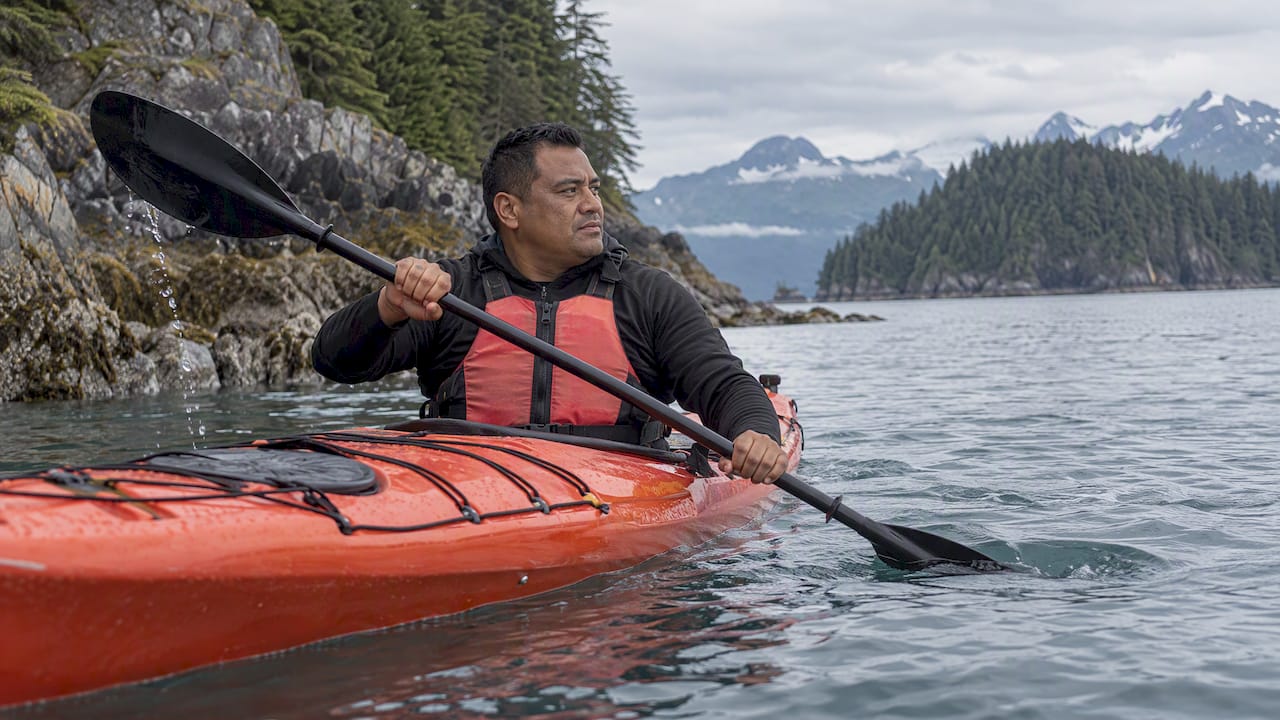
The cost is higher, but so is the simplicity: meals, logistics and activities are handled, which suits a founder who needs a real break from decisions.
Taos Goji Eco Lodge, New Mexico
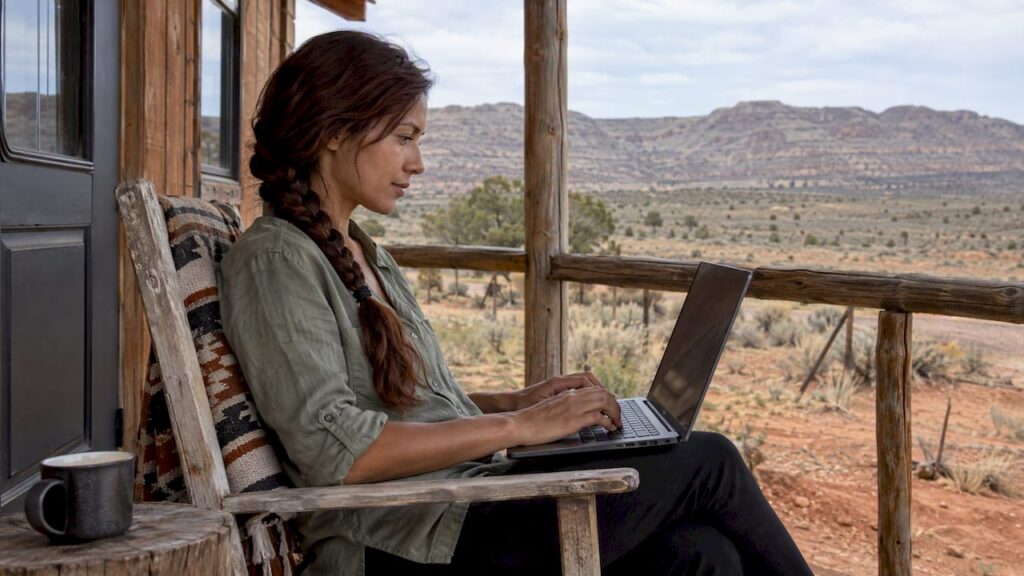
Not every remote stay means giving up the laptop. The lodge’s own listing shows cabins for two to seven guests, and each listing mentions free Wi-Fi, a kitchen and air conditioning. That combination makes it a candidate for a quiet working week in high-desert surroundings. As with any listing, ask the host about actual speeds before you commit to deadlines.
Remote places abroad you can work from
Abroad, the question changes from “can I get there” to “can I stay and work legally.” A growing number of countries publish dedicated routes.
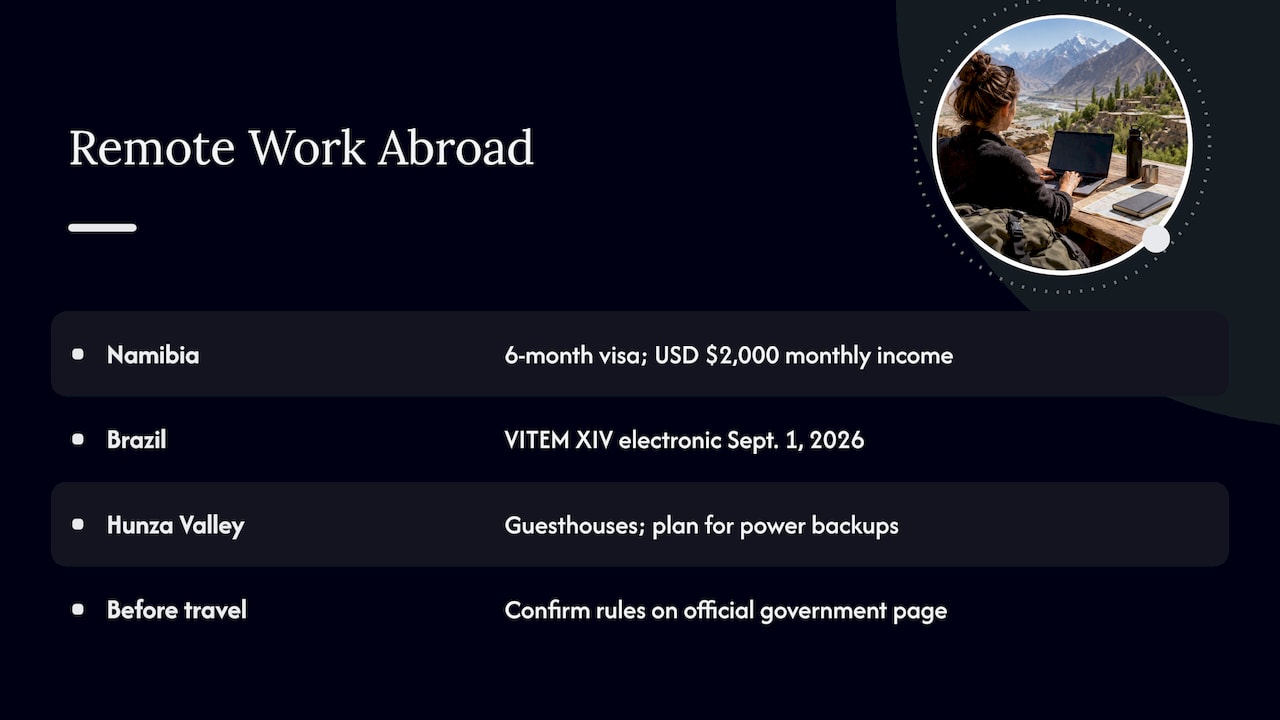
Namibia. The country’s investment promotion board describes a six-month Digital Nomad Visa that requires proof of USD $2,000 monthly income and valid travel insurance. Namibia’s open landscapes and low population density make it one of the clearest examples of a remote destination with a formal path for remote workers.
Brazil. Brazil’s foreign ministry explains that its digital nomad temporary visa, VITEM XIV, is issued electronically as of September 1, 2026, for nationals of countries exempt from visitor visas. Brazil’s long coastline has small beach towns far from big-city bustle. Rules differ by nationality, so read the ministry page for your own situation.
Pakistan’s Hunza Valley. Some remote workers are drawn to mountain valleys such as Hunza, where guesthouses cater to self-sufficient travelers. It rewards people comfortable with an unpolished setup and backup plans for power.
A caution that applies everywhere: visa rules, income thresholds and processing methods change. Treat any summary, including this one, as a starting point and confirm on the official government page before you pay for flights.
Staying connected when the map runs out
Connectivity is where remote trips most often go wrong for working travelers. A few habits help.
- Ask for numbers, not adjectives. “Good Wi-Fi” can mean anything. Ask hosts for a recent speed test and whether the connection survives power cuts.
- Carry a second path. A mobile data plan or eSIM as backup covers you when a guesthouse router fails. If your route passes through Israel, for example, a prepaid eSIM for travelers can be activated by QR code, with no SIM swap, so you are online on arrival.
- Plan around power. Backup batteries and offline copies of key files matter more than a faster plan.
- Budget data. Some island nations sell data by volume, which changes how you handle video calls and file syncs.
- Schedule meetings in buffers. Put client calls in the middle of your stay, not on arrival or departure days, when transport delays are most likely.
Our own guide to working from anywhere without losing momentum goes deeper on routines that survive patchy internet.
Planning logistics and risk
Remote travel punishes optimistic itineraries. Operations-minded travel writers point out that the transport link most likely to fail should shape the whole itinerary, because non-refundable onward bookings clash with unpredictable access. In practice:
- Find the fragile link first. It may be a weekly ferry, a single regional flight or a seasonal road. Book that, then build around it.
- Leave slack at both ends. Add a buffer day before any fixed commitment, such as an international flight home.
- Insure for evacuation. Local medical care may be limited or distant. Check that your policy covers evacuation, not only treatment, and ask your insurer about activities at your destination.
- Keep a contingency fund. Delays cost money in extra nights, rebooked flights and food. Set aside a cushion before you leave.
- Respect local capacity. Small communities have finite supplies, beds and services. Book ahead, buy locally and avoid treating a village like a resort.
For safety specifics, such as vaccinations, advisories and entry rules, rely on your government’s travel advisory service and a travel medicine clinic rather than a blog.
Short trip or long stay?
The half-day rule from earlier is a decent filter. If the journey is more than half a day each way, a two-night stay mostly buys you transit. Aim for at least a week.
- Weekend (2 to 3 nights): choose places reachable in a few hours, such as a state park cabin. Expect to be offline and to bring everything.
- One to two weeks: suits lodges and small coastal towns where the journey is long but daily life is easy once you arrive.
- A month or more: requires a visa path, stable power and a reliable internet source. This is where digital nomad visas, apartments with kitchens and local coworking spaces matter.
Season also matters. Weather dependence is one of the defining consequences of remoteness, so check the local climate for your dates, including whether roads, ferries or trails close at certain times of year.
Our perspective: remote works best with a purpose
We have seen a pattern across the founders and freelancers who join our programs. Remote places create focus, but only when the trip has a job to do. A beautiful, far-off location with no plan becomes an expensive version of your usual distractions. A location with a clear sprint goal, a small group and a daily rhythm becomes the place where an offer finally gets sharpened or a first client finally gets signed.
That is why our bootcamps pair inspiring destinations with structure: hands-on workshops, mentorship from experienced entrepreneurs, daily accountability and a community that continues after the week ends. The location is the setting, not the strategy. When we choose where to run a program, we look at the same things you should: how people get there, whether the internet supports real work, what the local services are like, and whether there is a space to gather and focus.
Our advice if you are choosing for yourself: pick the least remote place that still gives you the quiet you need. Going further than your goals require only adds risk and cost.
— Amichai
Where to work remotely with a community
If you would rather not solve every logistics puzzle alone, our in-person bootcamps are built around destinations where founders can work, learn and connect. Current listings include a 2-week bootcamp in Playa Venao, Panama, a 10-day bootcamp in Pipa, Brazil, and a 1-week bootcamp in Agaete, Canary Islands, each with a €400 registration fee. In Lisbon, the Entrepreneurship Sprint Bootcamp is €1,350 at Idea Space and €1,500 at Second Home. You can see what a past cohort looked like in Pipa, Brazil or Hiriketiya, Sri Lanka.
Prefer to test the format from home first? Our Online Entrepreneurship Bootcamp is €500, and the 5-Day Online AI Bootcamp is €300. When you are ready to travel, browse the upcoming bootcamps for current schedules.
Teams can also work remotely together. Our company retreats are designed end to end, from workshops to local experiences, and you can read more about business retreats for remote teams.
A simple checklist before you book
Run your shortlist through these questions. If you cannot answer one, find out before paying.
- Can I enter and stay legally for the whole trip, and does my work count as permitted activity?
- What is the slowest or least reliable leg of the journey, and what is my plan if it fails?
- What speeds does the host report, and what is my backup connection?
- Is there a clinic nearby, and does my insurance include evacuation?
- What does the full trip cost, including transit, meals, data and a contingency buffer?
- Does the place match the purpose of the trip: rest, deep work or community?
If you freelance and want your remote time to pay off, it also helps to know how to land international clients as a remote freelancer before you leave, so your income does not depend on the weakest signal.
FAQ
What is a remote country?
There is no single official definition. A country feels remote when it is far from major population centers, hard to reach and thinly served by infrastructure. Researchers describe remoteness as a mix of distance, access time and perceived isolation, so a small island nation and a landlocked highland country can both qualify for different reasons.
Can I really work from a remote destination?
Yes, if you verify the basics first. Confirm your legal right to stay, ask the host for real internet speeds, and carry a backup connection and power. Some countries, such as Namibia, publish visa routes that set out income and insurance requirements for remote workers.
How remote is too remote for a work trip?
If a missed connection or a power cut would cost you a client, it is too remote for that week. Choose places where the journey is manageable and you can get online quickly. Save the truly off-grid stays, like a canoe-in cabin, for time you deliberately set aside to disconnect.
How can I travel to remote places without overspending?
Stay longer in fewer places, since transit is the biggest cost in remote travel. Choose self-catering stays with kitchens, book the fragile transport link early, and keep a contingency fund. Compare prices on the operator’s own page, as all-inclusive lodges and basic cabins can differ by hundreds of dollars.
Sources
- IUCN WCPA Technical Note Series No. 10
- The most remote places on Earth worth visiting (Quartz)
- The USAP Portal: technology and internet access
- Cabins | North Dakota Parks and Recreation
- Cabins and rates at Kenai Fjords Wilderness Lodge
- Taos Goji Eco Lodge
- Digital Nomad Visa, Namibia Investment Promotion and Development Board
- VITEM XIV Digital Nomad, Brazil Ministry of Foreign Affairs
- Hunza Valley, Pakistan: coworking destination
- The World’s Most Remote Places: Six Journeys
- Internet on arrival in Israel
Comments are closed.