
The Essential Guide to Cultivating Entrepreneurial Independence
More than 60 percent of american adults dream about working for themselves but misconceptions about entrepreneurial independence hold many back. Launching a business is only one piece of the puzzle. This path challenges traditional nine-to-five thinking and rewards those willing to learn and adapt. If you have ever questioned the myths around entrepreneurship or sought a clearer view of what true independence looks like, this guide reveals the realities and benefits often missed.
Table of Contents
- Defining Entrepreneurial Independence and Misconceptions
- Types of Entrepreneurial Independence Explained
- Core Benefits for Entrepreneurs and Teams
- Key Skills and Mindsets Required
- Common Pitfalls and How to Avoid Them
- Practical Applications in Modern Business
Key Takeaways
| Point | Details |
|---|---|
| Entrepreneurial Independence Redefined | This concept emphasizes professional autonomy that can be learned rather than an innate talent exclusive to few. |
| Calculated Risk Assessment | Successful entrepreneurs evaluate risks strategically, contrasting the myth of reckless risk-taking. |
| Diverse Paths to Independence | Entrepreneurial independence encompasses various types, including small business, scalable startups, and social entrepreneurship. |
| Importance of Team Collaboration | Building strong teams and delegating effectively are crucial to avoid burnout and ensure business success. |
Defining Entrepreneurial Independence and Misconceptions
Entrepreneurial independence represents more than just starting a business—it’s a holistic approach to professional autonomy that challenges traditional career paradigms. Contrary to popular belief, this journey isn’t reserved for a select few with mystical talents. Entrepreneurial skills can be systematically learned and developed, dismantling the pervasive myth that entrepreneurs are somehow born, not made.
The landscape of entrepreneurial independence is riddled with misconceptions that prevent talented individuals from pursuing their dreams. Many believe entrepreneurs are fearless risk-takers who gamble everything on a whim. However, research reveals a nuanced reality: successful entrepreneurs actually engage in calculated risk assessment, carefully evaluating potential outcomes before making strategic moves. Entrepreneurial thinking involves methodical planning rather than reckless gambling, challenging the romanticized notion of the maverick business founder.
Financial expectations represent another critical area of misunderstanding. While many assume entrepreneurship guarantees instant wealth, the truth is far more complex. Entrepreneurial independence requires persistent effort, continuous learning, and the ability to navigate uncertainty. Some entrepreneurs might initially earn less than traditional employment, but they gain something far more valuable: control over their professional trajectory, the freedom to pursue passion projects, and the potential for exponential growth beyond fixed salary constraints. Success isn’t about overnight miracles but about building sustainable systems, developing resilient mindsets, and cultivating entrepreneurial leadership skills that transcend conventional career boundaries.
Types of Entrepreneurial Independence Explained
Entrepreneurial independence encompasses diverse pathways for professionals seeking autonomy and personal growth. Researchers have identified multiple types of entrepreneurship that offer unique approaches to building independent careers, each with distinct characteristics and strategic objectives. The traditional view of entrepreneurship as a one-size-fits-all model has been replaced by a more nuanced understanding of how individuals can create professional freedom.
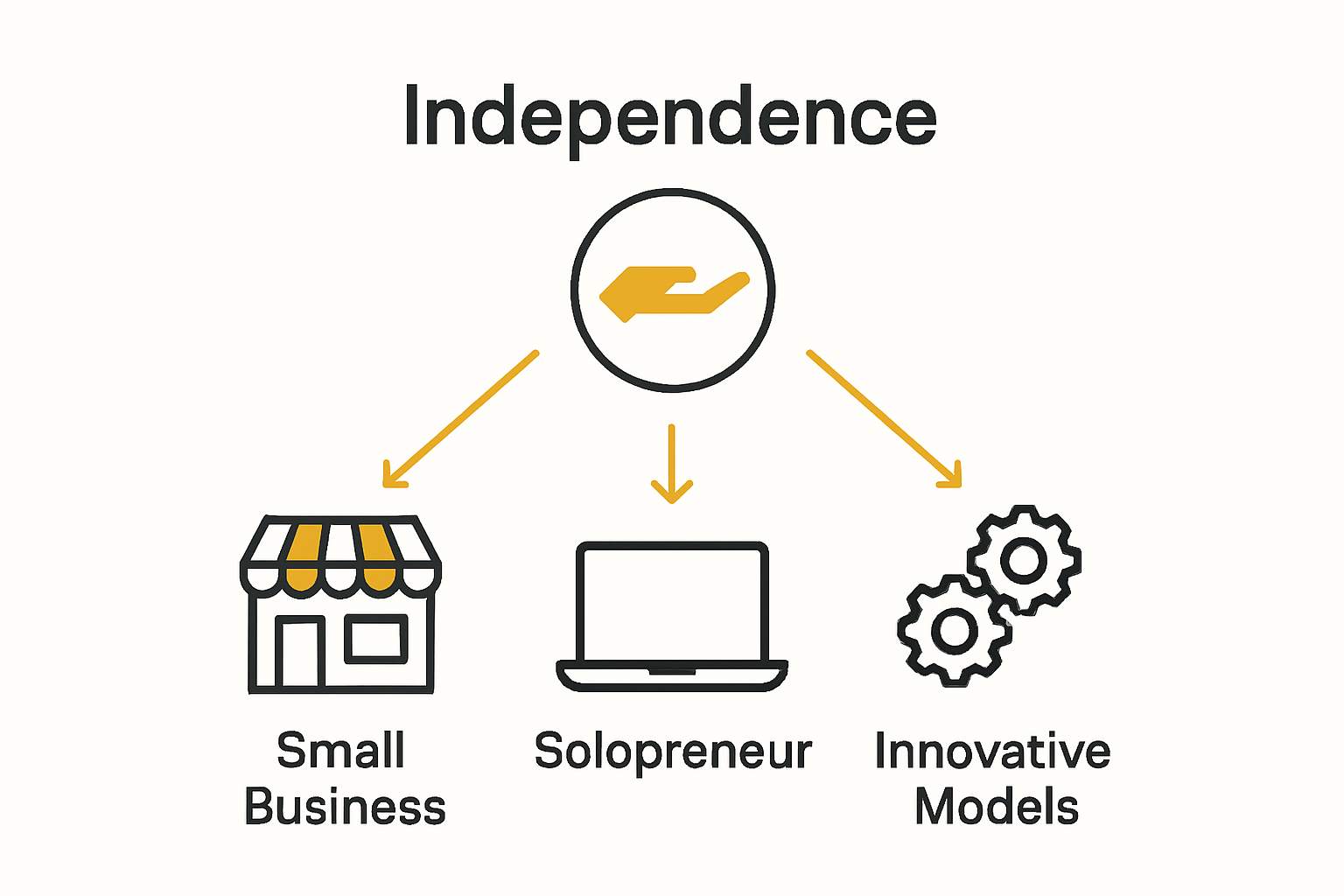
Fundamentally, entrepreneurial independence can be categorized into several key types. Small business entrepreneurship represents the most common form, where individuals create sustainable businesses serving local markets or specific niches. Scalable startup entrepreneurship differs by focusing on high-growth potential ventures designed to disrupt existing markets or create entirely new industry segments. Another fascinating category is social entrepreneurship, which prioritizes creating positive social impact alongside financial sustainability, challenging the traditional profit-only business model.
Beyond these primary categories, modern entrepreneurs have expanded the definition of independence to include innovative approaches like intrapreneurship, where professionals create entrepreneurial initiatives within existing corporate structures. Personal business growth strategies reveal that entrepreneurial independence isn’t limited to traditional business ownership but encompasses a wide range of professional approaches. Whether launching a technology startup, developing a consulting practice, or creating a mission-driven social enterprise, today’s entrepreneurs have unprecedented opportunities to design careers that align with their unique skills, passions, and vision for professional fulfillment.
Core Benefits for Entrepreneurs and Teams
Entrepreneurial independence offers profound advantages that extend far beyond traditional career paths. The entrepreneurial mindset fundamentally transforms how professionals approach work and innovation, creating unprecedented opportunities for personal and professional growth. By embracing autonomy, entrepreneurs unlock the potential to design careers that align deeply with their individual skills, passions, and values.
The core benefits of entrepreneurial independence are multifaceted and transformative. Personal autonomy stands as a primary advantage, enabling professionals to make strategic decisions without bureaucratic constraints. Financial potential represents another critical benefit, with entrepreneurs having unlimited earning capacity compared to fixed salary structures. Research highlights that entrepreneurs can create value through innovative problem solving, developing unique solutions that challenge existing market paradigms and generate exponential growth opportunities.

For teams, entrepreneurial approaches introduce dynamic advantages that traditional organizational structures often lack. Collaborative innovation becomes possible when professionals are empowered to think creatively and take calculated risks. Startup mentorship programs demonstrate how structured guidance can amplify team performance, creating environments where collective creativity thrives. Successful entrepreneurial teams distinguish themselves through adaptability, rapid decision making, and a shared commitment to pushing boundaries, transforming potential challenges into breakthrough opportunities for sustainable growth and meaningful impact.
Key Skills and Mindsets Required
Entrepreneurial success hinges on developing a distinctive set of cognitive and practical skills that transcend traditional professional capabilities. Entrepreneurs must cultivate a comprehensive skills checklist that goes beyond technical expertise, focusing on adaptable mindsets and strategic thinking. Research reveals that successful entrepreneurs are not born but systematically developed through intentional skill building and personal growth.
Critical entrepreneurial skills encompass several key domains. Psychological resilience stands at the forefront, enabling professionals to navigate uncertainty and bounce back from setbacks. Strategic risk assessment represents another fundamental skill, where entrepreneurs learn to make calculated decisions rather than impulsive choices. Innovative problem solving requires a unique blend of creativity and analytical thinking, allowing entrepreneurs to identify opportunities where others see obstacles. The ability to quickly adapt, learn from failures, and pivot strategies becomes a distinguishing characteristic of successful independent professionals.
Beyond individual capabilities, entrepreneurial mindsets demand a holistic approach to personal and professional development. Continuous learning emerges as a core competency, with successful entrepreneurs constantly expanding their knowledge and challenging existing paradigms. Team collaboration skills become increasingly important as entrepreneurs build networks, form strategic partnerships, and create collaborative ecosystems. The most effective entrepreneurs recognize that independence doesn’t mean isolation, but rather the ability to build flexible, dynamic relationships that drive collective innovation and mutual growth.
Common Pitfalls and How to Avoid Them
Entrepreneurial journeys are fraught with potential missteps that can derail even the most promising ventures. Misconceptions about entrepreneurship often lead aspiring entrepreneurs down dangerous paths of unrealistic expectations and ineffective strategies. Understanding these common pitfalls becomes crucial for navigating the complex landscape of independent business development.
One of the most critical mistakes entrepreneurs make is attempting to do everything alone. Successful business builders recognize the importance of building strong teams and delegating effectively. Overwork and burnout represent significant risks, with many entrepreneurs mistakenly believing they must personally handle every aspect of their business. Strategic delegation, building collaborative networks, and recognizing personal limitations are essential survival skills. Another common pitfall involves becoming overly attached to original ideas rather than focusing on market validation and customer needs. Entrepreneurs must learn to pivot, adapt, and prioritize execution over pure innovation.
Financial mismanagement stands as another treacherous area for emerging entrepreneurs. Cash flow management requires discipline and strategic planning, with many new business owners underestimating the complexity of financial sustainability. Successful entrepreneurs develop robust financial literacy, create multiple revenue streams, and maintain conservative financial projections. They understand that survival requires more than passion—it demands practical skills in budgeting, forecasting, and strategic financial decision making. By anticipating challenges, building resilient support systems, and maintaining flexibility, entrepreneurs can transform potential pitfalls into opportunities for growth and learning.
Practical Applications in Modern Business
Entrepreneurial innovation has transformed how businesses approach problem solving and value creation in contemporary markets. Entrepreneurial mindsets now drive strategic approaches across diverse industries, challenging traditional organizational structures and enabling more dynamic, responsive business models. Modern enterprises recognize that adaptability and creative thinking are no longer optional but essential for sustained competitive advantage.
The practical applications of entrepreneurial thinking extend far beyond startup environments. Social entrepreneurship emerges as a powerful model, where businesses simultaneously address societal challenges and generate economic value. Companies are increasingly integrating innovative approaches that blend mission-driven objectives with sustainable business strategies. Team collaboration techniques have evolved to support more flexible, cross-functional work environments that encourage rapid experimentation and collective problem solving.
Technology has dramatically expanded the landscape of entrepreneurial application, creating unprecedented opportunities for distributed, decentralized business models. Digital platforms enable entrepreneurs to create global networks, access international markets, and develop scalable solutions with minimal initial investment. Successful modern businesses now prioritize continuous learning, rapid iteration, and the ability to pivot quickly in response to changing market conditions. By embracing an entrepreneurial approach that values innovation, collaboration, and strategic flexibility, organizations can transform potential disruptions into meaningful opportunities for growth and impact.
Unlock Your Path to True Entrepreneurial Independence Today
The journey to entrepreneurial independence comes with unique challenges like mastering calculated risk, avoiding burnout, and building resilient, adaptable mindsets. If you are ready to move beyond misconceptions and outdated career models the insights in this guide reveal the essential skills and strategies needed for sustainable growth and personal autonomy. Whether you aspire to launch a scalable startup or develop entrepreneurial leadership within a team understanding these foundational concepts is key.
At Nomad Excel you can accelerate your progress through immersive experiences that blend hands-on learning mentorship and community support. Explore our Entrepreneurship Archives to discover proven frameworks for launching and scaling your business. Join a focused bootcamp or team retreat designed to sharpen your execution skills and empower you with daily accountability and real-world results. There is no better time to step into your full potential and craft a career aligned with your passions and vision.
Start transforming knowledge into action now by visiting Nomad Excel and reviewing our full Program Archives. Your entrepreneurial independence awaits.
Frequently Asked Questions
What is entrepreneurial independence?
Entrepreneurial independence refers to the holistic approach to professional autonomy, allowing individuals to create sustainable careers aligned with their skills and passions, while challenging traditional job structures.
What are the common misconceptions about entrepreneurship?
Many assume entrepreneurs are born, not made, and that they are fearless risk-takers. In reality, successful entrepreneurs engage in calculated risk assessment and systematic skill development, emphasizing methodical planning over impulsive decisions.
What are the key skills necessary for entrepreneurial success?
Critical skills for entrepreneurial success include psychological resilience, strategic risk assessment, innovative problem solving, and the ability to adapt quickly to changing circumstances, along with continuous learning and effective team collaboration.
How can I avoid common pitfalls when starting my entrepreneurial journey?
To avoid pitfalls, focus on building strong teams, managing cash flow effectively, and maintaining flexibility to pivot based on market validation. Delegating tasks and prioritizing execution over pure innovation are also essential for success.
Recommended
- The Essential Guide to Benefits of Entrepreneurial Mindset – Nomad Excel – Your Entrepreneurial Adventure Starts Here
- Personal Business Growth: Complete Guide for Entrepreneurs – Nomad Excel – Your Entrepreneurial Adventure Starts Here
- Networking for Entrepreneurs: Complete Guide to Success
- Entrepreneurial Leadership Explained: Complete Guide
Comments are closed.