
Accelerate business growth fast with proven strategies
Early-stage entrepreneurs often feel stuck spinning their wheels without clear direction or measurable progress. You’re working hard but not seeing the breakthrough results you expected. This guide walks you through four proven strategies that combine validation frameworks, expert mentorship, supportive community, and disciplined execution to help you accelerate growth and achieve measurable milestones in 2026.
Table of Contents
- Introduction: Understanding The Need For Acceleration In Business Growth
- Prerequisites: What You Need Before You Start
- Step 1: Validate Your Business Idea With Proven Frameworks
- Step 2: Leverage Expert Mentorship For Strategic Guidance
- Step 3: Build And Engage With A Supportive Entrepreneur Community
- Step 4: Establish Execution Discipline Through Structured Sprints
- Common Mistakes And Troubleshooting
- Expected Results And Success Metrics
- Alternative Approaches And Tradeoffs
- Unlock Accelerated Growth With Nomad Excel Bootcamps And Mentorship
- Frequently Asked Questions About Accelerating Business Growth
Key takeaways
| Point | Details |
|---|---|
| Clear validation frameworks reduce risk and increase success chances | Systematic testing of assumptions through customer feedback prevents costly pivots later |
| Expert mentorship can triple revenue growth within a year | Regular mentor engagement provides strategic insights and accountability that accelerate progress |
| Engaging with a supportive entrepreneur community doubles chance of successful pivots | Peer networks reduce isolation and offer fresh perspectives for overcoming obstacles |
| Structured daily execution routines boost task completion by 40% | Sprint cycles and accountability systems convert strategy into measurable results |
| Tracking milestones helps reach break-even faster | Clear metrics enable course correction and validate ROI on growth investments |
Introduction: understanding the need for acceleration in business growth
You’re not alone if your business feels stuck in neutral. Many early-stage entrepreneurs face three critical barriers that prevent meaningful progress: unclear strategic direction, lack of experienced guidance, and isolation from peers who understand the journey. These obstacles aren’t just frustrating. They’re statistically dangerous.
Ignoring these barriers leads directly to stagnation and higher failure rates. Without a clear roadmap, you waste time and resources testing ideas that never gain traction. Without mentorship, you repeat mistakes others have already solved. Without community, you lose motivation during the inevitable rough patches that test every founder’s resolve.
A structured approach changes everything. Combining business acceleration concepts with practical startup growth strategies creates a proven path from stagnation to sustainable growth. This methodology integrates four essential elements:
- Validation frameworks that test assumptions systematically
- Expert mentorship providing strategic guidance and accountability
- Supportive community offering motivation and fresh perspectives
- Disciplined execution routines converting plans into measurable results
In 2026, the competitive landscape demands this integrated approach more than ever. Markets move faster, customer expectations evolve constantly, and isolated entrepreneurs struggle to keep pace. The good news? You can implement these strategies starting today, regardless of your current stage or industry. Each element builds on the others, creating compound effects that accelerate your timeline from idea to sustainable revenue.
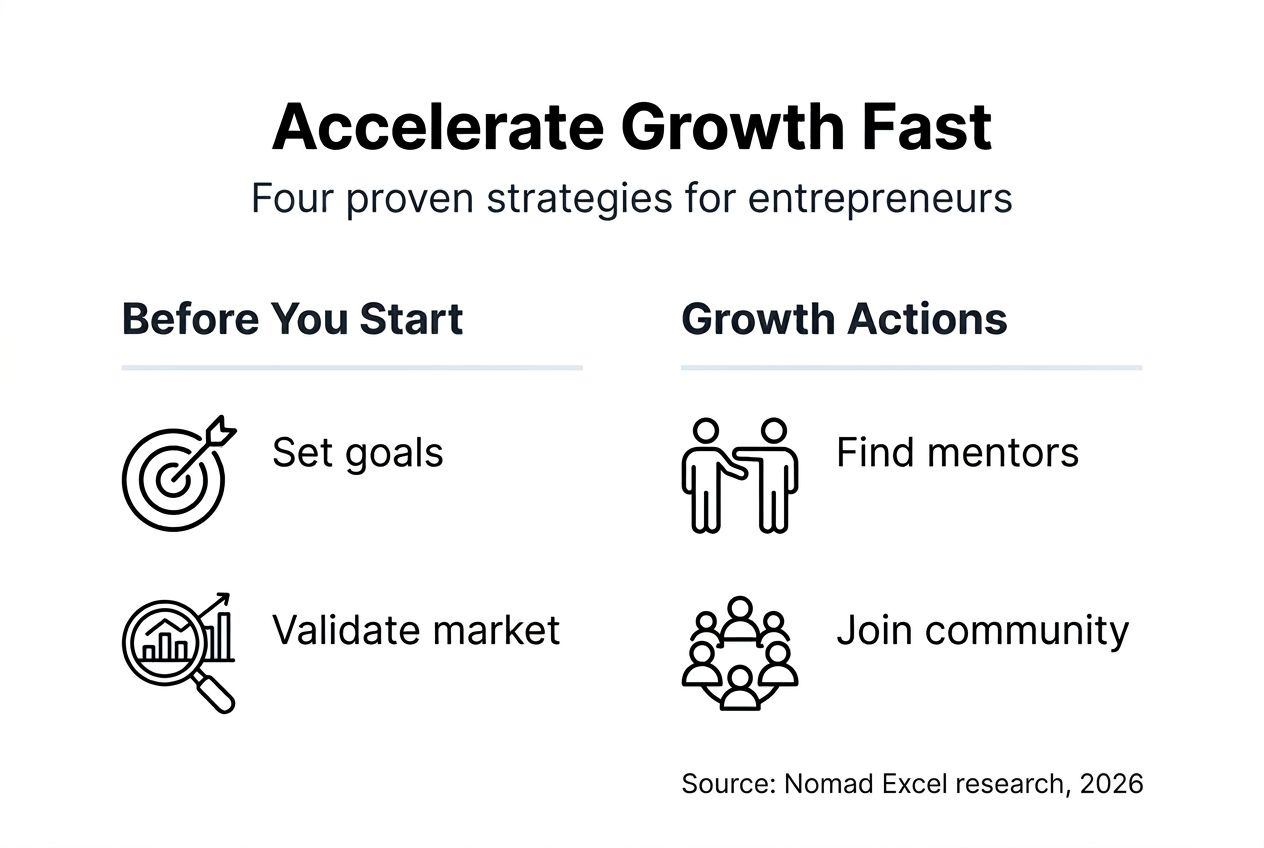
The following sections break down exactly how to apply each strategy with actionable steps you can implement immediately.
Prerequisites: what you need before you start
Before diving into acceleration strategies, ensure you have the right foundation in place. These prerequisites aren’t optional. They determine whether the strategies we’ll discuss actually work for your specific situation.
First, clarify your business goals and align them with your personal vision. Vague objectives like “make more money” won’t cut it. You need specific targets: revenue milestones, customer acquisition numbers, or market penetration goals. When your business goals conflict with your personal values or lifestyle preferences, growth becomes unsustainable.
Second, develop a basic understanding of market validation and lean startup principles. You don’t need an MBA, but you should grasp concepts like minimum viable product, customer discovery, and iterative testing. This foundational knowledge prevents costly mistakes as you accelerate.
Third, set up essential digital tools that track your progress. A simple CRM system, basic analytics platform, and project management tool create visibility into what’s working. These systems don’t need to be expensive or complex initially.
Fourth, budget realistically for growth investments like mentorship programs or educational bootcamps. Acceleration requires resource commitment. Calculate how much you can invest in guidance and learning without jeopardizing operations. Many entrepreneurs underestimate this critical investment, then wonder why growth stalls.
Pro Tip: Start with free or low-cost tools and educational resources if budget is limited, then scale up investment as traction builds and revenue validates your business model.
Finally, assess your time availability honestly. The growth strategy workflow we’ll outline requires consistent effort. If you can’t dedicate at least 10-15 hours weekly to focused growth activities, adjust your timeline expectations accordingly.
With these prerequisites addressed, you’re ready to implement the four core acceleration strategies that transform early-stage businesses from struggling to thriving.
Step 1: validate your business idea with proven frameworks
Validation is where most entrepreneurs either save themselves from disaster or commit to a slow, painful failure. Startups using validated business frameworks experience up to 27% higher early success rates compared to those relying on intuition alone.
Iterative customer feedback loops form the core of effective validation. You don’t validate once and move on. You constantly test assumptions, gather data, adjust your offering, and test again. This cycle continues throughout your business journey, though it’s most critical in the early stages.

The Lean Startup methodology provides a systematic approach to validation. Start by identifying your riskiest assumptions. What absolutely must be true for your business to succeed? Maybe customers actually have the problem you’re solving. Maybe they’ll pay your proposed price. Maybe they prefer your solution over existing alternatives.
Test these assumptions with minimal investment. Build a landing page describing your offer and measure sign-up interest. Run small paid ad campaigns to gauge demand. Conduct customer interviews to understand pain points deeply. Each test either validates your assumption or reveals the need to pivot.
“The goal of validation isn’t to prove you’re right. It’s to learn the truth as cheaply and quickly as possible before you invest significant resources.”
Real-world validation methods dramatically increase your odds of achieving sustainable product-market fit. When you validate systematically, you build investor and mentor confidence because you’re making data-driven decisions, not emotional ones.
Follow this validation sequence:
- Document your top five riskiest business assumptions
- Design simple, low-cost tests for each assumption
- Run tests and collect quantitative and qualitative data
- Analyze results objectively without confirmation bias
- Adjust your business model based on findings
- Repeat the cycle with new assumptions or refined tests
Applying business validation strategies transforms validation from a vague concept into a concrete process you execute daily. This discipline separates successful founders from those who burn through resources chasing unvalidated ideas.
Step 2: leverage expert mentorship for strategic guidance
Mentorship isn’t a nice-to-have luxury. It’s a growth accelerator with measurable ROI. Entrepreneurs involved in mentorship programs grow revenue 3 times faster within 12 months than those without mentorship support.
Expert mentors provide three critical benefits: strategic insights from experience, accountability that keeps you executing, and pattern recognition that helps you avoid common pitfalls. When you’re stuck on a decision, a mentor who’s navigated similar challenges can save you months of trial and error.
Finding quality mentors requires intentional effort. Industry events, online platforms like LinkedIn, and referral networks through your existing connections are proven channels. Don’t randomly message successful people expecting responses. Build genuine relationships first.
When approaching potential mentors, be specific about what you need. “Can you mentor me?” is too vague. “I’m struggling with pricing strategy for my SaaS product and noticed you successfully launched three similar companies. Could we schedule a 30-minute call to discuss your approach?” demonstrates respect for their time and clarity about how they can help.
Maximizing mentorship benefits requires preparation and follow-through:
- Prepare specific questions or challenges before each meeting
- Document action items and implement them before the next session
- Share progress updates regularly to maintain engagement
- Respect boundaries around time and availability
- Offer value in return through introductions, feedback, or other support
Pro Tip: Approach multiple mentors initially to find the best fit for your business needs, industry, and personality, then commit deeply to building those relationships.
Understanding the mentorship benefits for entrepreneurs and following a structured entrepreneur mentorship process ensures you’re not just collecting advice but actually implementing strategies that accelerate growth. Regular mentor check-ins create accountability pressure that pushes you past comfort zones where real growth happens.
Step 3: build and engage with a supportive entrepreneur community
Isolation kills entrepreneurial momentum. Community engagement reduces dropout risk by 30% and doubles your chances of successfully pivoting when market conditions demand it. The right peer network provides motivation, fresh perspectives, and collaborative opportunities that solo founders simply can’t access.
Your community serves multiple functions beyond just moral support. Peers offer honest feedback on ideas without the politeness filter friends and family apply. They share resources, tools, and tactics that worked in their businesses. They introduce you to potential customers, partners, or investors within their networks.
Practical ways to build or join entrepreneur communities include:
- Online groups focused on your industry or business stage
- Local meetups and coworking spaces with founder populations
- Bootcamp cohorts that create intensive bonding experiences
- Mastermind groups with regular accountability sessions
- Industry conferences where relationships form naturally
Peer accountability complements mentorship by creating horizontal support while mentors provide vertical guidance. When everyone in your circle is working toward ambitious goals, mediocrity becomes unacceptable. You push each other to execute faster and think bigger.
The building entrepreneur communities process takes time and intentional effort. Start by giving value before asking for help. Share resources generously, make introductions freely, and celebrate others’ wins authentically. This generosity builds social capital that returns multiplied.
Community also serves as a safe space for vulnerability. Entrepreneurship is emotionally demanding. Having peers who understand the stress of missing payroll, losing a major client, or questioning whether to pivot creates psychological safety. This emotional support prevents burnout that derails promising businesses.
The community importance for entrepreneurs extends beyond immediate business needs. Your entrepreneurial network becomes a career-long asset. Today’s peer founders become tomorrow’s co-founders, investors, customers, or strategic partners. Invest in community relationships as seriously as you invest in product development.
Step 4: establish execution discipline through structured sprints
Strategy without execution is just expensive daydreaming. Daily accountability routines increase task completion by 40%, converting plans into measurable progress that compounds over time.
Sprint cycles borrowed from agile software development work brilliantly for early-stage businesses. A sprint is a focused time period, typically one to two weeks, where you commit to specific goals and eliminate distractions. This structure forces prioritization and creates urgency.
Implement execution discipline following this framework:
- Start each sprint by identifying your top three priorities that move key metrics
- Break each priority into daily tasks with clear completion criteria
- Hold brief daily standup check-ins, even if it’s just you reviewing progress
- Track completion rates and obstacles in a simple spreadsheet or project tool
- End each sprint with a retrospective analyzing what worked and what didn’t
- Adjust your approach for the next sprint based on retrospective insights
Clear progress tracking identifies bottlenecks early. When you see the same type of task consistently incomplete, that signals a skill gap, resource constraint, or priority misalignment you need to address.
Daily standup meetings, even solo ones, create accountability pressure. Reviewing yesterday’s commitments and today’s plans forces honest assessment. You can’t hide from incomplete work when you’re checking in daily.
Pro Tip: Use collaboration tools like Trello or Asana and calendar blocking to optimize sprint effectiveness, but don’t let tool selection become procrastination disguised as productivity.
The business execution sprints approach transforms vague goals into concrete actions. Instead of “grow revenue,” you commit to “complete 20 customer discovery calls this sprint” or “launch email sequence to 500 subscribers.” Specific, measurable tasks eliminate ambiguity about whether you’re making progress.
Consistency matters more than intensity. Running focused two-week sprints throughout the year beats sporadic bursts of frantic activity followed by drift. Execution discipline becomes your competitive advantage when others rely on motivation that inevitably fades.
Common mistakes and troubleshooting
Understanding where entrepreneurs typically stumble helps you avoid repeating expensive mistakes. These patterns appear across industries and business models with remarkable consistency.
Skipping market validation causes nearly half of startup failures. 42% of startups fail due to poor product-market fit, often from building solutions nobody wants to buy. The painful irony is that validation costs a fraction of what founders waste building unvalidated products.
Ignoring mentorship raises stagnation risk significantly. Solo founders spend months solving problems mentors could address in a single conversation. This isolation also limits access to networks, introductions, and opportunities that accelerate growth.
Operating in isolation leads to higher dropout rates and burnout. Without peer support, the emotional weight of entrepreneurship becomes overwhelming. Every setback feels catastrophic because you lack perspective from others navigating similar challenges.
Inconsistent execution causes missed growth milestones. Starting strong then losing momentum when initial enthusiasm fades is the most common pattern. Without structured accountability systems, execution becomes optional rather than mandatory.
“The difference between successful and failed entrepreneurs often isn’t better ideas. It’s more disciplined execution over longer periods despite setbacks.”
Key fixes for these common mistakes:
- Apply iterative validation before significant product investment
- Seek mentors early, not after you’re already stuck or failing
- Engage community proactively even when you don’t think you need it
- Maintain daily discipline through sprint structures and accountability partners
- Track metrics religiously to catch problems before they become crises
Understanding how mentorship avoids stagnation helps you prioritize this investment. Many entrepreneurs wait until they’re desperate before seeking guidance. By then, reversing momentum takes far more effort than maintaining it would have required.
Troubleshooting effectively means building feedback loops into every process. When something isn’t working, you need data showing why, not just a vague sense of frustration. Measure everything that matters, review regularly, and adjust based on evidence.
Expected results and success metrics
Setting realistic expectations prevents premature discouragement while tracking the right metrics validates your strategy is working. Growth doesn’t happen overnight, but measurable progress should appear within specific timeframes.
Key milestones for early-stage entrepreneurs include achieving product-market fit within 6-12 months, hitting initial revenue targets by month 12-18, and reaching break-even by month 18-24. These timelines vary by industry, but they provide reasonable benchmarks.
Mentorship accelerates revenue growth up to 3 times within 12 months compared to solo efforts. This multiplier effect comes from avoiding dead ends, implementing proven strategies faster, and accessing mentor networks for customer or partner introductions.
Task completion rates and engagement metrics track execution discipline. If you’re completing less than 70% of sprint commitments consistently, either you’re overcommitting or facing obstacles that need addressing.
Bootcamp ROI becomes measurable within 6-12 months post participation for most attendees. The combination of mentorship, community, and structured learning compresses growth timelines significantly. 65% of startups hit break-even within 12-18 months when tracking milestones effectively.
| Metric | Target Timeline | What Success Looks Like |
|---|---|---|
| Product-market fit | 6-12 months | Repeat purchases, organic referrals, positive unit economics |
| First revenue | 3-6 months | Paying customers validating your offer |
| Consistent revenue | 12-18 months | Predictable monthly income covering basic operations |
| Break-even | 18-24 months | Revenue covers all expenses without external funding |
| Team expansion | 12-24 months | Hiring first employees or contractors as revenue allows |
These metrics enable entrepreneurs to benchmark progress and adjust strategies as needed. If you’re significantly behind timeline expectations, that’s data telling you to change approach, not just work harder doing the wrong things.
Tracking startup success metrics in 2026 provides context for your performance relative to broader market conditions. Some years are harder than others for specific industries. Understanding external factors helps you set realistic expectations.
Alternative approaches and tradeoffs
Multiple paths lead to business growth acceleration. Each approach offers different tradeoffs in cost, time commitment, community interaction, and growth speed. Understanding these options helps you select the best fit for your situation.
Immersive bootcamps deliver the fastest results, showing 35% faster growth due to the combination of intensive mentorship, peer community, and structured accountability. You’re removed from daily distractions and fully focused on growth for one to four weeks. The tradeoff is higher cost and significant time commitment away from operations.
Online courses offer lower cost and maximum flexibility. You learn at your own pace without travel or time away from your business. However, growth acceleration is approximately 25% slower than immersive programs because you lack the intensive accountability and peer interaction that drives rapid implementation.
Business retreats focus on team alignment and strategic planning with approximately 20% growth benefits. These work best for established small teams needing to reconnect and refocus rather than solo founders just starting out. Cost falls between bootcamps and online courses.
| Approach | Cost | Time Commitment | Community Interaction | Growth Speed | Best For |
|---|---|---|---|---|---|
| Immersive bootcamp | High | 1-4 weeks intensive | High, peer cohort | Fastest, 35% acceleration | Serious founders ready to invest heavily |
| Online course | Low | Flexible, self-paced | Low, mostly solo | Moderate, 25% slower | Budget-conscious, time-constrained |
| Business retreat | Medium | 3-7 days | Medium, team-focused | Slower, 20% benefit | Existing teams needing alignment |
| Solo learning | Lowest | Highly flexible | None | Slowest | Those testing commitment before investing |
Understanding what company retreats offer helps you determine if that format suits your needs or if you’re better served by founder-focused bootcamps. The right choice depends on your current stage, available resources, and learning style preferences.
Some entrepreneurs combine approaches, starting with online courses to build foundational knowledge, then investing in an immersive bootcamp when ready to scale seriously. This staged approach manages cost while still accessing high-impact acceleration when timing is right.
Unlock accelerated growth with Nomad Excel bootcamps and mentorship
Now that you understand the proven strategies for accelerating business growth, it’s time to put these principles into action. Nomad Excel offers immersive online entrepreneurship bootcamps and entrepreneur mentorship programs specifically designed to compress your growth timeline through the exact frameworks we’ve discussed.
Our programs combine expert guidance from experienced entrepreneurs, supportive peer communities, and structured workflows that drive measurable results. You’ll work alongside driven founders who challenge and support your growth while implementing proven strategies under mentor supervision.
Key program features include:
- Direct access to successful entrepreneur mentors who’ve built and scaled multiple businesses
- Curated peer cohorts providing accountability and collaboration opportunities
- Step-by-step frameworks for validation, execution, and scaling
- Structured sprint cycles converting strategy into measurable progress
Discover how to build business community for entrepreneurs while accelerating your growth trajectory. Join Nomad Excel and transform your business from stuck to scaling with expert support and a powerful community driving you forward.
Frequently asked questions about accelerating business growth
When is the right time to seek mentorship for my business?
Seek mentorship as soon as you’ve validated basic product-market fit and have paying customers or strong interest signals. Don’t wait until you’re stuck or failing. Early mentorship prevents costly mistakes rather than fixing them after damage is done.
How does community engagement actually accelerate growth?
Community provides motivation during difficult periods, fresh perspectives when you’re stuck, and accountability that drives consistent execution. Peer networks also offer collaboration opportunities, customer introductions, and resource sharing that solo founders can’t access.
Why is validation so important before scaling?
Validation ensures you’re building something people actually want to buy at your proposed price point. Scaling an unvalidated business just burns resources faster. Most startup failures trace back to poor product-market fit from skipping validation.
What if I can’t commit to structured daily sprints?
Start smaller with weekly review cycles rather than daily check-ins. The key is consistent accountability, even if less frequent initially. As you see results from basic structure, gradually increase sprint intensity as your schedule allows.
How quickly should I expect to see measurable results?
Most entrepreneurs see initial traction within 3-6 months of implementing structured growth strategies. Breaking even typically takes 12-18 months. If you’re not seeing any positive momentum within six months, reassess your approach with mentor guidance rather than just working harder.
Recommended
- Business Growth Strategy Workflow for Fast Results
- Business Growth Strategies: 30% Faster Startup Success 2026
- What Is Business Acceleration: Unlocking Startup Growth
- 7 Essential Growth Strategies for Startup Success
- Strategie apprendimento online per diplomarsi velocemente – Recupero Anni Scolastici e Diploma Online
Comments are closed.