Women Entrepreneur Network: How to Choose One That Works
The best women entrepreneur network is the one that gives you value-added relationships: a mentor who has done what you want to do, a peer who holds you accountable, an introduction that leads to a customer or to capital. Size and prestige matter far less. This guide explains the main types of networks, how to judge them before you pay or commit, and how remote and nomadic founders can build a circle that survives beyond a single event.
TL;DR
- A good network turns contacts into mentorship, accountability, market access or funding. If it only produces business cards, it is social networking.
- There are five broad types: online communities, local chapters and chambers, certification and procurement bodies, funding and training programs, and immersive in-person cohorts.
- Judge any network on its format, its member mix, its cost and what happens after the first month, not on its member count.
- Remote founders usually do best with a hybrid: a steady online rhythm plus a deliberate in-person experience every so often.
- Our bootcamps are open to aspiring and early-stage founders, and they are designed to leave you with a community that stays active after the program ends.
Table of Contents
- What a women entrepreneur network actually does
- Why “more contacts” is the wrong goal
- The five types of networks, and who each one suits
- How to evaluate a network before you join
- What remote and nomadic founders need that general networks miss
- Our perspective
- Where an immersive bootcamp fits
- Building your own circle: a 90-day plan
- Practical habits that make any network pay off
- FAQ
- Sources
What a women entrepreneur network actually does
The phrase covers a lot of ground. It can mean a Facebook group of a few hundred people, a monthly breakfast in your city, a federal contracting program, or a private collective that admits members by application. What they share is a premise: women building businesses often benefit from peers who understand their particular constraints, and from access that is not evenly distributed.
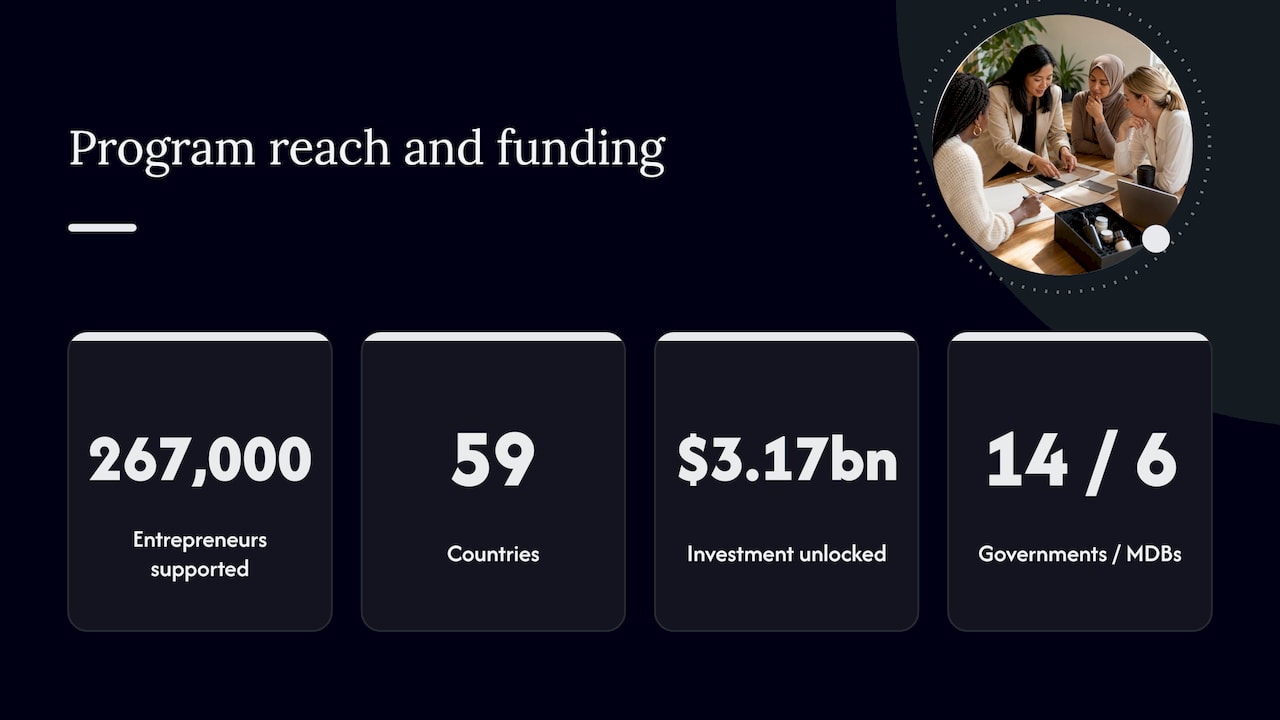
The scale of the effort behind that premise is real. As of September 2025, the Goldman Sachs 10,000 Women initiative and IFC had supported more than 267,000 women entrepreneurs across 59 countries and unlocked $3.17 billion in investment. The World Bank Group-hosted Women Entrepreneurs Finance Initiative, known as We-Fi, brings together 14 governments and six multilateral development banks to address financial and non-financial barriers for women-led small businesses in developing countries.
Those programs are aimed at emerging markets and at finance. If you are a freelancer in Austin, a founder working from Lisbon or a consultant who moves every few months, your needs are probably closer to the other end of the spectrum: people to think with, honest feedback, and a sense of belonging.
Why “more contacts” is the wrong goal
The most common misunderstanding is that networking means collecting connections. Leaders at women’s business organizations such as WIMBIZ and GBWCCI make the point that for early-stage founders, networking only counts when it produces value-added business relationships: mentorship, access to capital or trade opportunities.
There is evidence for the mentorship part. A Goldman Sachs 10,000 Women report on India found that business education alone is not enough, and that peer learning and mentorship carry a lot of the weight. The report links mentorship to a higher likelihood of adapting a business to outside challenges, and to graduates raising capital through mentor introductions. It is one program in one country, so treat the percentages as a signal rather than a promise for your own situation.
The practical lesson: before joining anything, write down what you want from it. “Meet people” is not an answer. “Find two founders at my revenue stage who will review my pricing monthly” is.
The five types of networks, and who each one suits
| Type | Typical format | Best for | Watch out for |
|---|---|---|---|
| Online communities | Private groups, forums, weekly calls | Founders anywhere who want daily peer contact | Noise, self-promotion threads, silent members |
| Local chapters and chambers | Monthly meetups, breakfasts, panels | Service businesses that sell locally | Value depends heavily on who shows up |
| Certification and procurement bodies | Application, directory, supplier events | Businesses selling to large buyers or government | Paperwork, eligibility rules, limited help for pre-revenue ideas |
| Funding and training programs | Cohorts, grants, advisory | Founders ready to scale or raise money | Competitive entry, specific geographies |
| Immersive in-person cohorts | Multi-day bootcamps, retreats | Founders who need focus, momentum and deep bonds | Cost, travel, time away from your business |
Most founders end up with two or three of these. A local chapter for referrals, an online group for daily questions and one intensive experience a year is a common and sensible mix.
A note on certification
If you plan to sell to the U.S. government, one specific option deserves attention. The SBA’s Women-Owned Small Business Federal Contract program limits competition for certain contracts to certified participants, but the SBA states that these benefits apply only to federal contracting, not to private-sector work. Check eligibility and the current application steps on the SBA site before you build a plan around it.
How to evaluate a network before you join
Use these criteria. They work for a free group and for a program that costs thousands.
- Member mix. Are the members at your stage, or one stage ahead? A network full of established executives can be inspiring and useless at the same time.
- Format. Does it create structured conversation, such as small groups, hot seats and pairings, or does it leave everyone to fend for themselves in a big feed?
- Accountability. Is there any mechanism that makes you do what you said you would do?
- Give and take. Can you offer something? Networks where you only consume tend to fade quickly.
- Cost against use. Divide the fee by the number of events you will realistically attend.
- What happens after. Ask what a member does in month six. If the answer is vague, the community is probably thin.
The broader research on how effective networks are built points to four pillars: financial literacy, structured mentorship, advocacy and market access. Practitioners in that field note that networks which neglect that balance drift into purely social events, and the value fades fast for serious founders. You will rarely find all four in one place, so ask which one a network is strongest in and fill the gaps elsewhere.
Red flags
- The pitch is about member count, not member outcomes.
- Every event is a speed-networking round with no follow-up.
- Leaders cannot tell you how members actually help each other.
- Pressure to upgrade to a premium tier in the first week.
- No way to talk to a current member before paying.
What remote and nomadic founders need that general networks miss
If you work from laptops and time zones, the problem is rarely a shortage of information. According to community builders interviewed on Community Inc., the real gap is belonging, and good networks prioritize authentic connection over volume and give people room to talk about the mental load of flexible work without promotional pressure.
That matches what we see. Founders who move between cities lose the casual contact an office or a home-town circle provides. Online groups help, but the bonds that become real business relationships usually form when people spend several days together, working side by side and eating dinner afterward.
A hybrid pattern tends to hold up best:
- Weekly rhythm online: a co-working hour, a small peer group, a monthly masterclass.
- Accountability partner: one person who knows your numbers and your goals.
- Periodic in-person immersion: a bootcamp or retreat that turns acquaintances into people you would call at 9 p.m. with a problem.
If you are building a product alongside the community side, it can also help to find practical help with the technical work. Founders who need a prototype or want to test an idea before hiring a team can look at custom software and idea-validation support for founders, which covers things like web and mobile apps and workflow automation.
Our perspective
We run entrepreneurship bootcamps and company retreats, so we have watched what makes founders stay connected and what lets a group go quiet. Three things stand out.
First, clarity comes before community. People arrive with a dozen half-formed ideas, and a room full of peers only helps once each person can say what they are building and for whom. That is why our programs lean on step-by-step frameworks for validating an idea, refining an offer and building systems, and on daily accountability rather than theory.
Second, mentorship has to be direct. Advice from people who have run businesses, marketed them and operated them is different from advice from a feed. The most useful moments are small: a mentor looking at your offer for ten minutes and asking the question you were avoiding.
Third, the bonds outlast the event only if the structure supports them. Founders who share a sprint, a deadline and a few hard conversations keep in touch because they have already been useful to each other. We are open about one point: our bootcamps are for aspiring and early-stage founders in general, not a women-only program. If a women-only setting is what you need, a dedicated network is a legitimate choice, and you can combine it with an intensive like ours.
— Amichai
Where an immersive bootcamp fits
A bootcamp is not a replacement for a network, but it is the fastest way to build the core of one. You spend one to four weeks with a curated group of driven founders, with workshops in the morning, building time in the afternoon and mentors on hand. By the end, you know who is strong at pricing, who has a copywriting gift and who will tell you the truth about your landing page.
Here is what we currently publish, with prices as listed on our site:
| Program | Format | Price |
|---|---|---|
| 5-Day Online AI Bootcamp | Online | €300 one-off |
| Online Business Bootcamp | Online | €500 one-off |
| Entrepreneurship Sprint Bootcamp, Idea Space | Lisbon | €1350 one-off |
| Entrepreneurship Sprint Bootcamp, Second Home | Lisbon | €1500 one-off |
| 2-Week Entrepreneurship Bootcamp | Playa Venao, Panama | €400 registration fee |
| 10-Day Entrepreneurship Bootcamp | Pipa, Brazil | €400 registration fee |
| 1-Week Entrepreneurship Bootcamp | Agaete, Canary Islands | €400 registration fee |
The three destination programs list only the registration fee here, so check the program page for what the full program involves before you commit. Dates change, so see upcoming bootcamps for what is open now, or browse previous bootcamps to see what past groups did.
If you are not ready to travel, the Online Entrepreneurship Bootcamp is a lower-commitment way to meet a cohort and test the format. Our guide to joining an entrepreneurship bootcamp explains how to decide if a program is right for you, and our program overview shows how the weeks are structured.
Building your own circle: a 90-day plan
You do not need to wait for the perfect network. Here is a plan you can start this week.
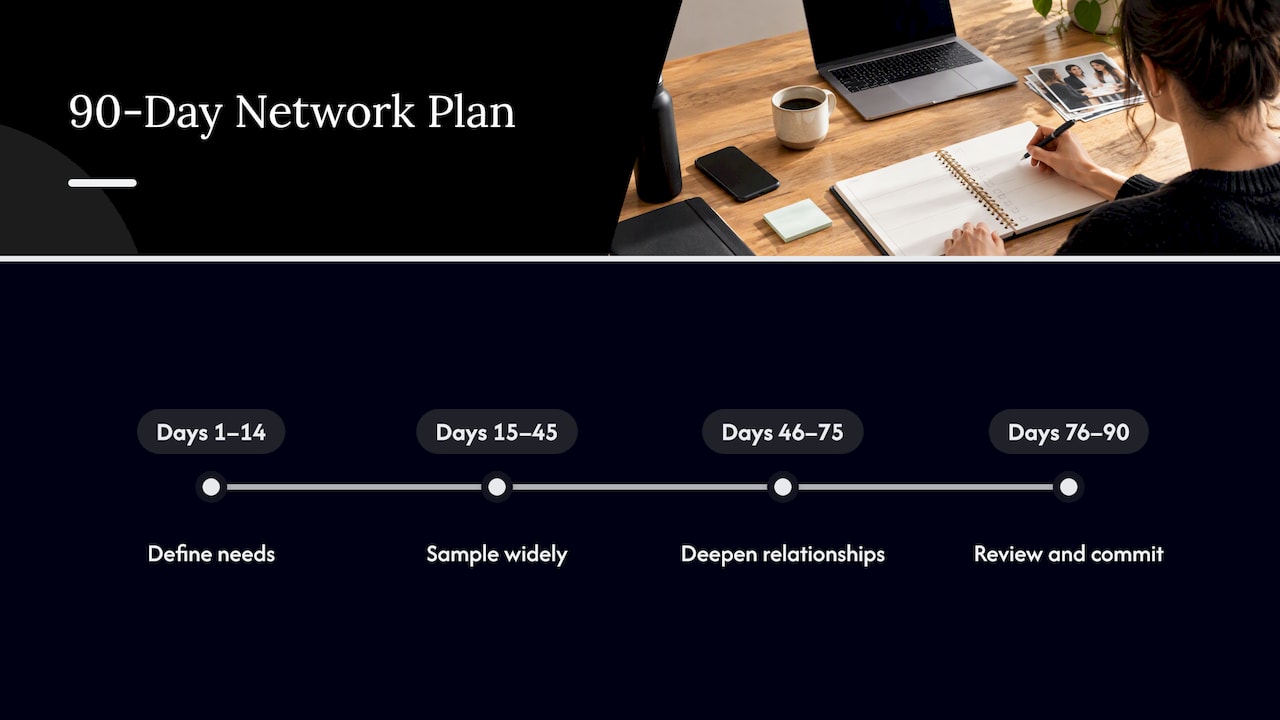
Days 1 to 14: define the need. Write down your three biggest bottlenecks, such as pricing, getting clients or hiring. Next to each, name the kind of person who could help.
Days 15 to 45: sample widely. Attend one online community event, one local meetup and one event in a format you have not tried. Take notes on who you wanted to talk to again, not on who had the biggest title.
Days 46 to 75: go deep with two or three. Pick people, not groups. Propose a fixed fortnightly call with one founder at your stage. Offer something first: an introduction, a critique, a template.
Days 76 to 90: review and commit. Which spaces produced a mentor, a client lead or a decision you would not have made alone? Keep those and drop the rest. If you feel you need a concentrated push, this is a good moment to book an intensive.
We have written more on why remote work communities help entrepreneurs and on how mentorship programs compare, which pairs well with this plan.
Practical habits that make any network pay off
- Ask specific questions. “Does anyone have thoughts on pricing?” gets silence. “I charge $90 an hour for brand strategy and lose a third of proposals at that price. What would you test?” gets answers.
- Share results, including the failures. Members trust people who report what did not work.
- Follow up within 48 hours. A short note referencing the conversation turns a chat into a relationship.
- Protect your time. Two networks used well beat six used badly.
- Say no to forced networking. Interest-based clusters and structured dialogue keep people engaged longer than open mingling, which is why many of the better-run communities avoid pressure to promote.
If you are a company leader rather than a solo founder, the same logic applies to teams. A retreat that gives people shared work and shared meals builds trust that a quarterly video call cannot. Read what a company retreat involves if you are considering one.
FAQ
What is a women entrepreneur network?
It is a group, online or in person, that connects women who run or are starting businesses so they can share advice, find mentors, make referrals and sometimes access funding or contracts. Formats range from free social media groups to selective paid collectives and government-linked programs.
Are women entrepreneur networks worth paying for?
Sometimes. A paid network is worth it when you can name the specific benefit, such as a peer group at your stage or a mentor, and you will use it. Ask to speak with a current member and check what members do after the first month. If the answers are vague, try a free group first.
Can I join one if I work remotely or travel a lot?
Yes, and online communities are built for it. Founders who move often usually get the most from a hybrid: regular virtual contact plus an occasional in-person program that turns online contacts into trusted relationships.
Do I need certification to benefit from a network?
No. Certification such as the SBA’s WOSB program matters mainly if you want to compete for federal contracts, and the SBA notes the benefits apply only to federal contracting. Most networks for early-stage founders require no certification.
Is Nomad Excel a women-only network?
No. Our bootcamps welcome aspiring and early-stage entrepreneurs, including freelancers, small business owners and digital nomads. Our focus is on practical business building, mentorship and a community that stays active after the program, which many women founders find useful alongside a dedicated women’s network.
Sources
- IFC and Goldman Sachs 10,000 Women press release, September 2025
- Women Entrepreneurs Finance Initiative (We-Fi)
- WIMBIZ, About us
- Goldman Sachs 10,000 Women India report 2023
- Community Inc., on building an entrepreneur collective
- U.S. Small Business Administration, WOSB Federal Contract program