
The Entrepreneurship Network: TEN or GEN? Verify Before You Apply
The Entrepreneurship Network (TEN) is a community-focused organization that lists virtual incubation programs, cohort-based learning, and startup support resources for early founders. If you are checking out its programs or weighing a job listing, the fastest path to clarity is the official website and its LinkedIn page, where current cohorts, openings, and terms are posted directly.
TL;DR:
- TEN is separate from the Global Entrepreneurship Network, active in roughly 170 to 200 countries; verify the organization before applying, paying, or sending a resume.
- TEN listings describe virtual incubation, cohort lessons, mentorship, and workshops, but prices, program lengths, and free or paid status differ by offering.
- Before committing, request the exact syllabus, cohort start date, total cost, and whether mentorship is scheduled or available on demand; vague answers warrant caution.
- Job seekers should verify openings on TEN’s official channels and confirm time zone, remote status, and whether internships or associate roles are paid.
- Nomad Excel lists online bootcamps at 300 EUR and 500 EUR, while destination programs require a 400 EUR registration fee, not the full program price.
Table of Contents
- Company Profile and Mission: Who TEN Serves
- Programs and Services Reported for TEN
- Who Runs TEN and How to Verify Leadership
- Reputation Snapshot: Reviews and Business Data
- Actionable Steps to Apply or Check Job Openings
- Publisher Perspective: Nomad Excel’s Program Approach
- Inside the Flagship Entrepreneurship Bootcamps
- Company Retreats and Bootcamps for Teams
- Pricing and Cost Structure for Individuals and Companies
- Typical Schedule for Programs and Retreats
- Mentorship and Expert Involvement During Programs
- Community and Support After the Program Ends
- How to Think About TEN Versus Other Network Models
- Nomad Excel: A Direct Route to Immersive Bootcamps and Retreats
- FAQ
- Sources
Company Profile and Mission: Who TEN Serves
TEN positions itself as an education and community platform built around early-stage founders, students, and aspiring entrepreneurs who want structured support rather than a solo path. Its public profiles describe a mix of virtual programming, peer community, and mentorship aimed at people testing a business idea or taking first steps toward launch.
A few things are worth separating before you go further:
- TEN is distinct from GEN (Global Entrepreneurship Network), a much larger international body that runs programs and chapters across roughly 170 to 200 countries.
- The naming overlap is common and causes real confusion in search results and casual conversation.
- Confirming which organization you are looking at matters before you apply, pay a fee, or submit a resume.
If your goal is a global, government-linked entrepreneurship ecosystem with chapters worldwide, GEN is the organization you want. If you are looking at TEN specifically, its scope reads smaller and more community-driven, closer to a startup support hub than a multinational network.
Programs and Services Reported for TEN
Public listings describe TEN’s offerings as a blend of virtual incubation, structured cohorts, and lighter-touch community events rather than a single flagship product. The typical model groups a cohort of founders together for a defined stretch of weeks, paired with mentorship check-ins and workshop sessions.
Across the programs referenced in org and job listings, a few patterns repeat:
- Virtual incubation tracks that walk early founders through idea validation and basic business planning.
- Cohort-based learning, where participants move through the same curriculum together on a set schedule.
- Mentorship touchpoints, often delivered by volunteer or affiliated entrepreneurs rather than a fixed in-house faculty.
- Community events and workshops that supplement the core curriculum with guest sessions or networking calls.
Participants commonly report gaining a clearer sense of their minimum viable product, exposure to mentors, and a peer group they can lean on during the early grind. What is less consistent across public sources is pricing, program length, and whether a given track is free or paid.
Pro Tip: Before you commit time or money, ask for the exact syllabus, the cohort start date, and whether mentorship is scheduled or on-demand. A vague answer to any of those three questions is worth noticing.
Who Runs TEN and How to Verify Leadership
Org-chart listings tie TEN to a named co-founder and CEO, with TheOrg’s profile showing leadership connected to several TEN-related ventures rather than a single standalone entity. That structure is common among smaller education and community startups that spin up adjacent brands over time.
Before trusting any program claim, it helps to run a short verification pass:
- Search the named leader’s LinkedIn profile and check that their history matches what is described on TEN’s own site.
- Cross-reference the TheOrg entry against current LinkedIn titles, since org charts can lag behind real staffing changes.
- Look for a bio page on the official site itself, not just a mention in a press release or directory.
Leadership background matters here mainly for program credibility: a founder with real operating experience lends more weight to mentorship claims than a title alone.
Reputation Snapshot: Reviews and Business Data
Employer-review platforms such as Glassdoor and AmbitionBox host employee ratings and comments for TEN, with recurring themes centered on the learning experience for junior staff and mixed feedback on compensation and growth paths. Business-data listings in the Growjo style add estimated employee counts and revenue figures, but these are modeled estimates, not confirmed company disclosures.
Treat third-party estimates as a starting point, not a verified fact: confirm current size, funding, and hiring status directly with the organization before making a decision.
A few practical notes for job seekers and prospective participants:
- TEN-related openings commonly surface on LinkedIn and platforms like Internshala, often labeled internship or associate roles.
- Many listed roles specify remote or virtual work, so confirm time zone expectations and whether the role is paid, unpaid, or stipended.
- When employer reviews are sparse or dated, recent social posts and current job listings tell you more than an old aggregate rating.
Actionable Steps to Apply or Check Job Openings
Getting a straight answer on programs or roles takes a short, repeatable routine rather than guesswork:
- Visit the official TEN website and look for an active application link tied to the specific program you want.
- Check LinkedIn, X, and Facebook for posts in the last few weeks mentioning cohort start dates or open roles.
- Prepare a short resume or founder bio, a one-paragraph pitch of your idea or background, and two or three portfolio examples if relevant.
- Before signing anything or submitting payment, ask directly about program length, total cost, mentorship format, and whether the role or seat is remote.
This same four-step pattern works whether you are applying as a founder or scanning for an internship, and it protects you from acting on outdated listings.
Publisher Perspective: Nomad Excel’s Program Approach
We built this guide from the publisher side: we run immersive entrepreneurship bootcamps and company retreats, so we think about program structure, mentorship design, and cohort dynamics daily. That vantage point shapes how we read organizations like TEN and what questions we think matter most for prospective participants.
A short summary of how our own model works, for context:
- Bootcamps run as in-person sprints of one to four weeks, built around daily execution rather than passive lectures.
- Mentorship comes from working entrepreneurs, marketers, and operators, not a generic curriculum.
- Community formed during the bootcamp tends to outlast the program itself, with participants staying in touch and collaborating afterward.
Structured accountability and a defined end date change how founders execute, compared with open-ended, self-paced tracks.
— Amichai
Inside the Flagship Entrepreneurship Bootcamps
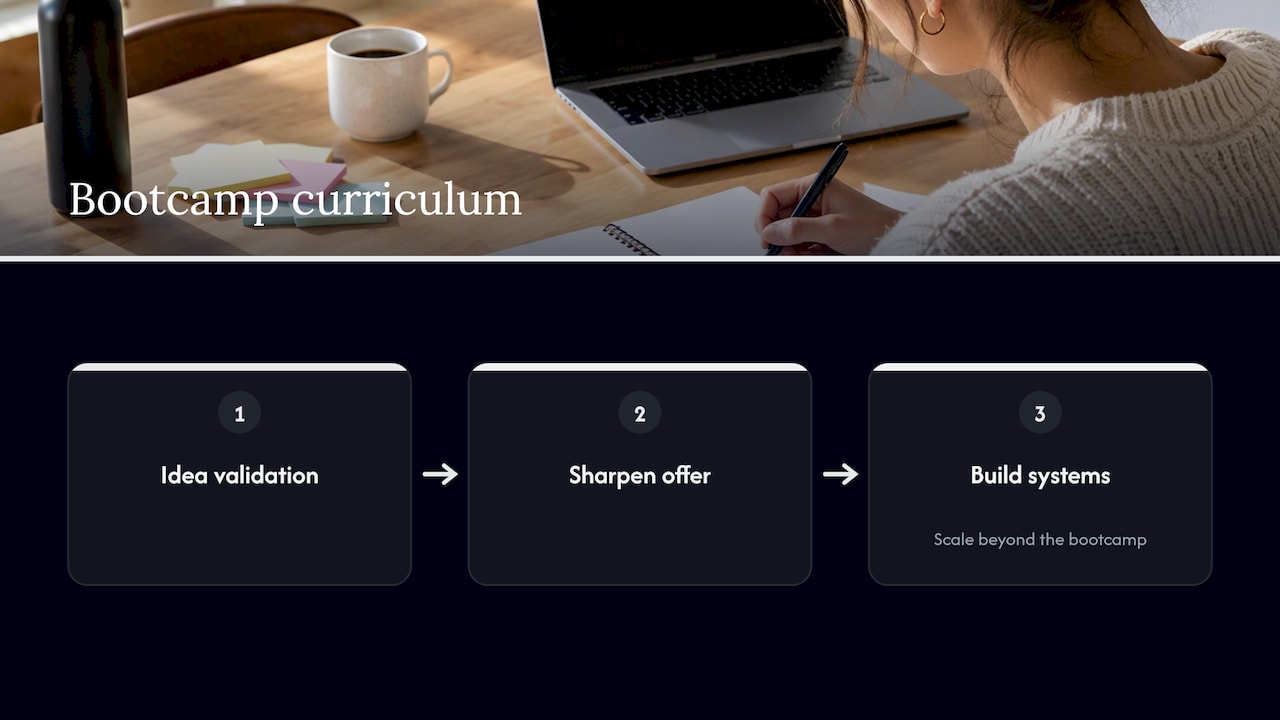
Our flagship bootcamps run as in-person sprints lasting one to four weeks, held at inspiring global destinations that help founders step away from their usual routine and focus, often enhanced by advanced AI integration services to streamline workflows and accelerate learning. The curriculum moves through validating a business idea, sharpening an offer, and building systems that can scale past the bootcamp itself, with daily structure that favors doing over discussing.
Participants typically arrive as aspiring or early-stage founders, freelancers, or digital nomads who already have an idea or small business and want to accelerate it rather than start from zero. Days combine workshop blocks, mentor sessions, and structured work sprints, with accountability checkpoints that keep momentum from stalling the way it often does when founders work alone.
Specific formats include the 5-Day Online AI Bootcamp, the Online Business Bootcamp, and in-person sprints such as the Entrepreneurship Sprint Bootcamp hosted at Idea Space and at Second Home in Lisbon. Longer destination formats run in various locations, each pairing the same core curriculum with a different setting and group dynamic. The thread across every format is the same: structured sprints, direct mentorship, and a cohort small enough that no one disappears into the background.
Company Retreats and Bootcamps for Teams
For organizations rather than individual founders, we design custom retreats focused on alignment, leadership development, and renewed creative energy rather than individual business building. These programs are built end to end, from workshop content and facilitation through logistics and local experiences, so a team shows up and the structure is already handled.
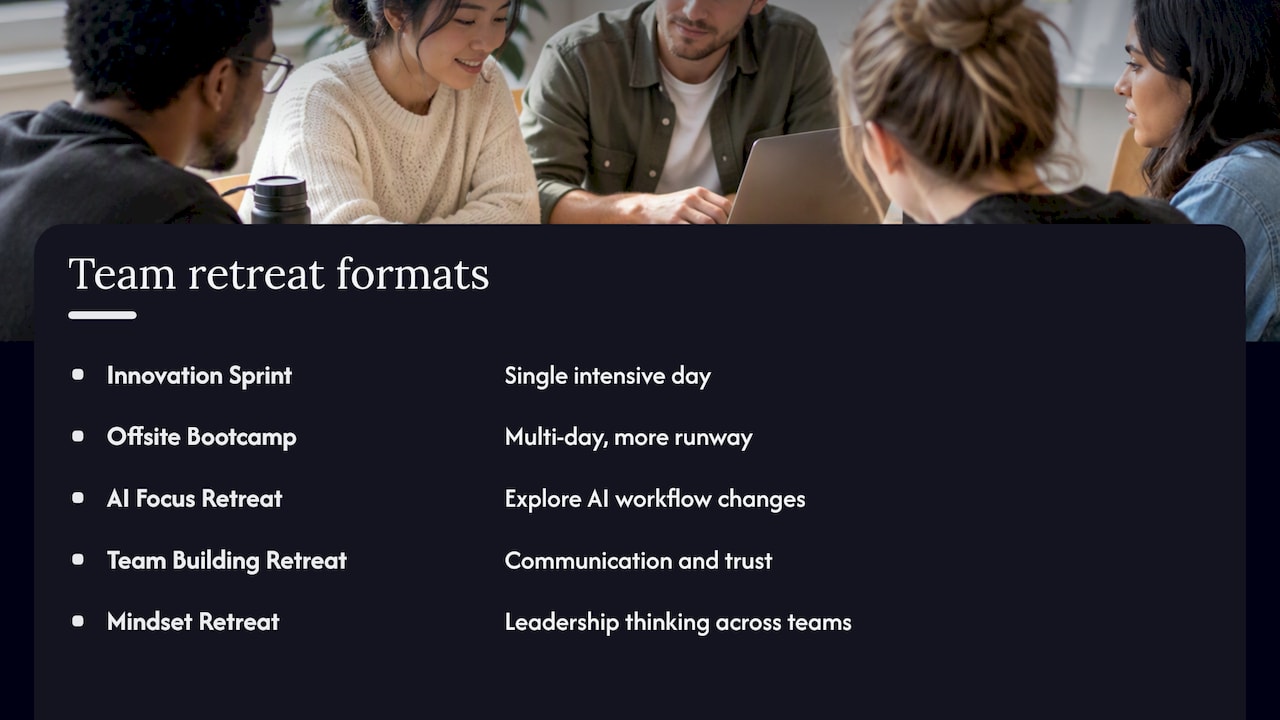
Customization runs across several formats: an Innovation Sprint delivered as a single intensive day, a multi-day Offsite Bootcamp for teams that need more runway, an AI Focus Retreat for groups exploring how artificial intelligence changes their workflow, a Personal skill and Team Building Retreat centered on communication and trust, and an Entrepreneurial Mindset Retreat aimed at building leadership thinking across a team. Each can be adapted to a company’s size, industry, and specific goals rather than following a fixed template.
Typical outcomes include stronger communication and trust among team members, clearer alignment around shared goals, and a team that returns to daily work with renewed focus rather than lingering burnout. The combination of business-relevant content and a genuine change of environment is what separates a retreat like this from a standard offsite meeting or team lunch.
Pricing and Cost Structure for Individuals and Companies
Individual bootcamp pricing is published directly and varies by format and length. The 5-Day Online AI Bootcamp costs 300 EUR as a one-time fee, and the Online Business Bootcamp runs 500 EUR one-off. In-person sprints cost more given the destination and depth: the Entrepreneurship Sprint Bootcamp at Idea Space in Lisbon is priced at 1,350 EUR one-off, while the version hosted at Second Home in Lisbon runs 1,500 EUR one-off.
Longer destination bootcamps use a registration-fee structure rather than a single all-in price. The 2-Week Entrepreneurship Bootcamp in Playa Venao, Panama, the 10-Day Entrepreneurship Bootcamp in Pipa, Brazil, and the 1-Week Entrepreneurship Bootcamp in Agaete, Canary Islands, each carry a registration fee of 400 EUR one-off.
Company retreats and bootcamps, including various thematic retreats and sprints, do not carry a published price since each is scoped to the team’s size and goals. Pricing for these is available on request once we understand what a given team needs.
Typical Schedule for Programs and Retreats
Online bootcamp formats run on the shorter end, with the 5-Day Online AI Bootcamp completing in under a week and the Online Business Bootcamp following a similarly compact structure for founders who need flexibility around existing commitments.
In-person sprint bootcamps at Idea Space and Second Home in Lisbon run as focused multi-day sessions designed to fit around a short trip, while the destination bootcamps in Panama, Brazil, and the Canary Islands stretch from one week to two weeks depending on location, giving founders more time to absorb the curriculum and build real relationships with the cohort.
Company retreats follow a different logic since length depends entirely on what a team needs: the Innovation Sprint fits into a single day, while an Offsite Bootcamp spans multiple days of workshops and facilitated sessions. Scheduling for retreats typically starts with a conversation about team goals before a specific agenda and timeline gets built around them.
Mentorship and Expert Involvement During Programs
Mentorship across our bootcamps comes from working entrepreneurs, marketers, and operators rather than career instructors reading from a fixed script. That distinction matters because guidance reflects what currently works in the market, not theory detached from execution.
During bootcamps, mentors typically show up in a few recurring roles: leading workshop sessions on specific skills like offer design or validation, running one-on-one or small-group check-ins tied to each founder’s specific business, and contributing to the daily accountability structure that keeps participants moving instead of stalling on planning.
Company retreats draw on a similar pool of experienced facilitators, adapted to whatever theme the retreat is built around, whether that is leadership development, team alignment, or building entrepreneurial thinking inside an existing organization. In both formats, mentorship is woven into the daily structure rather than offered as a single guest lecture, which keeps the guidance tied directly to the work participants are doing that same day.
Community and Support After the Program Ends
The relationships built during a bootcamp rarely end when the program does. Our model treats community as a long-term asset: founders who go through a cohort together tend to stay in touch, share updates on their businesses, and continue supporting each other well past the final day.
That ongoing connection shows up in a few practical ways: informal check-ins among former cohort members, continued access to the network built during the program, and the kind of peer accountability that is hard to manufacture outside a shared intensive experience. For founders working alone most of the time, that sustained community can matter as much as the curriculum itself, since isolation is one of the more common obstacles to following through on a plan. You can read more about why community supports long-term founder growth and how cohort learning tends to improve outcomes compared with solo study.
How to Think About TEN Versus Other Network Models
Entrepreneurship support generally falls into a few distinct models: venture-building studios that co-create companies, membership communities built around peer coaching, and referral networks focused on introductions. Before committing to TEN or any similar organization, ask directly about intensity, concrete deliverables, and how mentorship actually gets scheduled. If you want hands-on, structured execution with a defined end date, a bootcamp or retreat format usually delivers that more reliably than an open-ended membership.
— Amichai
Nomad Excel: A Direct Route to Immersive Bootcamps and Retreats
If what you are really after is structured execution rather than an open-ended community, our online entrepreneurship bootcamp gives you a defined curriculum, daily accountability, and mentorship from working entrepreneurs instead of a loosely scheduled cohort. For founders who want the in-person version, our destination sprints in Lisbon, Panama, Brazil, and the Canary Islands pair the same hands-on framework with a change of environment that tends to sharpen focus fast.
For teams and companies, our custom retreats handle everything end to end, from workshop design to logistics, so leadership can focus on the goals rather than the planning. If a structured path with clear dates and real mentorship sounds closer to what you need than a loosely defined network, our guide to joining an entrepreneurship bootcamp walks through what to expect and how to pick the right format for where you are right now.
FAQ
Is entrepreneurship a company?
No, entrepreneurship is the broader activity of starting and running a business, not a single company. Organizations with “entrepreneurship” in their name, including The Entrepreneurship Network, are companies or nonprofits that support that activity through programs, mentorship, or community.
What is the TEN platform?
TEN refers to The Entrepreneurship Network, a community-focused organization offering virtual incubation, cohort-based programs, and mentorship for early-stage founders and students. Program details, costs, and current openings are confirmed directly through its official website and LinkedIn page rather than through secondhand listings.
Who founded The Entrepreneurship Network?
Public org-chart listings identify a named co-founder and CEO associated with The Entrepreneurship Network, tied to several related ventures under the same leadership. For the most current bio and title, checking the leader’s LinkedIn profile directly is the most reliable step.
Who founded the Global Entrepreneurship Network?
The Global Entrepreneurship Network (GEN) is a separate international organization from The Entrepreneurship Network, operating chapters and programs across roughly 170 to 200 countries. GEN’s own site is the most reliable place to confirm its founding history and current leadership rather than secondhand summaries.
How do I verify a program before applying or paying?
Start with the official program page, then check recent LinkedIn or social posts for cohort dates and activity. Before paying, request written confirmation of program length, total cost, and mentorship structure, and treat third-party review sites like SCORE’s free mentoring resources as a useful comparison point for what a legitimate support organization typically offers.
Sources
- GEN Global
- The 5 types of business networking organizations — Entrepreneur
- SCORE | Free Business Mentoring, Workshops & Resources – SCORE