
Validate Ecommerce Business Model Canvas in Two Weeks for Founders
Yes: use a Business Model Canvas tailored to ecommerce. Start by sketching four boxes today: your customer segments, your value proposition, your primary channel, and one revenue stream. Give yourself two to four weeks to test those assumptions with real customers before you touch the other five blocks. Success at this stage means one validated hypothesis, not a finished document.
TL;DR:
- Less than two weeks of testing can validate or disprove key hypotheses about customer demand, supply constraints, and pricing before scaling or investing heavily.
- Focusing on desirability blocks first ensures your value proposition and channels are aligned with real customer behavior, reducing costly missteps.
- Running three low-cost tests, such as landing pages or small orders, helps confirm assumptions about marketing effectiveness, fulfillment, and revenue streams.
- Tracking metrics like customer acquisition cost, lifetime value, and contribution margin is essential to measure your business model’s viability and prioritize adjustments.
- Prioritize rapid iteration with mentor and peer feedback over perfecting the initial plan, as real unit economics and repeat purchase rates dictate long-term success.
Table of Contents
- How Do You Fill Out a Business Model Canvas for Ecommerce?
- What Goes in Each Block of an Ecommerce Business Model Canvas?
- Three Ecommerce Business Model Canvas Examples to Copy
- Which KPIs Prove Your Ecommerce Canvas Actually Works?
- Templates and Tools to Build Your Canvas This Week
- Why Hands-On Sprints Speed Up Canvas Execution
- What I’d Prioritize First on an Ecommerce Canvas
- Want Guided Help Turning Your Canvas Into a Real Business?
- Sources
- FAQ
How Do You Fill Out a Business Model Canvas for Ecommerce?
The nine-block framework built by Strategyzer was never written with online stores in mind, so the real work is translating each block into questions an ecommerce founder can answer this week. Here’s the order that actually gets results, based on what tends to break first when new stores launch.
- Gather your inputs before you write anything. Pull your analytics (even if it’s just three weeks of Meta ad data), talk to five potential customers, and confirm your supply constraints, minimum order quantities, and shipping realities.
- Fill the desirability blocks first. Customer Segments, Value Proposition, Channels, and Customer Relationships all answer “will anyone actually want this?” Write these as testable claims, not descriptions. “Busy parents will pay a premium for 15-minute meal kits” is testable. “We serve busy parents” is not.
- Document feasibility next. Key Activities, Key Resources, and Key Partnerships cover whether you can actually deliver. List your fulfillment partner, your supplier lead times, and the one piece of your tech stack you can’t operate without.
- Map revenue and cost last. Once you know who’s buying and how you’ll reach them, define your Revenue Streams and Cost Structure, then run the numbers: contribution margin per order and a rough LTV to CAC ratio.
- Run three cheap tests before building anything permanent. A landing page with a waitlist, a small-batch fulfillment run of 20 to 50 units, and a pre-order campaign each validate a different assumption without draining your budget.
- Set a two-week review cadence. Strategyzer’s own guidance on assessing business model design emphasizes testing assumptions in the market rather than refining them on paper, and ecommerce moves fast enough that a two-week loop catches problems before they get expensive.
Pro Tip: Treat your first canvas as a draft you’re allowed to be wrong about. The founders who get stuck are the ones trying to perfect the document instead of testing the riskiest assumption in it.
What Goes in Each Block of an Ecommerce Business Model Canvas?
Each of the nine blocks needs a different kind of thinking for a digital storefront than it does for a brick-and-mortar shop or a software company. Here’s what to actually write in each one.
Customer Segments. Skip vague personas. Segment by purchase behavior and value: first-time buyers, repeat customers, and high-AOV outliers behave differently and need different messaging. If you sell both wholesale and direct, that’s two segments, not one.
Value Proposition. For ecommerce, this almost always comes down to price, assortment, convenience, brand story, or a subscription convenience play. Pick one or two as your lead. Trying to compete on all five is how margins disappear.
Channels. Decide early whether you’re a direct-to-consumer (DTC) brand, a marketplace seller, or a hybrid. DTC gives you customer data and margin control; marketplaces like Amazon or Etsy give you built-in traffic at the cost of a take rate and less relationship ownership. Social commerce sits in between, useful for discovery but rarely for retention on its own. Shopify’s guide to the canvas frames channel choice as one of the clearest ways the tool forces founders to commit instead of trying to be everywhere at once.
Customer Relationships. This is your lifecycle plan: welcome flows, post-purchase email or SMS sequences, and a defined win-back trigger for lapsed buyers. Automate what you can; the goal is a faster path to a second purchase.
Revenue Streams. Name every stream separately: one-time transactional sales, subscription revenue, marketplace commissions if you also sell wholesale, and any B2B or bulk-order income. Blending them into one number hides which one is actually profitable.
Key Activities, Resources, and Partnerships. For most stores this means fulfillment, an order management system (OMS), your suppliers, and the core parts of your tech stack (payments, inventory sync, customer service). List each partner’s failure mode. If your 3PL goes down for a week, what happens?
Cost Structure. Separate variable costs (cost of goods sold, shipping, returns) from semi-fixed costs (platform fees, ad spend, salaries). This split is what lets you calculate contribution margin per order rather than a fuzzy overall margin number.
- Set a 20-minute timer per block and write in bullet form first, full sentences later.
- Use real numbers from your own store or your closest competitor’s public pricing, not placeholders.
- Cross out any block that duplicates another; overlap usually means you’re avoiding a harder question.
Pro Tip: If a block takes longer than 20 minutes, that’s usually a sign you don’t have the data yet, not that you need to think harder. Go get the data first.
Three Ecommerce Business Model Canvas Examples to Copy
Three quick sketches, one for each common ecommerce structure. Adapt the numbers to your own product before you commit to anything.
- DTC low-AOV consumer brand. Segments: value-conscious repeat buyers. Value proposition: convenience plus a subscribe-and-save discount.
Channels: owned site plus Meta and TikTok ads. Revenue: one-time purchase with a subscription upsell at checkout. Run these three tests: a $500 ad spend test on two creative angles, a subscription discount A/B test, and a fulfillment dry run with your first 50 orders. - Marketplace-enabled store. Segments: marketplace shoppers who compare on price and reviews. Value proposition: assortment depth and fast shipping via marketplace fulfillment programs. Revenue: per-unit sales minus marketplace commission, typically 8% to 15% depending on category. Test listing copy variants, a Buy Box pricing experiment, and a returns-rate check after your first 100 units.
- Subscription consumables brand. Segments: convenience-driven repeat buyers with a recurring need (coffee, supplements, pet food). Value proposition: predictable delivery and a lower per-unit price than one-off retail. Revenue: recurring subscription billing. Test your churn rate at 90 days, your fulfillment cost per box, and a win-back offer for the first cohort that cancels.
The full business model canvas examples library walks through more variations if none of these three match your product closely enough.
Which KPIs Prove Your Ecommerce Canvas Actually Works?
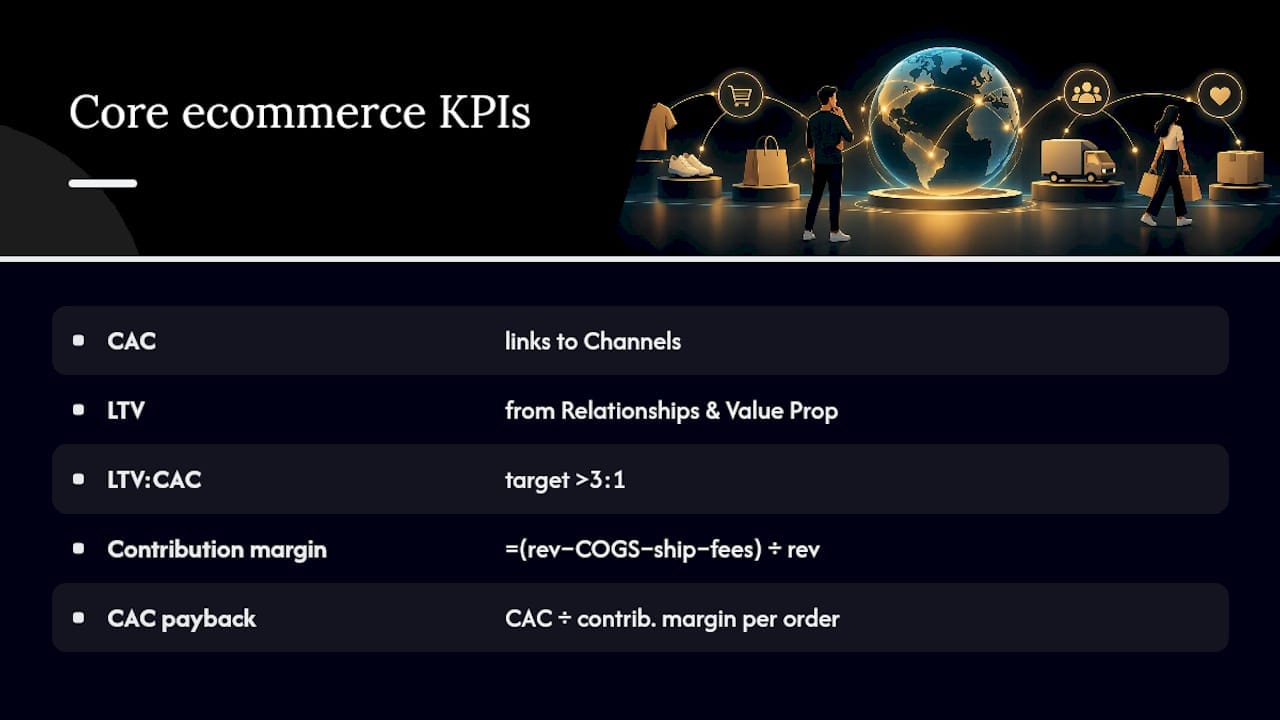
Every box on the canvas eventually shows up as a number, and connecting the two is what separates a strategy document from a working business. Customer acquisition cost (CAC) traces directly back to your Channels block. Lifetime value (LTV) traces back to Customer Relationships and how strong your Value Proposition actually is once someone has bought once. Contribution margin traces back to Cost Structure.
The formulas are simple spreadsheet math. LTV divided by CAC gives your ratio; most ecommerce operators aim for something north of 3:1. Contribution margin equals revenue minus COGS, shipping, and payment processing fees, then divided by revenue for a percentage. CAC payback period is your CAC divided by contribution margin per order, which tells you how many repeat purchases it takes to break even on acquiring that customer.
Large cross-brand DTC datasets show that retention and unit economics predict long-term survival more reliably than acquisition volume does, according to the 2025 DTC Mega Report, which analyzed $10.1 billion in sales across hundreds of brands.
Repeat-purchase rates and LTV benchmarks vary sharply by product category, and ecommerce cohorts tend to drop off far faster by month 12 than subscription businesses do, per customer lifetime value benchmark data. Build your benchmark against your own vertical, not a generic average.
For instrumentation, the smallest workable setup in your first 90 days is a store analytics platform, a basic customer relationship management (CRM) or email tool that tags first versus repeat purchases, and one dashboard that tracks CAC, AOV, and contribution margin weekly. Trade frames this as treating your canvas like a hypothesis tracker feeding your analytics, rather than a static plan you write once and file away.
Templates and Tools to Build Your Canvas This Week
Start with the official Strategyzer template for the base layout, and pair it with an ecommerce-specific PDF framework if you want prompts already adapted to online retail.
For tools, prioritize five categories: analytics (store-native reporting is fine to start), an order management system once you cross roughly 50 orders a week, email or SMS automation for lifecycle marketing, a landing-page tool for pre-launch testing, and a payment processor with built-in fraud screening. If organic channel growth matters to your strategy, a programmatic SEO rollout playbook shows how to scale content-driven traffic alongside paid acquisition.
Your 90-day checklist: fill the four desirability blocks, run one landing-page test, confirm one fulfillment partner, define your revenue streams, calculate contribution margin, launch to a small list, measure repeat-purchase rate at day 30, and revise one block based on what broke.
Why Hands-On Sprints Speed Up Canvas Execution
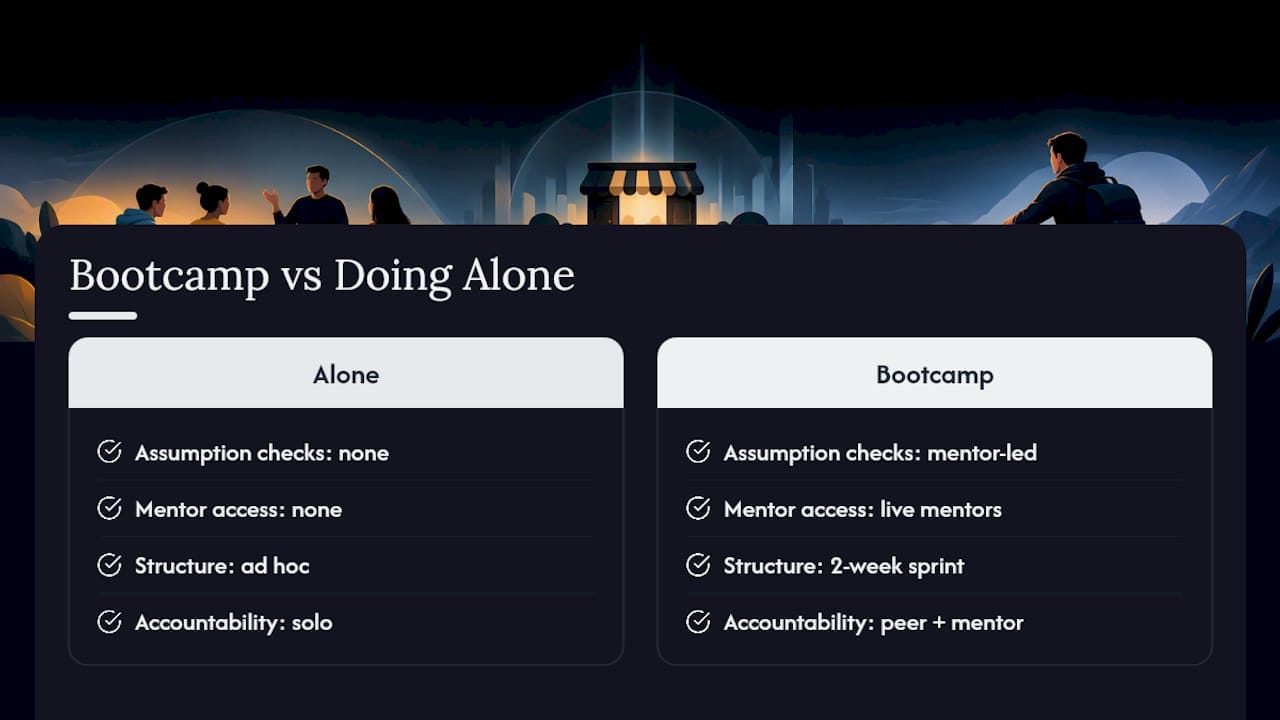
A canvas on paper doesn’t test itself. What compresses the timeline from plan to validated business is mentor feedback that catches a bad assumption before you spend on it, peer critique from other founders solving similar problems, and the accountability of a sprint deadline instead of an open-ended to-do list.
A one-day canvas sprint that ends with one landing-page test and one fulfillment test gives you a testable go-to-market hypothesis in 24 hours instead of a plan that sits untouched for a month.
A workable one-day agenda: morning spent on Customer Segments and Value Proposition with peer critique built in, midday on Channels and Revenue Streams with a mentor review, afternoon spent launching one live test before the day ends.
What I’d Prioritize First on an Ecommerce Canvas
Perfection on paper is a trap. I’d rather see a founder with a messy canvas and real unit economics than a polished one built on guesses. Pivot the canvas when your CAC to LTV ratio refuses to improve after two honest test cycles; double down when repeat-purchase rate climbs even slightly, because that’s the metric hardest to fake. Community and mentorship shorten the distance between a guess and a validated fact, and that distance is where most first-time founders lose months they didn’t need to lose.
— Amichai
Want Guided Help Turning Your Canvas Into a Real Business?
Reading about the canvas gets you the framework. Filling it in alone, without anyone to challenge your assumptions, is where most first-time founders lose weeks second-guessing boxes they already got right. Nomadexcel’s Online Entrepreneurship Bootcamp runs founders through exactly this process in a structured sprint, with mentors reviewing your Value Proposition and Channels blocks in real time instead of you guessing alone at a laptop. Pricing details are available on their website. The program pairs canvas work with the sprint structure, peer accountability, and follow-up support described above. It fits early-stage founders who have a product idea but want someone experienced checking their unit economics before they spend on ads or inventory. If you’d rather see what the format involves first, the entrepreneurship bootcamp guide breaks down what a typical week looks like before you commit to a seat.
Sources
For deeper detail beyond this guide, consult Strategyzer’s official canvas template, Trade.gov’s ecommerce strategy resources, and Nomadexcel’s why the canvas matters breakdown for a guided practice path.
- Business Model Canvas – Download the Official Template
- eCommerce Key Performance Indicators
- How To Use a Business Model Canvas Template (2024) – Shopify
FAQ
What Is the Business Model of Ecommerce?
An ecommerce business model describes how an online store creates, delivers, and captures value, typically through a mix of DTC sales, marketplace listings, or subscriptions. Most stores combine at least two revenue streams, such as one-time purchases and subscription upsells, to diversify income and lift LTV.
What Are the Main Ecommerce Business Models Founders Should Know?
The most common models are direct-to-consumer, marketplace selling, subscription boxes, wholesale or B2B, dropshipping, print-on-demand, and digital products. Each demands different answers in the Channels and Revenue Streams blocks of the canvas, so the seven ecommerce models breakdown is worth reviewing before you lock in your structure.
What Are the Nine Building Blocks of the Business Model Canvas?
The nine blocks are Customer Segments, Value Proposition, Channels, Customer Relationships, Revenue Streams, Key Activities, Key Resources, Key Partnerships, and Cost Structure, as defined by the official Strategyzer framework. For ecommerce, each block gets adapted into a specific, testable prompt rather than a generic description.
What Is the B2B Model of Ecommerce?
B2B ecommerce involves one business selling products or services to another business online, usually through bulk pricing, invoicing terms, and account-based Customer Relationships rather than one-time checkout flows. It shows up on the canvas as a distinct Customer Segment and Revenue Stream from any consumer-facing sales the same store might run.
How Long Should It Take to Complete an Ecommerce Canvas?
A first draft should take two to three hours if you already have some customer data and supplier information gathered beforehand. Validating the assumptions inside it, through landing pages, pre-orders, or small fulfillment runs, typically takes two to four weeks before you have enough evidence to revise the canvas confidently.