
Build a 6–12 Month Executive Development Plan HR Can Actually Use
Executive development is a strategic, sustained set of experiences that prepare senior leaders and high-potential successors to take on broader enterprise responsibility. It works through coaching, stretch rotations, executive education, peer cohorts, and board exposure, all aimed at sharpening judgment rather than teaching a discrete skill. Done well, it feeds directly into succession planning, turning “who could run this someday” into a documented, tested answer.
TL;DR:
- Executive development programs should focus on sharpening judgment through immersive experiences like stretch assignments, coaching, and peer learning, not just technical skills.
- Success depends on active sponsorship, clear competency frameworks tied to strategic roles, and continuous measurement of promotion and business KPIs.
- Program design must start with precise role and skill gap definitions, involving blended learning, milestones, and accountable sponsors to ensure behavior change.
- Digital tools, simulations, and personalized plans are transforming delivery methods, emphasizing ongoing tracking and real-time feedback over traditional static curricula.
- Measuring ROI requires tracking promotion rates, business outcomes, and retention, with a focus on how leadership judgment translates into tangible organizational results.
Table of Contents
- What Is Executive Development, Exactly?
- Why Does Executive Development Matter to the Business?
- How Is Executive Development Different From Leadership Training?
- What Skills Does Executive Development Actually Target?
- How Do You Design an Executive Development Program?
- What Does an Executive Development Plan Look Like?
- University Programs, Internal Tracks, or Immersive Cohorts?
- How Nomad Excel Maps to Executive Development Principles
- What Gets in the Way of Effective Executive Development?
- What’s Changing in Executive Development Right Now?
- How Do You Measure ROI on Executive Development?
- Ready to Build Your Program? Here’s What to Do First
- An Editorial Take on What Actually Moves the Needle
- Sources
What Is Executive Development, Exactly?
Executive development differs from a training course in one key way: it’s built around judgment, not tasks. Berkeley Executive Education frames it as immersive and time-sensitive, designed to sharpen strategic decision-making rather than teach technical proficiency. A leader doesn’t need a program to learn how to read a P&L statement. They need one to learn how to make a $40 million call with incomplete information and a room full of stakeholders who disagree.
The core components work together, not in isolation:
- Coaching and mentoring: One-on-one guidance from someone who has navigated the exact pressure the leader now faces, usually paired with 360-degree feedback.
- Rotational and stretch assignments: Moving a leader into an unfamiliar function or region forces them to build enterprise perspective instead of deepening a single lane.
- Executive education: Structured coursework, often through university-based business schools, that exposes leaders to frameworks and case studies from outside their own industry.
- Peer cohorts and action learning: Working through live business problems alongside other senior leaders, which surfaces blind spots that a solo review never would.
- Board exposure: Sitting in on governance conversations to understand how decisions get made at the level a leader is being groomed to reach.
Executive Development Programs typically blend several of these at once rather than running them as standalone modules.
Why Does Executive Development Matter to the Business?
Executive development matters because succession planning without it is guesswork. Organizations that wait until a vacancy appears to figure out who’s ready end up promoting on tenure instead of readiness, and the cost shows up fast in strategic missteps and turnover among the people who got passed over.
Leadership development research has shifted away from a narrow focus on individual traits toward building collective organizational capacity, aligning leaders’ efforts with strategic goals across the enterprise, not just improving one person’s presentation skills. That shift changes what “success” looks like for a program.
What to actually track:
- Internal promotion rate into senior roles versus external hires
- Time from identifying a successor to that person being ready
- Business KPIs tied directly to a leader’s remit, not just satisfaction scores
- Retention of high-potential leaders 12 to 24 months after program completion
Measuring readiness beats measuring satisfaction. Programs that only track how much participants enjoyed a workshop miss the point. The better signal is whether promotion-ready leaders actually get promoted and whether the business metrics they own improve afterward, a distinction leadership development research backs directly.
How Is Executive Development Different From Leadership Training?
Leadership training is broad, tactical, and often delivered to managers at every level to build baseline skills like feedback and delegation. Executive development is narrower and strategic: it targets senior leaders and named successors, runs over months or years instead of days, and ties directly to a specific future role.
Leadership training builds a foundation. Executive development builds a bench. If you’re preparing someone for a defined seat, whether it’s a business unit president or a future CEO, that’s executive development. If you’re raising the leadership capability of every people manager in the company, that’s leadership development, and it calls for a different design entirely.
What Skills Does Executive Development Actually Target?
Most programs organize around five competency areas, and a strong Executive Development Plan maps directly to them:
- Strategic thinking and judgment: Making sound calls with ambiguous or incomplete information.
- Stakeholder influence and presence: Communicating persuasively to boards, investors, and skeptical peers.
- Emotional intelligence and self-awareness: Recognizing blind spots before they become expensive mistakes.
- Financial and enterprise acumen: Reading the business the way a CFO or board member would, not just through one function’s lens.
- Change leadership and talent stewardship: Building the next layer of leaders while managing disruption in real time.
Pro Tip: Map each competency to a specific assessment tool before you design curriculum. A 360-degree review, a business simulation, and a stakeholder interview each surface different gaps, and a leader might be strong on judgment while genuinely weak on stakeholder presence.
How Do You Design an Executive Development Program?
A program built without a framework becomes a grab bag of workshops. Follow this sequence instead:
- Start with a competency framework tied to strategy. Define what “ready for the next level” actually means in your organization before you pick a single learning activity.
- Set selection criteria and assign sponsors. Choose participants based on documented potential and business need, and assign each one an executive sponsor accountable for their progress.
- Build a blended delivery model. Combine coaching, action learning, executive education, and rotational assignments. Blended programs that pair coaching with rotational experience and targeted academic input produce far better transfer of learning to real decisions than isolated classroom courses do.
- Establish measurement up front. Use 360-degree assessments at the start and end, track promotion and readiness rates, and connect the program to the business KPIs each leader owns.
- Budget and timeline realistically. Most substantial programs run 6 to 18 months and require sponsor time, not just a training budget line. Rushing the timeline to hit a fiscal year tends to produce shallow behavior change.
Skipping step one is the single most common design mistake. Everything downstream depends on a clear definition of the target role.
What Does an Executive Development Plan Look Like?
An Executive Development Plan (EDP) turns the framework above into something one leader can actually follow. A usable EDP contains six elements:
- Clear development objectives tied to a specific future role
- A gap analysis comparing current competencies to that role’s requirements
- Selected learning activities matched to each gap (coaching, rotation, course, project)
- Milestones with checkpoint dates, not just an end date
- A named sponsor accountable for removing obstacles
- Metrics that will define success
A workable 6 to 12 month structure looks like this:
- Months 1 to 2: Complete assessment and gap analysis; finalize the plan with the sponsor.
- Months 3 to 6: Begin coaching and a stretch assignment or cross-functional project.
- Months 6 to 9: Attend executive education or a structured cohort program; midpoint 360 review.
- Months 9 to 12: Present a business outcome tied to the stretch assignment; final readiness assessment.
Fold every EDP into existing performance reviews and succession discussions. A plan that lives in a separate binder gets forgotten by month four.
University Programs, Internal Tracks, or Immersive Cohorts?
Each format solves a different problem, and most serious programs use more than one.
- University executive education offers depth, faculty research, and a valuable external network, though it comes at real cost in both tuition and time away from the business. Executive education has grown into a large annual business in the U.S. precisely because business schools deliver that combination well, with schools like Harvard, MIT, and Tuck among the most frequently referenced providers.
- Internal tailored programs align tightly to company strategy and scale efficiently across a cohort, but they lean heavily on internal facilitation quality.
- Immersive cohort bootcamps and retreats compress behavior change into a short, intense window, useful when a business needs a fast shift in execution habits or team alignment rather than a slow academic build.
- Coaching and action learning work as the connective tissue across any format, converting classroom insight into workplace behavior change.
How Nomad Excel Maps to Executive Development Principles
Nomad Excel runs two program types that mirror the components above. Its entrepreneurship bootcamps bring founders together for one to four weeks of hands-on mentorship, structured execution sprints, and peer community, the same peer-cohort and action-learning mechanics that formal Executive Development Programs rely on.
Its custom company retreats apply that same immersive model to existing teams, focusing on strategic alignment, communication, and entrepreneurial thinking under real time pressure rather than in a classroom. Both formats trade the slow academic build for compressed, mentor-guided execution, daily accountability standing in for a semester-long syllabus.
What Gets in the Way of Effective Executive Development?
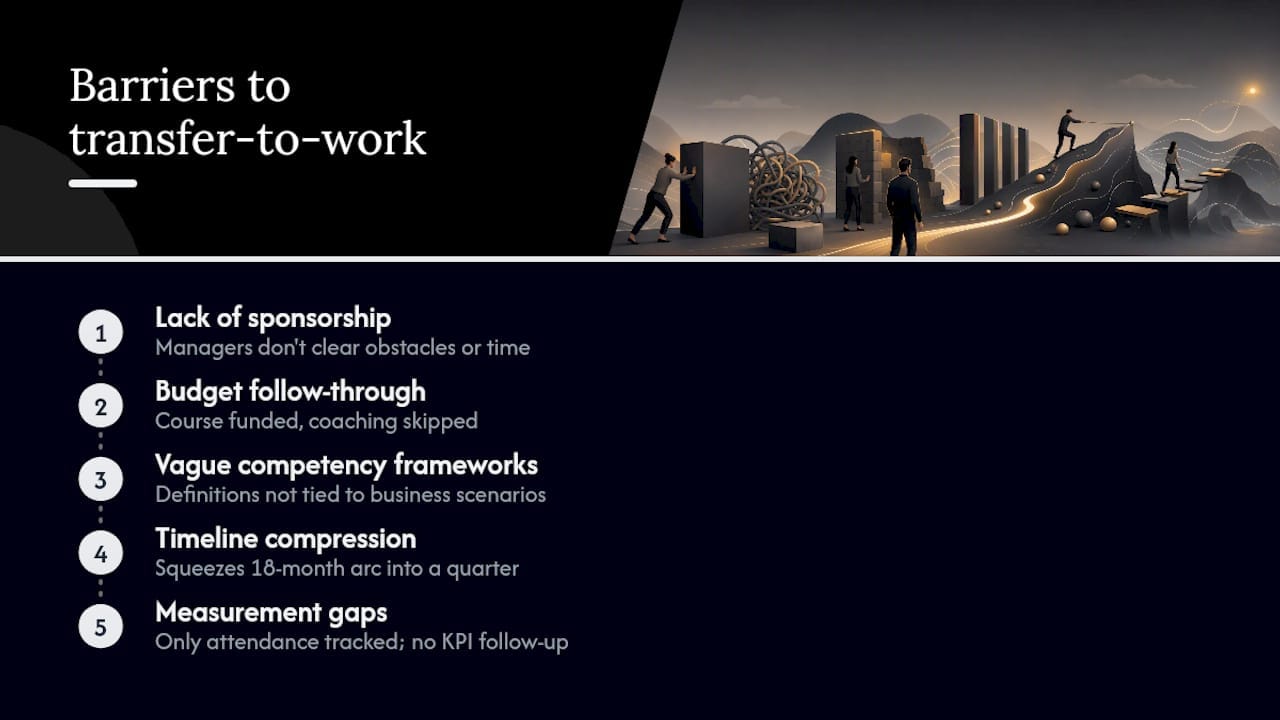
The most common failure isn’t a bad curriculum. It’s a lack of sponsorship. When a leader’s manager doesn’t actively remove obstacles or make time for the stretch assignment, even a well-designed EDP quietly stalls.
Budget without follow-through is the second-biggest barrier. Companies fund the executive education course but skip the coaching that turns classroom insight into changed behavior back on the job. Isolated coursework rarely transfers to workplace decisions the way a blended approach does, which is exactly why standalone academic programs underperform relative to combined models.
Vague competency frameworks cause a third failure mode. If “strategic thinking” isn’t defined against your actual business context, assessments become subjective and leaders can’t tell what “improved” even looks like. Fix this by defining each competency against real scenarios your senior leaders face, not generic leadership language pulled from a vendor’s slide deck.
Timeline compression kills the rest. Squeezing an 18-month development arc into a single fiscal quarter to satisfy a budget cycle produces a checklist, not changed judgment. Real behavior change under pressure, the kind an executive actually needs when the stakes are highest, takes sustained repetition, not a single offsite.
Measurement gaps round out the list. Programs that track attendance and satisfaction scores but never follow up on promotion rates or business KPIs can’t prove their own value, which makes them the first line item cut when budgets tighten. Solve for this before the program launches, not after someone asks for the ROI.
What’s Changing in Executive Development Right Now?
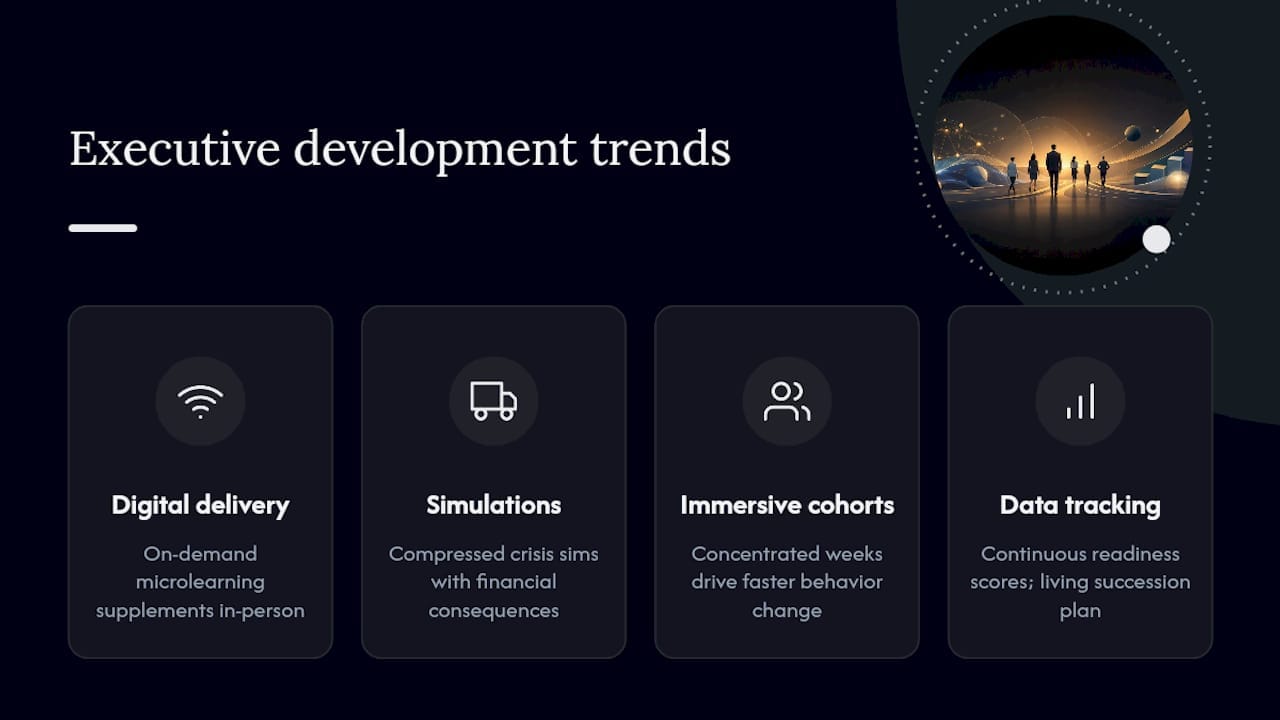
Digital delivery has moved from a stopgap to a permanent fixture. Virtual coaching platforms and on-demand microlearning now supplement, not replace, in-person immersion, letting leaders reinforce a concept between sessions instead of waiting months for the next workshop.
Experiential and simulation-based learning has grown alongside it. Business simulations that put leaders through a compressed crisis scenario, complete with real financial consequences inside the simulation, have become common because they force the same decision-making pressure a live crisis creates, without the live risk. This lines up with the broader shift in leadership development away from individual trait assessment and toward building collective, strategic capacity across a leadership team, not just polishing one person’s skill set.
Immersive, cohort-based formats have gained ground for a related reason: compressed time frames force faster behavior change than a spread-out weekly course ever manages. A concentrated week of peer accountability and mentorship tends to produce sharper shifts in execution habits than the same content delivered in ninety-minute sessions over three months.
Data-driven readiness tracking is the quieter trend, but arguably the most consequential one. Instead of a single annual talent review, more companies now track development progress continuously through structured check-ins and updated competency scores, treating succession planning as a living document rather than a spreadsheet dusted off once a year.
Personalization is the common thread across all of it. Generic, one-size-fits-all curricula are losing ground to plans built around one leader’s specific gaps, sequenced against their specific timeline to a specific role.
How Do You Measure ROI on Executive Development?
The honest answer: most companies measure this badly, defaulting to satisfaction surveys because they’re easy to collect. A better approach ties metrics to business outcomes from day one.
Track these four categories:
- Readiness and promotion metrics: What percentage of program participants get promoted into the target role within 12 to 24 months?
- Business performance metrics: Did the KPIs a leader directly owns, revenue, margin, retention within their unit, move after the program?
- Retention metrics: Did high-potential participants stay with the company longer than a comparable group who didn’t go through development?
- Succession coverage: How many critical roles now have at least one ready-now internal successor, compared to before the program launched?
Organizations should measure program success by promotion and readiness rates alongside business KPIs tied to the leader’s actual remit, not satisfaction scores alone, a distinction that separates programs HR can defend at budget time from ones that get quietly cut. A program that can show a board “three of our five VP successors were internally promoted within 18 months” wins the next budget cycle. One that can only show average workshop ratings usually doesn’t.
The uncomfortable part: ROI on judgment is harder to isolate than ROI on a sales training course. Attribute impact honestly by tracking a cohort against a comparable group of leaders who didn’t go through the program, rather than claiming credit for every promotion that happens to follow it.
Ready to Build Your Program? Here’s What to Do First
Pick one senior role you can’t currently fill internally on short notice. Build the competency framework for that single role before you design anything company-wide, because a framework built in the abstract almost always misses the specific judgment calls that role actually demands.
If your organization needs a faster, immersive way to build that judgment under real pressure rather than in a classroom, an entrepreneurship bootcamp or a custom company retreat through Nomad Excel compresses the peer learning, mentorship, and execution focus that formal Executive Development Programs are built around into a matter of weeks, not years.
An Editorial Take on What Actually Moves the Needle
Most executive development advice fixates on curriculum: which framework, which case studies, which assessment tool. That’s the wrong obsession. The research keeps pointing to the same conclusion from a different angle every time: transfer, not content, is what fails. A leader who sits through a brilliant program and returns to an unchanged environment, no sponsor, no stretch assignment, no accountability, reverts to old habits within weeks.
The conventional advice oversells classroom hours and undersells sponsorship. Companies will spend generously on a university program and then assign no one to actually champion the leader’s stretch assignment back home. That’s backwards. A mediocre curriculum with a genuinely invested sponsor beats an elite curriculum with none, because judgment only sharpens under real stakes with someone senior watching and pushing.
If you’re starting from zero, skip the temptation to build the perfect five-year curriculum. Pick one role, one successor, one sponsor, and one stretch assignment with a real business outcome attached. Prove the model works at that scale before you scale the framework. The plan on paper matters far less than whether anyone with authority actually follows through on it.
— Amichai
Sources
The U.S. Office of Personnel Management documents structured executive development resources built for federal leaders across full careers. MIT Professional Education explains why university-based programs remain central to executive curricula. For readers exploring the distinction between executive-specific and broader leadership work, this leadership development program overview is a useful next stop, alongside a look at thought leadership positioning for leaders building an external profile.
- Executive education – Wikipedia
- How to choose executive development programs — Berkeley Executive Education