
Types of Business Models PDF: Curated Downloads for Students & Founders
If you want the fastest path to understanding business model classifications, start with two downloads: the university compendium from Aalborg University for academic grounding, and the St. Gallen Business Model Navigator PDF for practical pattern work. Together, they cover definitions, typologies, and 55 reusable patterns in a concise combined format.
Here are the five types of business models PDF resources worth downloading right now:
- An Introduction to Business Models (Aalborg University compendium) — A structured academic overview covering definitions, components, and typologies. Best for students who need a citable, institutionally authored source for coursework.
- St. Gallen Business Model Navigator PDF — Gassmann, Frankenberger, and Csik’s pattern library, covering 55 business model patterns with recombination logic. Best for entrepreneurs and workshop facilitators.
- An Introduction to Business Models on ResearchGate — Open-access academic paper with a clear canvas-based framework. Best for students citing peer-reviewed sources.
- MIT Sloan CCS Working Paper (wp226) — Defines a business model in four elements and presents a Creator/Distributor/Landlord/Broker typology with 16 variations. Best for academic citation and financial modeling context.
- ProBM Compendium (Business Models Compendium PDF) — A practitioner-oriented compendium covering multiple model types with visual frameworks. Best for workshop prep and team facilitation.
Start here: If your goal is a class assignment or academic citation, open the Aalborg University compendium first. If you are building or validating a business idea, go straight to the St. Gallen Navigator PDF and map your concept against its 55 patterns.
Key Takeaways
The most effective approach to learning business model types is to start with two or three curated, institutionally authored PDFs, map a real idea onto the Business Model Canvas, and test your riskiest assumption within eight weeks rather than reading indefinitely.
| Point | Details |
|---|---|
| Start with two PDFs | The Aalborg University compendium covers definitions and typologies; the St. Gallen Navigator covers 55 reusable patterns for practical work. |
| Canvas before reading | Fill a blank nine-block canvas as you read any PDF case study; it converts passive reading into structured analysis. |
| 55 patterns, not infinite options | The St. Gallen Navigator identifies 55 business model patterns; most successful innovations recombine existing ones rather than inventing new arrangements. |
| Test within eight weeks | Map assumptions in weeks 1–4, run two customer interviews in weeks 5–6, and prototype the riskiest hypothesis in weeks 7–8. |
| Nomadexcel for guided work | Nomadexcel’s entrepreneurship bootcamp converts canvas theory into live experiments with mentorship and peer accountability. |
Table of Contents
- What makes a business models PDF worth downloading?
- What are the most common types of business models?
- How does the Business Model Canvas organize these nine blocks?
- What are the major academic taxonomies for classifying business models?
- How do you choose the right business model for your idea?
- How to turn a PDF into a working canvas over one weekend
- When should you update or pivot your business model?
- What mistakes do founders make when selecting a business model?
- How do hybrid business models work within one company?
- How do you customize the Business Model Canvas for real entrepreneurship work?
- How do you evaluate and cite a business models PDF properly?
- Why a curated PDF-first approach beats a random web search
- Ready to move from PDF to a working business model?
- Sources
What makes a business models PDF worth downloading?
Not every PDF that ranks for “types of business models” deserves a place in your reading list. The difference between a genuinely useful resource and a recycled slide deck often comes down to four trust signals: named authorship with institutional affiliation, a clear publication date or edition, a bibliography or citation list, and either a DOI or a stable open-access URL.
Here is a closer look at the five resources above, evaluated against those criteria:
- Aalborg University compendium — Authored by faculty at Aalborg University Business School, with a clear publication date and bibliography. Open access via the university’s VBN repository. Format: ~40-page lecture compendium. Best for students who need a citable, peer-reviewed-adjacent source. License: open institutional repository; cite with author name, institution, and URL.
- St. Gallen Business Model Navigator PDF — Authored by Oliver Gassmann, Karolin Frankenberger, and Michaela Csik, affiliated with the University of St. Gallen. The Navigator is the companion to their published book; the PDF is a freely distributed summary. Format: slide-style compendium with pattern cards. Best for facilitators and founders. License: freely distributed for educational use; check the book for formal citation details.
- ResearchGate Introduction to Business Models — Open-access academic paper with a DOI-linked record on ResearchGate. Covers the Business Model Canvas framework and its nine blocks. Best for students who need a DOI for citations. License: open access; cite via DOI.
- MIT Sloan CCS Working Paper wp226 — Institutional working paper from MIT’s Center for Coordination Science. Stable URL on the MIT domain. Defines a business model in four elements and presents a typology of 16 variations. Best for academic citation in finance or strategy coursework. License: institutional working paper; freely accessible.
- ProBM Compendium — A practitioner-focused PDF covering multiple model types with visual frameworks. Best for workshop prep. Check the source page for authorship and date before citing in academic work.
Trust signal checklist: Before citing any PDF, confirm you can answer: Who wrote it? What institution? When? Does it have a bibliography? Is the URL stable or likely to break? A PDF that fails three of these five checks belongs in your reading pile, not your reference list.
When you plan to use a PDF for a workshop rather than academic citation, the license bar is lower. Most open-access university materials and freely distributed practitioner PDFs permit educational use. For formal coursework, always trace the DOI or institutional repository link and format the citation in APA or Chicago as your program requires.
What are the most common types of business models?
A business model describes how a company creates value for customers, delivers that value, and captures enough of it to cover costs and generate profit. The MIT working paper frames this as four elements: value proposition, customer interface, infrastructure and value chain, and financial model. That four-part structure is a useful lens for reading any PDF case study.
LivePlan’s overview of business model examples notes that many companies use hybrid models, combining two or more of the types below. Apple is a frequently cited example: hardware sales paired with a subscription and app-marketplace layer.
The practical set of common models, with one short example each:
- Retail — A company buys finished goods and resells them at a markup. Example: a brick-and-mortar sporting goods store.
- Manufacturing — A company produces goods from raw materials and sells them directly or through distributors. Example: a furniture maker selling to retailers.
- Service — Revenue comes from time, expertise, or labor delivered to a client. Example: a consulting firm billing by the hour or project.
- Subscription — Customers pay a recurring fee for ongoing access. Example: a software platform charging monthly per user seat.
- Freemium — A base product is free; premium features require payment. Example: a project management tool with a free tier and a paid plan.
- Marketplace — The platform connects buyers and sellers and takes a transaction fee or commission. Example: an online handmade-goods marketplace.
- Brokerage — The company facilitates transactions between parties without holding inventory. Example: a real estate agency earning a commission on each sale.
- Franchise — A franchisor licenses its brand, systems, and supply chain to franchisees who pay fees and royalties. Example: a fast-food chain with independently owned locations.
- Razor-and-blade — A core product is sold cheaply or given away; consumables or refills generate recurring revenue. Example: a printer sold at low margin, ink cartridges at high margin.
- Leasing/rental — Customers pay for temporary access to an asset rather than ownership. Example: a commercial equipment rental company.
- Advertising — Content or a platform is offered free to users; revenue comes from advertisers who want access to that audience. Example: a news website funded by display ads.
- Affiliate — A company earns a commission for referring customers to another business. Example: a personal finance blog earning referral fees on credit card sign-ups.
- Pay-per-use — Customers pay only for what they consume. Example: a cloud computing platform billing by compute hours.
- Multi-sided platform — The platform serves two or more distinct user groups whose value to each other grows with network size. Example: a payment network that needs both merchants and cardholders.
Harvard Business School’s framework organizes these into eight practical types (product, service, shared assets, subscription, lease/rental, insurance, reselling, agency/promotion) and emphasizes thinking about the form of value customers are actually paying for. That framing is especially useful when you are reading a PDF case study and trying to identify the revenue logic quickly.
Pro Tip: When reading a PDF case study, look for two things: the primary revenue trigger (what event causes money to change hands?) and whether that trigger is transactional (one-time), recurring (subscription or retainer), or usage-based (pay-per-use). Those three shapes drive almost every model variant you will encounter.
How does the Business Model Canvas organize these nine blocks?
The Business Model Canvas, developed by Alexander Osterwalder and Yves Pigneur, is a single-page visual tool that maps how a business creates, delivers, and captures value across nine interconnected blocks. It appears in nearly every academic PDF on business models because it gives students and founders a shared vocabulary and a structured way to compare very different companies on the same template.
The nine blocks, defined briefly:
- Customer segments — The distinct groups of people or organizations the business serves.
- Value proposition — The bundle of products and services that create value for a specific customer segment. Writing a sharp value proposition is one of the hardest parts of the canvas; a practical guide to writing value propositions for entrepreneurs can help you draft this block before your workshop session.
- Channels — How the company reaches and delivers its value proposition to each segment (direct sales, retail, digital, partner networks).
- Customer relationships — The type of relationship the company establishes with each segment (self-service, dedicated support, community, automated service).
- Revenue streams — How the company generates cash from each segment. This block maps directly to the model types above: a subscription model produces recurring revenue streams; a marketplace produces transaction fees.
- Key resources — The assets required to make the model work (physical, intellectual, human, financial).
- Key activities — The most important things the company must do to deliver its value proposition and operate its revenue streams.
- Key partnerships — The network of suppliers and partners that make the model function, often used to reduce risk or acquire resources the company does not own.
- Cost structure — All costs incurred to operate the model, shaped by the key resources and activities above.
To see the canvas in practice, consider a subscription software product: the customer segment is small business owners; the value proposition is automated invoicing that saves two hours per week; the channel is a self-serve website with a free trial; the revenue stream is a monthly subscription fee; the key resource is the software codebase and the engineering team; the key activity is product development and customer support; the cost structure is dominated by cloud hosting and salaries.
When you read a PDF case study, extract the canvas by working through these four blocks first, in order:
- Customer segment (who pays?)
- Value proposition (what problem does it solve?)
- Revenue stream (how does money change hands?)
- Cost structure (what are the dominant costs?)
The remaining five blocks fill in naturally once those four are clear. The ResearchGate introduction to business models uses this canvas as its primary organizing framework and is a reliable reference for understanding how academic authors apply it.
What are the major academic taxonomies for classifying business models?
Beyond the practical list of model types, academic PDFs often classify business models using formal taxonomies. Three frameworks appear most frequently in the literature.
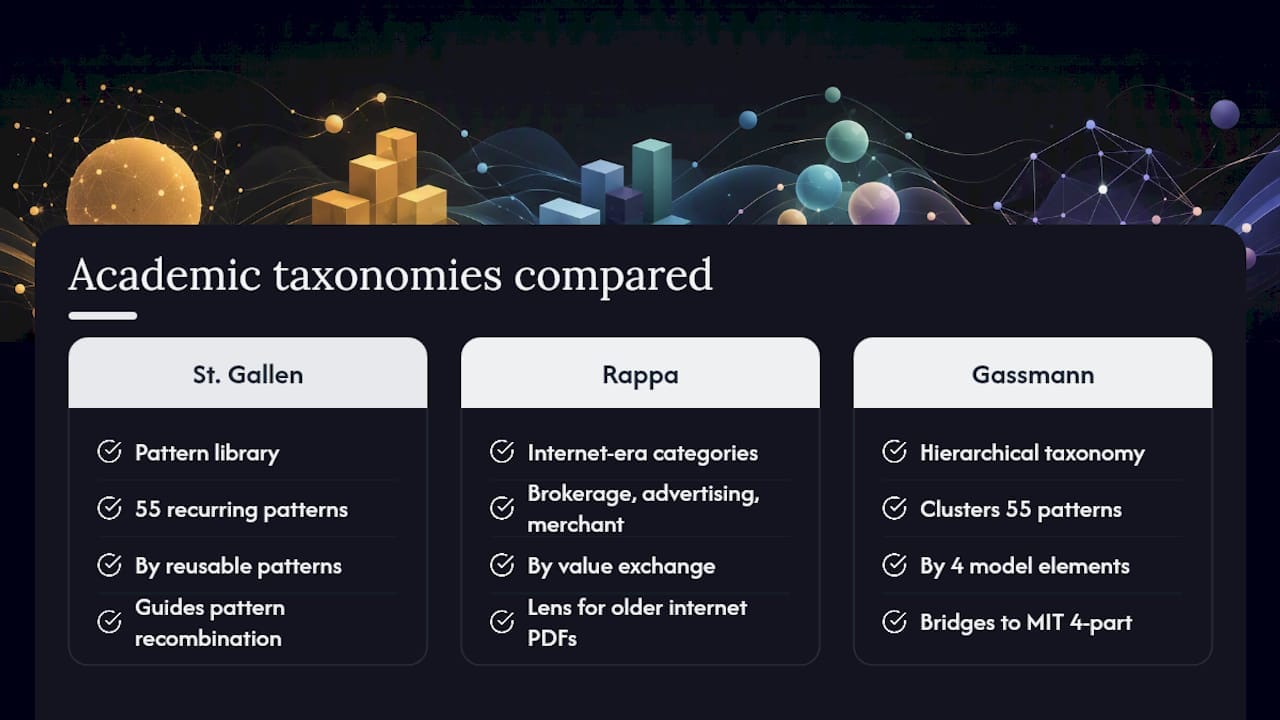
St. Gallen Business Model Navigator — Gassmann, Frankenberger, and Csik analyzed hundreds of companies and identified 55 recurring business model patterns. Each pattern is a named, reusable template (examples include “Subscription,” “Freemium,” “Razor and Blade,” “Long Tail,” and “Two-Sided Market”). The Navigator’s core argument is that business model innovation rarely means inventing something entirely new. Most successful innovations come from recombining two or three existing patterns and applying them to a new industry context. That insight makes the Navigator a practical starting point for founders, not just a theoretical taxonomy.
Rappa’s Internet business model categories — Michael Rappa’s classification, developed around 2000, organized internet-era business models into categories including brokerage, advertising, infomediary, merchant, manufacturer, affiliate, community, subscription, and utility. While the internet context dates some of the examples, the underlying logic (grouping models by how value is exchanged between parties) remains a useful lens for reading older academic PDFs that cite Rappa directly.
Gassmann’s pattern approach and the Springer hierarchical taxonomy — A hierarchical taxonomy published in the journal Electronic Markets extends Gassmann’s work by clustering the 55 patterns into dominant archetypes, with merchant and multi-sided platform emerging as the two most common. The taxonomy organizes patterns by which elements of the business model they primarily address: value proposition, value creation, value delivery, or value capture. That four-part structure maps directly onto the MIT working paper’s four-element definition, which makes it a useful bridge between the two frameworks when you are writing a literature review.
The practical value of pattern libraries is recombination. When you read a PDF case study and recognize that a company is running a “Freemium + Subscription” combination or a “Razor-and-Blade + Marketplace” hybrid, you can immediately look up both patterns in the Navigator and understand the financial logic, the risks, and the conditions under which each pattern tends to succeed.
How do you choose the right business model for your idea?
Investopedia’s guide on business models makes the starting point clear: begin with the customer’s problem, not the product. The model should follow from how customers prefer to solve that problem and what they are willing to pay for. Successful founders iterate their pricing, target audience, or product structure after launch; the first model choice is a hypothesis, not a permanent decision.
A practical five-step process:
- Define the customer problem — Write one sentence describing the specific problem your target customer faces and how they currently solve it (or fail to).
- Test willingness to pay — Before choosing a revenue shape, find out whether customers pay once (transactional), repeatedly (subscription), or only when they use something (pay-per-use). Their existing behavior is the best signal.
- Map core costs and resources — Identify the two or three dominant costs in your model. If your biggest cost is content creation, an advertising model may work. If it is physical inventory, a leasing model may be more capital-efficient than a sales model.
- Select a revenue shape — Match the revenue trigger to the customer’s payment preference and your cost structure. Recurring revenue is generally more predictable; transactional revenue is often easier to start.
- Check distribution and scale assumptions — Ask whether your chosen model requires a large user base to be viable (marketplace, multi-sided platform) or works at small scale from day one (service, subscription).
A compact checklist for students and founders reading a PDF or completing a class assignment:
- Can you name the customer segment in one sentence?
- Can you state the value proposition without using the word “solution”?
- Does the revenue trigger match how customers already pay for similar things?
- Are the dominant costs covered by the revenue model at realistic volume?
- Is there a plausible path to your first 100 customers without a large marketing budget?
For an initial model choice and rapid validation, a reasonable timeline is eight weeks: weeks 1 and 2 for problem and customer research, weeks 3 and 4 for canvas drafting and assumption mapping, weeks 5 and 6 for two to five customer interviews, and weeks 7 and 8 for a small prototype or pricing test. Red flags that usually signal a weak model fit include: no one in your target segment currently pays for anything like this, your revenue per customer is lower than your customer acquisition cost at any realistic scale, or the model requires a two-sided network to work but you have no plan to seed one side first.
For a deeper look at startup-specific model options, Nomadexcel’s guide to finding the right business model walks through practical startup variations with examples.
How to turn a PDF into a working canvas over one weekend
Reading a PDF is passive. The fastest way to internalize a business model framework is to run a short sprint that forces you to apply it to a real idea. Here is a compact weekend agenda:
Friday evening (prep, 90 minutes)
- Download the Aalborg University compendium or the St. Gallen Navigator PDF and read the first 20 pages.
- Print or open a blank Business Model Canvas template.
- Write one sentence each for: the customer problem, the proposed value proposition, and the primary revenue trigger.
Saturday (mapping and interviews, 4–6 hours)
- Fill all nine canvas blocks based on your current assumptions. Leave gaps rather than guessing.
- Identify the three assumptions that, if wrong, would kill the model. Write each as a testable hypothesis: “We believe [customer segment] will pay [price] for [value proposition] because [reason].”
- Conduct two short customer interviews (15–20 minutes each) focused on the problem block and the willingness-to-pay assumption. Do not pitch; ask questions.
- Revise the canvas based on what you heard.
Sunday (validation plan, 2–3 hours)
- Design one small prototype test for your riskiest hypothesis. This could be a landing page, a one-page proposal, or a manual version of the service.
- Set a specific success metric for the test (example: 10% of people who see the landing page sign up for a waitlist).
- Write a one-page summary: canvas, three hypotheses, two interview insights, one test plan.
Pro Tip: The most common mistake in a weekend sprint is filling the canvas with aspirational answers rather than honest assumptions. Mark every cell you are not certain about with a question mark. Those question marks are your research agenda for the following week.
Facilitators running this sprint with a team should review Nomadexcel’s practical guide to business workshop facilitation for agenda templates and group-discussion structures that keep sessions productive.
When should you update or pivot your business model?
The short answer: sooner than feels comfortable, and based on evidence rather than intuition. A business model is a set of hypotheses about how value is created and captured. When the evidence contradicts a hypothesis, the model needs to change.
Three signals that usually indicate it is time to update:
- Revenue per customer is declining despite stable volume. This often means the value proposition is weakening relative to alternatives, or the pricing model no longer matches how customers think about value.
- Customer acquisition cost is rising faster than lifetime value. The distribution or channel assumption in the model is probably wrong, and a different channel or a different customer segment may fit better.
- Churn is high in a subscription model. High churn usually points to a gap between the value proposition and actual delivered value. For subscription businesses specifically, reducing churn requires understanding why customers cancel before adjusting pricing or features.
When you do pivot, change one variable at a time. Changing the customer segment, the revenue model, and the value proposition simultaneously makes it impossible to know which change drove any improvement. The most productive pivots tend to be narrow: keeping the core product but changing the revenue shape (from transactional to subscription, for example), or keeping the revenue model but narrowing the customer segment to a group with a more acute problem.
Document each iteration on a new canvas version rather than overwriting the original. Comparing canvas versions side by side is one of the clearest ways to communicate a pivot to investors, advisors, or team members.
What mistakes do founders make when selecting a business model?
The most expensive mistake is choosing a model based on what sounds appealing rather than what the customer’s behavior actually supports. A marketplace model is attractive because it seems asset-light, but it requires solving a chicken-and-egg problem on both sides simultaneously. A subscription model produces predictable revenue, but only if the delivered value is strong enough to justify a recurring charge every month.
Four other mistakes appear repeatedly:
- Copying a competitor’s model without understanding why it works for them. A model that succeeds for a well-funded incumbent with an established network may be unworkable for an early-stage company with no distribution.
- Underpricing to win customers, then discovering the unit economics never work. Price is a signal of value. Customers who only buy because of a low price are often the first to churn when a cheaper alternative appears.
- Treating the first model as permanent. The MIT working paper’s four-element framework makes clear that the financial model (how revenue is generated and costs are incurred) is one of four interdependent components. Changing one element usually requires adjusting the others.
- Ignoring the cost structure until the model is already in place. If the dominant cost in your model is customer support and your revenue per customer is low, the math will not work regardless of how good the product is.
The practical fix for most of these mistakes is the same: fill a canvas honestly, mark every assumption you cannot yet verify, and test the riskiest ones before committing resources.
How do hybrid business models work within one company?
Most mature companies run more than one business model simultaneously. The key is understanding which model is primary (the one that drives most revenue and shapes the cost structure) and which models are secondary (layers that increase lifetime value or reduce acquisition cost).
A hardware manufacturer that also sells a subscription software layer is running a razor-and-blade logic at the product level and a subscription logic at the service level. The two models reinforce each other: the hardware creates a captive audience for the subscription, and the subscription revenue subsidizes competitive hardware pricing. That interdependence is what makes hybrid models powerful and also what makes them difficult to design correctly.
Three principles for integrating multiple model types:
- Sequence the models deliberately. Most successful hybrids start with one model and add a second only after the first is working. Adding a marketplace layer to a service business before the service is profitable usually spreads resources too thin.
- Keep the revenue logic transparent to customers. Customers who feel confused about what they are paying for and why tend to churn. Each revenue stream should map to a clearly understood value exchange.
- Watch for model conflicts. A freemium model and a high-touch enterprise sales model often conflict: the freemium layer attracts users who expect a self-serve experience, while enterprise sales requires a consultative process. Running both requires careful segmentation.
The HBS framework of eight model types is a useful starting point for identifying which combinations tend to be complementary (product + subscription, service + reselling) and which tend to create internal tension.
How do you customize the Business Model Canvas for real entrepreneurship work?
The standard nine-block canvas is a starting point, not a finished tool. In practice, founders and facilitators adapt it in several ways that make it more useful for specific contexts.
Customize the customer segments block by adding a problem statement. Rather than listing a demographic (“small business owners”), write the specific problem that segment faces and how they currently solve it. This forces the value proposition block to respond to a real pain point rather than a generic aspiration.
Split the revenue streams block by time horizon. Label each revenue stream as immediate (generates cash in the first 90 days), medium-term (requires 3–12 months to activate), or long-term (depends on scale or network effects). This makes the financial model more honest and helps identify cash flow risks early.
Add a “riskiest assumption” row below the canvas. After filling all nine blocks, write the single assumption that, if wrong, would require the most significant redesign. Keeping that assumption visible during every canvas review prevents teams from treating early decisions as settled.
Use the canvas as a communication tool, not just a planning tool. A completed canvas on one page communicates a business model faster than a 20-page business plan. When presenting to mentors, investors, or advisors, walk through the four primary blocks (customer segment, value proposition, revenue streams, cost structure) first, then fill in the supporting blocks as questions arise.

For students, the canvas is also a powerful reading tool. When working through a PDF case study, map the company’s model onto a blank canvas as you read. By the time you finish the case, you have both a summary and a structured analysis ready for class discussion.
How do you evaluate and cite a business models PDF properly?
Evaluating a PDF before citing it takes about five minutes and prevents the most common academic credibility problems. Work through these five trust signals in order:
Author and institutional affiliation — Is the author named? Are they affiliated with a university, research center, or recognized institution? An anonymous PDF or one attributed only to a company website carries much less academic weight than one tied to a named researcher at a named institution.
Publication date or edition — Business model frameworks evolve. A PDF from 2000 may use Rappa’s internet-era taxonomy, which predates the canvas and the St. Gallen Navigator. Knowing the date helps you place the PDF in the right intellectual context and flag when its examples may be outdated.
Bibliography or citation list — A PDF with no references is almost certainly a practitioner summary rather than an academic source. For coursework, you generally need sources that cite other sources, creating a traceable chain of evidence.
DOI or stable URL — A DOI (Digital Object Identifier) is the gold standard for academic citation because it is permanent. A stable institutional URL (MIT, a university repository, Springer) is the next best option. A PDF hosted on a random domain or a file-sharing site may disappear.
Scope and methodology — Does the PDF state what it covers and how it arrived at its conclusions? A compendium that says “we analyzed 250 companies across 10 industries” is more credible than one that presents a list of model types with no explanation of how they were selected.
When formatting citations, use the author’s full name, the document title, the institution or publisher, the year, and the DOI or URL. For APA 7th edition, a working paper follows this pattern: Author, A. A. (Year). Title of working paper (Working Paper No. XXX). Institution Name. URL.
Why a curated PDF-first approach beats a random web search
Most web searches for business model resources return a mix of blog posts, slide decks of unknown origin, and PDFs that have been copied and re-uploaded so many times that the original authorship is untraceable. The problem is not a shortage of content. It is a shortage of content you can actually trust and cite.
A curated PDF-first approach solves that problem by starting with sources that have clear authorship, institutional backing, and stable URLs. The Springer taxonomy paper, the MIT working paper, and the Aalborg University compendium are not the flashiest resources on the web, but they are the ones that will still be there when a professor asks for your source list, and they are the ones that will give you a framework rigorous enough to apply to a real business problem rather than just pass an assignment.
The other advantage of PDFs over blog posts is density. A 40-page academic compendium covers more ground, with more precision, than ten blog posts on the same topic. Reading one well-chosen PDF carefully is almost always more productive than skimming a dozen articles. That is especially true when you are preparing for a workshop or a class discussion where you need to be able to explain why a framework works, not just what it says.
Nomadexcel’s approach to business education reflects the same logic: structured, curated content paired with hands-on application produces faster and more durable learning than passive consumption. That is why the business education model is evolving toward experiential formats that combine frameworks with real-world testing.
Ready to move from PDF to a working business model?
Reading the right PDFs gives you the vocabulary and the frameworks. Applying them under pressure, with feedback from experienced mentors and a peer group who are building alongside you, is where the real learning happens.
Nomadexcel’s online entrepreneurship bootcamp is built for exactly this transition. Over one to four weeks, you work through canvas mapping, customer interviews, and model validation with direct mentorship from experienced founders and operators. You leave with a tested model, not just a filled-in template. The program is designed for early-stage founders and students who want to move from theory to a validated concept faster than self-study allows. If that describes where you are right now, the bootcamp is worth a close look.
Sources
These are the primary sources referenced throughout this guide, with brief notes on access and citation use:
- A Study of Business Models
- 8 Types of Business Models & the Value They Deliver | HBS Online
- Business Model: Definition and 13 Examples | Investopedia
- St. Gallen Business Model Navigator (patterns) — PDF
A note on citing PDFs in academic work: Always check whether a PDF has a corresponding journal article or book with a DOI before citing the PDF directly. The Springer article above, for example, is better cited via its DOI than via the PDF URL, because the DOI is permanent and the PDF link may change.
Comments are closed.