
What Is a Growth-Focused Mindset and Why It Matters
TL;DR:
- A growth-focused mindset believes that abilities can be developed through effort and strategies rather than being fixed traits. It is supported by research showing that belief alone is insufficient without environmental and strategic support. Developing it requires practicing reflection, seeking feedback, and managing fixed mindset triggers daily.
A growth-focused mindset is defined as the belief that intelligence, skills, and talents can be developed through dedication, effective strategies, and learning rather than being fixed traits you are born with. Psychologist Carol Dweck coined this concept after decades of research at Stanford University, contrasting it with a fixed mindset, where people believe their abilities are static and unchangeable. The core shift is simple but powerful: when you see challenges as opportunities to grow rather than threats to your identity, your entire approach to learning and setbacks changes. Understanding what is growth-focused mindset means is the first step toward applying it in your own life.
What does the science say about a growth-focused mindset?
The scientific foundation for growth mindset comes directly from Carol Dweck’s research, which shows that intelligence and talents can be developed through dedication and effective strategies. This is not motivational rhetoric. It is a finding replicated across thousands of students, athletes, and professionals over several decades. The contrast with a fixed mindset is stark: fixed mindset believers avoid challenges to protect their self-image, while growth mindset holders seek them out.
“The view you adopt for yourself profoundly affects the way you lead your life.” — Carol Dweck, Mindset: The New Psychology of Success
Meta-analyses of mindset research confirm that the effects are real but context-dependent. Researcher David Yeager’s work at the University of Texas at Austin found that mindset interventions are necessary but insufficient on their own. Success depends heavily on whether the surrounding environment provides practice opportunities and genuine feedback. A student who believes they can improve but attends a school that never gives them challenging work will not see the same gains as one in a supportive, feedback-rich setting.
Mindset is also not a permanent state. Individuals consistently oscillate between fixed and growth mindset states, and the goal is not to achieve a permanent growth mindset but to recognize when fixed thinking is triggered and consciously shift toward growth strategies. This makes mindset a skill to practice, not a personality trait to acquire once and keep forever.

Effective mindset changes occur when they are combined with environmental support, such as schools or workplaces that actively promote growth through feedback, psychological safety, and strategic praise. The science is clear: belief alone does not produce results. Belief plus environment plus strategy does.
How does growth-focused thinking differ from fixed mindset and common myths?
The growth mindset definition gets distorted more often than almost any other concept in personal development. The most common distortion is treating it as pure positive thinking. Growth mindset is not about telling yourself everything will work out. It is about accepting discomfort and holding high standards for your own development, even when the feedback is tough.
Here is where the fixed mindset vs growth mindset distinction becomes concrete:
- Fixed mindset: “I failed this presentation because I am just not a natural speaker.” The failure becomes evidence of a permanent limitation.
- Growth mindset: “I failed this presentation because my preparation strategy was weak. I need better practice methods.” The failure becomes data for improvement.
- False growth mindset: “I tried really hard, so I should have succeeded.” This version praises effort without examining whether the strategy was effective.
That third bullet is the most dangerous. Researchers call it the “false growth mindset,” and it is a risk when effort lacks proper strategies or a supportive environment. When someone works hard but fails repeatedly without adjusting their approach, a naive application of growth mindset can lead to self-blame rather than self-correction. The fix is pairing effort with reflection on strategy.
Pro Tip: When you catch yourself saying “I worked so hard and still failed,” add one more question: “Was my strategy the right one?” Effort without strategy is just exhaustion.
Growth mindset is a dynamic capability embedded through leadership and environment, not a static trait someone simply has or lacks. This means the people around you, your manager, your peers, your community, shape whether your growth mindset actually produces results.
How to develop a growth mindset in practical daily life
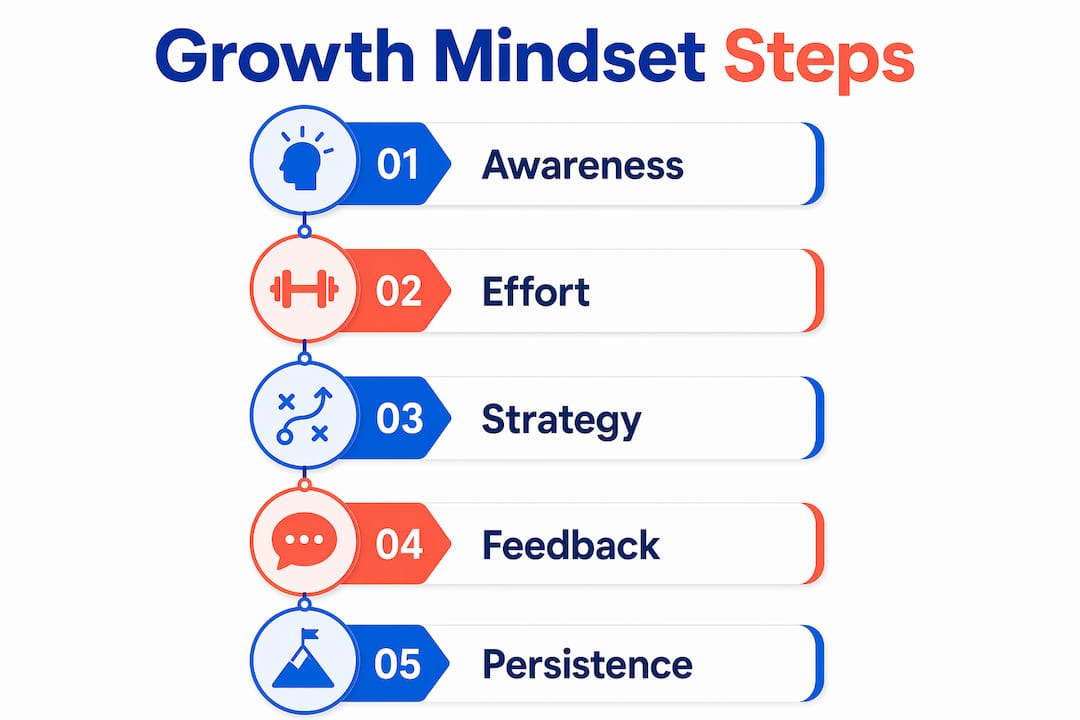
Building a growth-focused mindset is a gradual process, not a one-time decision. These steps move from awareness to habit, and each one compounds over time.
Shift your self-talk with “yet.” The single most practical technique from Dweck’s research is shifting self-talk from “I can’t do this” to “I can’t do this yet.” That one word reframes a permanent limitation into a temporary gap. Apply it every time you hit a skill ceiling.
Seek feedback before you feel ready. Most people wait until they are confident before asking for feedback. Growth mindset holders do the opposite. They ask early, when the feedback can still change their approach. Feedback is not a verdict on your worth. It is data for your next attempt.
Separate effort from strategy. Effort is necessary but not sufficient. After any significant attempt, ask yourself two questions: Did I work hard enough? Did I use the right approach? Both answers matter equally. You can read more about how feedback drives real improvement in practice.
Identify your fixed mindset triggers. Everyone has specific situations that activate fixed thinking, public speaking, competitive environments, unfamiliar skills. Write down the last three times you avoided a challenge. Those situations are your fixed mindset triggers. Naming them is the first step to choosing a different response.
Treat setbacks as experiments. Every failure contains a hypothesis. “I thought this approach would work. It did not. Here is what I learned.” This reframe turns frustration into curiosity, which is the emotional signature of genuine growth mindset.
Pro Tip: Keep a weekly “failure log” with three columns: what happened, what I assumed, and what I will try differently. Reviewing it monthly reveals patterns you cannot see in the moment.
Mindset shifts are ongoing and contextual. You will not develop a permanent growth mindset by reading one article. You develop it by practicing these responses repeatedly across different areas of your life, from career to relationships to physical skills.
What are the real benefits of a growth mindset for personal success?
The benefits of growth mindset are well-documented and span multiple areas of life. Growth mindset leads to persistence, seeking feedback, learning from failure, and improved outcomes across academic and personal domains. These are not abstract benefits. They show up in measurable behavior changes.
- Greater resilience under pressure. People with growth-focused thinking recover faster from setbacks because they interpret failure as information, not identity. This makes them more persistent in the face of obstacles that stop fixed mindset thinkers cold.
- Faster skill acquisition. When you believe a skill can be learned, you invest more time and better strategies in learning it. That belief becomes a self-fulfilling cycle of improvement.
- Better handling of criticism. Growth mindset holders actively seek critical feedback because they see it as a tool, not a threat. This makes them better collaborators, better employees, and better leaders.
- Stronger self-awareness. Regularly examining your own thinking patterns, asking why you avoided a challenge or why you reacted defensively, builds a level of self-knowledge that fixed mindset thinking never requires.
The mindset shift toward entrepreneurial growth is especially visible in business contexts, where the ability to adapt, learn from market feedback, and persist through early failure separates founders who scale from those who stall.
Key Takeaways
A growth-focused mindset produces real results only when belief in development is paired with effective strategies, honest feedback, and an environment that supports learning.
| Point | Details |
|---|---|
| Core definition | Growth mindset is the belief that skills and intelligence develop through effort and strategy, not fixed traits. |
| Science backs it up | Research confirms mindset effects are real but depend on supportive environments and feedback, not belief alone. |
| Avoid the false version | Praising effort without examining strategy creates self-blame, not growth. Pair hard work with reflection. |
| Practice the “yet” technique | Shifting self-talk from “I can’t” to “I can’t yet” is the most practical daily habit for building growth thinking. |
| Benefits compound over time | Resilience, faster learning, and better feedback tolerance all improve as growth mindset becomes habitual. |
Growth mindset in practice: what most guides get wrong
I have worked with hundreds of entrepreneurs and early-stage founders, and the most common mistake I see is treating growth mindset as a belief system to adopt rather than a practice to build. People read about it, feel inspired for a week, and then revert to fixed patterns the moment real pressure hits. That is not failure of character. That is just how mindset change actually works.
People are mixtures of fixed and growth mindsets, and the goal is not purity. The goal is awareness. I have caught myself avoiding feedback on work I was proud of, not because I did not believe in growth, but because that specific piece felt too personal to risk. That is a fixed mindset trigger. Recognizing it in the moment is the whole game.
What I have found actually works is building environmental accountability. You cannot sustain a growth mindset in isolation. You need peers who challenge you, mentors who give you honest feedback, and structures that reward learning over performance. This is exactly why immersive programs, where you are surrounded by people who share that orientation, produce faster mindset shifts than solo reading ever will. The mindset frameworks for founders that stick are always the ones built inside a community, not in a vacuum.
The uncomfortable truth is that growth mindset requires you to be wrong, often and publicly. Most people are not willing to pay that price consistently. The ones who are willing tend to outlearn everyone around them, not because they are smarter, but because they collect more data per unit of time.
— Amichai
Nomadexcel programs built around growth-focused development
Nomadexcel designs its entrepreneurship bootcamps around the same principles that make growth mindset work in practice: real feedback, peer accountability, and structured challenges that push you past your current ceiling. The programs are not about theory. They are about building the habits, skills, and community that make growth-focused thinking sustainable over time. If you are ready to move from understanding the concept to living it inside a high-performance environment, the online entrepreneurship bootcamp is built exactly for that. You can also explore why joining a bootcamp accelerates growth in ways that self-study simply cannot replicate.
FAQ
What is the growth mindset definition in simple terms?
A growth mindset is the belief that your abilities and intelligence can improve through effort, learning, and effective strategies. It was defined by psychologist Carol Dweck and contrasts directly with a fixed mindset, which treats traits as permanent.
What is the difference between growth and fixed mindset?
A fixed mindset treats failure as evidence of permanent limitation, while a growth mindset treats failure as feedback for improvement. The key difference is whether you see your abilities as static or developable.
How do you develop a growth-focused mindset?
Start by shifting self-talk using the word “yet,” seek feedback before you feel ready, and identify the specific situations that trigger fixed thinking in you. Consistent practice across different areas of life builds the habit over time.
Can you have both a fixed and a growth mindset at the same time?
Yes. Research shows that most people oscillate between fixed and growth mindset states depending on the situation. The goal is to recognize your fixed mindset triggers and consciously choose a growth response.
What are the main benefits of a growth mindset?
Growth mindset produces greater resilience, faster skill development, better tolerance for criticism, and stronger self-awareness. These benefits compound over time as growth-oriented responses become habitual.
Comments are closed.