
What Is Outcome-Focused Entrepreneurship? A Clear Guide
TL;DR:
- Outcome-focused entrepreneurship centers on designing ventures around meaningful, measurable results rather than completed tasks. It emphasizes tracking the actual change caused by outputs, fostering accountability, and aligning incentives toward real value creation. Implementing frameworks like IOOI and VMGS helps founders define, measure, and improve outcomes systematically to build impactful, enduring businesses.
Outcome-focused entrepreneurship is the practice of designing, managing, and measuring a venture around specific, meaningful results rather than completed tasks or delivered features. Where most early-stage founders track what they built, outcome-focused entrepreneurs track what changed because of what they built. The distinction sounds subtle, but it reshapes every decision from product roadmaps to team accountability. Frameworks like IOOI (Inputs, Outputs, Outcomes, Impacts) and VMGS (Vision, Mission, Goals, Strategies), used by organizations like Atlassian and Oshi Health, give this approach its structure. Understanding this model is the first step toward building a venture that creates real, measurable value.
What is outcome-focused entrepreneurship and why does it matter?
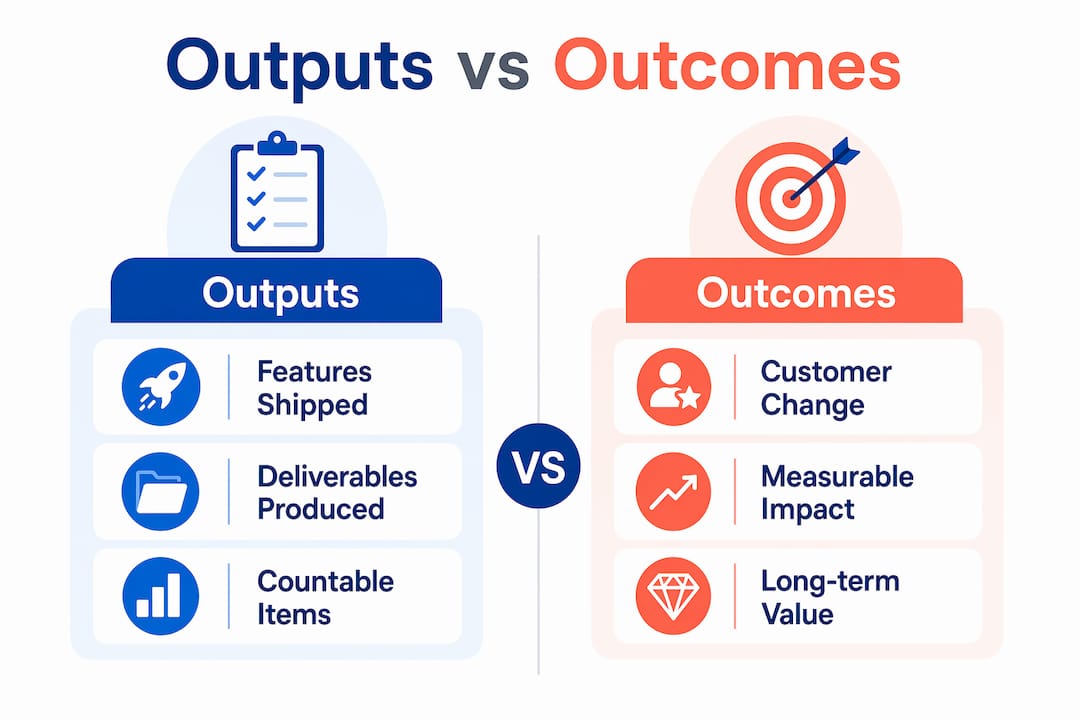
Outcome-focused entrepreneurship is defined as designing, managing, and measuring ventures around desired outcomes rather than just outputs. An output is something you produce: a feature shipped, a program run, a report filed. An outcome is the change that results from that output: a customer retained, a cost reduced, a behavior shifted. The gap between the two is where most ventures quietly fail.
This distinction matters because outputs are easy to count and outcomes are hard to fake. A team can ship ten features in a quarter and still lose customers. A founder can run fifty workshops and still see no revenue growth. The activity looks productive; the business is not moving. Outcome-focused thinking forces you to ask the harder question: did anything actually change?
The approach also creates a stronger foundation for accountability. When success is defined by a measurable result rather than a completed task, there is no ambiguity about whether the work delivered value. That clarity benefits founders, investors, and customers equally.
How does outcome-focused entrepreneurship differ from output-driven approaches?
The core difference between outcome-focused and output-driven entrepreneurship is what gets measured and rewarded. Output-driven organizations celebrate shipping. Outcome-focused organizations celebrate results. The table below makes this contrast concrete.
| Dimension | Output-driven approach | Outcome-focused approach |
|---|---|---|
| Success metric | Features shipped, tasks completed | Customer behavior changed, revenue grown |
| Team question | “When will it ship?” | “Are we moving toward the goal?” |
| Risk location | Customer absorbs risk of poor results | Provider shares risk through performance models |
| Decision driver | Roadmap and deadlines | Evidence and outcome progress |
| Culture signal | Busy teams are good teams | Effective teams are good teams |
Atlassian’s Jira Product Discovery uses the VMGS framework to keep teams focused on vision, mission, goals, and strategies rather than feature counts. Teams iterate hypotheses on how their work drives desired outcomes, which builds an experimental culture rather than a delivery culture. The practical effect is that teams stop, redesign, or kill work that is not producing outcome evidence, even if it was on the original plan.
Output-driven models also tend to misalign incentives. A development team rewarded for shipping features has no structural reason to care whether those features solve the customer’s problem. An outcome-focused team, by contrast, is evaluated on whether the customer’s situation improved. That alignment changes behavior at every level of the organization.
Pro Tip: When reviewing your team’s weekly progress, replace “what did we complete?” with “what changed for our customer this week?” The shift in question changes the conversation immediately.
What frameworks and measurement strategies define this approach?
Outcome-focused entrepreneurship relies on structured frameworks to translate ambition into measurable progress. Two of the most widely applied are IOOI and VMGS.

The IOOI framework separates a venture’s work into four layers: Inputs (resources invested), Outputs (deliverables produced), Outcomes (changes resulting from those deliverables), and Impacts (broader systemic effects like sustainability or community well-being). Most founders track inputs and outputs naturally. The framework forces them to also define and track outcomes and impacts, which is where real business value lives.
VMGS, used by Atlassian, works at the strategic level. Vision defines the long-term purpose. Mission defines the specific role the venture plays. Goals define the measurable outcomes the venture is pursuing. Strategies define the approaches the team will test to reach those goals. Together, these four layers connect daily work to long-term results without losing sight of either.
Effective outcome measurement also requires three conditions to be met upfront:
- Quantifiable: The outcome can be expressed as a number or a clearly observable state change.
- Attributable: There is a credible causal link between the venture’s activities and the outcome.
- Verifiable: A third party or agreed measurement method can confirm the result.
Oshi Health’s 2025 model demonstrates all three in practice. The company ties 100% of its fees to achieving measurable gastrointestinal health outcomes, claiming all-cause annual cost savings of $10,292 per member. Payment occurs only when sustained symptom control and cost reduction are verified. This is outcome-focused entrepreneurship operating at full intensity: the provider absorbs the risk, and the customer pays only for confirmed results.
Setting SMART outcomes as performance indicators is the practical bridge between frameworks and daily execution. Each outcome should be Specific, Measurable, Achievable, Relevant, and Time-bound. Without that structure, outcome goals drift back into vague aspirations that no one can hold accountable.
What are the common challenges in practicing outcome-focused entrepreneurship?
Shifting to an outcome-focused model is not a rebranding exercise. It requires real changes in how you define success, structure contracts, and build organizational culture. The challenges are predictable, and knowing them in advance reduces the cost of learning them the hard way.
The most common failure point is confusing output proxies with true outcomes. A company might track “number of users onboarded” as an outcome metric when it is actually an output. The real outcome is whether those users changed their behavior, reduced a cost, or achieved a goal. Durable impact measurement requires defining causal chains, not just counting engagement or volume.
Attribution is the second major challenge. Outcomes rarely have a single cause. A customer’s revenue growth might reflect your product, a market tailwind, a competitor’s exit, and a new hire they made. Outcome-based contracts require upfront agreement on attribution assumptions and how external factors will be adjusted for. Without that agreement, disputes are almost guaranteed when results arrive.
The financial model also carries real risk. Outcome-based pricing shifts risk to the provider, which requires capital reserves, strong data infrastructure, and the analytical capability to predict cost-to-serve accurately. Ventures that adopt this model without those foundations can face serious cash flow pressure if outcomes take longer to materialize than projected.
Culturally, outcomes-based organizations require a level of accountability that many teams find uncomfortable at first. When performance is measured by results rather than effort, there is nowhere to hide behind busyness. That accountability is ultimately a strength, but it demands a culture shift that takes time and deliberate leadership.
Pro Tip: Before launching any outcome-based program or contract, write a one-page measurement agreement that defines the outcome, the measurement method, the attribution rules, and the review cadence. Resolve disagreements on paper before they become disputes in practice.
How can entrepreneurs implement outcome-focused strategies in their ventures?
Moving from output-focused to outcome-focused execution is a process, not a switch. These steps give you a practical path forward.
Define your outcomes before you define your activities. Start every initiative by writing the specific change you want to see in the world: a customer behavior, a financial metric, a health result. Work backward from that change to identify what activities could plausibly cause it.
Build a measurement infrastructure early. Outcome-focused ventures require investment in analytics and actuarial evidence to explain cost and value drivers numerically. Even at an early stage, identify which data you need to collect and how you will collect it before you launch.
Align your team’s goals and roadmaps around outcomes, not deliverables. Replace feature lists with outcome statements in your planning documents. Instead of “launch referral program,” write “increase referral-driven signups by 20% in Q3.” The outcome version makes success unambiguous.
Use an iterative, experimental approach. Outcome-led execution means continuously evaluating progress evidence against strategic goals and adapting work focus to prevent drift back to output metrics. Treat each initiative as a hypothesis: define the expected outcome, run the work, measure the result, and adjust.
Review outcome evidence on a regular cadence. Weekly or biweekly reviews should ask one question: are we seeing evidence that we are moving toward the outcome? If not, the team needs to redesign the approach, not just work harder on the current one. This is where accountability shapes startup success in a concrete, operational way.
Avoid activity metrics as success proxies. Metrics like “hours worked,” “meetings held,” or “content pieces published” measure effort, not impact. They belong in operational dashboards, not in your success criteria. Keep outcome metrics and activity metrics in separate categories so they do not get conflated.
The hands-on entrepreneurship model reinforces this approach well: learning by doing, measuring what changes, and iterating based on evidence rather than assumption.
Key takeaways
Outcome-focused entrepreneurship succeeds when ventures define measurable results upfront, build the infrastructure to track them, and hold teams accountable to evidence rather than activity.
| Point | Details |
|---|---|
| Outcomes vs. outputs | Outputs are deliverables; outcomes are the changes those deliverables produce in the real world. |
| Core frameworks | IOOI and VMGS connect daily work to strategic results and keep teams focused on value, not volume. |
| Measurement conditions | Every outcome must be quantifiable, attributable, and verifiable before it can anchor a contract or OKR. |
| Common failure point | Mistaking output proxies for outcomes is the most frequent reason outcome-focused programs underdeliver. |
| Implementation priority | Define outcomes before activities, build measurement infrastructure early, and review evidence on a regular cadence. |
Why outcome focus is the discipline that separates serious founders from busy ones
I have worked with hundreds of founders across bootcamps and retreats, and the pattern is consistent: the ones who struggle are almost always measuring the wrong things. They can tell you exactly how many posts they published, how many calls they made, how many features they shipped. What they cannot tell you is what changed because of any of it.
Outcome focus is not a framework you adopt once. It is a discipline you practice every week. The question “are we moving toward the outcome?” sounds simple, but it is genuinely hard to answer when your team is deep in execution mode and the pressure to ship is real. The founders who build that habit early, who insist on outcome evidence before celebrating progress, are the ones who build companies that last.
The data infrastructure argument also deserves more attention than it typically gets. Ventures like Oshi Health do not offer ROI guarantees because they are brave. They offer them because they have invested in the analytics to know, with confidence, what their interventions produce. That investment is a competitive moat. Most competitors cannot match it because they never built the measurement capability in the first place.
The future of entrepreneurship is outcome-based. Investors, customers, and partners are all moving toward paying for results rather than activities. Founders who build outcome-oriented cultures now will be positioned to compete in that world. The ones who keep counting outputs will find themselves explaining why their busy teams are not producing results.
— Amichai
Build your outcome-focused venture with Nomadexcel
Nomadexcel’s online entrepreneurship bootcamp is built around exactly the principles this article covers: defining clear outcomes, building measurement habits, and executing with accountability. Every program combines hands-on frameworks, direct mentorship from experienced operators, and a community of founders who hold each other to results rather than effort. If you are ready to move from tracking activity to tracking impact, explore why joining a bootcamp accelerates that shift faster than going it alone. Nomadexcel is where outcome-driven entrepreneurs come to build the clarity and execution discipline their ventures need.
FAQ
What is outcome-focused entrepreneurship in simple terms?
Outcome-focused entrepreneurship means building and measuring a venture around specific, real-world changes rather than completed tasks or delivered products. Success is defined by what improved, not what was built.
How does outcome-focused entrepreneurship differ from traditional entrepreneurship?
Traditional entrepreneurship often measures success by outputs like features shipped or programs run. Outcome-focused entrepreneurship measures success by the actual changes those outputs produce, such as customer behavior shifts or cost reductions.
What is the IOOI framework in entrepreneurship?
IOOI stands for Inputs, Outputs, Outcomes, and Impacts. The IOOI framework helps entrepreneurs move beyond counting deliverables to measuring the real changes and broader systemic effects their ventures create.
What makes an outcome measurable in a business context?
A measurable outcome must be quantifiable, attributable to the venture’s activities, and verifiable by an agreed method. Outcome-based models fail most often when one of these three conditions is missing from the original agreement.
Can early-stage startups adopt outcome-focused strategies?
Yes. Early-stage founders can start by defining the specific change they want to create before planning any activities, then building simple data collection habits to track whether that change is occurring. The infrastructure scales as the venture grows.
Recommended
- Execution Focused Entrepreneurship Guide for Fast Growth
- The Essential Guide to Benefits of Entrepreneurial Mindset – Nomad Excel – Your Entrepreneurial Adventure Starts Here
- What Is Entrepreneurial Facilitation? A Startup Guide
- The Essential Guide to the Future of Entrepreneurship Education – Nomad Excel – Your Entrepreneurial Adventure Starts Here
Comments are closed.