
Benefits of remote bootcamps for aspiring entrepreneurs
TL;DR:
- Remote bootcamps have proven to be equally rigorous and effective as in-person programs, offering structured, mentor-led learning accessible globally. They provide early-stage founders with flexible, affordable options to develop critical entrepreneurial skills while maintaining their existing commitments. Success largely depends on founders’ engagement and clear goals, as these programs facilitate ongoing networks, mentorship, and measurable career growth.
Remote bootcamps have quietly rewritten what it means to invest in your growth as a founder. The assumption that only in-person programs can deliver real mentorship, real accountability, and real career results is increasingly hard to defend, especially when the data tells a different story. The benefits of remote bootcamps extend well beyond convenience: they offer structured learning, global cohorts, and measurable outcomes that match or rival traditional formats, all without requiring you to uproot your life or pause your business. This article breaks down exactly what you gain and why it matters if you are an early-stage entrepreneur ready to move faster.
Table of Contents
- How remote bootcamps accelerate entrepreneurial skills with flexible, structured learning
- Cost-effectiveness and accessibility advantages of remote bootcamps for entrepreneurs
- Career outcomes and salary growth after remote bootcamp graduation
- Why remote bootcamps are ideal for early-stage founders balancing multiple responsibilities
- Community, mentorship, and networking benefits unique to remote bootcamps
- The uncomfortable truth about remote bootcamp ROI most founders miss
- Ready to experience the benefits of a structured entrepreneurship bootcamp?
- Frequently asked questions
Key Takeaways
| Point | Details |
|---|---|
| Structured mentorship remotely | Remote bootcamps offer one-on-one mentorship and cohort support matching in-person benefits for entrepreneurs. |
| Cost and flexibility | Lower tuition and no relocation make remote bootcamps accessible for founders balancing multiple commitments. |
| Strong career outcomes | Graduates achieve up to 79% full-time employment and median salary increases of over 50% within six months. |
| Ideal for busy founders | Flexible scheduling allows entrepreneurs to learn part-time without quitting jobs or losing business momentum. |
| Supportive communities | Active cohort and alumni networks drive long-term business growth through mentorship and connections. |
How remote bootcamps accelerate entrepreneurial skills with flexible, structured learning
One of the most persistent myths about remote education is that it lacks the rigor or depth of in-person learning. Founders who have been through a quality remote bootcamp will tell you the opposite. The structure is real, the accountability is built in, and the curriculum is often tighter because it has to be.
Remote bootcamps deliver programs through a combination of live video sessions via tools like Zoom, asynchronous coursework, and real-time collaboration channels on platforms like Slack. The rhythm feels less like a university course and more like a startup sprint, which is exactly what early-stage founders need. Understanding what a business bootcamp actually involves helps set accurate expectations before you enroll.
According to Course Report’s analysis of online bootcamps, legitimate remote programs deliver one-on-one mentorship, cohort interaction, and career coaching equivalent to in-person alternatives. That finding matters because it removes the format concern entirely. The question stops being “remote or in-person?” and starts being “which program has the right curriculum and mentors for where I am right now?”
A typical remote bootcamp for entrepreneurs covers:
- Idea validation frameworks that help you test assumptions before spending money
- Revenue model design so you build offers that actually sell
- Pitch and storytelling skills for investor conversations and customer acquisition
- Operational systems including hiring, delegation, and team communication
- Marketing and growth fundamentals tailored to early-stage budgets
Most programs ask for 15 to 25 hours per week, which is demanding but workable if you treat it like a second job with a defined end date. The payoff is a compressed learning curve that would otherwise take years of trial and error. The reasons for joining entrepreneurship bootcamps often come down to exactly that: trading time spent guessing for time spent executing with expert guidance.
“The best remote bootcamps do not lower the bar to accommodate remote delivery. They redesign the bar so it actually fits the way modern founders work and learn.”
Pro Tip: Before enrolling in any remote bootcamp, ask the program coordinator for a sample week schedule. If the curriculum is built around live accountability sessions rather than just recorded video lessons, that is a strong signal the program was designed for real outcomes, not passive consumption.
Cost-effectiveness and accessibility advantages of remote bootcamps for entrepreneurs
The financial case for remote bootcamps is straightforward and compelling. When you remove the need to relocate, pay for campus housing, or commute, the total cost of participation drops meaningfully. Online coding bootcamps cost 20% less on average than their in-person counterparts, making them accessible for working entrepreneurs who are already managing tight budgets.
Tuition for remote entrepreneurship and coding bootcamps typically falls between $10,000 and $15,000. That range sounds significant, but compare it to the cost of a traditional MBA, which can exceed $100,000, and the value proposition becomes clear quickly.
| Cost factor | In-person bootcamp | Remote bootcamp |
|---|---|---|
| Tuition (average) | $13,000 to $18,000 | $10,000 to $15,000 |
| Relocation/housing | $2,000 to $6,000+ | $0 |
| Commuting costs | $200 to $800/month | $0 |
| Lost income risk | High (often requires quitting) | Low (part-time options available) |
| Geographic requirement | City-specific | Global access |
The geographic dimension is worth emphasizing. A founder based in rural Montana or central Kansas previously had to move to access elite programs. Remote delivery removes that barrier entirely. You can access the same mentors, the same cohort quality, and the same curriculum as someone sitting in San Francisco, without the San Francisco rent.
The online entrepreneurship bootcamp model also means you can keep your current income stream while building the skills that will eventually replace or amplify it. That is not a small thing. Quitting your job to attend a program is a risk multiplier. Keeping your job while attending part-time is a calculated, sustainable investment.
- No relocation required: Access programs from anywhere with reliable internet
- Maintain current income: Part-time schedules protect your financial runway
- Reduced ancillary costs: No commuting, campus fees, or city-specific living expenses
- Global mentor access: Learn from practitioners around the world, not just your local market
Pro Tip: When comparing program costs, calculate the total investment including your time at your current hourly rate. A cheaper program that demands 40 hours per week may cost more in real terms than a focused 20-hour-per-week program at a slightly higher tuition.
Career outcomes and salary growth after remote bootcamp graduation
Founders and career changers alike want to know one thing before committing to a bootcamp: does it actually work? The employment and income data for remote bootcamp graduates is genuinely encouraging.
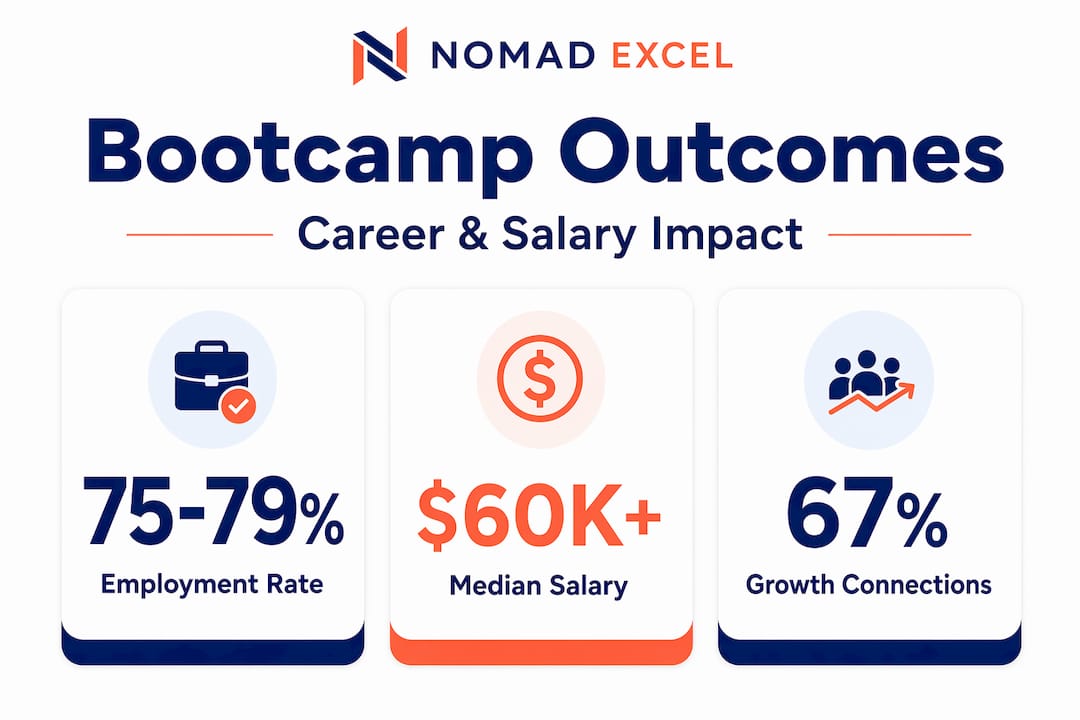
Remote bootcamp graduates achieve 75 to 79% full-time employment within six months of completing their program, with median salary increases of approximately 51%, pushing average first salaries to around $70,698. For a founder, this data point reflects something important: the skills you build in a quality remote bootcamp are recognized and rewarded in the real market.
| Outcome metric | Pre-bootcamp average | Post-bootcamp average |
|---|---|---|
| Employment rate within 6 months | Varies by field | 75 to 79% |
| Median salary increase | Baseline | +51% |
| Average starting salary | Below $47,000 | ~$70,698 |
| Access to remote-first roles | Limited | Significantly expanded |
For entrepreneurs specifically, the salary trajectory matters in a different way. Higher technical and business skills mean you can either hire more selectively (because you understand what good looks like), charge more for your own services, or build a more credible founding team because you speak the language of growth.
Here is what the ROI progression typically looks like for a remote bootcamp graduate who transitions into entrepreneurship:
- Complete the program and leave with a validated business model or a portfolio of skills
- Apply skills immediately through client work, a side project, or a new revenue stream
- Leverage the alumni network to find early customers, co-founders, or strategic partners
- Scale into higher-value opportunities using credentials and demonstrated results from the program
The ability to access coastal market salaries from anywhere is one of the most underrated entrepreneurship bootcamp benefits. A founder in a lower cost-of-living city who can command a San Francisco rate for technical consulting work has a structural financial advantage that compounds quickly.
Why remote bootcamps are ideal for early-stage founders balancing multiple responsibilities
Founders rarely have the luxury of pressing pause on life. You are managing customers, suppliers, partners, and often a day job or family obligations simultaneously. The flexibility of remote training is not a feature added for convenience. For most early-stage founders, it is the condition that makes participation possible at all.

Remote bootcamps accommodate this reality through a blend of synchronous and asynchronous learning. Live sessions, typically two to four times per week, anchor the schedule and maintain accountability. Everything else, including recorded lessons, worksheets, and project work, fits around your existing commitments.
72% of bootcamp students are career changers who dedicate 15 to 25 hours per week without quitting their jobs. That number reflects something real about the population choosing remote formats: these are people with full lives who cannot afford to stop everything but are committed enough to invest serious weekly hours in their growth.
Key flexibility advantages remote bootcamps provide for founders:
- Asynchronous content access: Watch lessons, complete exercises, and submit work on your own schedule
- Live session replays: Miss a session due to a client call? Catch up without losing progress
- Self-paced milestone tracks: Move through foundational content faster if you already have relevant experience
- Global cohort timing options: Many programs run multiple cohort start dates to fit your timeline, not theirs
- No geographic constraint: Run your business from anywhere while attending the program
The dropout risk in traditional in-person programs often spikes when life events collide with fixed schedules. Remote formats reduce that friction significantly. When attendance does not require a commute and lessons can be revisited, the barriers to showing up consistently drop.
Pro Tip: Block your bootcamp hours in your calendar the same way you would block a meeting with an investor. Treat it as a non-negotiable commitment rather than optional study time. Founders who treat the program like a sprint with a real deadline get disproportionately better outcomes than those who treat it as a flexible self-study project. Explore how Nomad Excel’s program structures accountability to keep participants on track.
Community, mentorship, and networking benefits unique to remote bootcamps
The community dimension of a remote bootcamp is where many people are most pleasantly surprised. The expectation is isolation: you, a laptop, and some videos. The reality in well-run programs is a living network of peers, mentors, and alumni who become genuine growth assets long after graduation.
Cohort-based Slack channels function as always-on war rooms where founders share wins, ask for feedback, make referrals, and hold each other accountable between live sessions. This kind of peer pressure is one of the most powerful forces in entrepreneurial development because it mirrors the best parts of working inside a high-growth team.
Active alumni networks and cohort community channels drive 67% of business growth connections beyond the six months following graduation. That statistic reframes how you should think about the value of your bootcamp investment. You are not just buying a curriculum. You are buying ongoing access to a network that can send you clients, introduce you to investors, or become your first co-founder.
One-on-one mentorship during live sessions is where real pivots happen. A mentor with ten years of operator experience can spot a flawed business model assumption in a five-minute conversation that might take you six months to discover on your own. That compression of feedback cycles is one of the most tangible virtual bootcamp advantages.
Benefits that extend well beyond the classroom:
- Peer accountability partners: Cohort members who track your goals and call you out when you miss them
- Mentor office hours: Direct access to experienced founders and operators for specific challenges
- Alumni deal flow: Referrals, partnerships, and introductions that originate from shared program experience
- Co-founder matching: Many programs intentionally connect complementary skill sets within cohorts
- Global diversity of perspective: A remote cohort draws founders from different industries and geographies, broadening your strategic thinking
Remote formats level the playing field for founders outside major metropolitan areas who previously lacked access to the same quality of networks and mentors available to founders in coastal startup hubs.
“The mentorship and community you build in a well-run remote bootcamp are not substitutes for in-person connection. They are a different kind of connection, one built around shared execution and real business problems.”
Understanding the mentorship process for entrepreneur growth and reviewing outcomes from previous bootcamp communities gives you a concrete picture of what sustained community support looks like in practice.
Pro Tip: Engage with your cohort Slack channel daily, even when you have nothing urgent to share. Consistent presence builds the kind of trust that converts peers into long-term collaborators and referral partners.
The uncomfortable truth about remote bootcamp ROI most founders miss
Here is what the articles focusing on enrollment numbers and salary statistics tend to overlook: the biggest variable in remote bootcamp outcomes is not the program. It is the posture you bring to it.
Founders who enter a remote bootcamp with a specific problem to solve, a real business to test, and genuine openness to challenge their assumptions consistently report outcomes that exceed their expectations. Founders who enroll looking for a credential or a general education tend to graduate with a certificate and not much else.
The benefits of remote bootcamps are real and well-documented. But they are activated, not delivered. A mentor cannot pivot your business for you. A Slack channel will not build your customer pipeline without your participation. The curriculum will not generate revenue until you apply it. What remote formats do is remove every excuse related to geography, schedule, and cost, leaving only the question of whether you are genuinely committed to the work.
We have seen founders use a remote bootcamp as the forcing function that finally clarified their offer, found their first ten paying customers, or identified the co-founder they had been searching for. We have also seen founders complete the same program and credit the certification on LinkedIn without implementing a single framework. The program was identical. The outcomes were not.
This is not a warning to avoid remote bootcamps. It is an invitation to be the kind of founder who gets the most out of them, which means showing up with a real problem, engaging your cohort honestly, and treating every mentor conversation like the expensive resource it is.
Ready to experience the benefits of a structured entrepreneurship bootcamp?
At Nomad Excel, we build bootcamp experiences specifically for the kind of founder who is done waiting for the right moment and ready to accelerate with the right support. Whether you are validating a new idea, refining your offer, or looking for a cohort of peers who take growth as seriously as you do, our programs combine expert mentorship, daily accountability, and a global community that sticks around long after the program ends. If the benefits of remote bootcamps resonate with where you are right now, explore what a Nomad Excel online entrepreneurship bootcamp looks like in practice and see whether the next cohort aligns with your goals.
Frequently asked questions
How long does it typically take to get a job after completing a remote bootcamp?
Most graduates find full-time employment within 3 to 6 months, with 75 to 79% securing roles in that window, depending on program quality, specialization, and how actively they engage their alumni network during the job search.
Are remote bootcamps as effective as in-person bootcamps for career changers?
Yes. Reputable remote bootcamps with live mentorship and audited outcomes perform comparably to in-person programs, because employer recognition correlates more strongly with program reputation and verifiable results than with delivery format.
Can I attend a remote bootcamp while running my startup or working a full-time job?
Absolutely. Remote bootcamps are specifically designed for busy founders, with 72% of students dedicating 15 to 25 hours per week without leaving their jobs, making part-time participation the norm rather than the exception.
How can remote bootcamp alumni networks help my business grow?
Alumni networks and cohort communities provide ongoing referrals, co-founder matching, and strategic introductions, with active networks driving 67% of business growth connections that materialize in the six months or more following graduation.
Comments are closed.