
Business model creation guide for modern entrepreneurs
TL;DR:
- Testing ideas against reality early reduces risk and increases chances of success.
- Modern frameworks like BMC and Lean Startup enable rapid, evidence-based business development.
- Continuous validation and iteration with real customer feedback are crucial for sustainable growth.
Most startups don’t fail because the founder lacked passion or intelligence. They fail because the idea was never tested against reality. Guesswork disguised as strategy burns through time, savings, and momentum faster than almost any other mistake an early-stage entrepreneur can make. The good news is that a structured, step-by-step approach to business model creation changes all of that. When you move from assumptions to evidence, you stop building for an imaginary customer and start building for a real one. This guide walks you through the frameworks, preparation steps, and validation techniques that give your business idea its best possible shot.
Table of Contents
- Understanding modern business model frameworks
- Preparation: Defining your idea and forming early hypotheses
- Step-by-step: Building your business model using Lean and BMC
- Verification: Testing, learning, and adapting your business model
- Why most business model guides set you up for failure
- Accelerate your business journey with expert support
- Frequently asked questions
Key Takeaways
| Point | Details |
|---|---|
| Use dynamic frameworks | Flexible tools like Business Model Canvas and Lean Startup adapt faster and reduce wasted effort at launch. |
| Test assumptions early | Turn every key idea into a hypothesis and test it with real customers before you scale. |
| Iterate, don’t overplan | Continuous learning through rapid cycles leads to business model fit faster than static planning. |
| Prioritize real feedback | Market signals and customer actions are more valuable than internal opinions or theoretical models. |
Understanding modern business model frameworks
For decades, the default advice for anyone starting a business was to write a detailed business plan. Projections, market analysis, five-year forecasts, all stacked into a polished document that took months to produce. The problem? By the time you finished writing it, the market had already shifted. Traditional plans are static and predictive, while modern tools like the Business Model Canvas and Lean Startup are dynamic and hypothesis-testing, designed to reduce waste through early validation rather than extensive upfront planning.
The Business Model Canvas (BMC) is a one-page visual framework made up of nine building blocks: customer segments, value propositions, channels, customer relationships, revenue streams, key resources, key activities, key partnerships, and cost structure. Instead of paragraphs of narrative, you fill in sticky notes or digital cards for each block. It’s fast, collaborative, and brutally honest about gaps in your thinking. Understanding the Business Model Canvas benefits becomes clear the moment you try to fill in the “customer segments” block and realize you’ve been picturing five completely different people.
The Lean Startup methodology, introduced by Eric Ries, emphasizes validated learning and rapid experimentation over the traditional approach of building a full product before testing market demand. Instead of spending a year developing something no one asked for, you build a minimum viable product (MVP), measure how real people respond, and learn what to do next. Applying Lean Startup principles alongside the BMC creates a powerful combination: structure meets speed.
Here’s how the two main approaches compare:
| Feature | Traditional business plan | Business Model Canvas + Lean |
|---|---|---|
| Time to create | Weeks to months | Hours to days |
| Flexibility | Low | High |
| Based on | Assumptions and forecasts | Evidence and customer feedback |
| Best for | Investors, banks | Early-stage validation |
| Risk of wasted effort | High | Low |
The most successful early-stage founders use these frameworks not because they’re trendy, but because they work. Key benefits include:
- Faster identification of what customers actually want
- Reduced financial risk before committing significant resources
- Easier pivoting when early signals say “not quite right”
- Clearer communication with co-founders, mentors, and early investors
- A living document that evolves as your knowledge grows
Preparation: Defining your idea and forming early hypotheses
With frameworks in hand, it’s time to zero in on your specific business idea. Before you touch a canvas or run any experiments, you need to be ruthlessly clear about two things: what problem you solve, and who experiences that problem most acutely. Vague answers here create vague businesses. The sharper your focus at this stage, the faster everything else moves.

Start by writing a one-sentence problem statement: “[Customer type] struggles with [specific problem] because [root cause].” If you can’t complete that sentence confidently, you have more discovery work to do. Once you have it, turn your assumptions into testable hypotheses. A hypothesis isn’t a guess. It’s a structured statement you can prove or disprove with real data.
The Build-Measure-Learn loop from Lean Startup methodology gives you a repeatable structure for doing exactly that: build a small test, measure the response, and learn what the result means for your next step. Every assumption you hold about your business is a hypothesis waiting to be tested.
Here are the core hypotheses most early-stage founders need to form before building anything:
- Customer hypothesis: Who exactly is your target customer, and what does their daily life look like?
- Problem hypothesis: Is this problem painful enough that someone will pay to solve it?
- Solution hypothesis: Does your proposed solution actually address the root cause?
- Channel hypothesis: How will you reach your customer, and at what cost?
- Revenue hypothesis: What is the customer willing to pay, and how often?
Getting good at validating your idea before you invest real resources is one of the most valuable entrepreneurship skills you can develop. It saves you from the common trap of building something technically impressive but commercially irrelevant.
Pro Tip: Map out the customer journey from the moment your target customer first feels the problem to the moment they find and use your solution. Hidden friction points in that journey often reveal risks you hadn’t considered, and opportunities you hadn’t imagined.
Step-by-step: Building your business model using Lean and BMC
Once your hypotheses are clear, you’re ready to roll up your sleeves and build your business model. This is where frameworks meet action, and where many founders either accelerate or stall depending on how committed they are to evidence over ego.
Step 1: Fill out your Business Model Canvas using evidence, not wishful thinking. Each of the nine blocks should reflect what you currently know, not what you hope is true. Leave blocks blank if you don’t have evidence yet. Blank blocks are honest; false certainty is dangerous.
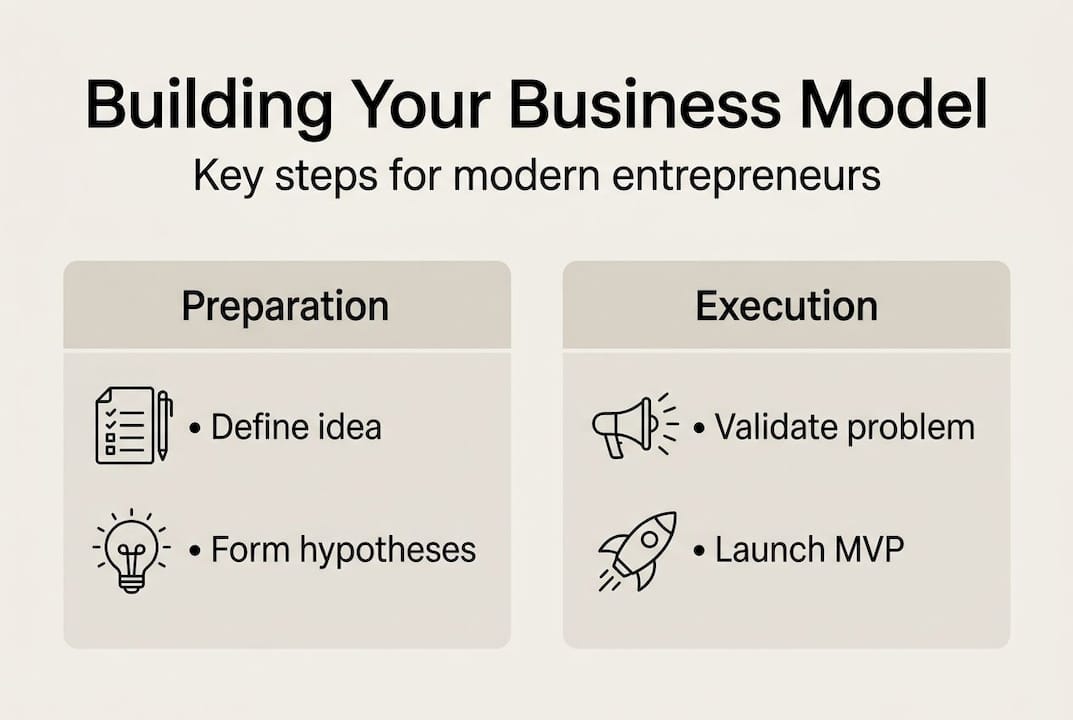
Step 2: Prioritize which hypotheses carry the most risk. Not all assumptions are equally important. Start with the ones that, if wrong, would sink the entire business. Usually, that’s the customer problem and willingness to pay.
Step 3: Design your MVP. Your minimum viable product should be the simplest version of your solution that lets you test your riskiest hypothesis. Landing pages, pre-sales, concierge services, and customer interviews all count as valid MVP formats. The goal of validating your idea is evidence, not perfection.
Step 4: Run your first Build-Measure-Learn cycle. Launch the MVP, track specific metrics (conversion rate, sign-up rate, response rate), and set a clear time limit. One to two weeks is usually enough to gather early signals.
Step 5: Document and decide. After each cycle, write down what you learned. Did the results support or challenge your hypothesis? Based on that, decide: persevere, adjust, or pivot. Keeping records here is critical; memory is unreliable under the pressure of building a business.
Here’s a quick comparison of common MVP validation tools:
| Tool | Best for | Cost | Speed |
|---|---|---|---|
| Landing page | Testing demand and messaging | Low | Fast |
| Customer interviews | Understanding motivations | Free | Moderate |
| Pre-sales | Testing willingness to pay | Low | Moderate |
| Concierge MVP | Validating the solution manually | Time | Slow |
While validation using the Build-Measure-Learn loop is highly effective for speed, it’s worth noting that BMC can create tension with longer-term sustainability goals if every decision is driven purely by short-term experiment results. Balance speed with strategic thinking.
Pro Tip: After every sprint, review your BMC and update the blocks that changed based on what you learned. Your canvas should look different after each round of testing. If it doesn’t, you’re not learning fast enough.
Explore what a structured bootcamp step-by-step experience looks like if you want to run this process with real-time mentorship and peer accountability. Understanding customer journey mapping can also sharpen how you interpret what customers do versus what they say.
Verification: Testing, learning, and adapting your business model
Building the model is one thing. Now it’s time for reality checks and smart adjustments. Validation doesn’t end after your first MVP test. It’s an ongoing practice that becomes the operating rhythm of your early business.
The most important thing to measure depends on which hypothesis you’re testing. But in general, watch these four signals closely:
- Conversion rate: Are people taking the action you’re asking them to take?
- Engagement: Are they spending time, coming back, and exploring further?
- Retention: Do they stay after their first experience with your product or service?
- Willingness to pay: Are they handing over real money or just saying they would?
When results come in, founders face a choice: pivot or persevere. This is one of the most emotionally charged moments in early-stage entrepreneurship. Negative data feels like failure, but it’s actually the most useful information you can collect. The founders who thrive treat every disappointing result as a clue, not a verdict.
“The goal of a startup is to figure out the right thing to build as quickly as possible.” This means that speed of learning, not speed of building, is your real competitive advantage in the early stages.
One critical challenge: Lean Startup excels in speed but requires thoughtful adaptation when dealing with systemic issues like regulatory constraints, long sales cycles, or infrastructure-heavy models. Not every business fits neatly into a two-week sprint cycle.
Common mistakes founders make during verification include ignoring negative feedback because it contradicts their vision, failing to set measurable success criteria before running a test, and moving too fast between iterations without documenting what changed. Use your market validation guides and startup growth frameworks to keep your process grounded and systematic rather than reactive.
Why most business model guides set you up for failure
Here’s an uncomfortable truth worth saying clearly: most business model resources teach you what to think about, not how to act. You finish a book or an article feeling equipped, then sit down to build something and realize you have no idea how to start. The gap between knowing a framework and applying it under real conditions is enormous.
At Nomad Excel, we’ve seen this pattern repeatedly with early-stage founders. They arrive having read the right books, understood the theory, and still feeling stuck. The missing ingredient is almost never more information. It’s structured action, real feedback, and the courage to be wrong publicly and quickly.
Hands-on entrepreneurship isn’t a nice add-on to business education. It’s the entire point. The founders who grow fastest are the ones who launch imperfect MVPs, get honest customer reactions, and iterate with a community around them. Overplanning is a form of procrastination that the best frameworks in the world can’t fix. What fixes it is deciding that real-world feedback is more valuable than imagined certainty.
Accelerate your business journey with expert support
Ready to implement what you’ve learned with expert guidance? Understanding frameworks is a strong start, but applying them alongside experienced mentors and a driven community of founders accelerates everything. At Nomad Excel, our entrepreneurship bootcamp is designed for exactly this moment: when you’re ready to stop planning in isolation and start building with structure, accountability, and real feedback. Each program guides you through validated business model creation, hands-on MVP testing, and the kind of peer learning that solo study simply can’t replicate. Discover why join a bootcamp and take your next step with a community built to help you launch and grow.
Frequently asked questions
What is the Business Model Canvas and why is it useful?
The Business Model Canvas is a visual tool that helps you structure and test your business idea quickly, making early adjustments before committing significant resources.
How do I know if my business model is validated?
Your model is validated once real customers engage, pay, or commit, and your core assumptions are tested with measurable results, not just opinions.
What are common mistakes when creating a business model?
Common mistakes include skipping real customer interviews, assuming demand without evidence, and sticking to a plan despite negative market feedback.
Do I need a full business plan before launching?
No, a simple, testable business model is better at the start; full business plans often slow momentum and can lead to wasted effort.
Recommended
- Business Model Innovation: Fueling Entrepreneurial Growth
- Streamline your business model creation workflow
- Find the right business model: startup options & examples
- Entrepreneurship Skills Guide for Launching Your Own Venture – Nomad Excel – Your Entrepreneurial Adventure Starts Here
- Master the commercial relocation process: your complete guide
Comments are closed.