
Unlock growth: what entrepreneurial collaboration means for success
TL;DR:
- Most startups actively pursue partnerships to access resources and markets they cannot reach alone.
- Effective entrepreneurial collaboration involves structured, ongoing commitments like mentorships, joint ventures, and online communities.
- Successful collaboration accelerates growth, enhances resilience, and significantly improves startup survival rates.
Most people picture the entrepreneur as a lone figure grinding through sleepless nights, building something from nothing on sheer willpower alone. That image is compelling, but it is also misleading. Over 70% of startups actively pursue partnerships to access resources, skills, and markets they could not reach independently. The reality is that modern entrepreneurial success is rarely built in isolation. It is built through smart networks, trusted mentors, and strategic partners who fill the gaps you cannot fill alone. This guide breaks down what entrepreneurial collaboration actually means, why it matters more than ever, and how you can start using it to grow faster.
Table of Contents
- Defining entrepreneurial collaboration: Concept and core benefits
- Types and mechanics: How entrepreneurial collaboration actually works
- Effective strategies for aspiring entrepreneurs: Building and sustaining collaboration
- Common pitfalls and real-world results: What to watch for and how to measure success
- Why true entrepreneurial collaboration defies outdated myths
- Your next step: Join a thriving entrepreneurial community
- Frequently asked questions
Key Takeaways
| Point | Details |
|---|---|
| Collaboration accelerates growth | Working with mentors, peers, and communities helps entrepreneurs learn faster and scale more effectively. |
| Structure partnerships for success | Clear goals, communication, and mutual trust are essential to avoid common pitfalls in collaborations. |
| Start small and build | Begin with peer and mentor relationships before seeking larger strategic alliances as your business matures. |
| Measurable results | Benchmarks like survival rates and innovation speed prove the value of collaboration for startups. |
Defining entrepreneurial collaboration: Concept and core benefits
Entrepreneurial collaboration is the deliberate practice of working with other individuals, organizations, or communities to share resources, knowledge, and capabilities in pursuit of shared or complementary business goals. It is not simply networking at events or exchanging business cards. It is a structured, ongoing commitment to mutual growth. Think of it as a strategic alliance where each party contributes something the other lacks, whether that is capital, connections, technical skills, or market access.
The research is clear: collaboration accelerates innovation and growth while helping founders overcome the resource limitations that derail so many early-stage businesses. When you collaborate, you are not just borrowing someone else’s strengths. You are compressing your learning curve, reducing costly trial-and-error, and building resilience into your business model from day one.
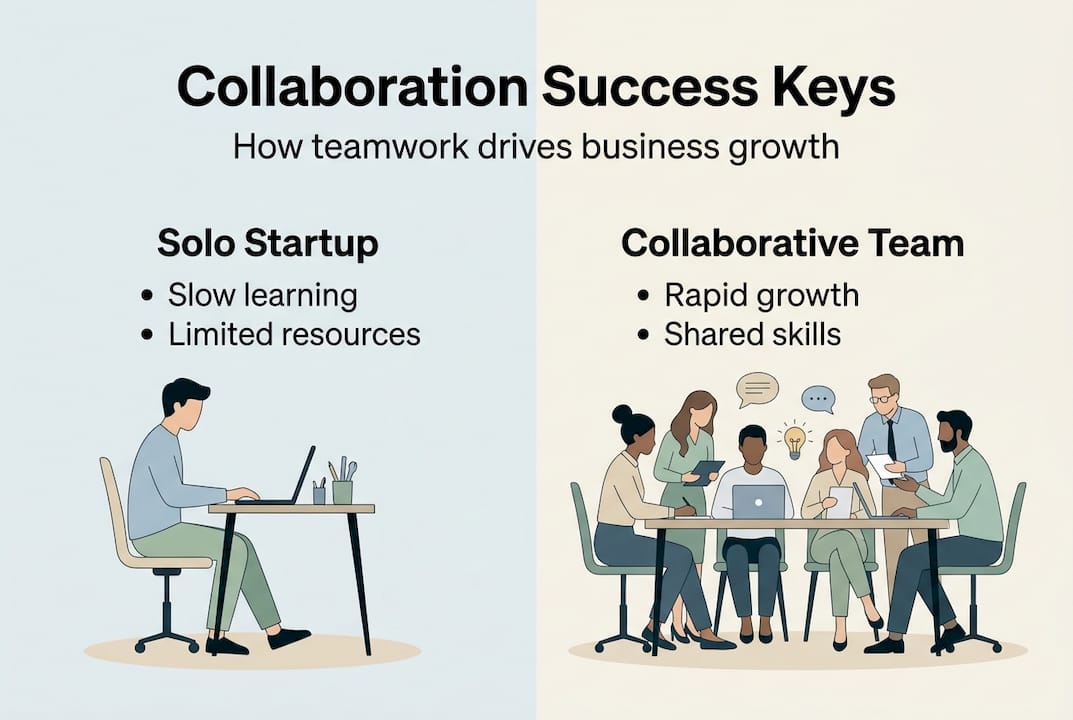
Here is a direct comparison of what solo versus collaborative approaches typically look like for early-stage founders:
| Factor | Solo approach | Collaborative approach |
|---|---|---|
| Learning speed | Slow, trial-and-error | Fast, shared knowledge |
| Resource access | Limited to own capital | Pooled skills and networks |
| Problem-solving | One perspective | Diverse, faster solutions |
| Resilience | Vulnerable to setbacks | Supported through challenges |
| Market reach | Narrow | Expanded through partners |
The benefits extend well beyond what a table can capture. Founders who engage in peer collaboration report faster product validation, stronger accountability, and a significantly reduced sense of isolation, which is one of the most underrated threats to early-stage momentum.
Key direct benefits include:
- Faster learning: Mentors and peers compress years of experience into months of guidance.
- Expanded problem-solving: Multiple perspectives surface solutions you would never find alone.
- Broader market access: Partners open doors to customers, suppliers, and investors you cannot reach solo.
- Greater resilience: A collaborative network acts as a buffer when challenges arise.
“Collaboration is not a soft skill for entrepreneurs. It is a strategic asset that directly determines how quickly and sustainably a business can grow.”
For aspiring founders, the takeaway is simple: collaboration is not optional support. It is a core business strategy.
Types and mechanics: How entrepreneurial collaboration actually works
Understanding why collaboration matters is one thing. Knowing how to actually structure it is what separates founders who benefit from those who simply talk about it. Collaboration mechanics span a wide range of formats, from formal strategic alliances and joint ventures to informal mastermind groups and online communities.
Here are the most common and accessible forms for early-stage entrepreneurs:
- Mentorship networks: Experienced founders or operators guide you through specific challenges, offering perspective earned through real experience. Structured mentorship networks are among the highest-leverage starting points for new entrepreneurs.
- Mastermind groups: Small, curated groups of peers who meet regularly to share challenges, hold each other accountable, and brainstorm solutions. The format works because everyone is invested in each other’s success.
- Incubators and accelerators: Structured programs that provide workspace, funding, mentorship, and networks in exchange for equity or program fees. These create a dense, focused environment for rapid growth.
- Joint ventures: Two or more businesses formally agree to collaborate on a specific project or market opportunity, pooling resources while sharing both risk and reward.
- Online communities: Platforms like Slack groups, LinkedIn communities, and dedicated forums enable ongoing peer learning and connection across geographies.
The structural elements that make any collaboration work consistently are: regular scheduled meetings, clearly documented goals, shared tools for communication, and defined roles for each party. Trust is the foundation, but it is built through consistent follow-through, not just good intentions.
| Collaboration type | Best for | Key success factor |
|---|---|---|
| Mentorship | Skill gaps, direction | Experienced guide, clear goals |
| Mastermind group | Accountability, ideas | Peer commitment, regular cadence |
| Incubator/accelerator | Rapid scaling | Structured program, strong network |
| Joint venture | Market expansion | Aligned objectives, legal clarity |
| Online community | Broad networking | Active engagement, consistent value |
Exploring innovation strategies for teams can also help you understand how to bring collaborative thinking into your internal operations, not just your external partnerships.
Pro Tip: Before approaching any potential collaborator, write down exactly what you bring to the table and what you need in return. Clarity on your own value proposition makes every conversation more productive and more likely to result in a genuine partnership.
Effective strategies for aspiring entrepreneurs: Building and sustaining collaboration
Knowing the types of collaboration is useful. Knowing how to actually build and sustain them is what drives results. The good news is that you do not need a large network or a big budget to start. You need a clear strategy and the willingness to show up consistently.
Here is where to focus your energy:
- Start with mentorship matching platforms. Programs and platforms that connect early-stage founders with experienced mentors are among the most accessible entry points. Vet potential mentors by reviewing their track record, checking for alignment in industry or stage, and having an honest first conversation about expectations. A well-matched mentorship program can be transformative.
- Join incubators, bootcamps, and structured communities. These environments create concentrated collaboration opportunities. You are surrounded by peers at similar stages, guided by experienced operators, and held accountable by the structure itself.
- Engage actively in online communities. LinkedIn groups, industry-specific Slack channels, and founder forums are free and accessible. The key is to contribute value before you ask for anything. Share insights, answer questions, and build a reputation as someone worth knowing.
- Use AI-powered networking tools. In 2026, tools that match founders with compatible partners based on industry, stage, and goals are increasingly effective. They reduce the friction of cold outreach and surface connections you might never find manually.
- Sustain collaboration through documentation and recurring check-ins. The collaborations that fade are almost always the ones without structure. Set a regular meeting cadence, document shared goals, and celebrate wins together.
The data on mentorship alone is striking: 92% of mentored startups survive their first year, compared to just 67% of those without mentors. That gap represents real businesses, real livelihoods, and real potential either realized or lost.

Looking at mentorship program examples from successful founders can also give you a practical template for what a high-impact mentoring relationship actually looks like in practice.
Pro Tip: Start with peer and mentor communities before approaching corporate partners or formal joint ventures. Build your collaboration muscles in lower-stakes environments first, then scale up as your confidence and track record grow.
Common pitfalls and real-world results: What to watch for and how to measure success
Collaboration is powerful, but it is not without risk. Understanding the most common failure points before you encounter them is one of the smartest things you can do as an aspiring founder.
The most frequent pitfalls include:
- Misaligned objectives: When partners want different outcomes, friction is inevitable. Clarify goals before committing.
- Poor communication: Assumptions kill collaborations faster than almost anything else. Over-communicate early.
- Trust breakdown: Trust erodes when commitments are not honored. Start small, build a track record, then deepen the relationship.
- Intellectual property risks: Sharing ideas and strategies creates exposure. Always use written agreements, even in informal partnerships.
- Unclear roles: When no one knows who is responsible for what, nothing gets done and resentment builds.
The numbers on corporate-startup collaborations are sobering: only 28% achieve strong ROI, with misaligned goals and communication breakdowns cited as the primary culprits. The solution is not to avoid collaboration but to structure it carefully from the start.
Research also confirms that sequenced open innovation boosts SME success significantly. This means building collaboration in deliberate stages rather than jumping straight into complex alliances. Start with mentorship, move to peer groups, and then consider formal partnerships as your business matures.
“The collaborations that thrive are not the ones with the most ambitious goals. They are the ones with the clearest agreements and the most honest communication.”
To measure whether your collaborative efforts are working, track these benchmarks:
- Startup survival rate at 12 months versus industry average
- Speed to market for new products or services
- New network connections and referral sources gained
- Revenue attributed to partner introductions or joint efforts
Exploring types of mentorship programs and understanding the benefits of structured incubators can help you choose the right collaborative environments for your current stage.
Why true entrepreneurial collaboration defies outdated myths
For decades, entrepreneurial culture celebrated the lone visionary. The founder who outworked everyone, trusted no one, and built an empire through sheer individual force. That story sells books, but it does not reflect how most successful businesses actually get built.
The evidence is clear: collaborative orientation is now recognized as a core entrepreneurial trait, especially for SMEs and early-stage founders operating with limited resources. The founders who grow fastest in 2026 are not the ones who guard their ideas most jealously. They are the ones who build the right relationships at the right time.
The outdated myth says competition is the default mode. The reality is that strategic collaboration and healthy competition can coexist. You can share knowledge with peers in your space, collaborate on market education, and still compete fiercely for customers. These are not contradictions.
What sets lasting collaborations apart is intentional sequencing and honest communication. Start with peer-driven success models before reaching for complex corporate alliances. Build trust incrementally. Document everything. And treat collaboration as a skill you practice and refine, not a one-time event you either get right or get wrong.
The entrepreneurs who thrive are the ones who learn to ask for help early, give generously to their networks, and build partnerships that outlast any single project.
Your next step: Join a thriving entrepreneurial community
Putting collaboration into practice requires more than good intentions. It requires the right environment, the right people, and a structure that holds you accountable to your goals. That is exactly what Nomad Excel is built to provide. Whether you are looking to sharpen your strategy, find your first mentor, or connect with a community of driven founders, the Online Entrepreneurship Bootcamp offers an immersive experience designed around real execution and lasting connection. Explore the entrepreneurship bootcamp guide to understand what the program offers, or visit the Nomad Excel community to take your first step toward building the collaborative network your business needs.
Frequently asked questions
What is entrepreneurial collaboration in simple terms?
Entrepreneurial collaboration means working with others such as peers, mentors, or organizations to share resources and ideas so your business grows faster and more sustainably than it could alone.
What are the main benefits of collaboration for startups?
Collaboration accelerates innovation and growth while overcoming resource limitations, giving startups access to skills, networks, and problem-solving capacity they cannot build independently.
How can I start collaborating as a new entrepreneur?
Join mentorship networks, incubators, or online communities to connect with potential partners and begin sharing knowledge in a structured, low-risk environment.
What challenges should I watch out for in collaborations?
Misaligned goals and communication breakdowns are the most common collaboration killers, so always clarify objectives upfront and put agreements in writing before moving forward.
Does collaboration really improve startup survival rates?
Yes. Mentored startups survive at a 92% rate in their first year, compared to just 67% for those without mentors, making mentorship one of the highest-impact forms of collaboration available.
Comments are closed.