
How to build remote teams that thrive: proven steps & tools
TL;DR:
- Remote team success depends on clear purpose, outcome-based metrics, and documented workflows.
- Hiring requires skill-focused assessments, culture fit, and consideration of time zone overlap.
- Effective onboarding and consistent communication habits build trust, engagement, and long-term performance.
Building a high-performing remote team sounds straightforward until you’re six months in, dealing with missed deadlines, communication gaps, and a revolving door of talent. Most distributed teams don’t fail because of bad people. They fail because of missing structure, unclear expectations, and a culture that never quite took root. This guide walks you through every critical stage, from defining your purpose and hiring the right people to onboarding with intention and building workflows that actually stick. Whether you’re starting from scratch or fixing a struggling team, you’ll find practical steps, proven frameworks, and the pitfalls that quietly sink even well-funded distributed teams.
Table of Contents
- Define your purpose and success metrics
- Find and hire the right remote talent
- Onboard for immediate engagement and trust
- Establish workflows, communication, and culture
- Why most remote teams fail (and how to avoid it)
- Accelerate your remote team’s success with Nomad Excel
- Frequently asked questions
Key Takeaways
| Point | Details |
|---|---|
| Prioritize clear outcomes | Define each role and team objective with measurable, outcome-based metrics to ensure alignment. |
| Structure onboarding for success | A well-designed 30-60-90 day onboarding plan improves connection, speed, and retention for remote hires. |
| Optimize for deep work | Balance synchronization and autonomy to maximize productivity and focus by leveraging effective tools and processes. |
| Document everything | Build team culture and performance on clear documentation, not just meetings or presence. |
Define your purpose and success metrics
Having outlined what you’ll gain from this guide, let’s start by defining why and how remote teams drive your business forward.
Before you post a single job listing, you need to answer one question honestly: what does this remote team exist to accomplish? Not in vague terms like “support growth” but in specific, measurable ones. If you’re looking to launch a remote business, this clarity becomes the foundation everything else is built on. Without it, you’ll hire busy people instead of productive ones.
Start by mapping your core business strategy to the roles you actually need. Each role should be defined by outcomes, not hours logged. Outcome-based metrics before hiring align remote hires with team goals far more effectively than job descriptions built around tasks. This is the difference between a content writer who “writes blog posts” and one who “drives 20% organic traffic growth per quarter.”
Here’s an example table of outcome-based success metrics for common remote roles:
| Role | Output metric | Time frame |
|---|---|---|
| Content writer | 8 published articles | Monthly |
| Sales rep | 15 qualified demos booked | Monthly |
| Developer | 4 features shipped | Per sprint |
| Customer support | 95% satisfaction score | Weekly |
| Project manager | 90% on-time delivery rate | Quarterly |
Once you’ve defined the metrics, document them. The GitLab TeamOps model is one of the most battle-tested frameworks for this, built entirely around documented decisions, asynchronous workflows, and measurable outputs. It’s worth studying even if you don’t adopt it wholesale.
For team building for startups, the temptation is to hire fast and figure out structure later. Resist it. A few weeks spent clarifying roles and metrics upfront saves months of confusion later.
Key actions to take before hiring:
- Write a one-page team charter that connects your business goals to each role
- Define 2 to 3 measurable outcomes per role, not a list of responsibilities
- Decide on your async vs. sync communication ratio before day one
- Identify which roles require time zone overlap and which can operate fully async
Pro Tip: Use documented workflows, not just verbal expectations. If a process only lives in someone’s head, it doesn’t exist for your remote team.
Find and hire the right remote talent
With your team’s purpose and success metrics set, it’s time to build the team, starting with targeted hiring strategies.
Sourcing remote talent globally opens up an extraordinary talent pool, but it also introduces complexity. The best remote hires aren’t just skilled. They’re self-directed, clear communicators, and comfortable operating with minimal hand-holding. Remote hiring best practices consistently point to structured assessments and skills-first evaluation as the most reliable filters.
Here’s a comparison of two common hiring approaches:
| Approach | Skills-first hiring | Culture-add hiring |
|---|---|---|
| Focus | Proven ability to deliver outputs | Values alignment and growth mindset |
| Best for | Technical and specialized roles | Leadership and cross-functional roles |
| Risk | Misalignment with team values | Skill gaps that slow execution |
| Screening tool | Paid test projects | Behavioral interview questions |
For most remote teams, the sweet spot is a blend of both. You need someone who can do the job and someone who will thrive in your specific work culture.
Here’s a practical hiring process to follow:
- Write a role scorecard with 3 to 5 non-negotiable skills and 2 to 3 culture indicators
- Post on role-specific platforms, not just general job boards
- Use an async video screening round to assess communication style early
- Assign a short, paid skills test that mirrors real work
- Conduct a structured final interview with consistent questions across all candidates
- Check references with specific questions about remote work habits
Time zone fit is often underestimated. If your team needs real-time collaboration, prioritize candidates with at least 3 to 4 hours of daily overlap with your core team. If you’re building a truly async team, make that explicit in your job posting and screen for candidates who have transitioned to remote work successfully before.
Strong leadership skills for remote teams also mean knowing when to pass on a technically strong candidate who shows poor async communication habits during the hiring process. Those habits don’t improve once they’re on the payroll.
Onboard for immediate engagement and trust
Once the right people are hired, the next challenge is engaging them instantly and ensuring they feel truly part of the team.

Onboarding is where remote teams either cement trust or quietly lose it. Sending a laptop and a Slack invite is not onboarding. It’s a missed opportunity. Structured 30-60-90 day onboarding plans accelerate ramp-up, build connection, and improve retention in remote teams in ways that ad hoc approaches simply can’t match.
Here’s what a strong remote onboarding journey looks like:
- Days 1 to 30 (Orient): Focus on culture, tools, and relationships. Assign a buddy. Schedule daily check-ins for the first two weeks. Provide access to all documented workflows and team norms.
- Days 31 to 60 (Contribute): Shift to small, real projects with clear success criteria. Weekly one-on-ones with the manager. Introduce the new hire to cross-functional collaborators.
- Days 61 to 90 (Own): Full ownership of their role’s core responsibilities. Formal feedback session. Discuss 90-day performance against agreed metrics.
The research backs this up. A University of Chicago study found that structured in-person onboarding boosted long-term retention, a finding that translates directly to remote contexts when the structure is replicated digitally.
“The biggest mistake remote leaders make is treating onboarding as a checklist rather than a relationship-building process. Connection is the real deliverable.”
Using remote onboarding templates can help you standardize the process without making it feel robotic. The goal is consistency with warmth, not bureaucracy.
Building trust remotely starts in the first 30 days. New hires who feel seen and supported early become your most loyal and productive team members. Those who feel dropped into the deep end often start quietly job hunting within 60 days.
Pro Tip: Pair every new hire with a buddy for their first 30 days. This single practice dramatically reduces early turnover and accelerates the social integration that remote work makes harder.
Establish workflows, communication, and culture
With your new hires engaged, the final piece is creating repeatable systems and culture that power long-term success.
Even the best team will underperform without clear systems. The good news is that remote teams, when structured well, actually outperform their office counterparts on focus. Remote teams achieve 51% deep work time versus 49% coordination time, while hybrid teams average lower focus at 31% compared to fully remote teams at 41%. That’s a structural advantage worth protecting.
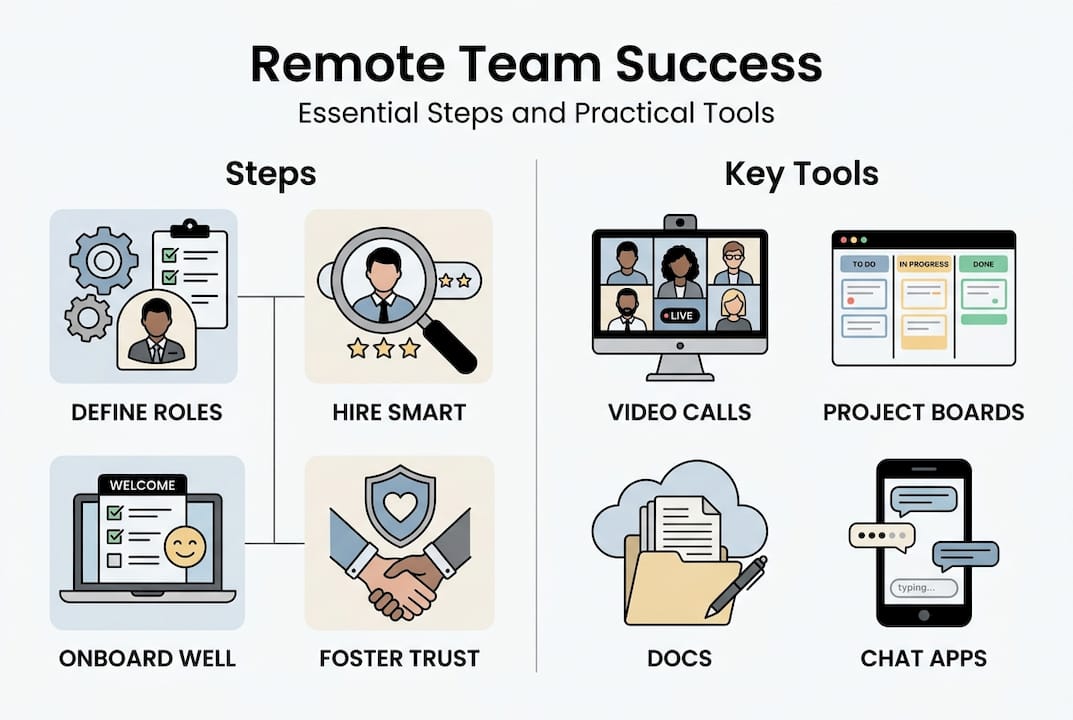
To protect and build on it, you need the right tools and the right habits:
Must-have remote tools:
- Project management: Asana, Linear, or Notion for task tracking and accountability
- Async communication: Loom for video updates, Slack with strict channel norms
- Documentation: Confluence or Notion as your team’s single source of truth
- Sync communication: Zoom or Google Meet, reserved for decisions and relationship-building
- Time zone management: World Time Buddy or Clockwise for scheduling across regions
Communication habits that actually work:
- Default to async for updates, context-sharing, and non-urgent questions
- Reserve sync meetings for brainstorming, conflict resolution, and culture moments
- Create a “no meeting” block of at least 3 hours per day for deep work
- Use documented team workflows to reduce the need for repeated clarification
Culture in remote teams doesn’t happen by accident. It’s built through consistent rituals: weekly team standups, monthly virtual social events, and, when possible, in-person retreats. Psychological safety, the belief that you can speak up without fear, is the invisible infrastructure of high-performing teams. You build it through regular feedback, transparent communication, and leaders who model vulnerability.
Exploring remote team collaboration tips and investing in business retreats for remote teams are two of the highest-leverage moves a remote team leader can make. The ROI on a well-designed retreat often shows up in months of improved cohesion and output.
Why most remote teams fail (and how to avoid it)
Here’s the uncomfortable truth most remote work guides won’t tell you: the majority of distributed teams fail not because of technology or time zones, but because leaders try to run remote teams like offices with video calls.
Endless Zoom meetings, real-time availability expectations, and culture built on presence rather than output are office habits wearing a remote costume. They destroy the very advantages remote work offers. The teams that avoid this trap share one trait: they invest in process before people. Not because people don’t matter, but because even great people can’t thrive in broken systems.
Documentation beats meetings. Every time. When a decision, a process, or an expectation only exists in a conversation, it creates ambiguity that compounds across time zones and team sizes. The remote team building pitfalls that sink most distributed teams are almost always rooted in this gap.
The teams that thrive treat their handbook, their workflows, and their documented norms as living assets, not administrative burdens. They over-communicate in writing and under-schedule in meetings. That’s not a management style. It’s a competitive advantage.
Accelerate your remote team’s success with Nomad Excel
Building a thriving remote team takes more than good intentions. It takes the right frameworks, the right culture, and sometimes, the right environment to reset and realign. At Nomad Excel, we design immersive company retreats and programs specifically for distributed teams who want to strengthen trust, sharpen strategy, and return to work with renewed focus.
Our business retreats for remote teams combine structured workshops, facilitated alignment sessions, and authentic team experiences that no Zoom call can replicate. For leaders looking to develop their own entrepreneurial edge, our online entrepreneurship bootcamp delivers the clarity and execution frameworks your team needs to grow faster. When your team is ready to level up, we’re ready to help.
Frequently asked questions
What is the best structure for remote teams?
The best structure prioritizes clear roles and outcomes over hours logged, with documented workflows that match your company’s mission and time zone reality. Flat or pod-based structures tend to work well for distributed teams under 50 people.
How do you manage time zones in remote teams?
Aim for at least 3 to 4 hours of daily overlap for collaborative roles, or establish strict async protocols to reduce communication lag and prevent burnout across distributed time zones.
What makes remote onboarding effective?
A structured 30-60-90 day plan combined with a buddy system, clear documentation, and early community touchpoints drives faster ramp-up and significantly better retention compared to unstructured onboarding.
How do you maintain productivity and trust in remote teams?
Protect deep work time, build a culture of documented processes, and create regular feedback loops. Remote teams achieve 51% deep work time when workflows are structured correctly, which is a measurable edge over less organized distributed setups.
Comments are closed.