
How to Create a Mastermind Group for Business Success
Launching a business can feel isolating, even when surrounded by energy at a Nomad Excel bootcamp. For many aspiring entrepreneurs, finding trusted peers to support growth and hold each other accountable is a game changer. Forming a mastermind group creates a space for brainstorming, peer accountability, and authentic support—turning individual ambitions into shared momentum. This guide outlines how to design a mastermind group with a clear purpose, intentional membership, and structured meetings for real, sustainable progress.
Table of Contents
- Step 1: Define Your Mastermind Group Purpose
- Step 2: Select The Right Members For Success
- Step 3: Establish Structure And Meeting Frequency
- Step 4: Set Clear Goals And Accountability Measures
- Step 5: Facilitate Effective Collaboration And Feedback
- Step 6: Review Group Progress And Optimize Results
Quick Summary
| Key Insight | Explanation |
|---|---|
| 1. Define Your Group’s Purpose | Clearly articulate the specific goals, skills, and collaboration expectations for your mastermind group to attract the right members. |
| 2. Carefully Select Members | Choose members based on commitment, complementary skills, and mutual respect to ensure a productive environment. |
| 3. Establish Meeting Structure | Design a consistent meeting format with defined duration, frequency, and accountability mechanisms for effective engagement. |
| 4. Implement Goal-Setting and Accountability | Develop measurable goals and regular check-ins to maintain motivation and track progress effectively among members. |
| 5. Facilitate Collaboration | Use active listening and structured discussions to maximize participation and productive feedback within the group. |
Step 1: Define your mastermind group purpose
Creating a successful mastermind group starts with crystal-clear purpose definition. This crucial first step transforms a casual networking group into a powerful engine of professional growth and collaborative success.
Defining your mastermind group’s purpose requires strategic thinking and intentional design. Mastermind groups combine brainstorming, accountability, and peer support to help members achieve breakthrough results. Your group’s specific purpose should articulate three key dimensions:
- Business Growth Goals: What specific professional outcomes are members seeking?
- Skill Development Areas: Which competencies do participants want to enhance?
- Collaboration Expectations: How will members support and challenge each other?
Start by conducting individual conversations with potential members to understand their core motivations. Some entrepreneurs seek revenue acceleration, while others prioritize strategic problem-solving or personal leadership development. Your purpose statement should be specific enough to attract the right members but flexible enough to accommodate individual journeys.
A well-defined mastermind group purpose acts as a magnetic north, guiding members toward collective and individual success.
Critical Elements of an Effective Purpose Statement:
- Clear objectives
- Measurable outcomes
- Shared values
- Mutual commitment
Pro tip: Write your purpose statement as a living document that can evolve with your group’s growth and changing professional landscapes.

Step 2: Select the right members for success
Building a high-performing mastermind group hinges on carefully curating members who will collectively drive exceptional results. The selection process is more nuanced than simply gathering ambitious professionals.
Strategic member selection involves balancing diverse perspectives while maintaining a core alignment of values and professional goals. Your ideal group should include members who demonstrate:
- Commitment to Growth: Participants actively investing in personal and professional development
- Complementary Skills: Members with diverse yet intersecting professional backgrounds
- Emotional Intelligence: Individuals capable of giving and receiving constructive feedback
- Mutual Respect: Professionals who understand collaborative dynamics
The recruitment process requires thoughtful assessment. Schedule individual interviews to evaluate each potential member’s compatibility, motivation, and capacity for meaningful contribution. Look beyond surface-level credentials and assess their genuine willingness to engage deeply, share vulnerabilities, and support collective advancement.
Effective mastermind groups are not networking events, but transformative spaces of mutual growth and accountability.
Key evaluation criteria for potential members include:
- Professional alignment
- Personal motivation
- Communication skills
- Demonstrated reliability
Pro tip: Consider creating a preliminary application or screening process to ensure only truly committed professionals join your mastermind group.
Step 3: Establish structure and meeting frequency
Designing a robust framework for your mastermind group will determine its long-term success and member engagement. The right structure transforms a casual gathering into a powerful catalyst for professional growth.
Mastermind groups thrive with consistent meeting formats that balance structure with flexibility. Consider these critical elements when designing your group’s operational blueprint:
- Meeting Duration: Typically 60-90 minutes per session
- Frequency: Weekly, bi-weekly, or monthly gatherings
- Communication Channels: Consistent platforms for ongoing interaction
- Accountability Mechanisms: Clear methods for tracking progress
Your meeting structure should incorporate predictable yet dynamic components. A typical session might include:
- Personal progress updates
- Specific challenge presentations
- Collective problem-solving
- Goal setting and accountability check-ins
Remain adaptable to your members’ professional rhythms and availability. Virtual platforms can provide additional flexibility, allowing geographic diversity and accommodating different schedules.
Consistency is the heartbeat of a successful mastermind group – reliable rhythms create transformative collaborative spaces.
Decide whether your group will prioritize:
Here is a comparison of meeting formats for mastermind groups to help you choose the best fit:
| Format | Main Advantage | Limitation | Best For |
|---|---|---|---|
| In-Person | Strong personal bonds | Requires local availability | Deep connection building |
| Virtual | High flexibility | Less nonverbal cues | Geographically diverse teams |
| Hybrid | Blends both benefits | Complex scheduling | Flexible, mixed groups |
- In-Person Meetings: Deep personal connection
- Virtual Sessions: Maximum convenience and accessibility
- Hybrid Approach: Blending both interaction styles
Pro tip: Create a preliminary group charter that outlines meeting expectations, allowing members to review and collaboratively refine the structure.
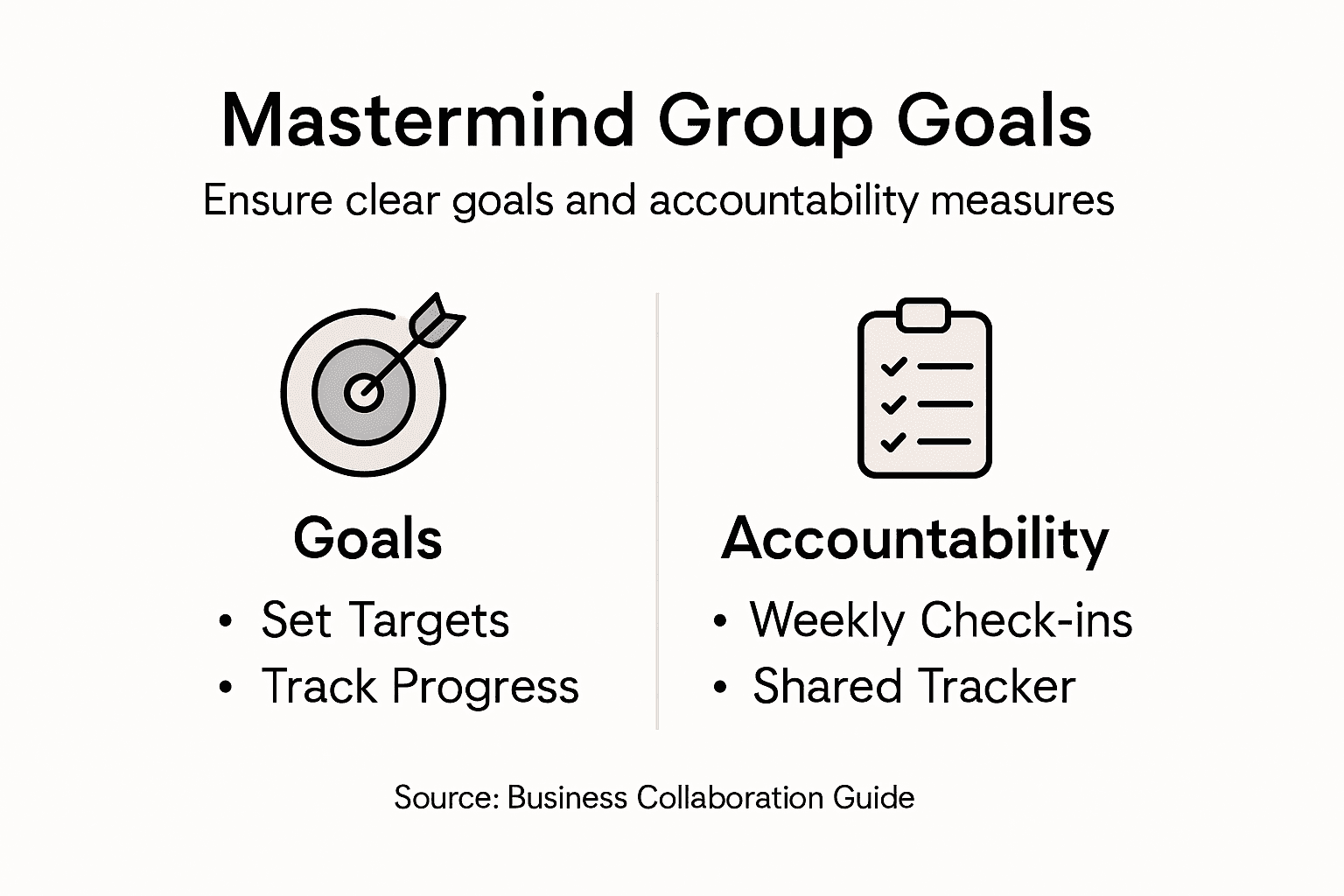
Step 4: Set clear goals and accountability measures
Establishing robust goal-setting and accountability mechanisms transforms your mastermind group from a casual meetup into a powerful engine of professional transformation. The right approach ensures every member stays motivated and makes meaningful progress.
Peer-driven accountability drives collective success by creating a structured environment of mutual support and honest evaluation. When designing your accountability framework, consider these critical components:
- Specific Goal Articulation: Clearly defined, measurable objectives
- Quantifiable Metrics: Concrete ways to track progress
- Regular Check-ins: Scheduled progress review sessions
- Transparent Reporting: Open, honest discussions about challenges
Implement a goal-setting methodology that balances individual aspirations with group dynamics. A recommended approach involves:
- Personal goal presentation
- Group feedback and refinement
- Breaking large goals into actionable milestones
- Periodic progress tracking
Accountability is not about perfection, but about commitment and consistent forward movement.
Key strategies for maintaining accountability include:
- Written Documentation: Formal goal statements
- Scheduled Reviews: Monthly or quarterly progress assessments
- Peer Support: Constructive feedback mechanisms
- Celebration of Achievements: Recognizing individual and collective wins
Pro tip: Develop a shared digital tracker where members can log goals, update progress, and provide real-time mutual support.
Step 5: Facilitate effective collaboration and feedback
Transforming your mastermind group from a collection of individuals into a powerful collaborative ecosystem requires intentional facilitation strategies. The right approach can unlock collective intelligence and drive breakthrough insights.
Collaborative techniques enhance group problem-solving by creating a safe, dynamic environment for meaningful exchange. Effective facilitation demands a nuanced approach that balances structure with creative exploration:
- Active Listening: Encouraging full engagement from every member
- Balanced Participation: Ensuring all voices are heard
- Constructive Dialogue: Promoting respectful, meaningful feedback
- Conflict Resolution: Managing disagreements productively
Implement collaborative techniques that maximize group potential:
- Use round-robin discussion formats
- Employ structured brainstorming methods
- Create small breakout groups for deeper exploration
- Rotate facilitation responsibilities
Great collaboration is an art of balancing structure with spontaneity – creating space for both individual expression and collective wisdom.
Key facilitation strategies include:
- Time Management: Keeping discussions focused and productive
- Questioning Techniques: Asking provocative, insight-generating questions
- Emotional Intelligence: Reading and responding to group dynamics
- Inclusive Communication: Welcoming diverse perspectives
Pro tip: Develop a group communication agreement that establishes ground rules for respectful, constructive feedback and open dialogue.
Step 6: Review group progress and optimize results
Transforming your mastermind group from a static meeting into a dynamic performance optimization engine requires systematic progress review and continuous adaptation. The most successful groups treat their collaborative process as an evolving strategy, not a fixed approach.
Regular reflection drives group effectiveness by creating opportunities for honest assessment and strategic recalibration. Implement a comprehensive review process that goes beyond surface-level updates:
- Quantitative Metrics: Tracking concrete goal achievements
- Qualitative Insights: Understanding deeper learning and growth
- Individual Perspectives: Capturing personal transformation stories
- Collective Intelligence: Synthesizing group wisdom
Design a robust review framework that includes:
- Quarterly comprehensive group assessments
- Individual member progress evaluations
- Anonymous feedback collection
- Strategic realignment sessions
Progress is not about perfection, but about consistent movement and collective learning.
Key optimization strategies include:
This summary highlights optimization strategies for ongoing mastermind group performance:
| Strategy | Description | Result |
|---|---|---|
| Performance Tracking | Use metrics to monitor progress | Continuous improvement focus |
| Adaptive Methodology | Adjust goals as needs change | Greater group resilience |
| Continuous Learning | Embrace new skills and ideas | Ongoing member development |
| Member Feedback | Integrate perspectives regularly | Higher engagement and buy-in |
- Performance Tracking: Using data-driven insights
- Adaptive Methodology: Flexible goal-setting approaches
- Continuous Learning: Embracing iterative improvement
- Member Feedback: Integrating individual perspectives
Pro tip: Create a digital dashboard that visualizes individual and group progress, making tracking transparent and motivational.
Unlock Your Mastermind Group’s Full Potential with Nomad Excel
Struggling to build a mastermind group that truly drives business growth and accountability is a common challenge for entrepreneurs eager to accelerate success. This article highlights key pain points such as defining clear goals, selecting committed members, and sustaining effective collaboration. If you want to go beyond theory and create a thriving community where execution meets mentorship and mutual support, Nomad Excel offers immersive entrepreneurship bootcamps designed to help you launch or scale your business alongside like-minded founders.
Explore practical frameworks, gain expert mentorship, and join a dynamic community committed to real-world results. Discover how structured programs and ongoing peer support empower you to build the growth-driven mastermind group you need. Start your journey today by browsing our Entrepreneurship Archives and Program Archives for inspiring insights and proven strategies. Don’t wait to turn your vision into action — learn more at Nomad Excel and take the first step toward meaningful business transformation.
Frequently Asked Questions
How do I define the purpose of my mastermind group for business success?
Defining your mastermind group’s purpose involves establishing clear business growth goals, skill development areas, and collaboration expectations. Start by having individual conversations with potential members to identify their motivations and desired outcomes.
What criteria should I use to select members for my mastermind group?
Select members based on their commitment to growth, complementary skills, emotional intelligence, and mutual respect. Schedule individual interviews to evaluate each candidate’s compatibility and willingness to engage deeply within the group.
How often should my mastermind group meet, and for how long?
Your group should meet consistently, typically for 60-90 minutes, either weekly, bi-weekly, or monthly. Choose a frequency that aligns with your members’ availability and ensure it becomes a reliable habit for everyone involved.
What accountability measures should I implement for my mastermind group?
Implement specific goal articulation, quantifiable metrics, and regular check-ins to keep everyone accountable. Establish scheduled progress review sessions, allowing members to share updates on their goals and provide constructive feedback to one another.
How can I facilitate effective collaboration and feedback among members?
Encourage collaboration by fostering active listening, balanced participation, and constructive dialogue. Use structured brainstorming methods or round-robin discussions to ensure all members contribute and feel valued during each session.
How should I review group progress and make necessary optimizations?
Conduct quarterly assessments to evaluate both individual member progress and overall group effectiveness. Collect anonymous feedback and hold strategic realignment sessions to adapt goals and strategies, ensuring continuous improvement and engagement.
Comments are closed.