
Idea Validation: Proven Steps for Startup Success
Aspiring founders often face the challenge of determining whether their vision truly meets a real market need or risks becoming another costly misstep. The journey from idea to launch demands far more than enthusiasm—it hinges on mastering the art of systematic idea validation. By experimenting with concepts, gathering customer feedback, and testing product viability, entrepreneurs from every country learn to make informed decisions, conserve resources, and reduce the chances of failure due to poor market fit. This guide reveals actionable strategies for building confidence in your business idea before making significant investments.
Table of Contents
- Defining Idea Validation in Entrepreneurship
- Key Types and Stages of Validation
- Essential Methods for Testing Viability
- Common Risks and Cost Implications
- Critical Mistakes to Avoid in Validation
Key Takeaways
| Point | Details |
|---|---|
| Idea Validation is Essential | Entrepreneurs should validate their business ideas to minimize risk and ensure market fit before major investments. |
| Structured Validation Process | Progressing through stages like problem discovery, customer research, and market feedback is crucial for effective validation. |
| Diverse Testing Methods | Employing various methods such as customer interviews and prototypes helps gather comprehensive insights into market potential. |
| Avoid Common Pitfalls | Entrepreneurs must guard against mistakes like confirmation bias and emotional attachment to enhance validation effectiveness. |
Defining Idea Validation in Entrepreneurship
Idea validation is the strategic process entrepreneurs use to systematically test and confirm the potential success of a business concept before committing significant resources. At its core, this approach helps founders minimize risk and maximize the probability of creating a viable product or service that truly addresses market needs.
The concept of idea validation involves several critical components designed to evaluate a business concept’s market potential:
- Problem Verification: Confirming that the proposed solution addresses a genuine market challenge
- Market Research: Gathering comprehensive insights about target customers and competitive landscape
- Customer Feedback: Collecting direct input from potential users about product desirability
- Feasibility Assessment: Evaluating technical and financial capabilities to execute the idea
Idea validation goes beyond theoretical planning by requiring entrepreneurs to gather evidence through systematic experimentation. This means transforming abstract concepts into tangible prototypes or minimum viable products (MVPs) that can be tested with real potential customers. The goal is not just to have a good idea, but to prove that the idea can generate sustainable business value.
Entrepreneurs typically progress through a structured validation framework that includes multiple validation stages:
- Problem Definition
- Market Research
- Solution Prototyping
- Customer Testing
- Iterative Refinement
By methodically working through these stages, founders can dramatically reduce the likelihood of building products nobody wants. Systematic validation helps prevent failure due to lack of market fit and saves critical resources that might otherwise be wasted on unviable concepts.
Pro tip: Always allocate at least 20% of your initial project budget and timeline specifically for thorough idea validation to mitigate potential future risks.
Key Types and Stages of Validation
Entrepreneurs navigate multiple types of validation to comprehensively assess their business idea’s potential. Each validation type serves a unique purpose in reducing risk and increasing the likelihood of successful product development.

The primary types of startup validation include:
The following table summarizes the main types of startup validation and their business impact:
| Validation Type | Core Focus | Business Impact |
|---|---|---|
| Problem Validation | Identify real market challenges | Ensures genuine demand exists |
| Solution Validation | Test effectiveness of solution | Confirms product solves problems |
| Market Validation | Assess market size and fit | Enables scalability assessment |
| Technical Validation | Evaluate build feasibility | Avoids costly tech failures |
| Financial Validation | Examine revenue and sustainability | Supports long-term planning |
- Problem Validation: Confirming that a genuine market problem exists and is worth solving
- Solution Validation: Testing whether the proposed solution effectively addresses the identified problem
- Market Validation: Analyzing market size, competition, and customer willingness to pay
- Technical Validation: Assessing the feasibility of building the proposed product or service
- Financial Validation: Evaluating potential revenue models and financial sustainability
Startup validation follows a structured process that systematically reduces entrepreneurial risk. The typical stages involve deep investigation and progressive testing of core business assumptions.
Entrepreneurs typically progress through these key validation stages:
- Problem Discovery
- Customer Research
- Initial Prototype Development
- Market Feedback Collection
- Solution Refinement
- Business Model Validation
Each stage builds upon the previous one, creating a cumulative evidence base that either supports moving forward or signals the need to pivot. The validation process is not linear but iterative, requiring continuous learning and adaptation.
Successful validation transforms an untested idea into a validated business concept with real market potential.
Pro tip: Document every validation stage meticulously, creating a clear audit trail that captures insights, decisions, and pivot points in your entrepreneurial journey.
Essential Methods for Testing Viability
Entrepreneurs have multiple powerful methods to systematically test and validate their business ideas before investing substantial resources. These techniques provide critical insights into market potential, customer interest, and product feasibility.
The most effective viability testing methods include:
Here is a quick comparison of common viability testing methods for startups:
| Method | Key Benefit | Typical Limitation |
|---|---|---|
| Customer Interviews | Deep user insights | Small sample size bias |
| Landing Page Tests | Fast real-world interest signals | May lack context or detail |
| Surveys | Quantitative market data | Lower response accuracy |
| Prototype Development | Early product feedback | Resource-intensive to build |
| Competitor Analysis | Identify market gaps | May miss emerging competitors |
- Customer Interviews: Direct conversations to understand pain points and validate problem assumptions
- Landing Page Tests: Creating minimal web pages to gauge market interest and collect early user signals
- Prototype Development: Building low-fidelity mockups to test core product concepts
- Competitor Analysis: Examining existing solutions to identify market gaps
- Surveys: Collecting quantitative data about potential customer needs and preferences
Startup idea validation requires comprehensive testing strategies that go beyond surface-level assumptions. Successful entrepreneurs use a combination of qualitative and quantitative research methods to build robust evidence supporting their business concept.
Entrepreneurs can implement these practical testing approaches:
- Create a Problem Hypothesis
- Design Targeted Research Instruments
- Collect User Feedback
- Analyze Data Objectively
- Iterate or Pivot Based on Insights
Each testing method provides unique insights that collectively paint a comprehensive picture of the idea’s potential. Lean startup methodologies emphasize rapid experimentation and continuous learning, allowing entrepreneurs to make data-driven decisions quickly and efficiently.
Real validation comes from understanding actual user needs, not just theoretical market potential.
Pro tip: Allocate dedicated time for systematic research and be prepared to objectively evaluate findings, even if they challenge your initial assumptions.
Common Risks and Cost Implications
Startup ventures encounter complex financial landscapes where risk management and strategic cost allocation become critical determinants of success. Understanding the potential financial challenges helps entrepreneurs make more informed decisions and develop robust mitigation strategies.
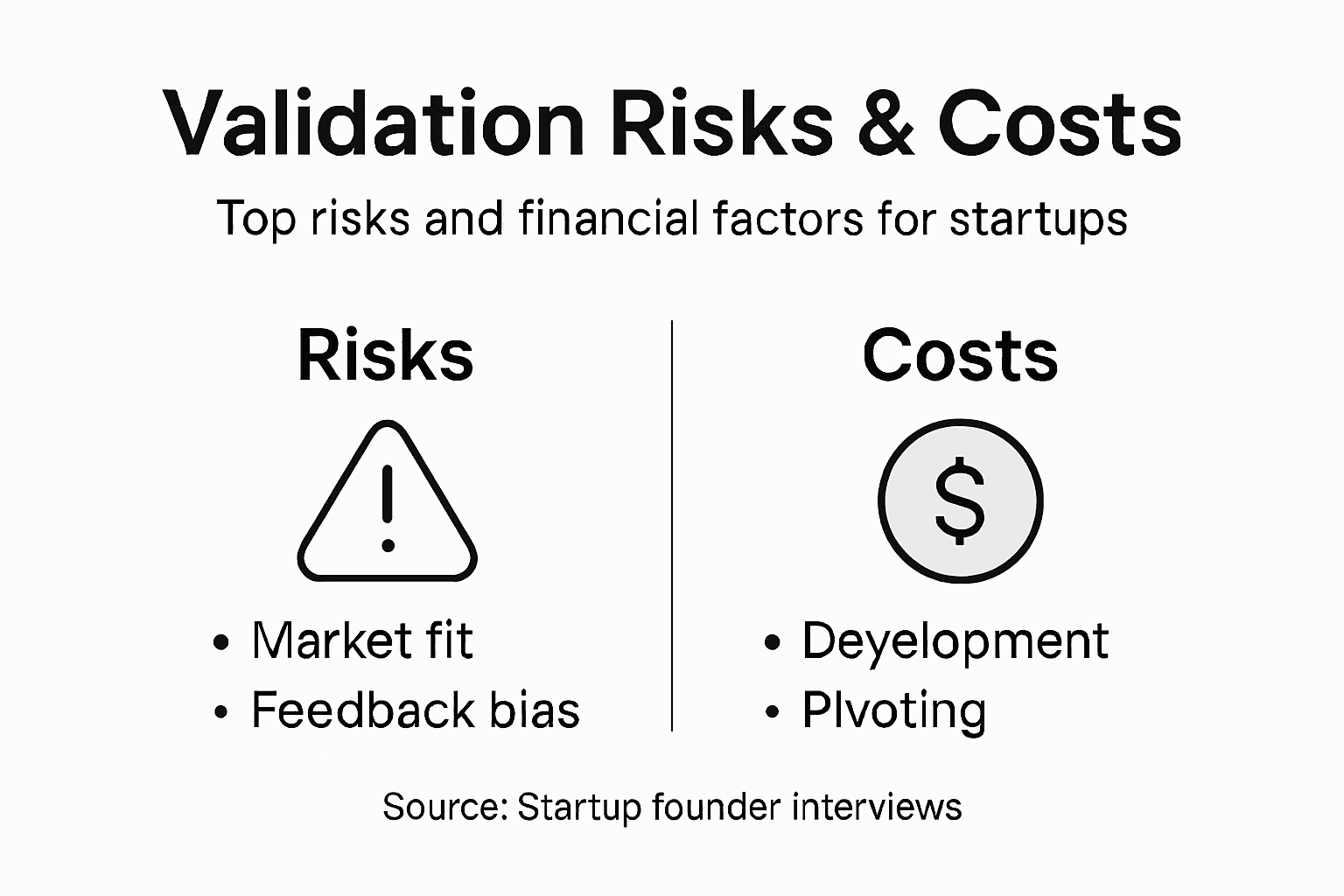
The primary financial risks entrepreneurs must navigate include:
- Technology Development Costs: Expenses related to prototype creation and initial product engineering
- Market Research Investments: Funds required for comprehensive customer and competitive analysis
- Talent Acquisition: Costs associated with recruiting skilled team members
- Marketing Expenditures: Resources needed to generate initial market awareness
- Operational Overhead: Ongoing expenses for infrastructure, tools, and basic business operations
Startup ventures face escalating costs and uncertainties during different lifecycle stages, with early phases presenting the highest financial vulnerability. These initial investments often represent significant sunk costs with minimal predictability of returns.
Entrepreneurs can manage financial risks through strategic approaches:
- Develop Comprehensive Financial Projections
- Create Lean Operational Models
- Establish Multiple Funding Contingencies
- Implement Rigorous Expense Tracking
- Build Financial Buffers for Unexpected Challenges
The most successful startups recognize that financial risk management is not about eliminating risks entirely, but about creating adaptive strategies that allow for controlled experimentation and rapid learning.
Financial prudence in early stages determines long-term startup sustainability.
Pro tip: Allocate at least 20% of your initial budget as a financial buffer for unexpected challenges and pivot opportunities.
Critical Mistakes to Avoid in Validation
Entrepreneurs frequently encounter potential pitfalls during the idea validation process that can dramatically undermine their startup’s potential for success. Recognizing and avoiding these critical errors becomes essential for maintaining momentum and increasing the probability of building a viable business.
The most dangerous validation mistakes include:
- Confirmation Bias: Seeking only evidence that supports your existing beliefs
- Premature Scaling: Investing heavily before thoroughly validating core assumptions
- Ignoring Negative Feedback: Dismissing critical customer perspectives
- Insufficient Market Research: Relying on limited or anecdotal information
- Emotional Attachment: Falling in love with the idea instead of solving real problems
Critical startup validation mistakes can derail entrepreneurial efforts by leading founders down unproductive paths. Understanding these common traps helps entrepreneurs develop more rigorous and objective validation strategies.
Entrepreneurs should systematically protect against validation errors through:
- Maintaining Objective Perspective
- Gathering Diverse Feedback
- Creating Measurable Success Metrics
- Conducting Comprehensive Market Analysis
- Remaining Flexible to Pivot
Successful validation requires a delicate balance between passionate commitment and ruthless objectivity. The most effective entrepreneurs treat their initial ideas as hypotheses to be tested, not sacred concepts to be defended.
True innovation emerges from the willingness to challenge and transform original assumptions.
Pro tip: Cultivate a network of honest, experienced mentors who will provide direct and sometimes uncomfortable feedback about your startup concept.
Accelerate Your Idea Validation Journey with Expert Guidance
Validating your startup idea can feel overwhelming when facing challenges like confirmation bias, costly missteps, or insufficient customer feedback. This article lays out proven steps to methodically test your assumptions and avoid common pitfalls. If you are eager to transform your untested concept into a validated business opportunity with real market potential, you are not alone.
At Nomad Excel we specialize in bringing together aspiring entrepreneurs and teams through immersive Entrepreneurship Bootcamps where you will learn step-by-step frameworks for validation and receive direct mentorship from experienced founders and operators. Our programs are designed to help you conquer key validation stages like problem discovery, prototype development, and customer feedback collection by combining learning with execution and community support.
Don’t let financial risks or premature scaling slow your progress. Join Nomad Excel now and gain access to a powerful network and structured sprints that keep you accountable. Take the next step to confidently validate your startup idea today by visiting Nomad Excel and exploring how our hands-on bootcamps and retreats can help you build a scalable business that lasts.
Frequently Asked Questions
What is idea validation in entrepreneurship?
Idea validation is a strategic process that entrepreneurs use to test and confirm the potential success of a business concept before committing significant resources, helping to minimize risk and maximize the chance of creating a viable product or service that meets market needs.
Why is problem validation important?
Problem validation is crucial as it confirms that a genuine market challenge exists and that the proposed solution is worth pursuing. It ensures that there is actual demand for the product or service being developed.
What methods can be used for testing a startup idea’s viability?
Effective methods for testing a startup idea’s viability include customer interviews, landing page tests, surveys, prototype development, and competitor analysis. Each method provides unique insights into market potential and customer interest.
What common mistakes should be avoided during the validation process?
Common mistakes include confirmation bias, premature scaling, ignoring negative feedback, insufficient market research, and emotional attachment to the idea. Avoiding these pitfalls helps maintain rigorous and objective validation strategies.
Comments are closed.