
Business Alignment: Driving Startup Growth Globally
Building a startup team often feels like trying to row across the Atlantic with everyone paddling in their own direction. Without true business alignment, even the most talented founders find their growth stalling long before reaching global markets. For early-stage entrepreneurs, coordinating strategic choices across your whole organization is the difference between chaotic effort and sustainable success. Discover how alignment gives startups a strong foundation to move faster, stay resilient, and turn growth challenges into real momentum.
Table of Contents
- Defining Business Alignment For Startups
- Types Of Business Alignment In Companies
- How Business Alignment Works In Practice
- Key Features And Success Factors
- Risks, Challenges, And Common Pitfalls
Key Takeaways
| Point | Details |
|---|---|
| Importance of Business Alignment | Business alignment ensures all parts of a startup work towards the same goals, which is crucial for sustainable growth and effective operation. |
| Types of Alignment | There are five essential types of alignment: strategic, operational, cultural, functional, and financial, each affecting a startup’s performance uniquely. |
| Ongoing Process | Alignment is not static; it requires continuous assessment and adaptation as market conditions, team dynamics, and strategies evolve. |
| Common Pitfalls | Awareness of common pitfalls, such as the perception-reality gap and siloed departments, can help prevent misalignment and foster a more cohesive organization. |
Defining Business Alignment for Startups
Business alignment happens when every part of your startup moves in the same direction. Your team, strategy, operations, and market positioning work together instead of pulling in different directions. Think of it like a rowing team where everyone has the same stroke, rhythm, and destination. Without alignment, even the strongest rowers get nowhere fast.
At its core, alignment means coordinating strategic choices across your entire organization. You define what your startup does, how you do it, who you serve, and why it matters. Then you ensure every decision, hire, process, and dollar spent reflects those choices. This coordination becomes the foundation for sustainable growth, especially when you’re trying to scale globally.
Here’s what makes alignment critical for early-stage founders. Without it, your marketing team promotes a product feature that your product team hasn’t built yet. Your sales process promises timelines your operations can’t deliver. Your leadership spends on growth while operations scrambles to fulfill current demand. These misalignments drain resources, frustrate teams, and slow momentum.
Alignment also protects you from hidden risks. When strategy integrates with operational management, you spot problems before they become crises. You anticipate market shifts because your entire team understands the vision. You adapt faster because everyone shares the same priorities.
For global startups especially, alignment becomes your competitive edge. You face time zones, cultural differences, and diverse market conditions. Without clear alignment, these challenges fracture your organization. With alignment, these same challenges become strengths because your team knows exactly how to adapt while staying true to your core strategy.
The real power shows up in execution. Aligned startups move faster. Team members make better decisions independently because they understand the “why” behind your strategy. Hiring becomes easier because candidates see a coherent vision. Revenue flows more predictably because your entire operation works toward the same goals.
Pro tip: _Start by writing a single page that answers three questions: What problem do we solve? Who do we solve it for? How do we make money doing it? Share this with your team and refine it together until everyone can explain it the same way. This one-page clarity becomes your alignment foundation.
Types of Business Alignment in Companies
Not all alignment looks the same. Different parts of your startup need different types of alignment working together. Understanding these types helps you diagnose where your organization is breaking down and what to fix first.
Strategic alignment is where your business direction matches your market opportunity. Your team agrees on what you’re building, why customers need it, and how you’ll win. This means your product roadmap, marketing message, and sales strategy all point the same direction. When strategic alignment breaks, teams chase conflicting priorities and customers hear mixed messages about what you actually do.

Operational alignment keeps your daily work moving smoothly. Your processes, systems, and workflows support your strategy without friction. Teams know their responsibilities. Work flows logically from one function to the next. When operational alignment fails, you see bottlenecks, duplicate work, and frustrated team members.
Cultural alignment ensures your team’s values and behaviors match your stated mission. This is where strategic alignment integrates with long-term success. Your people believe in what they’re doing. They make decisions aligned with your core values even when no one’s watching. Without cultural alignment, your best talent leaves, and you attract people who don’t fit.
Functional alignment coordinates how different departments work together. Sales talks to product. Product talks to operations. Marketing aligns timelines with customer success. Each function understands how their work affects others. Functional alignment ensures teams adapt quickly to market changes because they’re not working in silos.
Financial alignment means your spending supports your strategy. Your budget reflects your priorities. You invest in what matters for growth. You’re not overspending on vanity projects while neglecting core needs.
The magic happens when all five types work together. One weak area drags down everything else. A startup with perfect strategy but broken operations still fails. Strong culture without operational systems creates good vibes and no results.
Here’s a summary of the main alignment types and how each affects startup performance:
| Alignment Type | Core Focus | Common Issues from Weakness | Direct Startup Impact |
|---|---|---|---|
| Strategic | Market fit and direction | Confused priorities | Lost market opportunities |
| Operational | Process and workflow | Bottlenecks, inefficient work | Slower delivery, wasted effort |
| Cultural | Values and team mindset | Poor fit, high turnover | Talent drain, less engagement |
| Functional | Coordination between teams | Siloed departments | Slow adaptation to change |
| Financial | Resource and spending support | Misallocated budgets | Risk of stalling growth |
Pro tip: Audit each alignment type separately by asking your leadership team to rate your startup on each one from one to ten, then discuss where scores differ most. Those gaps reveal your biggest alignment problems to solve first.
How Business Alignment Works in Practice
Alignment sounds great in theory. The real test comes when you try to actually implement it across a growing team. Most founders discover a painful gap between what they think is aligned and what’s actually happening on the ground.
Start with your leadership team. They need to agree on three things: your core strategy, the priorities that support it, and how success looks measured. This isn’t a one-time meeting. Cross-level communication across your organization creates the foundation where alignment actually sticks. Your CEO can’t just announce strategy and expect everyone to understand it the same way.
Next, embed that strategy into daily work. This means connecting every project, goal, and decision back to your core priorities. When someone proposes a new feature, they explain how it serves your strategy. When you hire, you screen for people who naturally think aligned. When you review progress, you measure against strategic goals, not just output.
Conflict resolution matters more than you’d think. Aligned teams don’t avoid disagreement. They disagree about the right things because they share the same ultimate goal. Management involvement, conflict resolution, and collaboration become the mechanisms that keep alignment alive as your startup scales.
Information sharing makes alignment possible at scale. When team members lack information, they guess at priorities and make misaligned decisions. Create systems where decisions, data, and strategy updates flow freely. Use weekly standups, shared documents, and transparent metrics so everyone stays informed.
Remember this: alignment isn’t static. Your market changes. Your team grows. Your strategy evolves. Treat alignment as an ongoing process you revisit monthly. Ask your team simple questions. Do they understand the strategy? Do they see how their work supports it? Are they making aligned decisions independently? Their answers tell you where alignment is breaking.
Pro tip: Have your team separately write down your top three strategic priorities without talking to each other, then compare answers. Wide variation means your alignment work just started. Close alignment means your communication is working.
Key Features and Success Factors
Alignment doesn’t happen by accident. Specific features and factors make the difference between startups that scale smoothly and those that fracture under growth. Understanding these elements helps you build alignment intentionally.
Clear vision is foundational. Your team needs to understand not just what you’re building, but why it matters. A compelling vision connects daily work to bigger purpose. When your engineer understands they’re solving a real problem for real people, they make better decisions. When your marketer sees the vision clearly, they communicate authentically.
Leadership commitment determines whether alignment sticks. Your founders and leadership team must visibly live aligned behavior. If your CEO preaches customer focus but ignores customer feedback, alignment collapses. If your leadership team disagrees publicly about strategy, the entire organization fragments. Clear vision, strategic coherence, and leadership commitment create the conditions where alignment actually takes root.
Strong communication systems make alignment scalable. As you grow from five people to fifty, you can’t rely on hallway conversations. You need structured ways to share information, discuss strategy, and resolve disagreements. Weekly all-hands meetings work differently than they did at three people, but they become more critical.
Strategic coherence means your strategy actually makes sense. Your positioning, product roadmap, pricing, and go-to-market strategy all reinforce each other. Conflicting strategies create misalignment even with perfect communication.
Resource alignment backs your priorities with real investment. If innovation is your stated priority but you allocate 90 percent of resources to maintenance, you have a credibility problem. Resources follow strategy, or alignment dies.
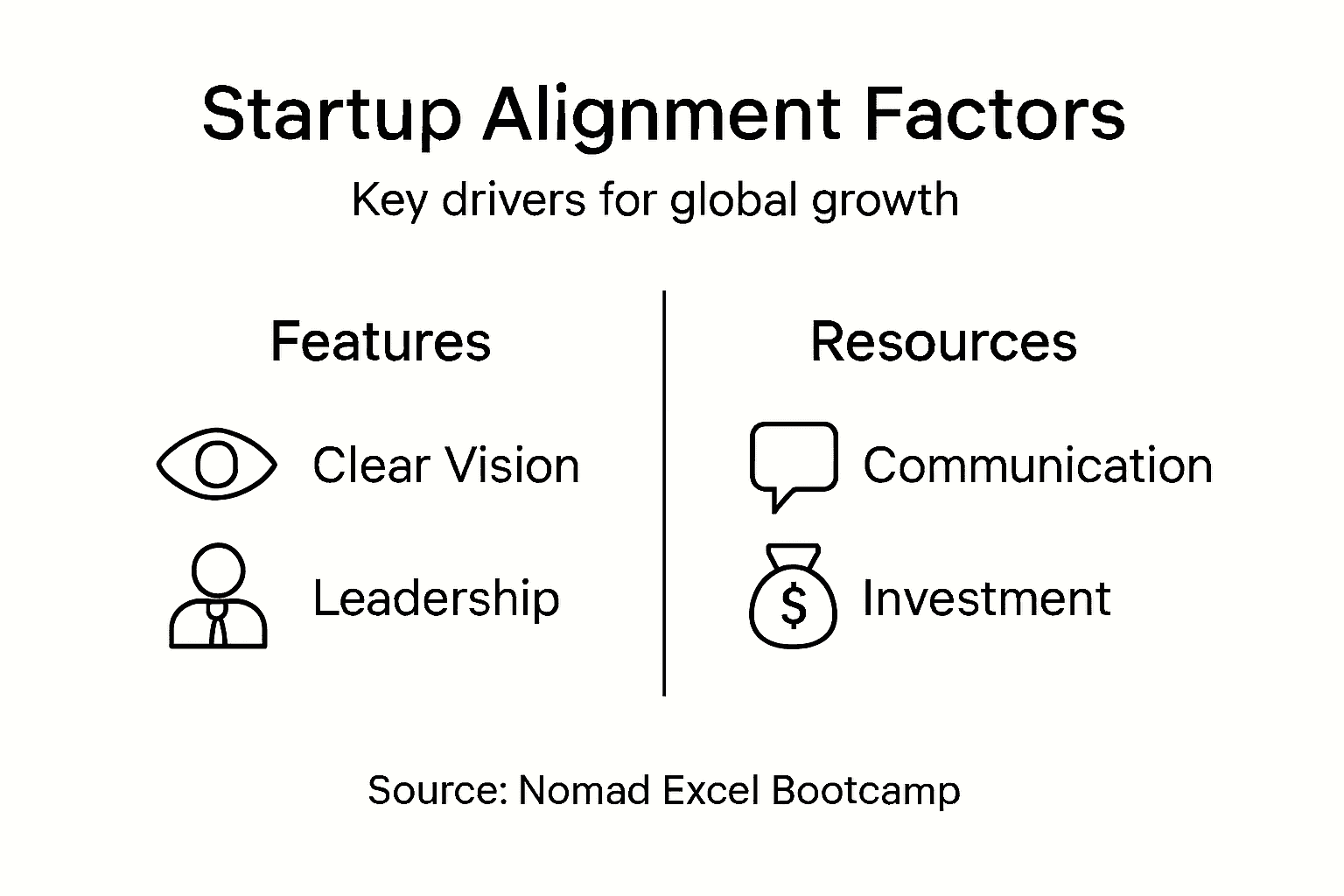
These factors work together as an integrated system. Leadership, strategy, and resource management represent multiple dimensions of startup success, with alignment serving as the connective tissue. Missing any one creates weak points where your organization breaks under pressure.
The startups that scale fastest don’t have perfect execution across all factors. They have alignment that makes their teams adaptive and resilient. When market conditions shift, aligned teams respond as one organism.
Pro tip: Assess your startup on each factor by asking your leadership team to rate alignment strength from one to ten, then identify which factor needs immediate attention first.
Risks, Challenges, and Common Pitfalls
Alignment fails more often than it succeeds. Knowing what typically goes wrong helps you avoid the traps that derail most startups. The good news: these pitfalls are predictable and preventable.
The biggest risk is the perception-reality gap. Your leadership team thinks you’re aligned when you’re not. Everyone nods during strategy meetings, then makes different decisions afterward. You discover this too late when projects clash, resources get wasted, and momentum stalls. The gap between perceptions and reality of alignment catches founders off guard because alignment feels easier to achieve than it actually is.
Siloed departments create misalignment by accident. Product builds features without talking to sales about customer reality. Marketing promises capabilities operations can’t deliver. Finance allocates resources without understanding strategy. When departments stop talking, miscommunication, siloed operations, and misaligned incentives become the default state. You end up with teams working at cross purposes.
Resistance to change undermines alignment efforts. When you’ve operated one way for years, shifting direction creates friction. People dig in. They defend their turf. They wait for the new strategy to fail so they can say “I told you so.” This resistance slows everything down and creates chaos.
Misaligned incentives sabotage alignment from the inside. Your sales team earns commissions for closing deals, so they promise features that damage long-term product strategy. Your engineers want technical perfection while your business needs speed. When what people get rewarded for contradicts your stated strategy, alignment dies.
Geographic and cultural distance amplifies alignment challenges. Remote teams miss the casual conversations where misalignments surface. Teams in different countries interpret strategy through different cultural lenses. Time zone differences mean some people never join important decisions.
The worst pitfall: ignoring these challenges until they compound. Small misalignments become major fractures. Teams stop trusting leadership. Good people leave. Execution slows. By then, fixing alignment becomes exponentially harder.
The table below compares challenges and suggested approaches to overcoming misalignment in startups:
| Challenge | Typical Symptoms | Effective Approach | Long-Term Benefit |
|---|---|---|---|
| Perception-reality gap | Decisions misalign | Regular alignment checks | Early issue detection |
| Siloed departments | Teams work at cross-purposes | Promote cross-team communication | Unified company goals |
| Resistance to change | Low buy-in, delays | Transparent change management | Increased adaptability |
| Misaligned incentives | Short-term wins, conflict | Realign rewards and metrics | Sustainable growth |
| Geographic and cultural distance | Misunderstandings | Foster inclusive information sharing | Stronger remote teamwork |
Pro tip: Run a monthly alignment check where you ask three people from different departments to independently explain your top priority without discussing it first. Inconsistent answers reveal emerging misalignment before it becomes a crisis.
Accelerate Your Startup’s Growth Through True Business Alignment
Struggling with team misalignment or unclear strategic priorities can stall your startup’s momentum and slow your global growth potential. This article highlights the crucial need for strategic, operational, and cultural alignment to make better decisions, improve communication, and unify your entire organization around shared goals. If misaligned incentives, siloed departments, or communication gaps are holding your startup back from moving forward powerfully and cohesively, you are not alone.
Nomad Excel offers entrepreneurship bootcamps and company retreats that directly address these challenges. Our immersive programs help founders and teams build clarity, alignment, and execution skills essential for scaling globally. Through guided mentorship, structured frameworks, and a supportive community, you will learn how to connect strategy with daily work, foster cross-functional collaboration, and create alignment that lasts even as your startup grows. Don’t let fragmentation slow you down when your breakthrough is just one step away.
Ready to build the alignment that drives sustainable growth and faster execution? Discover how our Entrepreneurship Bootcamps and Company Retreats can transform your startup’s potential. Take action now to gain sharper strategy, stronger team cohesion, and lasting momentum. Visit Nomad Excel to learn more and join a global community that moves startups forward together.
Frequently Asked Questions
What is business alignment in startups?
Business alignment in startups refers to the coordinated efforts of various organizational components, including strategy, operations, and team goals, to ensure everyone is working towards the same objectives and vision.
Why is alignment critical for startup growth?
Alignment is crucial for startup growth because it helps teams avoid conflicting priorities, improves decision-making, enhances efficiency, and fosters faster adaptation to market changes, ultimately leading to sustainable growth.
How can startups achieve operational alignment?
To achieve operational alignment, startups should establish clear processes, define team responsibilities, and ensure workflows logically connect different functions to reduce friction and bottlenecks in daily operations.
What factors contribute to successful business alignment in a startup?
Successful business alignment is driven by a clear vision, strong communication systems, leadership commitment, strategic coherence, and resource alignment that collectively support the startup’s goals.
Comments are closed.