
Why Mentorship Accelerates Growth for Entrepreneurs
Most American entrepreneurs report that effective mentorship triples their chances of launching a successful business. For those just starting out, the right guidance often draws the line between rapid growth and costly mistakes. With business environments growing more competitive around the globe, understanding the real role and types of mentorship can empower aspiring leaders to make smarter decisions and tap into the kind of support that accelerates their journey.
Table of Contents
- Defining Mentorship And Its Core Role
- Types Of Mentorship In Entrepreneurship
- How Mentorship Fuels Business Growth
- Key Qualities Of Effective Mentorship Relationships
- Common Mentorship Pitfalls And How To Avoid Them
Key Takeaways
| Point | Details |
|---|---|
| Importance of Mentorship | Mentorship is crucial for entrepreneurial development, providing guidance and knowledge transfer essential for growth. |
| Types of Mentorship | Understanding various mentorship models, such as Traditional, Virtual, and Peer-to-Peer, enables entrepreneurs to find the right fit for their needs. |
| Qualities of Effective Relationships | Successful mentorship hinges on trust, active listening, and reciprocal learning, fostering a supportive growth environment. |
| Avoiding Common Pitfalls | Clear expectations and consistent communication are vital to prevent misunderstandings and enhance the mentoring experience. |
Defining Mentorship and Its Core Role
Mentorship represents a strategic developmental relationship where an experienced professional provides targeted guidance, knowledge transfer, and support to an emerging entrepreneur. Comprehensive research demonstrates that this dynamic goes far beyond simple advice sharing, representing a nuanced process of personal and professional transformation.
At its core, entrepreneurial mentorship functions as a deliberate knowledge exchange mechanism. A seasoned mentor brings not just theoretical insights, but practical wisdom gained through navigating complex business landscapes. Strategic mentorship enables entrepreneurs to accelerate their learning curve, avoid common pitfalls, and develop critical decision-making skills by leveraging their mentor’s accumulated experience. Empirical studies in entrepreneurship consistently highlight how structured mentorship programs significantly enhance entrepreneurs’ self-efficacy and long-term professional intentions.
The mentor-mentee relationship is fundamentally about trust, vulnerability, and mutual growth. Effective mentors do not simply provide instructions but create safe environments where emerging entrepreneurs can explore ideas, challenge assumptions, and develop authentic leadership capabilities. This relationship typically involves multiple dimensions of support:
- Knowledge Transfer: Sharing industry-specific insights and strategic perspectives
- Emotional Support: Providing psychological resilience during challenging business phases
- Network Expansion: Introducing mentees to valuable professional connections
- Skill Development: Guiding personal and professional competency enhancement
Pro Tip – Mentor Selection Strategy: When seeking a mentor, prioritize individuals who have successfully navigated challenges similar to your current entrepreneurial journey and demonstrate genuine commitment to your professional development.
By understanding mentorship as a multifaceted, relationship-driven growth mechanism, entrepreneurs can transform what might initially seem like a simple advisory connection into a profound catalyst for personal and professional transformation.
Types of Mentorship in Entrepreneurship
Entrepreneurial mentorship is not a one-size-fits-all approach, but a dynamic landscape with multiple specialized forms designed to address diverse business development needs. Peer mentoring strategies represent one critical dimension, enabling entrepreneurs to learn from colleagues with similar experiences and challenges, creating a collaborative knowledge-sharing environment.
Three primary mentorship models dominate the entrepreneurial ecosystem. Traditional mentorship involves experienced business leaders providing direct guidance to emerging entrepreneurs, typically through in-person meetings and structured professional interactions. Virtual mentorship has gained significant traction, leveraging online platforms to connect mentors and mentees across geographic boundaries, offering unprecedented flexibility and access to global expertise.
The third prominent mentorship type is Peer-to-Peer mentorship, which creates horizontal learning networks where entrepreneurs at similar stages exchange insights, strategies, and mutual support. This model distinguishes itself through reciprocal knowledge transfer and shared vulnerability. Key variations include:
Here’s a comparison of the main types of entrepreneurial mentorship models:
| Mentorship Model | Typical Format | Strengths | Business Contexts |
|---|---|---|---|
| Traditional Mentorship | In-person meetings | Deep relationship, tailored advice | Early-stage startups |
| Virtual Mentorship | Online platforms | Flexible, access to global experts | Remote or global businesses |
| Peer-to-Peer Mentorship | Group exchanges | Mutual learning, diverse views | Collaborative environments |
- Industry-Specific Mentorship: Focused on niche sector expertise
- Startup Ecosystem Mentorship: Connected through accelerators and innovation hubs
- Cross-Generational Mentorship: Bridging experience levels and perspectives
- Skill-Specific Mentorship: Targeting particular business competencies
The mentorship landscape continues evolving, integrating technology and recognizing that entrepreneurial growth requires multifaceted, personalized guidance approaches.
Pro Tip – Mentorship Matching Strategy: Seek mentors who not only understand your industry but demonstrate a genuine commitment to your specific entrepreneurial vision and challenges.
By understanding these diverse mentorship models, entrepreneurs can strategically select relationships that provide targeted support, accelerating their professional development and business success.
How Mentorship Fuels Business Growth
Entrepreneurial growth is fundamentally accelerated through strategic mentorship, transforming raw potential into sustainable business success. Research on entrepreneurial support systems demonstrates that mentors play a critical role in enhancing entrepreneurs’ self-efficacy, providing targeted guidance that bridges knowledge gaps and builds critical business competencies.

Business growth acceleration occurs through multiple interconnected mechanisms within mentorship relationships. Experienced mentors offer more than theoretical advice – they provide nuanced, practical insights drawn from navigating complex business landscapes. Startup ecosystem research consistently reveals that mentors help entrepreneurs make informed decisions, dramatically reducing costly mistakes and accelerating strategic development.
The transformative impact of mentorship extends across several key dimensions of business growth:
This summary highlights how mentorship influences different aspects of business growth:
| Growth Dimension | Example Mentor Contribution | Impact on Entrepreneur |
|---|---|---|
| Strategic Planning | Suggests model changes | Clarifies vision and direction |
| Network Expansion | Introduces key industry contacts | Opens doors to new opportunities |
| Resource Optimization | Advises on efficient allocation | Maximizes limited resources |
- Strategic Planning: Refining business models and long-term vision
- Network Expansion: Connecting entrepreneurs with critical industry relationships
- Skill Development: Identifying and addressing personal leadership gaps
- Emotional Intelligence: Building resilience and adaptive leadership capabilities
- Resource Optimization: Strategically allocating limited startup resources
Mentors serve as both navigational guides and strategic partners, helping entrepreneurs translate potential into measurable business performance. Their external perspective provides crucial insights that internal teams might overlook, creating breakthrough opportunities for innovation and growth.
Pro Tip – Mentor Impact Assessment: Regularly evaluate your mentor’s contributions by tracking specific business improvements, strategic shifts, and personal development milestones achieved through your mentorship relationship.
By understanding mentorship as a dynamic, multifaceted growth accelerator, entrepreneurs can transform potential challenges into strategic opportunities for sustainable business success.
Key Qualities of Effective Mentorship Relationships
Successful entrepreneurial mentorship transcends simple advice-giving, requiring a complex interplay of interpersonal dynamics and professional expertise. Research on mentorship dynamics reveals that truly transformative relationships are built on foundational qualities of trust, mutual respect, and genuine commitment to growth.
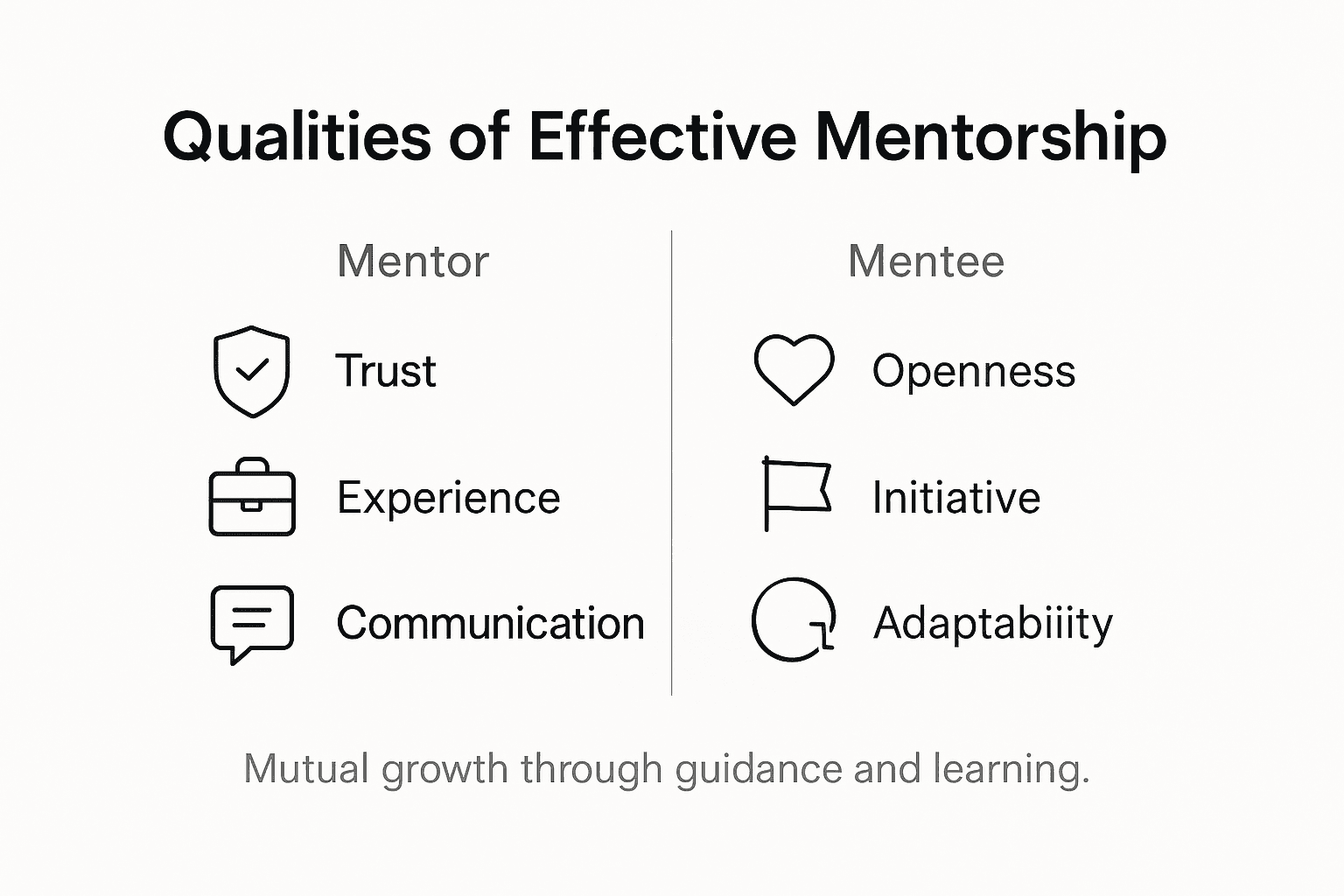
Psychological safety emerges as a critical component of effective mentorship, creating an environment where entrepreneurs feel empowered to explore vulnerabilities, challenge assumptions, and develop authentic leadership capabilities. Empirical studies in entrepreneurial development highlight how mentors who understand Social Cognitive Theory can significantly enhance mentees’ self-efficacy by providing nuanced, contextually relevant guidance.
The most impactful mentorship relationships demonstrate several key characteristics:
- Radical Candor: Providing honest, constructive feedback with genuine care
- Active Listening: Understanding underlying motivations and unspoken challenges
- Strategic Empathy: Balancing emotional support with pragmatic business insights
- Contextual Wisdom: Sharing experience without prescribing rigid solutions
- Reciprocal Learning: Recognizing mentorship as a two-way growth opportunity
Mentors who excel create a delicate balance between challenging entrepreneurs and providing psychological safety, enabling mentees to push beyond perceived limitations while feeling supported throughout their growth journey.
Pro Tip – Relationship Calibration: Schedule quarterly mentor-mentee alignment sessions to realign expectations, assess progress, and ensure the relationship continues to drive meaningful personal and professional development.
By understanding mentorship as a nuanced, dynamic relationship rather than a transactional interaction, entrepreneurs can unlock exponential growth potential through strategic, meaningful guidance.
Common Mentorship Pitfalls and How to Avoid Them
Entrepreneurial mentorship can quickly derail without careful navigation, presenting complex challenges that can undermine potential growth opportunities. Research on mentorship effectiveness consistently demonstrates that misaligned expectations and poor communication are primary obstacles preventing meaningful mentor-mentee relationships.
Expectation mismanagement represents the most significant risk in mentorship dynamics. Entrepreneurs often enter these relationships with unrealistic assumptions about immediate transformation or guaranteed success. Empirical studies in entrepreneurial mentorship underscore the critical importance of establishing clear, mutually understood goals and transparent communication channels from the relationship’s inception.
The most common mentorship pitfalls entrepreneurs encounter include:
- Passive Participation: Expecting mentors to solve problems without personal effort
- Undefined Boundaries: Failing to establish clear relationship parameters
- Inconsistent Engagement: Sporadic communication and lack of commitment
- Ego Interference: Defensiveness that prevents genuine feedback absorption
- Misaligned Expectations: Unrealistic outcomes or undefined success metrics
Successful mentorship requires both parties to approach the relationship with intentionality, professionalism, and a genuine commitment to mutual growth. This means active listening, consistent communication, and a willingness to be vulnerable and receptive to challenging perspectives.
Pro Tip – Mentorship Calibration: Develop a structured quarterly review process where both mentor and mentee explicitly discuss progress, realign goals, and honestly assess the relationship’s effectiveness.
By proactively addressing potential pitfalls and maintaining a growth-oriented mindset, entrepreneurs can transform mentorship from a potential liability into a powerful catalyst for personal and professional development.
Unlock Accelerated Growth Through Expert Mentorship and Community Support
Struggling with vague guidance or feeling isolated in your entrepreneurial journey is more common than you think. This article highlights how strategic mentorship is not just advice but a powerful growth catalyst that fosters clarity, confidence, and actionable progress. If you are eager to move beyond trial and error, avoid costly pitfalls, and develop a resilient mindset, you need hands-on guidance combined with a supportive community.
Nomad Excel offers immersive programs that deliver exactly this experience. Our entrepreneurship bootcamps bring together driven founders for focused mentorship, proven business frameworks, and meaningful connections that extend beyond the program. You will gain direct access to experienced entrepreneurs who help you refine your vision, expand your network, and sharpen your execution. Whether you are launching or scaling, our tailored approach turns mentorship into measurable business momentum.
Explore more insights on accelerating your entrepreneurial success through the Entrepreneurship Archives. Ready to transform your growth trajectory with expert mentorship and a vibrant community? Visit Nomad Excel today and discover our range of programs designed to empower your entrepreneurial journey. Take the next step now and accelerate the growth you deserve.
Frequently Asked Questions
What is the role of a mentor in entrepreneurship?
A mentor provides guidance, support, and knowledge transfer to emerging entrepreneurs, helping them navigate challenges and accelerate their growth.
How can mentorship accelerate business growth?
Mentorship accelerates business growth by offering practical insights, helping with strategic planning, expanding networks, and developing essential skills that enhance decision-making capabilities.
What are the different types of mentorship models available for entrepreneurs?
The main types of mentorship models include traditional mentorship (in-person guidance), virtual mentorship (online connections), and peer-to-peer mentorship (collaborative learning among peers).
What qualities should I look for in an effective mentor?
Look for a mentor who exhibits trust, active listening, empathy, contextual wisdom, and a commitment to mutual growth, as these qualities foster a productive mentoring relationship.
Comments are closed.