
What Are Key Activities in a Business Model? A Founder’s Guide
Key Activities are the essential actions a business must perform to create and deliver its value proposition. In the Business Model Canvas, this block answers one question: what does your company actually have to do, day after day, to keep its promise to customers? Get this wrong and you’ll drown in busywork; get it right and every hour you spend maps directly to growth. The practical move for any early-stage founder is to narrow the list to a small number of activities that are truly indispensable, not just helpful.
A product-based business might land on: sourcing materials, manufacturing, and quality control. A consultancy might land on: client diagnosis, custom solution design, and delivery. Notice what’s missing from both lists: everything else. That’s the point.
TL;DR:
- The top three activities should be prioritized based on their direct impact on delivering the value proposition, avoiding busywork.
- Identifying your business category—such as production, problem-solving, or platform—guides which activities to focus on for growth.
- Use a three-question filter to determine if an activity is truly essential, should be kept in-house, or can be outsourced or cut.
- Reassess key activities every three to six months, especially after pivots or major milestones, to ensure ongoing alignment with stage goals.
- Avoid vague tasks like “marketing” and instead specify measurable actions, focusing on activities that directly support value delivery.
Table of Contents
- What Are Key Activities in a Business Model, and Why Limit Them?
- What Categories Do Key Activities Fall Into?
- How Do You Identify Your Business’s Key Activities?
- What Do Key Activities Look Like in Real Businesses?
- What Mistakes Should You Avoid When Listing Key Activities?
- How Do You Measure and Revisit Key Activities Over Time?
- How Nomad Excel Turns This Framework Into Practice
- Why the Standard Advice on Key Activities Falls Short
- Key Takeaways
- Sources
What Are Key Activities in a Business Model, and Why Limit Them?
Key Activities exist to answer a discernment question, not a to-do-list question. The Washington University in St. Louis library guide on the Business Model Canvas frames this well: you identify key activities by enumerating the steps needed to deliver value, not by running traditional market research. That distinction changes how you approach the whole block.
Founders who list ten or fifteen “important” activities usually haven’t done the harder work of ranking them. A tight list of three to five forces prioritization. It also speeds up learning, because you can actually measure whether each activity is producing results instead of losing signal in a pile of tasks that all feel urgent. Our guide to the full Business Model Canvas walks through how this block connects to the other eight, but the short version is: Key Activities is the block that keeps the rest of your model honest.
What Categories Do Key Activities Fall Into?
Business models tend to lean on one or two dominant activity categories, and knowing which one your business fits changes how you should be spending your time. The pressbook on business models from the University of Virginia groups these into a small set of recognizable types, and here’s how each one plays out in practice:
- Production activities cover designing, manufacturing, and delivering a physical or digital product at volume and quality. A furniture maker’s key activity is production; a bakery’s is too.
- Problem-solving activities center on generating new solutions to individual customer problems, common in consultancies, agencies, and hospitals, where every engagement demands custom thinking.
- Platform or network activities involve building, maintaining, and growing a network, marketplace, or platform, where the activity is less about making something and more about connecting people.
- Marketing, sales, and customer support activities dominate businesses where the product itself is simple but customer acquisition and retention require constant work, think subscription services or direct-to-consumer brands.
Plenty of businesses straddle two categories. A SaaS company does platform-style development work and problem-solving through customer success. Microsoft’s key activities center heavily on software development, while Dell built its model around supply chain management, a reminder that even similarly sized companies can have completely different centers of gravity.
Pro Tip: If you can’t decide which category dominates your business, ask which activity would cause the most damage if it stopped for a week. That’s usually your primary category.
How Do You Identify Your Business’s Key Activities?
Start with your value proposition, not your task list. Map the customer journey from first contact to delivered outcome, then write down every step required to make that journey work. You’ll end up with more candidates than you need, which is fine, that’s what filtering is for.
Apply this three-question test to each candidate, drawn from Visual Paradigm’s Business Model Canvas documentation:
- Is this activity required to deliver the value proposition?
- Would removing it break delivery entirely, not just slow it down?
- Should it stay in-house for a strategic reason, like protecting a competitive advantage?
An activity that fails all three isn’t key. It might still matter, but it belongs somewhere else, maybe outsourced, maybe automated, maybe cut.
Stage matters too. At ideation, emphasize activities tied to validating the idea itself, customer discovery conversations, rough prototypes. At early traction, shift toward activities that make delivery repeatable. At growth, prioritize activities that scale without proportionally scaling your headcount.
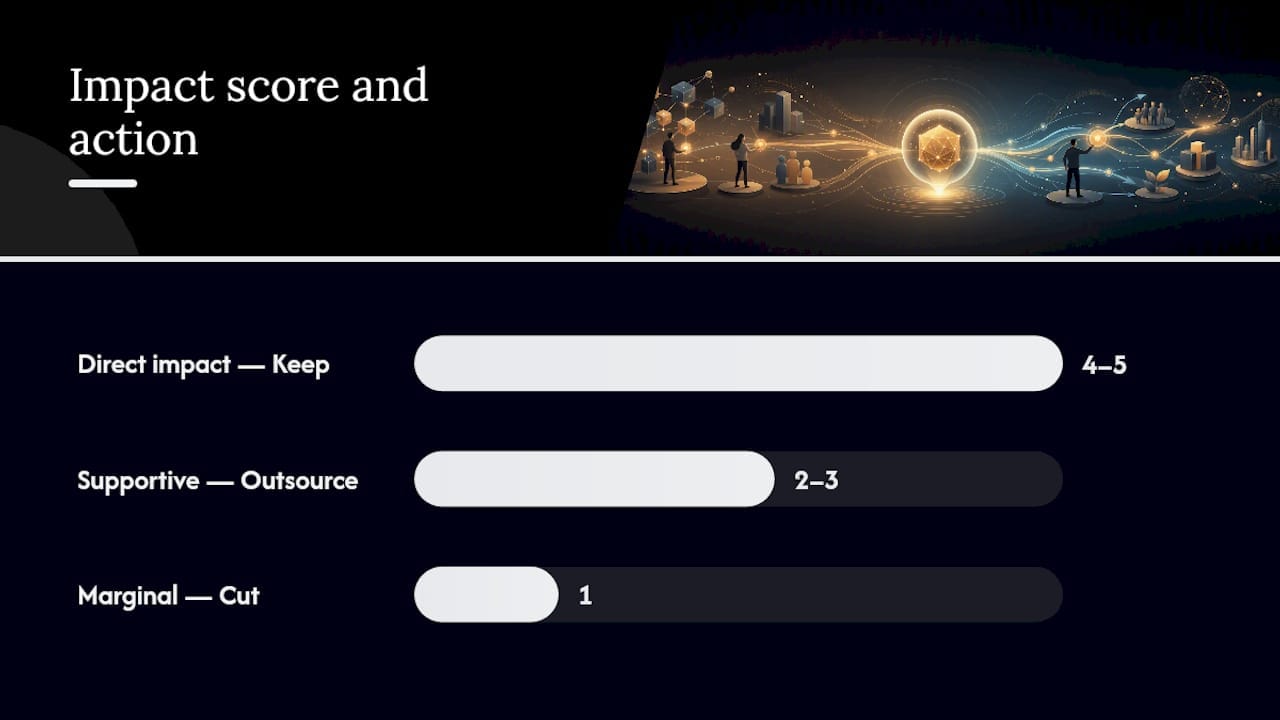
A simple 1-to-5 impact score on each surviving candidate helps you cut the list down fast:
| Score | What It Means | Action |
|---|---|---|
| 4–5 | Directly drives the value proposition | Keep, invest resources here |
| 2–3 | Supports delivery but isn’t core | Consider outsourcing |
| 1 | Marginal or duplicative | Cut or automate |
This scoring approach mirrors guidance from the same Visual Paradigm framework and gives you a defensible reason to say no to activities that feel busy but aren’t load-bearing.
What Do Key Activities Look Like in Real Businesses?
Abstract categories only click once you see them applied. Here’s how the same three-to-five-activity discipline plays out across four common business types:
- Product manufacturer: sourcing raw materials, production planning, quality control, and logistics coordination. Everything else, accounting, hiring, is support work, not a key activity.
- Consultancy: client diagnosis, solution design, delivery and facilitation, and knowledge capture for reuse on future engagements.
- Platform or marketplace: platform development, partner or seller onboarding, content or transaction moderation, and growth engineering to keep both sides of the market active.
- SaaS or digital product: feature development, hosting and infrastructure operations, customer onboarding, and customer success to protect retention.
Notice how the list shifts as a company scales. An MVP-stage SaaS founder might list “feature development” as one broad activity; by growth stage, that often splits into distinct engineering and product functions with separate owners. The category stays the same, but the granularity increases. Our startup business model examples resource breaks down more of these by industry if you want additional reference points.
What Mistakes Should You Avoid When Listing Key Activities?
The most common failure is treating this block like an inventory of everything the business does. That defeats the purpose. A close second: vague verbs. “Marketing” and “customer service” aren’t activities, they’re departments. Rewrite them into something measurable: “run weekly acquisition campaigns” or “resolve support tickets within 24 hours.”
A third mistake is confusing resources with activities. Your team, your software, your warehouse, these are Key Resources. What you do with them is the activity. Keep a short checklist before finalizing your list:
- Does each entry start with a verb, not a noun?
- Could someone else read this list and know what your team does every day?
- Have you separated a resource (a tool, a person) from the action performed with it?
Pro Tip: If an activity doesn’t change what your customer experiences, it’s probably not key, even if it feels essential internally.
How Do You Measure and Revisit Key Activities Over Time?
Key Activities connect directly to Key Resources and Key Partnerships. Once you know your core activities, you can decide what resources they require and which non-core activities to hand off. Outsourcing non-core work is standard practice precisely because it frees up focus for the activities that actually differentiate you.
Track metrics tied to each activity rather than vanity numbers:
- Time-to-value for production or delivery activities
- Cost-per-delivery or cost-per-unit
- Throughput and defect rate for production-heavy models
- Uptime, latency, and activation rate for platform businesses
Revisit the block every three to six months, or immediately after a significant pivot, a cadence recommended by BusinessModelHacking’s guidance on the Key Activities block. What counted as key during validation often stops being key once you’re scaling, and metrics are what tell you it’s time to update the list.
How Nomad Excel Turns This Framework Into Practice
Reading about the three-question filter is one thing. Applying it under time pressure, with real feedback, is another. Nomad Excel bootcamps build this directly into a single workshop sprint: founders map their value proposition, walk the customer journey with peers and mentors, then run their candidate activities through the filter live, scoring each one before the day ends.
That timeboxed structure matters because early-stage founders often over-invest in scale-focused activities before they’ve validated anything. The sprint format pushes learning-focused activities, customer discovery, MVP testing, onboarding experiments, to the front of the list, where they belong at this stage.
- Live workshops pairing value proposition mapping with activity scoring
- Direct mentor feedback on which activities are genuinely load-bearing
- A peer cohort testing the same framework against different business models
If you want to work through your own Key Activities block with structured guidance, our online entrepreneurship bootcamp runs exactly this exercise as part of its curriculum.
Why the Standard Advice on Key Activities Falls Short
Most guidance on this topic stops at definitions. It tells you what Key Activities are, gives you a template, and leaves you to figure out prioritization on your own. That’s backward. The definition is the easy part. The hard part, and the part most founders actually struggle with, is cutting a list of twelve plausible activities down to four real ones.

The conventional advice also treats the Key Activities block as static, something you write once during a planning session and file away. In practice, what’s “key” at ideation is often irrelevant by the time you hit traction. A founder validating demand needs to prioritize customer discovery conversations over building polished infrastructure. A founder scaling needs the opposite. Treating this as a one-time exercise instead of a living document is where most business plans go stale.
If you take one thing from this article, let it be the three-question filter, applied on a schedule, not just once. Score honestly, cut ruthlessly, and revisit before you assume last quarter’s answer still holds.
— Amichai
Key Takeaways
Identifying key activities requires mapping your value proposition to concrete actions, then filtering to three to five through a repeatable, stage-aware test.
| Point | Details |
|---|---|
| Limit your list | Keep key activities to three to five items tied directly to your value proposition. |
| Use the three-question filter | Ask if it’s required, if removing it breaks delivery, and if it should stay in-house. |
| Match category to business type | Identify whether production, problem-solving, platform, or support activities dominate. |
| Rewrite vague entries | Replace department names like “marketing” with measurable actions and clear verbs. |
| Revisit every 3 months | Reassess your key activities after major pivots or every quarter to stay aligned with stage. |
Sources
- Business Model Canvas: Key activities and resources — Washington University in St. Louis
- Key activities — Visual Paradigm skills documentation
- Foundations of Commerce — Business models (University pressbooks)
- Business Model (unit) — BMSCE educational PDF
Comments are closed.