
Personal Business Growth: Complete Guide for Entrepreneurs
Nearly half of new entrepreneurs struggle to maintain steady growth beyond their first two years in business. This ongoing challenge highlights why understanding personal business growth concepts and entrepreneurial success factors matters to anyone aiming for long-term results. By exploring skill development, strategic networking, and growth strategies, you can discover proven ways to strengthen your abilities, build lasting relationships, and create more sustainable progress in your career or business.
Table of Contents
- Defining Personal Business Growth Concepts
- Types of Growth for Entrepreneurs
- Key Drivers and Influences on Growth
- Essential Skills for Sustained Progress
- Common Obstacles and How to Overcome Them
Key Takeaways
| Point | Details |
|---|---|
| Personal Business Growth Is Strategic | It involves skill development, strategic networking, and continuous learning to enhance professional capabilities and ensure sustainable success. |
| Types of Entrepreneurial Growth Vary | Entrepreneurs can pursue small businesses, scalable startups, large companies, or social entrepreneurship, each with unique objectives and impacts. |
| Networking and Knowledge Are Crucial | Access to quality professional networks and knowledge channels significantly enhances entrepreneurial growth and opportunity recognition. |
| Overcoming Obstacles Leads to Innovation | Entrepreneurs should view challenges as opportunities for strategic innovation, emphasizing continuous learning and flexibility in their approach. |
Defining Personal Business Growth Concepts
Personal business growth represents a deliberate and strategic approach to expanding professional capabilities, enhancing organizational effectiveness, and creating sustainable success. According to Wikipedia, capability management focuses on managing an organization’s core competencies to ensure competitive positioning and ongoing profitability.
At its core, personal business growth involves three fundamental dimensions: skill development, strategic networking, and continuous learning. Strategic networking plays a critical role in this process. As research from Wikipedia indicates, effective business networking involves building relationships with individuals and organizations to share information and resources, which ultimately fosters mutual growth and creates unexpected opportunities.
Key elements of personal business growth include:
- Developing specialized professional skills
- Building meaningful professional relationships
- Creating adaptive strategic frameworks
- Implementing continuous improvement processes
- Measuring personal and professional performance metrics
Successful entrepreneurs understand that personal business growth is not a linear journey but a dynamic, iterative process. It requires a combination of self-awareness, strategic thinking, and proactive skill enhancement. By consistently investing in personal development and maintaining a growth-oriented mindset, professionals can transform potential challenges into opportunities for meaningful advancement and sustainable success.
Types of Growth for Entrepreneurs
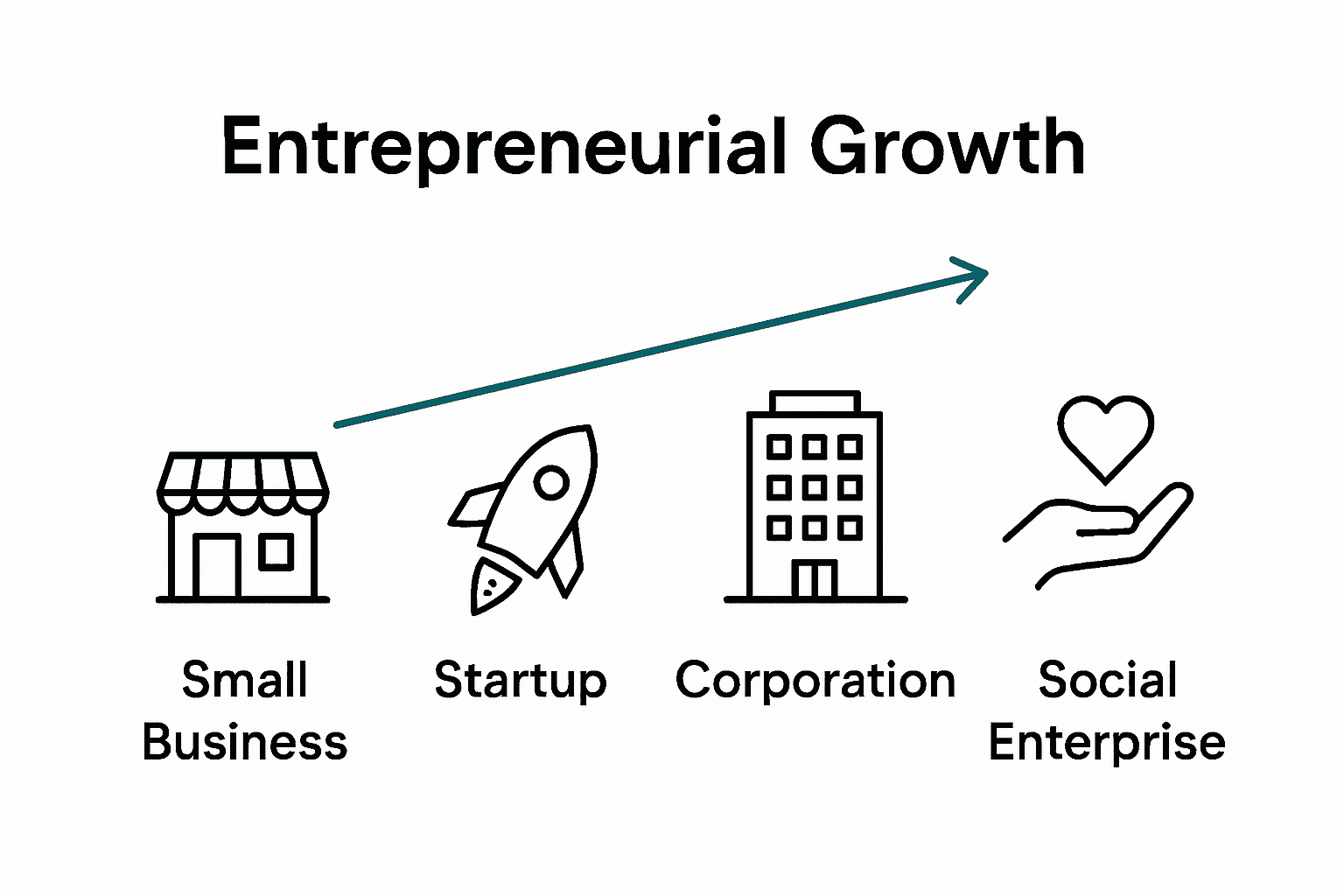
Entrepreneurial growth is a multifaceted journey with diverse pathways and strategies. According to research from the Center for Entrepreneurship, entrepreneurs can pursue four primary types of growth: small business, scalable startups, large company (intrapreneurship), and social entrepreneurship. Each type represents a unique approach to building and expanding business potential.
Here’s a comparison of the four primary types of entrepreneurial growth:
| Growth Type | Main Objective | Typical Scale | Distinctive Feature |
|---|---|---|---|
| Small Business | Steady, sustainable progress | Local or niche market | Personal control and stability |
| Scalable Startup | Rapid expansion, global impact | High growth potential | Seeks venture capital |
| Large Company/Intrapreneurship | Innovation within corporations | Corporate environment | Drives internal transformation |
| Social Entrepreneurship | Societal impact with sustainability | Local to global | Focus on positive social change |
These growth types differ significantly in their objectives, scale, and impact. Small business entrepreneurship focuses on steady, sustainable growth within local or niche markets. Scalable startups aim for rapid expansion and potential global impact, often seeking venture capital and high-growth trajectories. Large company entrepreneurship, or intrapreneurship, involves innovation within existing corporate structures, while social entrepreneurship prioritizes creating positive societal change alongside financial sustainability.
Key characteristics of entrepreneurial growth include:
- Adaptability to changing market conditions
- Continuous learning and skill development
- Strategic resource allocation
- Innovation and creative problem solving
- Measured risk taking
As academic research suggests, understanding these entrepreneurial growth types helps policymakers and entrepreneurs align their strategies with broader economic development goals. Successful entrepreneurs recognize that growth is not one-size-fits-all but a personalized journey requiring self-awareness, strategic thinking, and the ability to pivot when necessary. By understanding these growth models, entrepreneurs can select the most appropriate path that aligns with their vision, skills, and long-term objectives.

Key Drivers and Influences on Growth
Entrepreneurial growth is fundamentally shaped by complex internal and external forces that interact dynamically. Research from ArXiv reveals that access to external knowledge through social networks significantly enhances an entrepreneur’s ability to recognize and capitalize on new business opportunities, serving as a critical driver of sustainable development.
Network mechanisms play a pivotal role in entrepreneurial expansion. As demonstrated by network growth models, the way entrepreneurs strategically position themselves and make connection decisions can profoundly impact their future economic trajectory. ArXiv describes this phenomenon as an ‘opportunistic attachment’ mechanism, where entrepreneurs’ strategic network entry points directly influence potential growth structures.
Key drivers of entrepreneurial growth include:
- Quality of professional networks
- Access to knowledge and information channels
- Personal adaptability and learning capacity
- Strategic resource allocation
- Ability to identify and seize emerging opportunities
Successful entrepreneurs understand that growth is not linear but an intricate process of continuous learning, strategic networking, and adaptive problem solving. By cultivating a robust ecosystem of relationships, staying intellectually curious, and maintaining flexibility in their approach, entrepreneurs can create sustainable pathways for meaningful business expansion and personal development.
Essential Skills for Sustained Progress
Entrepreneurial skills form the critical foundation for long-term business success and sustainable growth. According to research by Wikipedia, pioneering entrepreneurship expert Jeffry Timmons emphasized three fundamental skills essential for sustained business development: opportunity recognition, resource acquisition, and effective team building.
The landscape of entrepreneurial competencies is dynamic and multifaceted. Global Entrepreneurship Monitor research provides comprehensive insights into the skills entrepreneurs must cultivate to thrive in diverse economic environments. These skills extend beyond traditional business knowledge and encompass adaptive thinking, emotional intelligence, and strategic problem-solving capabilities.
Key skills for sustained entrepreneurial progress include:
- Strategic vision and long-term planning
- Emotional resilience and stress management
- Advanced communication and negotiation techniques
- Financial literacy and resource optimization
- Continuous learning and skill adaptation
Successful entrepreneurs recognize that skill development is an ongoing journey, not a destination. By consistently investing in personal growth, maintaining intellectual curiosity, and remaining adaptable to changing market dynamics, entrepreneurs can build robust capabilities that transcend temporary challenges and create lasting competitive advantages in their chosen domains.
Common Obstacles and How to Overcome Them
Entrepreneurial growth involves navigating a complex landscape of challenges that can potentially derail business progress. Research on Scaleup Companies reveals that maintaining operational controls during rapid growth represents one of the most significant hurdles entrepreneurs face. Implementing structured management practices becomes crucial in addressing these potential roadblocks and ensuring sustainable development.
Digital transformation presents another critical challenge for entrepreneurs, particularly in service-based industries. According to ArXiv, many personal service firms struggle with digital ecosystem transitions due to limited technological know-how. A strategic maturity model can help entrepreneurs systematically overcome these technological barriers and adapt to evolving market demands.
Common obstacles entrepreneurs frequently encounter include:
- Financial resource constraints
- Market uncertainty and competitive pressures
- Technological adaptation challenges
- Skill and talent acquisition limitations
- Operational scalability issues
Successful entrepreneurs approach obstacles not as insurmountable barriers but as opportunities for strategic innovation and personal growth. By maintaining a flexible mindset, continuously learning, and developing robust problem-solving skills, entrepreneurs can transform potential challenges into catalysts for business transformation and personal development.
Accelerate Your Personal Business Growth Journey Today
Building lasting success requires more than just skill development and strategic networking. This guide highlights common challenges like adapting to rapid growth, managing operational controls, and overcoming knowledge gaps. If you are ready to transform these obstacles into opportunities and build a scalable, sustainable business, support from the right community and expert mentorship makes all the difference.
At Nomad Excel, we believe personal business growth is most powerful when combined with action and real-world experience. Through immersive entrepreneurship bootcamps, you gain step-by-step frameworks, expert guidance, and a supportive network that drives measurable progress. Whether you want to refine your ideas, develop critical skills, or build lasting connections, our programs align perfectly with the insights shared in this complete guide. Explore our Inspiration Archives to see stories of fellow entrepreneurs who have accelerated their journeys. Don’t wait to grow. Visit Nomad Excel and take the next step toward your entrepreneurial breakthrough now.
Frequently Asked Questions
What is personal business growth?
Personal business growth refers to a strategic and intentional approach to enhancing one’s professional capabilities, improving organizational effectiveness, and achieving sustainable success through skill development, networking, and continuous learning.
What are the different types of entrepreneurial growth?
The four primary types of entrepreneurial growth are small business growth, scalable startups, large company intrapreneurship, and social entrepreneurship. Each type has distinct objectives, scales, and impacts on the business ecosystem.
What are the key drivers of entrepreneurial growth?
Key drivers include the quality of professional networks, access to information and knowledge, personal adaptability, strategic resource allocation, and the ability to identify and capitalize on emerging opportunities.
What essential skills are needed for sustained entrepreneurial success?
Essential skills for sustained progress include strategic vision, emotional resilience, advanced communication, financial literacy, and a commitment to continuous learning and skill adaptation.
Recommended
- Entrepreneur Mindset Guide for Growth and Independence – Nomad Excel – Your Entrepreneurial Adventure Starts Here
- Role of Networking in Entrepreneurship: Essential Guide – Nomad Excel – Your Entrepreneurial Adventure Starts Here
- Entrepreneurship Skills Guide for Launching Your Own Venture – Nomad Excel – Your Entrepreneurial Adventure Starts Here
- Outdoor Group Games For Adults Perfect for Team Building
Comments are closed.