
Mentorship Agreement Example for Founders: Start With Five Key Fields
A short, customizable mentorship agreement template is the fastest way to formalize mentor-mentee expectations, and you can download and adapt the example below right now. A working agreement should cover contact preferences, meeting cadence, SMART goals, confidentiality, and a clear term. Fill those five pieces in first, then refine the rest as your relationship grows.
TL;DR:
- A mentorship agreement should include contact preferences, meeting frequency, SMART goals, confidentiality, and a clear term to ensure clarity from the start.
- Specific goals should be measurable, with deadlines, and paired with scheduled check-ins to prevent drift and maintain progress.
- Clarify boundaries by stating what the mentor is and isn’t responsible for, including confidentiality and scope to avoid scope creep.
- Agreements should specify how feedback and support are delivered, setting expectations for timely responses and between-meeting communication.
- Termination clauses and review points are essential, with milestone-based progress checks every three months to decide if the relationship remains productive.
Table of Contents
- Section-by-section: what to include in a mentorship agreement
- Downloadable mentorship agreement example and how to customize each field
- Short filled example: a 1-page excerpt completed
- Communication plan and meeting best practices
- Boundaries, confidentiality, liability and scope: practical language
- Evaluation, milestones, review cadence and ending the agreement
- Printable checklist: questions mentors and mentees should answer together
- How agreements are used inside programs: publisher practitioner perspective and resources
- Expectations for feedback and support
- Mentorship agreement legal considerations and enforceability
- Author’s perspective: quick priorities for your first meeting
- An alternative path: program-based mentorship with facilitator support
- Sources
- FAQ
Section-by-section: what to include in a mentorship agreement
A mentoring agreement works best when it reads like a shared plan rather than a legal contract, though a few clauses do real protective work. Institutional templates recommend drafting the agreement at your first meeting, while everyone’s expectations are still fresh and easy to align.
Start with the practical pieces, then move into the substance of the relationship:
- Contact information and response expectations: list preferred channels (email for updates, Slack for anything urgent) and a reasonable reply window, such as 48 hours.
- Roles and responsibilities: spell out what the mentor will provide (feedback, introductions, accountability check-ins) and what the mentee will prepare before each session (an update, a specific question, a decision to review).
- SMART goals and milestones: write goals that are specific and time-bound rather than aspirational, following the framework professional mentoring guidance recommends for measuring mentoring impact.
- Meeting logistics: frequency, duration, platform, who sends the invite, and what happens when someone needs to reschedule.
- Confidentiality and boundaries: a short clause stating what stays private and what triggers an escalation.
- Term, review points, and renewal or termination language: an end date, at least one scheduled check-in, and a simple way to part ways if the fit is not there.
- Expenses or compensation: state plainly whether this is an unpaid relationship, includes reimbursement for shared costs, or involves a stipend.
Mentoring agreement templates and toolkits, including one built for university mentoring programs, typically bundle a communication plan with meeting logistics so both people know not just when they will meet, but how they will prepare. That pairing matters more than any single clause: a goal without a meeting cadence tends to drift, and a meeting cadence without a goal tends to become a pleasant but unproductive habit.
Downloadable mentorship agreement example and how to customize each field
Once you know what belongs in the agreement, filling it out is mostly a matter of plain language. Open a blank document, add the sections above as headers, and work through them in order rather than trying to draft everything at once.
- Names, effective date, and term: “This agreement is between [mentor name] and [mentee name], effective 2026, for a term of six months ending 2026.”
- Role descriptions: for the mentor, something like “provide feedback on strategy and introductions to relevant contacts”; for the mentee, “arrive with a written update and one specific question per session.”
- Sample SMART goals: a short-term goal might read “conduct five customer interviews and summarize findings by 2026,” while a medium-term goal could be “reach $2,000 in monthly recurring revenue by 2026.”
- Meeting cadence and agenda ownership: note who books the recurring call, who sends the agenda 24 hours ahead, and who takes brief notes afterward.
- Storage and versioning: save the signed document in a shared folder with the date in the file name, and update the file rather than starting a new document each time goals change.
A professional mentoring agreement template commonly organizes these same fields under headers for scope, term, confidentiality, and compensation, which gives you a reliable structure to copy even if you write the actual language yourself.
Short filled example: a 1-page excerpt completed
Seeing a filled example makes the blank template far less intimidating. Here is a condensed excerpt showing how the language might actually read once you have made your decisions.
Goal: Validate the target customer segment by conducting five interviews and producing a one-page summary by March 15, 2026.
Meetings: One 45-minute video call per month, scheduled by the mentee at least three days in advance.
Boundaries: The mentor offers business guidance and is not a therapist, financial advisor, or paid contractor.
Notice how specific the goal is: a number, a deliverable, and a date, not a vague ambition like “improve my business.” The meeting line answers three questions at once (how long, how often, who books it), and the boundary line takes one sentence to prevent months of confusion about what the mentor is and is not offering.
Communication plan and meeting best practices
An agreement only stays useful if the meetings that follow it are consistent and easy to prepare for. A short recurring agenda, prepared by the mentee before each call, keeps sessions focused and respects the mentor’s time.
- Review progress on the current goal and any blockers since the last call.
- Ask the one or two questions the mentee has prepared in advance.
- Agree on the specific action items each person will complete before the next meeting.
Keep notes in a shared document rather than scattered emails; a running log makes it easy to spot patterns and prepare for the scheduled review. Practical meeting frameworks that pair a light agenda with brief written follow-up tend to keep momentum without adding administrative weight.
Pro Tip: Send the agenda and any update the night before, so your mentor can think about your question instead of reading it cold.
Boundaries, confidentiality, liability and scope: practical language
Boundary language prevents the relationship from quietly turning into something neither person signed up for. Practitioner mentoring toolkits recommend stating explicitly what the mentor is not, since entrepreneurial mentorship in particular can drift toward unpaid consulting work if nobody names the limit.
- Add a line like "the mentor is not a therapist, licensed financial advisor, or paid contractor unless separately engaged, to prevent scope creep.
- Include a short confidentiality clause stating that shared business details stay private, and name an escalation step for any safety or harassment concern.
- Add intellectual property or publicity language only if proprietary work will be reviewed, and consult legal counsel for compensation or ownership clauses that carry real financial stakes, as several institutional templates advise.
Evaluation, milestones, review cadence and ending the agreement
A mentoring relationship needs checkpoints, not just a start date and good intentions. Tie each milestone to something concrete: a deliverable, a metric, or a specific decision made.
- Set milestone dates that match your SMART goals, so progress is easy to confirm rather than argue about.
- Schedule a review every three months and ask one simple question at each: is this relationship still moving the mentee’s stated goals forward?
- Write plain termination language, such as a two-week notice period for either party, and a renewal clause that requires mutual agreement rather than automatic continuation.
Printable checklist: questions mentors and mentees should answer together
Bring this list to your first meeting and answer each item out loud before anyone signs anything.
- Who schedules meetings, and what is the expected response window for messages?
- What are the top two or three goals, and how will progress be measured?
- What stays confidential, and what is outside the mentor’s role?
- When is the first review date, where will the signed agreement be stored, and who needs to sign it?
How agreements are used inside programs: publisher practitioner perspective and resources
Structured agreements do more work inside a cohort setting, where several mentor pairs need consistent accountability at once. Nomad Excel bootcamps build milestone tracking directly into the mentorship program structure, pairing each written agreement with a short letter of intent so goals and role expectations are documented from day one. Participants who want help drafting or wording their own agreement can reference annotated mentorship letter samples that show how the language pairs with a signed agreement.
Expectations for feedback and support
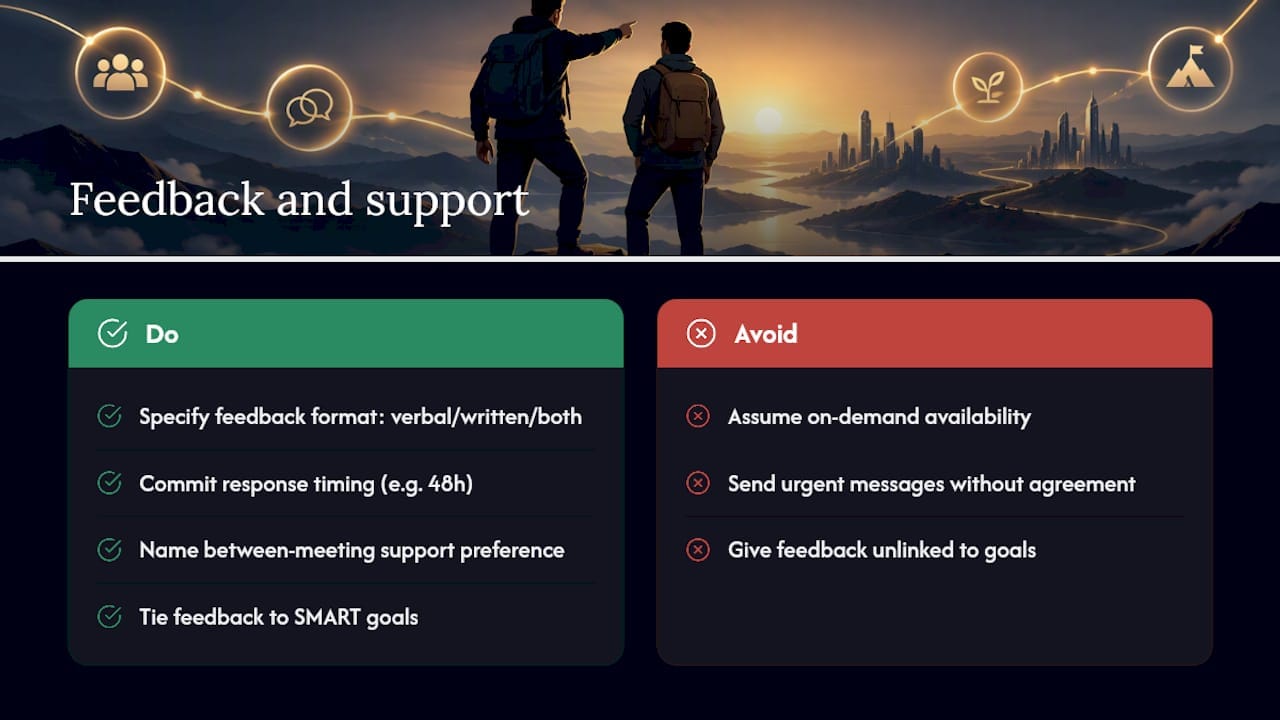
A mentoring agreement should say plainly how feedback will be given and how much support the mentor is expected to offer between sessions. Vague expectations here cause more friction than almost any other clause, since mentees sometimes expect on-demand availability while mentors assume feedback only happens during scheduled calls.
State the format up front: will feedback be verbal during the call, written afterward, or both? A mentor who prefers to think before responding might commit to written notes within 48 hours of a call, while a mentor comfortable with real-time input might offer feedback live and skip the follow-up note entirely. Either approach works, as long as it is written down rather than assumed.
Support between meetings deserves the same clarity. Some mentors welcome a short message if something urgent comes up, while others prefer everything saved for the next scheduled call. Naming that preference in the agreement avoids the awkward moment where a mentee sends three messages in a week and a mentor quietly starts feeling burdened by the relationship.
Feedback should also be tied back to the SMART goals in the agreement rather than offered in general terms, since specific feedback against a specific goal is what actually moves a mentee’s business forward.
Mentorship agreement legal considerations and enforceability
Most mentoring agreements are not contracts in the strict legal sense. They function as a written understanding rather than a legally binding document, which is exactly why plain language works better than dense legal phrasing for most pairs. Even so, certain clauses carry real weight and deserve care.
Confidentiality clauses, intellectual property provisions, and any compensation or stipend arrangement are the sections most likely to matter if a disagreement escalates. When a mentee shares a pitch deck, financial model, or product roadmap, a short clause clarifying ownership and any permitted use protects both sides. Sample professional agreements typically include a section addressing exactly this.
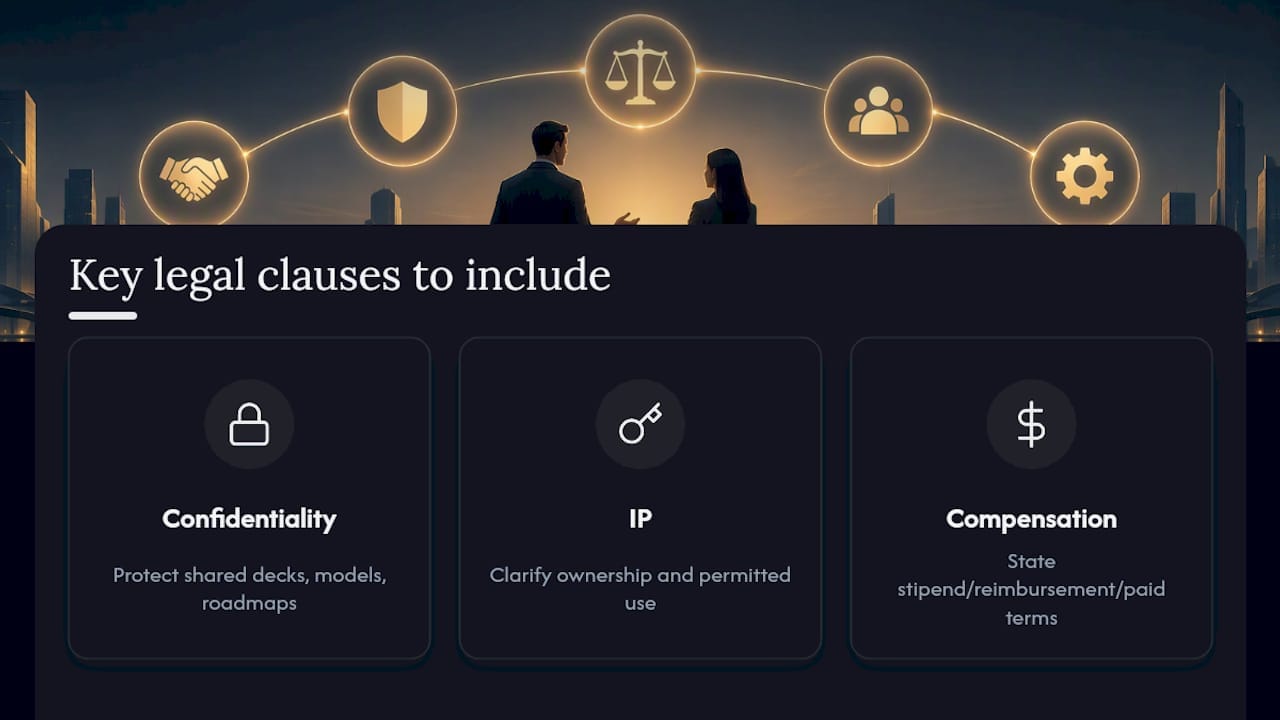
If money changes hands, whether as a stipend, reimbursement, or paid advisory arrangement, the agreement should say so explicitly and specify the terms, since an unpaid mentoring relationship and a paid consulting arrangement carry different expectations and different legal exposure. For anything involving compensation, equity, or significant intellectual property, a quick review by a lawyer familiar with your jurisdiction is worth the modest cost, since template language cannot account for every local rule.
Author’s perspective: quick priorities for your first meeting
If you take one thing from this guide, keep the first version of your agreement light. Pick one measurable goal, one meeting cadence, and one confidentiality statement, then stop. The checklist above exists precisely so you do not over-engineer a document meant to support a relationship, not replace one.
Revisit the agreement at your first scheduled review and adjust based on what actually happened, not what you guessed would happen. The best agreements get better with a single revision, not with a longer first draft.
— Amichai
An alternative path: program-based mentorship with facilitator support
Writing and maintaining your own agreement works well when you have one mentor and a clear sense of your goals. Some founders want more structure than a solo agreement provides, especially when accountability tends to slip once the initial enthusiasm fades. A managed program removes that administrative load by building the milestone tracking, review cadence, and mentor access directly into the schedule, so you spend your time executing rather than drafting clauses.
Some immersive bootcamps build mentorship, goal-setting, and accountability structures directly into the program rather than leaving them for participants to design from scratch. The online entrepreneurship bootcamp pairs founders with experienced mentors inside a structured sprint, and details on how the programs are run are available for anyone weighing a facilitated option against a self-managed agreement. Neither path is required over the other. A written agreement you build yourself and a structured program each solve the same problem in different ways, depending on how much scaffolding you want around your mentorship relationship.
Sources
- The Mentoring Agreement – UC Davis Human Resources
- AIA Best Practices: Formal mentoring goals and guidelines
- Mentoring Agreement Template (Fieldsafe / Colorado)
- Professional Mentoring Agreement | signNow (airSlate)
FAQ
Do I need a lawyer to write a mentorship agreement?
Most mentoring agreements do not require a lawyer, since they function as a written understanding rather than a binding contract. Consider legal review only when compensation, equity, or significant intellectual property is involved, as sample professional agreements note for those specific clauses.
How often should mentor and mentee meet?
There is no single required cadence, but monthly or biweekly meetings around 45 minutes are common in mentoring program templates. What matters more than frequency is naming who schedules the meeting and how rescheduling will be handled.
What should a mentorship agreement include at minimum?
At minimum, include contact preferences, a meeting schedule, at least one measurable goal, a confidentiality statement, and a term with an end date. Institutional mentoring templates recommend drafting these fields at the very first meeting.
Can a mentorship agreement be ended early?
Yes, a well-written agreement includes a termination clause, typically requiring a short notice period such as two weeks and allowing either party to end the relationship. Naming this upfront makes an early exit far less awkward than leaving it unaddressed.
Should the agreement address confidentiality even for informal mentorships?
Yes, even informal mentoring relationships benefit from a short confidentiality clause, since mentees often share business plans or financial details. Practitioner mentoring toolkits recommend pairing confidentiality language with clear boundaries about the mentor’s role.
Comments are closed.