
Research-Backed Immersive Learning: Checklist for Founders and Teams
Immersive entrepreneurship bootcamps and company retreats speed up business results by combining hands-on execution, direct mentorship, and cohort networks that outlast the program itself. Peer-reviewed research and practitioner evidence both point to faster validation, stronger applied skills, and better team alignment as the measurable payoff. Founders gain the most when they lack a network or are stuck pre-launch, while teams benefit when retreats are designed around structured follow-up rather than a single week of activity.
TL;DR:
- Cohort-based immersive programs significantly boost startup validation speed, especially for founders without an existing network or early-stage ideas.
- Formal follow-up and structured activities after retreats lead to more durable team improvements and sustained innovation.
- Immediate results include clearer value propositions, prototypes, and early customer or investor engagement within six months.
- Program outcomes depend heavily on mentor quality, participant stage fit, and ongoing support rather than the event itself.
- Companies should prioritize programs with proven alumni success, balanced cohort sizes, and guaranteed post-program engagement.
Table of Contents
- 1. Top benefits founders and HR leaders can act on
- 2. What the research shows about immersive programs
- 3. Benefits for founders and solo entrepreneurs
- 4. Benefits for teams and retreats
- 5. How immersive programs actually deliver value
- 6. What to expect: timeline, outcomes, and cost framing
- 7. How to choose the right bootcamp or retreat
- 8. Why immersive learning sits at the center of our approach
- 9. Nomad Excel programs built around these benefits
- Sources
- FAQ
1. Top benefits founders and HR leaders can act on
Immersive programs deliver a specific set of gains, and knowing which ones apply to your situation makes it easier to choose the right format and measure the payoff afterward.
- Faster validation: structured sprints push founders through customer conversations and pricing tests in days rather than months.
- Skill acceleration: pitching, sales conversations, lean experiments, and basic operations get practiced live, not just studied.
- Mentorship and feedback loops: direct critique from experienced operators catches costly mistakes before they become expensive.
- Network access: peers, mentors, and sometimes investor or partner introductions extend well past the closing session.
- Team-level gains: retreats build psychological safety, align goals, and tend to lift innovation output.
- Execution focus: daily deliverables and public accountability replace theory with a shipped result.
Founders lacking a peer network tend to see the largest jump in confidence and clarity, while teams get the most from programs that build in follow-up rather than treating the retreat as a one-off event.
Pro Tip: Treat every bootcamp deliverable, whether it is a pitch, a pricing test, or a prototype, as a milestone you can track against your business plan after you go home.
2. What the research shows about immersive programs
The strongest evidence comes from three types of studies, and each points the same direction while flagging real limits.
- A 2025 meta-analysis on intensive entrepreneurial programs found a statistically significant link between participation and improved new venture performance, with stronger effects in tailored, cohort-based formats.
- A randomized controlled trial on psychological safety covering more than 500 teams and 4,300 employees tied safety interventions to higher innovation and better team performance.
- A systematic review of business accelerators found consistent soft outcomes like validation and networking, while funding and revenue gains depend heavily on program design.
The meta-analysis behind these numbers covers programs assessed through 2025, and its central caveat matters: results vary by founder experience level, program length, and whether structured follow-up happens after the event.
3. Benefits for founders and solo entrepreneurs
For an individual founder, the immediate output of an immersive program is concrete: a sharper value proposition, a working prototype, and a short list of prioritized experiments rather than a vague strategy deck.
- Immediate deliverables include a clarified offer, an MVP or prototype, and a ranked experiment list.
- Near-term outcomes, typically within one to six months, include real customer conversations, early pilot revenue, and sometimes investor leads.
- First-time founders and those without an existing network see the biggest jump, since the program compresses months of cold outreach into a few days.
- Founders stuck at the validation stage before the program tend to move fastest afterward, according to the systematic review of accelerators.
A related breakdown of why joining a bootcamp matters walks through specific participant outcomes in more depth.
4. Benefits for teams and retreats
Company retreats work differently than solo bootcamps because the unit of change is the team, not the individual, and the payoff is measured in how people work together afterward.
- Structured retreat activities build psychological safety and a shared vocabulary that survives the trip home.
- Teams typically report faster decision-making, higher idea throughput, and clearer alignment on strategic priorities.
- A practice summary from CIPD links psychological safety directly to team learning and innovation, particularly in new or remote teams.
- Facilitated exercises like structured feedback rounds and joint problem-solving sprints tend to produce more durable change than open social time alone.
Pro Tip: Expect a short friction phase after a retreat, as teams work through differences in style before the new norms settle in, and plan a follow-up check-in rather than assuming the gains stick on their own.
5. How immersive programs actually deliver value
The mechanism behind these results is learning-by-doing applied to a participant’s real project, not a case study borrowed from someone else’s business.
- Founders apply concepts immediately to their own venture instead of a hypothetical exercise, which speeds retention according to research on learning-by-doing in entrepreneurship education.
- Mentor feedback loops create tight critique cycles, and the systematic review of accelerators notes that internal peer networks formed this way often become lasting resources for partnerships, supported by research showing how engaging content boosts retention through effective feedback and engagement loops like these engagement’s impact on bounce rate.
- Cohort dynamics add vicarious learning: watching a peer solve a pricing problem is often as useful as solving your own.
- Small cohorts, structured sprints, pitch nights, and scheduled follow-up all amplify the effect, while loose, unstructured formats tend to dilute it.
6. What to expect: timeline, outcomes, and cost framing
Set your expectations around a realistic curve rather than an overnight transformation.
- Immediate clarity on offer, audience, and next steps by the end of the program.
- Measurable outcomes within one to six months, including validated experiments, early pilot revenue, and mentor follow-ups.
- Business impact that compounds over six to eighteen months as networks and habits formed during the program keep paying off.
Gains can fade without reinforcement, according to longitudinal research on entrepreneurship education, so treat the program fee as an investment in both learning and network access, and expect the return to vary depending on how much follow-up work you put in afterward.
7. How to choose the right bootcamp or retreat
A short checklist saves you from picking a program on marketing alone.
- Confirm cohort fit: are other participants at a similar stage, or will you be the only early founder in a room of experienced operators?
- Ask about mentor credentials and the mentor-to-participant ratio, since feedback quality depends on it.
- Request examples of past deliverables and alumni outcomes rather than general claims.
- Check whether the program includes structured follow-up after the event, since that is where gains often get locked in or lost.
Red flags include vague promises with no alumni examples, oversized cohorts that dilute mentor time, and no structured feedback mechanism.
Pro Tip: Ask any provider one direct question: what happens 30 days after the program ends? A clear answer usually signals real follow-up support.
8. Why immersive learning sits at the center of our approach
Immersive entrepreneurship bootcamps grow fastest when founders and teams apply ideas to real work in front of people who can push back immediately. The most effective programs pair mentorship with daily execution and a community that keeps functioning after the closing session, which is the part many programs skip.
— Amichai
9. Nomad Excel programs built around these benefits
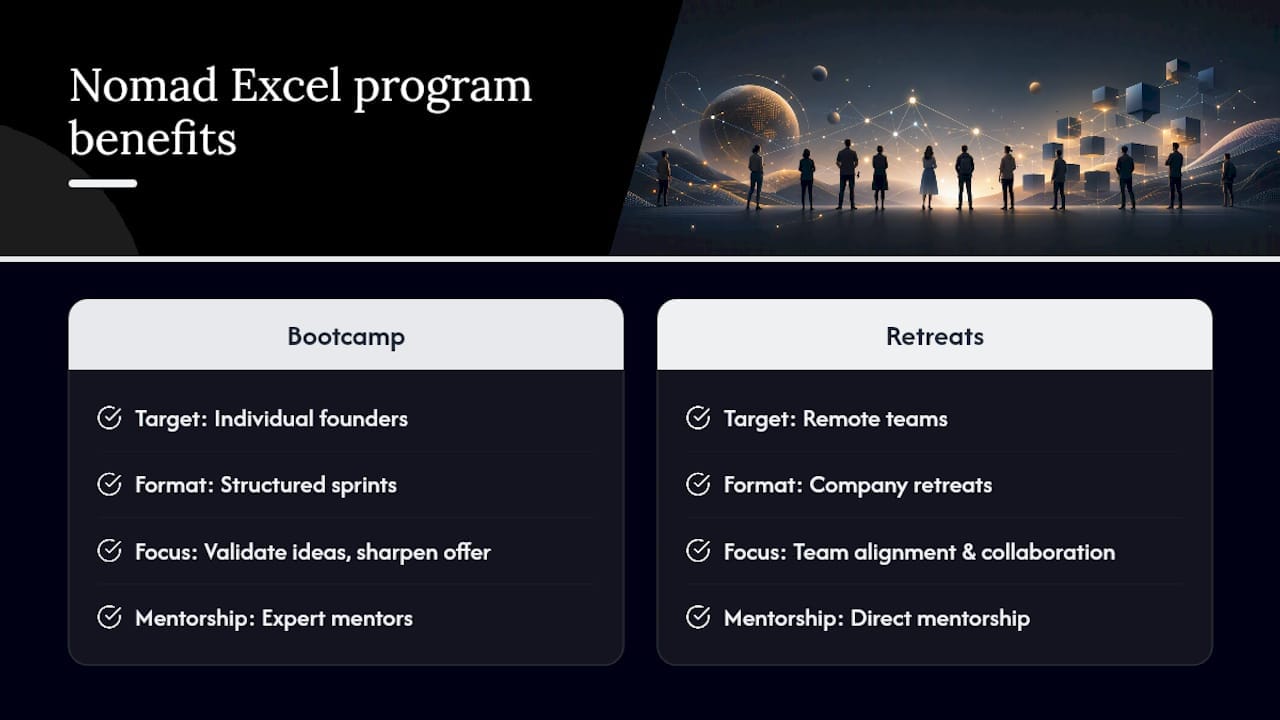
If you are an individual founder ready to validate an idea or sharpen your offer, our Online Entrepreneurship Bootcamp combines structured sprints, expert mentorship, and a peer community that keeps working long after the program ends. Teams looking for alignment and stronger collaboration have a different starting point: our company retreats for remote teams are built around the same psychological safety and follow-up principles the research points to. Both paths share the same core design: hands-on execution over lectures, direct mentorship over generic advice, and a community that sticks around.
Ready to see which format fits your stage? Explore our programs or start with the option that matches where you are right now.
Sources
- Meta-analysis on intensive entrepreneurial programs (2025)
- Fostering Psychological Safety in Teams: Evidence from an RCT (CEPR, 2025)
- A learning-by-doing approach to entrepreneurship education (MDPI, 2022)
- An updated systematic review of business accelerators (ScienceDirect, 2023)
FAQ
What are the main benefits of immersive learning for entrepreneurs?
The main benefits are faster idea validation, applied skill-building in areas like pitching and sales, direct mentor feedback, and access to a peer network. A 2025 meta-analysis links these programs to measurable improvements in new venture performance, especially when the format is cohort-based.
How does immersive learning improve retention compared to traditional courses?
Retention improves because participants apply concepts to their own real project instead of a hypothetical case, which creates immediate feedback and correction. Research on learning-by-doing in entrepreneurship education attributes short-term gains in skills and entrepreneurial intent to this direct application.
Do company retreats actually improve team performance?
Retreats can improve team performance when they build psychological safety and include structured follow-up after the event. A randomized trial covering more than 500 teams found that safety interventions led to higher innovation and better team stability.
How long does it take to see results from an immersive bootcamp?
Clarity on strategy and next steps often shows up immediately, with concrete outcomes like pilot revenue or investor leads typically appearing within one to six months. Larger business impact tends to build over six to eighteen months as the network and habits formed during the program compound.
What should I look for when choosing a bootcamp or retreat provider?
Look for a strong mentor-to-participant ratio, real alumni examples, a cohort that matches your stage, and structured follow-up after the program ends. Vague outcome claims, oversized cohorts, and no post-program support are the clearest red flags.
Comments are closed.