
Entrepreneur Mindset Guide for Growth and Independence
Nearly 90 percent of startups fail within their first few years, yet those with an entrepreneurial mindset are far more likely to adapt, persist, and thrive. Building this mindset goes beyond just ambition or luck. It is rooted in clear self-awareness, intentional habits, and strong relationships. By understanding what truly motivates you and developing daily resilience, you set yourself up for lasting success in any venture.
Table of Contents
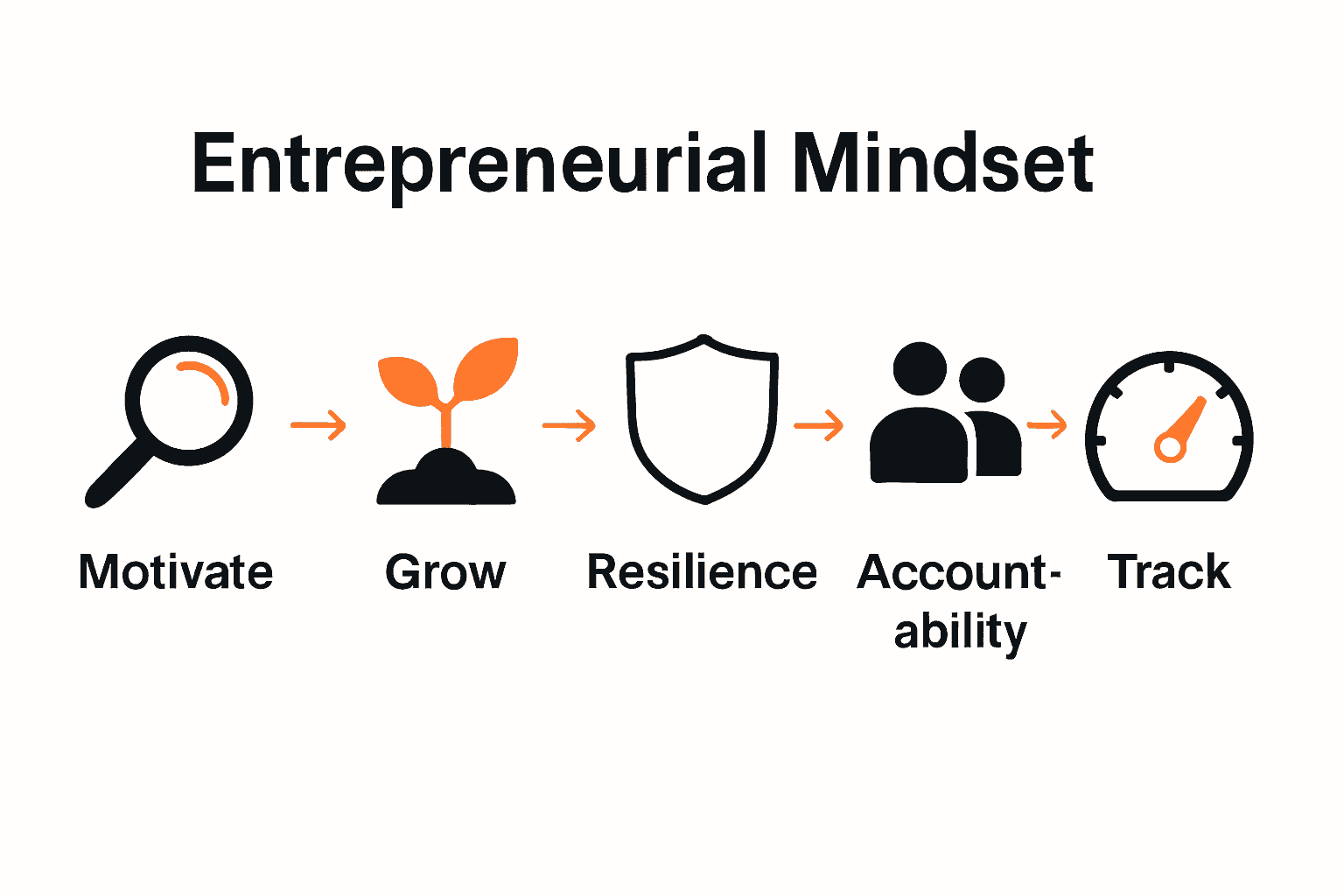
- Step 1: Define Your Core Motivations And Vision
- Step 2: Adopt Growth-Oriented Beliefs And Habits
- Step 3: Build Daily Resilience With Proven Practices
- Step 4: Engage In Collaborative Accountability Circles
- Step 5: Track Progress And Optimize Your Mindset
Quick Summary
| Key Point | Explanation |
|---|---|
| 1. Define your core motivations. | Conduct self-assessment to uncover personal passions, skills, and long-term goals for authentic entrepreneurial vision. |
| 2. Adopt a growth-oriented mindset. | View challenges as learning opportunities, maintain a learning journal, and engage in weekly reflection to promote improvement. |
| 3. Build daily resilience practices. | Establish morning routines and resilience logs to prepare for challenges and develop healthy emotional processing mechanisms. |
| 4. Engage in accountability circles. | Form peer groups to support each other with honest feedback and structured meetings to track goals and challenges collaboratively. |
| 5. Track progress strategically. | Create a quarterly dashboard for both qualitative and quantitative metrics, and conduct monthly reviews to motivate and guide growth. |
Step 1: Define Your Core Motivations and Vision
Defining your core motivations and vision is the foundational step in building an entrepreneurial mindset that will sustain and drive your professional journey. According to research from Eric.ed.gov, successful entrepreneurs begin by conducting a comprehensive self assessment that evaluates personal aptitudes, skills, and professional potential.
To start this process, grab a notebook and create three distinct columns: personal passions, professional skills, and long term goals. Begin by honestly documenting what truly excites you about potential business opportunities. Ask yourself probing questions like “What problems do I feel compelled to solve?” and “What unique perspectives or experiences do I bring to my chosen field?” This introspective exercise helps connect your internal motivations with potential entrepreneurial paths.
A critical warning for this stage is avoiding wishful thinking or copying someone else’s vision. Your entrepreneurial path must be authentic and deeply personal. Authenticity creates resilience when challenges emerge. By grounding your vision in genuine passion and realistic self understanding, you build a motivation framework that can withstand inevitable obstacles and setbacks.
 Your next step will involve transforming these initial insights into actionable strategic objectives that align with your identified core motivations.
Quick Pro Tip: Review your motivations quarterly. Entrepreneurs evolve, and so should your vision.
Step 2: Adopt Growth-Oriented Beliefs and Habits
Adopting a growth-oriented mindset is your critical foundation for entrepreneurial success. According to AACSB, entrepreneurs who view challenges as opportunities for development create pathways for continuous personal and professional transformation.
To cultivate a growth mindset, start by reframing your relationship with failure. Nexford emphasizes that successful entrepreneurs see setbacks not as roadblocks but as valuable learning experiences. Practice this by maintaining a “learning journal” where you document challenges, analyze what went wrong, and extract actionable insights. Commit to weekly reflection sessions where you intentionally deconstruct your experiences and identify specific skills or perspectives you can improve.
A critical warning in this process is avoiding stagnation through comfort. Growth requires consistent discomfort and deliberate stretching beyond your current capabilities. Challenge yourself to learn one new skill every month, attend workshops outside your comfort zone, and actively seek feedback from mentors and peers. Remember that a growth mindset is not about perfection but about persistent, incremental improvement. Your next step involves translating these belief shifts into tangible habits that support continuous learning and adaptation.
Quick Pro Tip: Surround yourself with individuals who challenge and inspire your growth. Your environment significantly influences your mindset transformation.
Step 3: Build Daily Resilience With Proven Practices
Building daily resilience is your secret weapon for navigating the unpredictable entrepreneurial landscape. According to research from Perimeter, successful entrepreneurs develop key attributes like perseverance and adaptability that transform challenges into opportunities for growth.
Start by creating a structured morning routine that primes your mindset for resilience. American English suggests developing practices that help you embrace challenges rather than avoid them. This might include 15 minutes of journaling where you outline potential obstacles and preemptively brainstorm solutions, or a meditation practice that builds mental flexibility. Track your progress by maintaining a “resilience log” where you document challenges encountered, your initial emotional response, and how you ultimately navigated through them.
A critical warning in developing resilience is avoiding the trap of toxic positivity. Resilience is not about never feeling discouraged but about developing healthy mechanisms to process and move through difficult emotions. Practice self compassion by acknowledging your struggles while maintaining forward momentum. Challenge yourself to view setbacks as data points for learning rather than personal failures.
Your next step involves integrating these resilience practices into a consistent daily framework that supports your entrepreneurial journey.
Quick Pro Tip: Design team building activities that challenge your comfort zone and strengthen collective resilience.
Step 4: Engage in Collaborative Accountability Circles
Collaborative accountability circles are powerful transformative spaces where entrepreneurs support and challenge each other toward meaningful growth. According to Denison, building genuine relationships is a critical foundation for entrepreneurial success and provides essential support networks that accelerate personal and professional development.
To create an effective accountability circle, start by identifying 4 to 6 peers who share similar entrepreneurial ambitions but come from diverse professional backgrounds. Schedule monthly meetings with clear structures where each participant presents their current goals, progress, challenges, and specific areas where they need support and honest feedback. Develop a group covenant that establishes trust boundaries. This might include guidelines about confidentiality, commitment to constructive feedback, and expectations around participation. Use a digital shared document to track individual and collective progress, allowing transparent documentation of goals and achievements.
A critical warning when forming these circles is avoiding toxic dynamics that devolve into complaint sessions or superficial interactions. The most effective accountability groups maintain a delicate balance between empathetic support and rigorous challenge. Commit to creating an environment where members feel safe being vulnerable yet are consistently pushed toward meaningful action. Rotate facilitation responsibilities to ensure everyone contributes equally and maintains engagement. Your next step involves refining your communication strategies to maximize the collaborative potential of these entrepreneurial support networks.
Quick Pro Tip: Design team building activities that can help strengthen initial connections within your accountability circle.
Step 5: Track Progress and Optimize Your Mindset
Optimizing your entrepreneurial mindset requires intentional self assessment and strategic progress tracking. According to OpenStax, successful entrepreneurs understand the critical importance of continuous evaluation and adaptive thinking as fundamental tools for personal and professional growth.
Create a comprehensive tracking system that goes beyond traditional metrics. Develop a quarterly personal dashboard that captures both quantitative achievements and qualitative growth indicators. According to Government Polytechnic Nayagarh, successful entrepreneurs prioritize foresightedness and proactive self management. Your dashboard should include key performance indicators like revenue milestones, skill acquisition progress, network expansion, personal development goals, and emotional resilience metrics.
 Schedule monthly deep dive review sessions where you critically analyze your progress with radical honesty and compassionate self reflection.
A critical warning in progress tracking is avoiding toxic perfectionism or becoming overly self critical. Your tracking system should motivate and inspire you rather than create additional stress. Design your metrics to celebrate incremental progress and learning experiences. Recognize that entrepreneurial growth is rarely linear and moments of apparent stagnation often precede significant breakthroughs. Your next step involves integrating these tracking practices into a holistic approach that supports continuous personal and professional evolution.
Quick Pro Tip: Design team building activities that can help you develop collaborative skills while tracking collective and individual progress.
Unlock Your Entrepreneurial Potential with Nomad Excel
Building a resilient and growth-oriented mindset is just the beginning. If you find yourself struggling to translate your core motivations and growth beliefs into real-world business success, you are not alone. Many entrepreneurs face challenges like staying accountable, managing setbacks, and maintaining clarity in their vision. This guide showed how critical it is to embrace continuous learning, resilience, and collaborative support.
At Nomad Excel, we understand these pain points deeply. Our immersive Entrepreneurship Archives offer proven frameworks and mentorship designed to empower entrepreneurs to execute with confidence every day. Whether you are just starting or ready to scale, our bootcamps provide structured sprints, expert guidance, and a vibrant community that fuels growth and independence. Take control of your mindset and your business by joining a program that turns insights into action and builds lasting entrepreneurial habits. Visit us at Nomad Excel to discover how you can start transforming your ideas into real impact today. Don’t wait to accelerate your growth — your entrepreneurial adventure starts now.
Frequently Asked Questions
How can I define my core motivations for my entrepreneurial journey?
To define your core motivations, begin by creating three columns: personal passions, professional skills, and long-term goals. Reflect on what excites you about potential business opportunities and document your insights to create a clear vision for your entrepreneurial path.
What are effective ways to adopt a growth-oriented mindset?
To adopt a growth-oriented mindset, practice reframing setbacks as learning experiences. Start a weekly reflection routine where you analyze challenges and identify specific skills you want to improve, aiming to learn one new skill each month.
How can I build daily resilience in my entrepreneurial life?
You can build resilience by establishing a structured morning routine that includes journaling or meditation to prepare for challenges. Maintain a resilience log to document your responses to obstacles and the strategies you used to overcome them, aiming to review it weekly.
What are the key principles for creating an accountability circle?
To create an effective accountability circle, select 4 to 6 peers with similar entrepreneurial ambitions and schedule monthly meetings focused on each person’s goals and challenges. Establish a group covenant to ensure trust and constructive feedback, and rotate facilitation responsibilities to keep everyone engaged.
How should I track my progress as an entrepreneur?
Track your entrepreneurial progress by creating a personal dashboard that includes both quantitative and qualitative metrics. Schedule monthly review sessions to analyze your achievements and areas for growth, aiming to celebrate incremental progress directly linked to your goals.
What should I focus on to optimize my entrepreneurial mindset?
To optimize your entrepreneurial mindset, prioritize regular self-assessment and progress tracking. Create a comprehensive tracking system that celebrates both achievements and learning experiences, and aim to integrate these practices into your routine within the next quarter.
Recommended
- Entrepreneurship Skills Guide for Launching Your Own Venture – Nomad Excel – Your Entrepreneurial Adventure Starts Here
- Outdoor Group Games For Adults Perfect for Team Building
- What Is Early-Stage Entrepreneurship? Complete Guide – Nomad Excel – Your Entrepreneurial Adventure Starts Here
- Entrepreneurial Leadership Guide for Accelerated Growth – Nomad Excel – Your Entrepreneurial Adventure Starts Here
- Why Choose Entrepreneurship: Complete Guide for Moms – Prosperual
- Master the Personal Growth Process for Lasting Change – Wisdom
Comments are closed.