
BNI for Entrepreneurs: Costs, Time and Who It Fits
BNI is a structured, weekly referral-networking organization, and for entrepreneurs with a local, trust-based business it can be a steady source of introductions. It asks a lot in return: a fee, a fixed weekly meeting and a real block of your time. If you travel often, sell mostly online or are still validating your idea, the fit is less obvious. This guide covers what BNI is, what it costs, where it works and where it doesn’t, and what to try instead when it doesn’t match how you work.
TL;DR
- BNI is a chapter-based referral group that meets weekly, and each chapter admits one professional per specialty.
- Expect an application fee plus an annual or monthly membership. One US region lists $199 to apply, then $85 a month or $799 for a year, and local chapters may add room or meal costs.
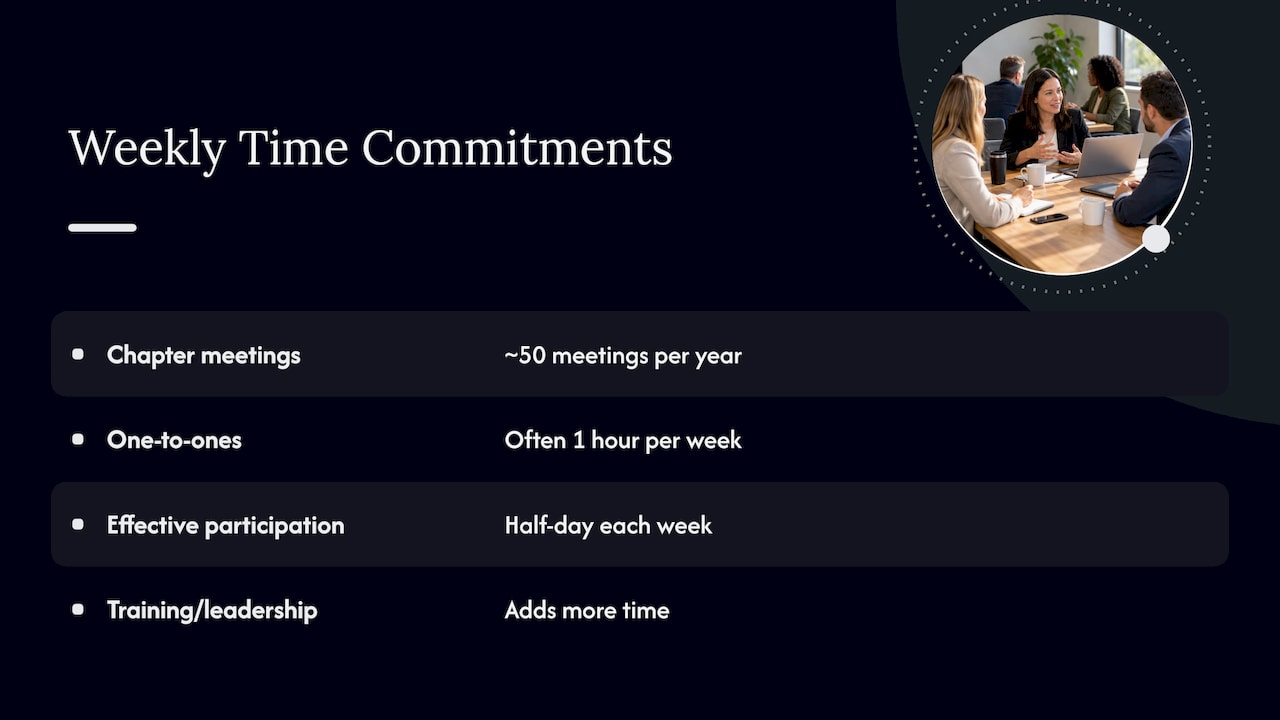
- The real price is time: strict attendance, weekly one-to-ones and chapter roles can take roughly a half-day each week.
- It suits local, referral-driven businesses best. Nomads, frequent travelers and online-first founders often need a more flexible community.
- Visit at least twice before you join, and judge the specific chapter, not just the brand.
Table of Contents
- What BNI is and how the referral model works
- How much BNI costs
- The real cost is your time
- Who BNI works well for
- Who may find it a poor fit
- How to decide: a short checklist before you join
- Our perspective: community works when it matches how you live and work
- Flexible alternatives when a weekly chapter doesn’t fit
- Build your founder community with Nomad Excel
- FAQ
- Sources
What BNI is and how the referral model works
BNI, short for Business Network International, was founded by Dr. Ivan Misner in 1985 and describes itself as the world’s largest networking organization. Its core idea is “Givers Gain”: you pass business to people you trust, and over time they pass business to you.
The mechanics are simple. Members meet regularly in a chapter, usually weekly, and follow a set agenda that includes short presentations about each member’s business. Each chapter accepts only one professional per industry specialty, so your chapter has one accountant, one photographer, one insurance agent. The aim is to remove internal competition so members share referrals openly instead of guarding their contacts.
What this means in practice: you are not attending an event to collect business cards. You are joining a small team of non-competing professionals who agree to become each other’s informal sales force. That only works when the people in the room can plausibly send work to one another.
A note on “BNI Billionaires” and similar names
If you searched for chapter names such as “BNI Billionaires” or “BNI Elite Entrepreneurs,” these are not separate tiers. BNI Billionaires, for example, is a name chosen by an individual chapter to signal its ambitions, and each chapter runs independently inside the standard BNI referral system. Chapter names tell you about local branding, not about quality or price, so evaluate the people in the room.
How much BNI costs
BNI regions operate independently, so prices differ by location. The most useful approach is to read the pricing page of the region where you would join. Two published examples show the typical shape.
| Item | Example (a US region) | Notes |
|---|---|---|
| Application fee | $199 | One-time, paid when you join |
| Monthly option | $85 per month | Lower upfront cost, higher cost over a year |
| One-year membership | $799 | Listed as a 21.5% discount versus monthly |
| Two-year membership | $1,299 | Listed as a 37% discount |
BNI’s own prospect page cites a $699 annual membership and claims the average membership generates $38,100 in annual revenue. That is BNI’s figure about its own members, not a guarantee, and your result depends on your industry and chapter.
A regional BNI page in Alberta notes that pricing varies widely, with some regions offering multi-year discounts, and that renewals generally skip the initial registration fee. Another regional page explains that the initial payment is meant as a symbol of commitment to the system. Budget also for extras: local chapters may charge for meeting rooms or breakfast, and you will want business cards, a decent one-minute pitch and time for coffee meetings.
A practical way to judge cost: take the first-year total, add what your hours are worth, then ask how many closed referrals you need to break even. For a high-ticket service, a single client may cover it. For a low-priced product, you may need many.
The real cost is your time
Money is the easy part to compare. Time is where BNI surprises people.
Attendance. Meetings are weekly, and chapters expect near-total presence. One regional chapter describes roughly 50 meetings a year, expects attendance at all of them and asks you to send a substitute when you cannot come. A substitute can be anyone willing to give your pitch. Chapters commonly allow a limited number of absences per six months, and persistent absenteeism can lead to your seat being opened to another professional.
One-to-ones. Members are encouraged to meet each other individually, often an hour a week. Add chapter role training and, if you take a leadership post, committee work. One analysis estimates that effective participation often means blocking out a half-day each week, and leadership can add more.
Pacing yourself. A freelancer who reviewed her BNI experience warns against being too generous with her calendar. Her advice, echoed by seasoned members, is to set firm office hours for one-to-ones and cap the weekly number so billable work doesn’t suffer.
The model is consistent by design. Mandatory attendance builds trust, and trust is what makes people comfortable putting a client’s name behind yours. But if your schedule is unpredictable, that same rule becomes a constant source of friction.
Who BNI works well for
Networking specialists generally agree that BNI performs best for businesses that depend on local, trust-based referrals, such as financial services, trades and local professional services, rather than those driven by digital marketing. It rewards a “networking as work” mindset: an active, long-term growth strategy rather than a source of quick, passive leads.
BNI is likely a good match if:
- Your customers hire by recommendation, and one trusted introduction beats ten cold leads.
- Your service is local or regional, and you will be in the same city every week.
- Your specialty is open in the chapter you want to join.
- You can reliably protect a weekly half-day.
- You enjoy being part of a recurring group and are willing to hold a chapter role.
Who may find it a poor fit
BNI is likely a weak match if:
- You travel for weeks or months at a time, as many digital nomads and remote professionals do.
- You sell mainly through online channels to customers spread across many countries.
- You are pre-revenue and still working out what to sell. Referral partners need a clear offer they can describe in a sentence.
- You need flexibility more than structure.
The common downside people raise is exactly this rigidity. The attendance policy, with limited absences and the expectation of a substitute, can clash with unpredictable travel schedules. That is not a flaw in the model, only a mismatch with a particular lifestyle.
There is a second, softer risk: chapter culture. Some chapters are supportive and results-oriented, while others can become cliquey. Treat your first two visits as a vetting process, as one long-time networker recommends. Look at the professional caliber of members, how leadership runs the meeting, and whether people actually pass referrals or just talk about it.
How to decide: a short checklist before you join
- Visit two different chapters if you can. The brand is the same; the energy is not.
- Check your specialty. If another member already holds your category, you cannot join that chapter.
- Ask for recent referral examples. Members should be able to describe real introductions that closed.
- Read the regional pricing page. Confirm the application fee, term options and any meeting-room costs.
- Map your calendar for the next 12 months. Count the weeks you will be away. If it is many, plan for substitutes or choose another route.
- Define a success number. Decide in advance what referral value would justify renewal.
Our perspective: community works when it matches how you live and work
We run entrepreneurship bootcamps and company retreats, so we think about community every day. What we see is that founders rarely lack contacts. They lack the right people around them at the right moment: someone who has validated an offer, someone who will challenge a pricing decision, someone who will hold them to a sprint deadline.
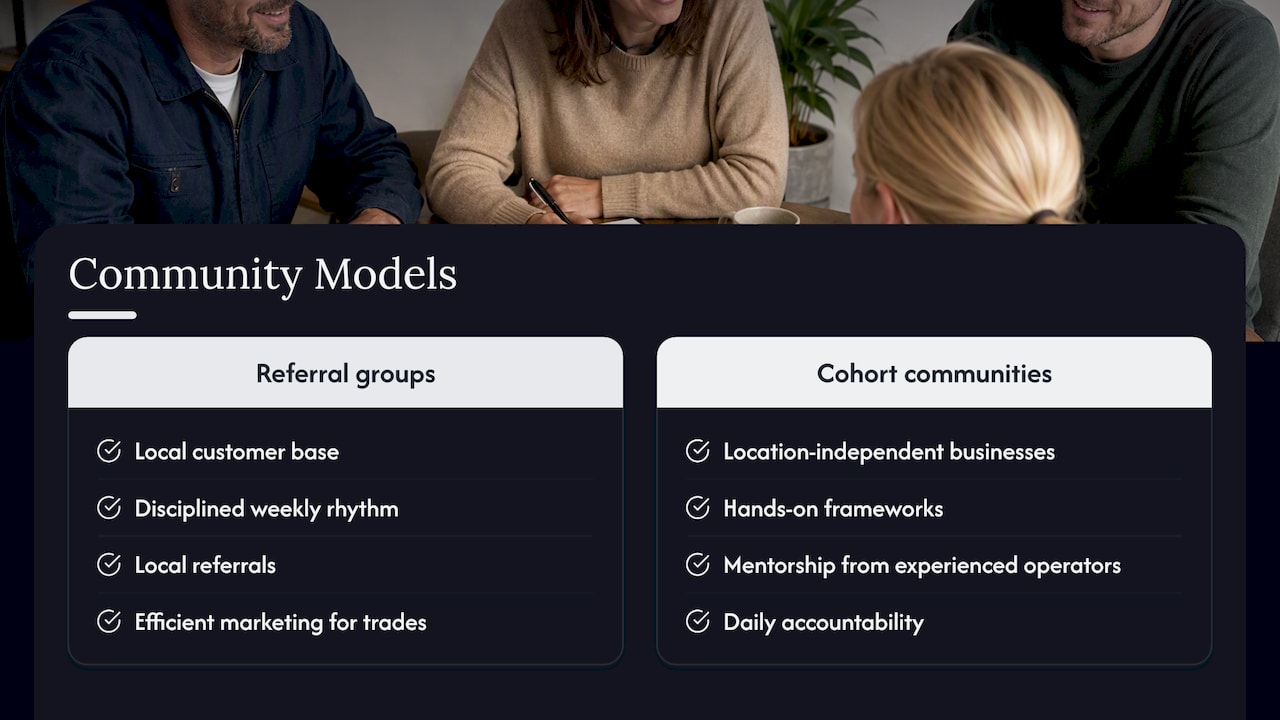
BNI answers one need well, local referrals through a disciplined weekly rhythm. That is a real strength, and for a plumber, a mortgage broker or a local accountant it may be the most efficient marketing habit available. But the entrepreneurs who come to us are often building location-independent businesses. Their problem is not who in town can refer them. It is clarity, execution and a peer group that travels with them.
That is why our programs combine hands-on frameworks, direct mentorship from experienced operators and daily accountability, then keep the community going after the event. If you want to understand how networks compound, our guide on why entrepreneurs need networks for growth and our overview of the role of networking in entrepreneurship go deeper. Our honest view: use structured referral groups if your customers are local, and use immersive, cohort-based communities if you are building something that moves with you. Many founders use both.
— Amichai
Flexible alternatives when a weekly chapter doesn’t fit
You don’t have to choose between a strict weekly group and going it alone. Alternatives fall into a few types:
- Peer cohorts and bootcamps. Short, intensive programs bring a curated group of founders together for days or weeks, then keep them connected online. Our piece on bootcamps that connect founders faster explains how.
- Online communities. Useful for ongoing questions, though accountability depends on you.
- Industry meetups and conferences. Flexible and low-commitment, but you must follow up yourself.
- Business networking retreats. Immersive time away that blends learning and relationship-building. See how networking retreats work for entrepreneurs.
If you are earlier in your journey, our guides on networking for entrepreneurs, practical networking examples and finding a young entrepreneurs network will help you build a routine that fits your schedule. For a repeatable approach, try the networking workflow for founders.
Combining both approaches
A practical hybrid: spend a few weeks sharpening your offer and building a peer circle in a bootcamp, then decide whether a local referral chapter makes sense once your message is clear. A clear offer makes any referral group more productive, because members know exactly who to send your way.
Build your founder community with Nomad Excel
If you want a community and a plan rather than a weekly meeting, our programs are built for that. Our Online Business Bootcamp costs 500 EUR one-off, and our 5-Day Online AI Bootcamp costs 300 EUR one-off. If you prefer to be in the room, our in-person Entrepreneurship Sprint Bootcamps in Lisbon are 1,350 EUR (Idea Space) or 1,500 EUR (Second Home), and we also run bootcamps in Playa Venao, Panama, Pipa, Brazil and Agaete in the Canary Islands, each with a 400 EUR registration fee. Read what our program involves or see why joining a bootcamp can be worth it before you decide.
Running a team rather than a solo business? We design company retreats end to end, from workshops to logistics.
FAQ
What is the downside of BNI?
The main downside is the time and rigidity. Attendance is expected weekly, absences are limited, and one-to-ones and chapter roles add hours on top. That structure can be hard for digital nomads or anyone with unpredictable travel. Chapter quality also varies, so visit before joining.
How much does BNI cost per month?
It depends on your region. One US region lists an $85 monthly option after a $199 application fee, while annual plans cost less per month. Chapters may add meeting-room or meal charges, so check your local pricing page.
What is BNI Billionaires?
It is not an official BNI program or tier. It is a name used by individual chapters as motivational branding, while each follows the standard BNI referral structure. The same is true of other chapter names you may see.
Is BNI worth it for a new entrepreneur?
It can be if you serve local clients and have a clear, easy-to-describe offer. One freelancer’s honest review of joining BNI shows the upside and the effort involved. If you are still validating your idea or travel constantly, build your offer and peer network first.
Sources
- What Is BNI? How the Referral System Works
- About BNI
- BNI Billionaires, BNI UAE Blog
- Pricing, BNI regional page
- Discover BNI membership
- Become a Member, BNI Alberta
- Where does the money go?
- BNI Meeting Attendance
- Is Joining BNI Worth It? An Honest Review
- Is joining BNI worth it?
- Should I Join a BNI Chapter?
Comments are closed.