
Young Entrepreneurs Network: How to Find Your Community
A young entrepreneurs network is any group that connects early-stage founders with peers, mentors and resources. The best one for you depends on your stage, your budget and how much structure you need. Some are free online communities, some are revenue-gated clubs, and some are in-person cohorts where you work side by side for days. This guide explains the main types, what research says makes them work, and how to pick one without wasting a year on the wrong room.
TL;DR
- Networks fall into four types: free global communities, local meetups and chambers, revenue-gated founder organizations, and cohort programs such as bootcamps and accelerators.
- Structure beats casual contact: a randomized field experiment found that founders given formal management advice grew their firms 28% larger within two years than those given informal advice.
- The right network changes as your business matures, so choose for the stage you are in now.
- Judge any network on who is in the room, how often you meet, and whether anyone holds you accountable.
- If you want an intensive, in-person or online cohort, our bootcamps start at €300 for a 5-day online program.
Table of Contents
- What a young entrepreneurs network actually is
- The four types of networks, and who each one suits
- What makes a network work: three findings worth knowing
- How to choose: six questions to ask before you join
- Online or in person?
- Our perspective: why we built cohorts, not directories
- Where our programs fit
- Getting the most from any network
- Common mistakes young founders make
- FAQ
- Sources
What a young entrepreneurs network actually is
The phrase covers a lot of ground. Search it and you will find podcasts, LinkedIn groups, regional membership clubs and international platforms, all using nearly the same name. What they share is a promise: you will stop building alone.
That promise matters more than it sounds. Early-stage founders usually have no manager, no team to test ideas on and no benchmark for what “normal” progress looks like. A good network supplies those missing things. It gives you people who have faced your problem a few months or years earlier, people who will say your offer is unclear, and people who notice when you stop shipping.
Age is a secondary question. Some groups cap membership by age, and others care only about the stage of the business. A 22-year-old with a first prototype and a 38-year-old freelancer launching a first product often need the same thing: honest peers and a rhythm of execution.
The four types of networks, and who each one suits
Free global communities
These are the easiest entry point. One example is the Ye! Community, a platform for young entrepreneurs up to 35 years old run through the International Trade Centre. It offers free access to startup tools, country guides and e-learning, plus a network of more than 30,000 members that includes mentors and business support organizations.
The strength of this type is reach and cost. The limit is intimacy: with tens of thousands of members, you have to do the work of finding the three or four people worth talking to. Free communities reward self-starters who already know what to ask.
Local meetups, chambers and mentoring chapters
In the United States, many founders start with local groups: chamber of commerce mixers, referral groups, volunteer mentoring chapters and city startup meetups. Costs vary from free to a few hundred dollars a year, according to one directory of U.S. business networking groups.
Proximity is a real advantage. A study of entrepreneurs in developing economies found that those paired with peers living within 1 km were much more likely to keep up the relationship, share knowledge and see profit gains than those paired with distant peers. The lesson applies beyond that setting: the easier it is to meet, the more likely you are to keep meeting.
Revenue-gated founder organizations
Some membership organizations admit founders only once the business reaches a revenue threshold, and some also apply age limits. They offer small confidential peer groups, which can be extremely valuable, but they are designed for owners who are already scaling. If you are pre-revenue or at the idea stage, you will not qualify, and the dues would be hard to justify even if you did.
The common misconception is that these clubs are simply the “grown-up” version of a young entrepreneurs network. They serve a different operating level. Treat them as a later chapter, not a goal for month one.
Cohort programs: bootcamps, sprints and accelerators
A cohort program puts a defined group through the same experience over a fixed period. You get a shared curriculum, mentors, deadlines and a group of people who know exactly what you are working on.
Research on accelerators points to a strong cohort effect that gives portfolio companies signaling, networking and advisory benefits. In plain terms, the people you go through the program with become part of your network, and they are often the part that lasts.
What makes a network work: three findings worth knowing
Structure and accountability matter more than contacts
The 28% growth figure comes from a randomized field experiment in India, published in the Strategic Management Journal. Entrepreneurs who received advice built around regular meetings, consistent goal-setting and frequent feedback outperformed those who received informal advice. The takeaway for you is practical: prefer a network where someone asks what you did this week and what you will do next week.
Mix matters
Research on accelerator peer networks notes that peer effects are not automatically positive. When cohorts are too similar or lack complementary skills, performance can suffer. A strong network curates a mix of backgrounds and management styles so you learn something you did not already believe.
The best network changes as you grow
The same research describes a shift: in early validation, peer-to-peer advice does most of the work, and as the business scales, founders benefit more from professionalized mentoring. That means a network that suits you at the idea stage may feel thin at $500,000 in revenue. Plan to move on, and treat that as progress rather than disloyalty.
How to choose: six questions to ask before you join
- Who else is in the room? Look at stage, not just age. You want people slightly ahead of you and a few at your level.
- How often will you actually meet? Weekly rhythm beats an annual conference.
- Is there structure? Look for goals, sprints, check-ins and feedback, not just a chat channel.
- Who are the mentors? Check whether they have built and operated businesses, and whether they are available to you directly.
- What does it cost in total? Include travel, time away from client work and any add-on fees.
- What happens after it ends? A network should outlast the event. Ask about alumni channels and how members stay in contact.
If you are a freelancer or remote professional, add a seventh: can you take part without pausing your income? Online and short-format options exist for exactly this reason.
Online or in person?
Online communities win on cost, flexibility and range. In-person experiences win on trust. Spending several days with the same people, eating together, working through problems at a whiteboard and meeting again the next morning builds relationships faster than months of occasional messages.
If you go online, the format matters. Peer learning only works when sessions are designed for it, with clear activities, roles and a first-session routine. This guide to peer learning online covers activities, rubrics and a first-session checklist you can borrow to make a virtual group more than a video call.
For a deeper look at how peers drive results, see our piece on peer collaboration and entrepreneur success.
Our perspective: why we built cohorts, not directories
We run entrepreneurship bootcamps because we kept seeing the same pattern: ambitious people collected contacts and stayed stuck. A directory of names does not change what you do on Tuesday morning.
Our programs bring a curated group of founders together for anywhere from a few days to four weeks, with step-by-step frameworks for validating ideas, refining offers and building scalable systems. Experienced entrepreneurs, marketers and operators mentor directly. Daily accountability and structured sprints keep the focus on real-world results over theory.
We also believe the best network is one you earn by working alongside people. When founders spend a week solving real problems together, the conversation shifts from “what do you do?” to “here is what I would try.” That is the community that keeps supporting, and challenging, long after the program ends.
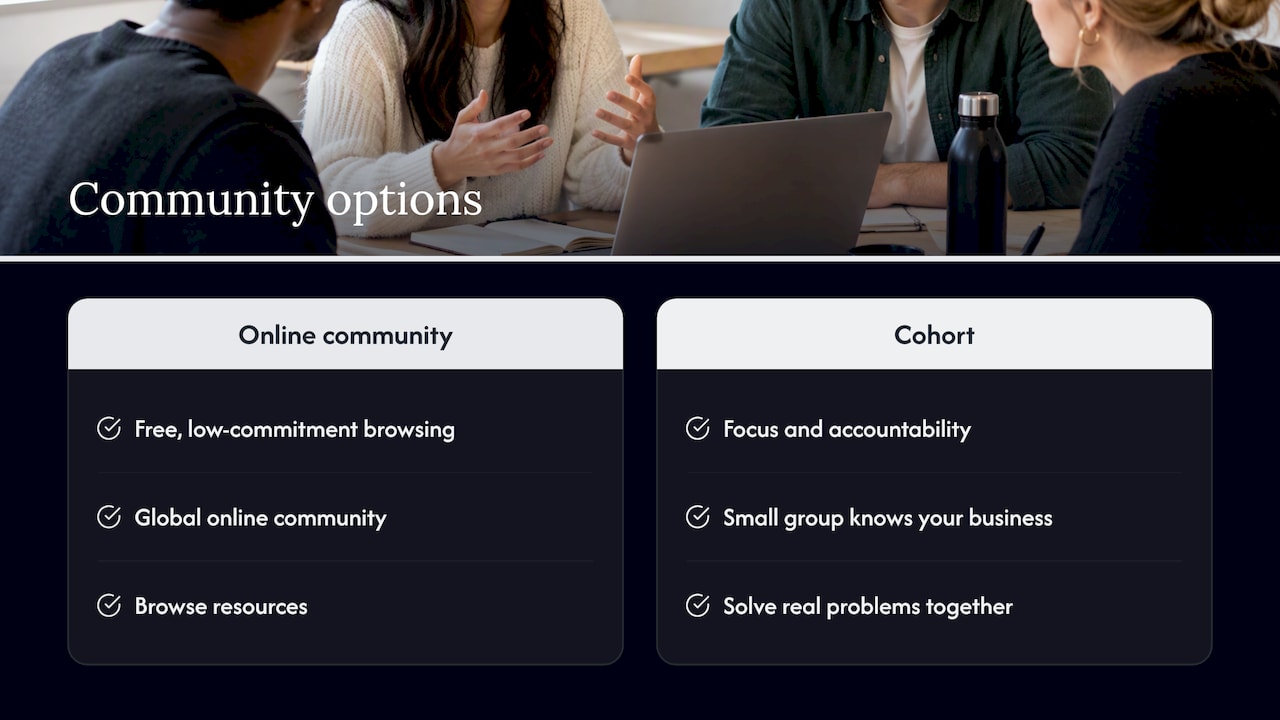
Honesty matters here, too. A bootcamp is not the right tool for everyone. If you want a free, low-commitment place to browse resources, a global online community is a perfectly good start. If you want focus, accountability and a small group that knows your business, a cohort is hard to beat.
— Amichai
Where our programs fit
We offer formats for different budgets and schedules. The prices below are as published on our site.
| Program | Format | Price |
|---|---|---|
| 5-Day Online AI Bootcamp | Online, 5 days | €300 |
| Online Business Bootcamp | Online | €500 |
| Entrepreneurship Sprint Bootcamp, Idea Space | In person, Lisbon | €1350 |
| Entrepreneurship Sprint Bootcamp, Second Home | In person, Lisbon | €1500 |
| 1-Week Entrepreneurship Bootcamp | Agaete, Canary Islands | €400 registration fee |
| 10-Day Entrepreneurship Bootcamp | Pipa, Brazil | €400 registration fee |
| 2-Week Entrepreneurship Bootcamp | Playa Venao, Panama | €400 registration fee |
If you are testing the waters, the online options let you meet a cohort without travel. If you are ready to commit time and attention, the in-person sprints and destination bootcamps put you in the room with other founders for days at a stretch. Not sure which format fits? Our page on what to expect from our program is a good next step, and our guide to joining an entrepreneurship bootcamp explains who benefits most.
Getting the most from any network
Joining is the easy part. These habits turn membership into results:
- Arrive with a specific ask. “Does this offer make sense?” gets better answers than “any advice?”
- Give first. Share a template, an introduction or a teardown of someone’s landing page. People remember who helped them.
- Set a weekly commitment. Put it on your calendar the way you would a client call.
- Follow up within 48 hours. A short message after a good conversation is what converts a contact into a relationship.
- Find a mentor and a peer. You need someone ahead of you and someone beside you. Our overview of the mentorship process for entrepreneurs shows how to build both.
- Review quarterly. Ask whether the network still matches your stage, and be willing to move on.
If you are comparing structured mentorship options as part of your search, our startup mentorship programs comparison lays out the criteria we use.
Common mistakes young founders make
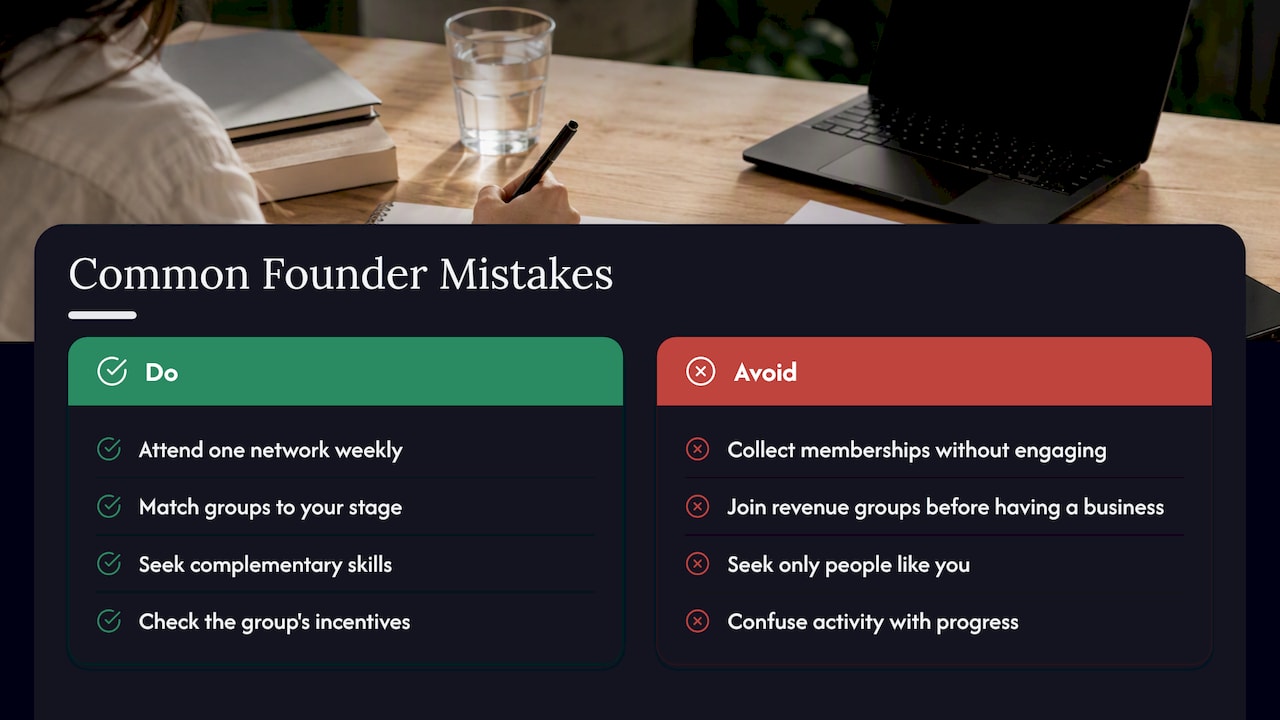
Collecting memberships. Three networks you never engage with are worth less than one you attend weekly.
Joining too late or too early. Revenue-gated groups are premature before you have a business, and a casual meetup is not enough once you need hard operational feedback.
Seeking only people like you. Similar peers feel comfortable, but research shows that cohorts lacking complementary skills can drag on performance. Seek out people who run things differently.
Confusing activity with progress. Attending events feels productive. Ask what you shipped, tested or sold as a result.
Ignoring the network’s own incentives. Every group has a business model. Know whether it earns from your dues, from sponsors or from selling you services, and judge its advice accordingly.
FAQ
What is the network for young entrepreneurs?
There is no single one. The name applies to many groups: free global platforms such as the Ye! Community for founders up to 35, local meetups, paid membership clubs and cohort programs. Pick the type that fits your stage and the amount of structure you want.
Is a free network enough, or should I pay for one?
Free networks are a good start, particularly if you are validating an idea and need information and contacts. Paid cohorts add structure, mentoring and accountability, which research links to stronger growth. If you are struggling to follow through alone, that is usually the signal that paying for structure is worth it.
Do I need to be under a certain age?
It depends on the group. Some global platforms set an upper limit of 35, and some executive clubs set one at 45. Many bootcamps and cohort programs, ours included, focus on the stage of your business rather than your birthdate. Check each program’s requirements before you apply.
Can I build a network online without traveling?
Yes, if the format is designed for interaction. Look for live sessions, small groups, shared deadlines and a way to stay in contact afterward. Our online business bootcamp is built this way, and it is a lower-cost way to meet a cohort before committing to travel.
Sources
- When does advice impact startup performance? (Strategic Management Journal)
- Ye! Community, International Trade Centre
- Accelerator Impact on Peer Networking (Junior Management Science)
- Networking Frictions and Entrepreneurial Learning in Developing Economies (Management Science)
- Peering Inside: Peer Effects and Entrepreneurial Outcomes in Accelerators (Wharton)
- Every Business Networking Group in the U.S.