
Global Entrepreneurship Network: Bootcamps Connect Founders Faster
A global entrepreneurship network is a cross-border peer community where founders trade introductions, market knowledge, and honest feedback. Connectedness is what speeds growth. The fastest way in is to pick one focused entry point, such as a curated cohort, a niche online group, or a short bootcamp, and commit to a steady follow-up rhythm afterward.
TL;DR:
- Before joining, look for trust, reciprocal help, and geographic diversity; ask members for recent examples of what they gave and received.
- After a few real conversations, send something useful, check in every few weeks, and propose a pilot or shared experiment.
- Pair short in person meetings, which build trust, with LinkedIn introductions or WhatsApp and Slack groups that keep selected relationships active.
- Track introductions that become meetings, pilots, leads, revenue, and applied lessons; redirect your effort if the network produces no concrete results.
- Choose accessible events over large gatherings; research finds that barriers to making connections and following up reduce their value.
Table of Contents
- Why does global connectedness matter for founders?
- What makes a global entrepreneurship network worth joining?
- How do you join and activate cross-border ties?
- How do you combine in-person trust with digital reach?
- How do you track and sustain the value of your network?
- What should founders prioritize this month?
- How does an immersive bootcamp or retreat speed up joining a global network?
- FAQ
- Sources
Why does global connectedness matter for founders?
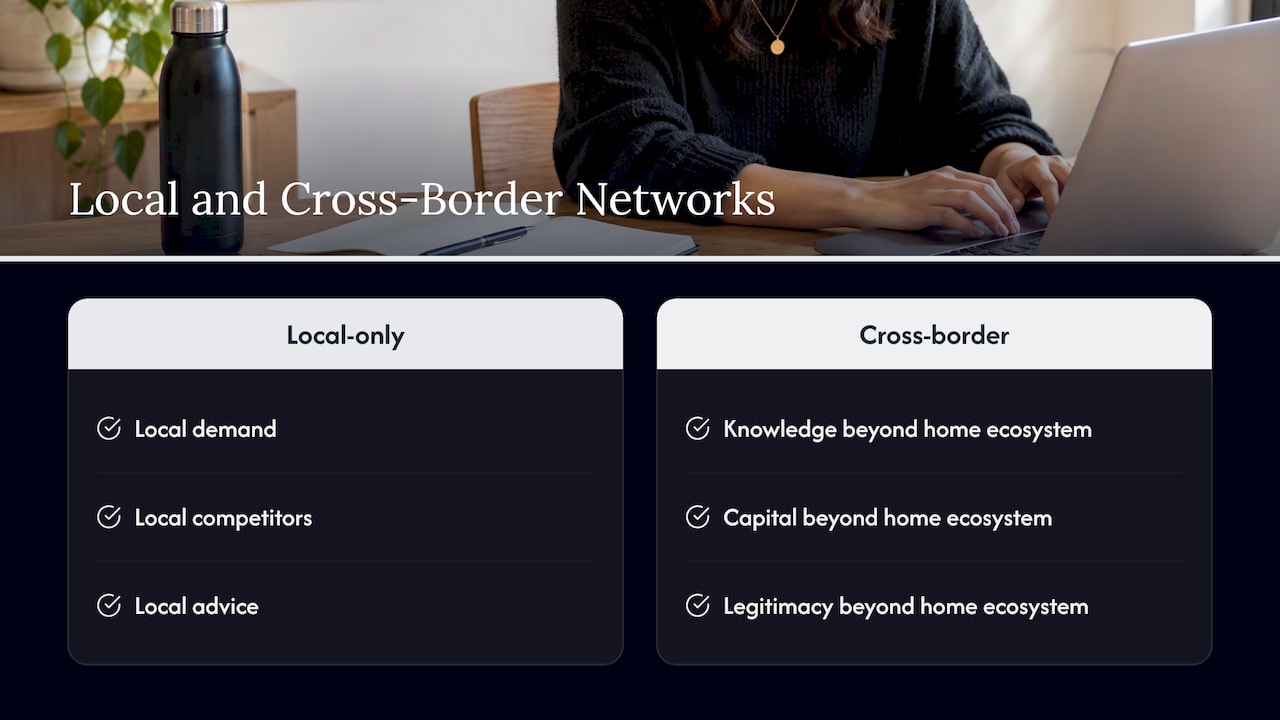
Founders who stay inside a local circle see only local demand, local competitors, and local advice. A cross-border network widens that view. Startup Genome finds that globally connected startup ecosystems consistently grow faster and perform better than local-only systems, because personal relationships import know-how, ambition, and global market insight.
Globally connected ecosystems consistently grow faster and perform better than local-only systems, according to Startup Genome. For a founder, that means the people you know abroad shape your growth as much as the market you serve at home.
The mechanisms are practical. A peer in another market can tell you whether your pricing holds up, who to ask for a warm referral, and which assumptions will fail before you spend months testing them. That validation prevents wasted effort.
Academic work points the same way. A systematic literature review connects networking with entrepreneurial internationalization, though it notes that causal evidence is still thin. Newer research on international network activity shows that interorganizational networks give firms access to knowledge, capital, and legitimacy beyond their home ecosystem. We cover the wider pattern in our piece on why global business experiences drive startup growth.
What makes a global entrepreneurship network worth joining?
Not every community deserves your time. Three traits separate a useful network from a crowded chat room.
- Trust comes first. Network-building experts treat trust as the core currency of a network, and they argue it takes structured, intentional engagement rather than passive attendance at mixers.
- Reciprocity signals maturity. A study of a digital international innovation platform found that reciprocity correlates strongly with ecosystem connectivity. Members who give as often as they ask keep the whole network alive.
- Diverse ties open new doors. A Columbia Business School research brief on the globalization of entrepreneurship concludes that weak ties, along with geographic and gender diversity, drive innovation and new opportunities more than a small set of strong local ties.
Pro Tip: Before joining, ask current members what they gave and received recently. Specific answers beat any marketing page.
How do you join and activate cross-border ties?
Start with low-friction entry points. Curated cohorts, focused in-person events, academic collaborations, and niche online communities all work. Research on international academic mobility shows that interpersonal networks are how temporary stays abroad turn into entrepreneurial knowledge, and work on pre-founding R&D collaboration shows that international partners help academic spin-offs reach early international revenue.
Once you pick an entry point, follow this sequence:
- Prepare a clear ask and a value exchange. Write one sentence on what you need and one on what you can offer.
- Engage intentionally. Skip the business-card sweep. Hold a few real conversations and take notes.
- Follow up promptly. Send something small and useful: an article, an introduction, a short answer to a question they raised.
- Keep a steady cadence. A short message every few weeks beats a long one twice a year.
- Convert the connection into action. Propose a pilot, a joint webinar, or a shared experiment.
Consistency matters more than volume. Research on networking frictions finds that difficulty connecting, following up, or meeting lowers the value of events, so accessible contacts and reliable follow-up beat chasing large, high-friction gatherings.
Pro Tip: Validate your idea with new contacts before you ask for anything big. Polsia’s guide on how to validate a startup idea pairs well with a first round of introductions.
For templates and a follow-up routine, see our networking for founders workflow.
How do you combine in-person trust with digital reach?
Face-to-face time builds relational capital quickly. Digital tools then keep dozens of relationships warm without the travel. Research on cross-border social networks finds that open, geographically dispersed networks supply more varied resources, and practitioner insight there favors a hybrid of short in-person trust-building plus digital follow-up. A study of foreign entrepreneurs in Poland reaches a similar conclusion: LinkedIn, WhatsApp, and forums amplify and sustain the relationships that begin face to face.
Match each tool to a job:
- LinkedIn for introductions and light, public touchpoints.
- WhatsApp or Slack for small ongoing groups where people actually reply.
- Niche forums for topic-driven collaboration with people you have not met yet.
A simple recipe works well. Attend one short in-person intensive, set up a few scheduled digital micro-workstreams with the people you clicked with, then run project-based follow-ups. If you are preparing to work across cultures, our guide to cross-cultural entrepreneurship strategies helps you frame your first ask.
How do you track and sustain the value of your network?
Measure outcomes, not contacts. A handful of simple numbers tells you whether a network is paying off.
- Introductions that led to real meetings.
- Pilots or collaborations started.
- Leads or revenue opened through the network.
- Concrete things you learned and applied.
Networking frictions lower the value of events, and consistent follow-up beats high-volume, high-friction gatherings, according to research on entrepreneurial learning. If an event is hard to reach and hard to follow up on, it is probably not your best use of time.
Add light rituals: a monthly check-in with a small accountability group, a simple log of who helped whom, and one shared project at a time. One-off contacts rarely turn into partnerships, so keep a few relationships warm instead of many thin ones. Our examples of effective networking show what this looks like in practice.
What should founders prioritize this month?

My view is that most founders over-invest in finding networks and under-invest in using them. Three priorities cover nearly everything. First, choose one entry point and commit to it for a quarter. Second, plan your hybrid follow-up before you arrive, not after. Third, pick one outcome to measure, such as a pilot or an investor introduction, and ignore vanity counts.
A realistic result is modest and valuable: a joint marketing test with a founder in another market, or a warm introduction that skips months of cold outreach. Networks reward people who show up consistently and give first.
— Amichai
How does an immersive bootcamp or retreat speed up joining a global network?
An immersive cohort can help founders build trust through focused, shared experiences. You work shoulder to shoulder with founders from other countries, share real problems, and leave with accountability partners instead of business cards. We design our programs around that idea, pairing hands-on learning with mentorship and a community that keeps supporting you after the program ends.
Programs founders can choose from:
- The 5-Day Online AI Bootcamp, a short cohort for founders who want to apply AI in their business, priced at €300 (published price).
- Our Entrepreneurship Sprint Bootcamps in Lisbon, for founders ready for an in-person push.
- Tailored company retreats for teams that want alignment and shared momentum.
If you are ready to act, start with our Online Business Bootcamp and meet your first international cohort.
FAQ
What is a global entrepreneurship network?
It is a cross-border peer community where entrepreneurs connect, learn, and collaborate. Members share introductions, market knowledge, and feedback across countries. The aim is to reach resources and perspectives that a purely local circle cannot offer.
How do I connect with entrepreneurs in other countries?
Pick one focused entry point, such as a curated cohort, a niche online community, or a short in-person program. Arrive with a clear ask and something to offer. Then follow up with small, useful actions rather than large requests.
Are online or in-person networks better?
A hybrid works best. Cross-border network research points to short in-person trust-building combined with digital follow-up, since face-to-face time builds relationships and digital tools maintain them.
How do I know if a network is worth my time?
Look for trust, reciprocity, and diverse members. Then check for outcomes: introductions that became meetings, pilots, or leads. If you cannot name a concrete result after giving the network a fair try, move your effort elsewhere.
Sources
- Global Connectedness: The Key to Fast-Growing Startups and Ecosystems | Startup Genome
- Building Trust
- The Globalization of
- Managing social capital networks in digital international innovation ecosystems