
Business Plan Model Example With Copy-Ready Snippets for Founders
A model business plan example is a completed or template plan you adapt to your own numbers, market, and stage, not a script you copy word for word. Choose a traditional plan if you need funding from a bank or investor, a lean or one-page plan if you’re testing an idea or aligning a small team, and start filling in the financials section first since that’s where every reviewer looks hardest.
TL;DR:
- Most business plans should be tailored to your business type, emphasizing unit economics for product businesses, utilization metrics for local service businesses, or recurring revenue for SaaS models.
- Use recent, industry-specific samples with real financials and source data to ensure your projections are credible and comparable to actual market conditions.
- Adapt a template by removing specific details, replacing placeholders with sourced inputs, and building realistic financial forecasts aligned with your historical data.
- A structured mentorship or bootcamp can significantly accelerate your process by providing feedback, validation, and a concrete launch plan.
- Start with official templates from SBA or SCORE, and verify that sample plans and industry data reflect current market trends and your business model closely.
Table of Contents
- What a Model Business Plan Example Actually Contains
- Matching the Right Sample to Your Business Type
- How to Adapt a Downloaded Model Plan to Your Business
- Financials and Forecasting: What Belongs in the Numbers Section
- Choosing the Right Format: Traditional, Lean, One-Page, or Canvas
- Where to Download Templates and Sample Plans
- Turning a Model Plan Into a Launchable Business
- A Faster Path: Finishing Your Plan Inside a Bootcamp
- Sources
What a Model Business Plan Example Actually Contains
Every credible plan follows a recognizable skeleton, whether it’s fifteen pages for a bank loan or one page pinned above a founder’s desk. The SBA outlines nine standard sections that show up in nearly every traditional plan, and understanding what each one does (not just what it’s called) is what separates a plan that reads as thoughtful from one that reads as filled in.
Executive summary. This is the one page a lender or investor actually reads closely, and it should summarize the entire plan, not introduce it. Fill it in last, and include: your one-sentence value proposition, the size of the opportunity, and a specific funding ask if you have one. A weak summary opens with “We are excited to…” A strong one opens with the number that matters: “We project $340,000 in first-year revenue serving 200 recurring clients.”
Company description. State your legal structure, location, and the specific problem you solve. Prompt yourself with: What changed in the market that makes now the right time? What’s your unfair advantage (supplier relationship, patent, founder expertise)?
Market analysis. This section separates real plans from wishful ones. Prompts to fill: total addressable market size with a cited source, your specific target segment, and three customer pain points backed by actual conversations or survey data, not assumptions.
Competitive analysis. List direct and indirect competitors by name, then explain your position on price, quality, or convenience. Avoid the trap of writing “we have no competitors.” Every business has substitutes.
Product or service description. Describe what you sell in plain language a stranger would understand in thirty seconds, then list the specific features that support your pricing.
Marketing and sales strategy. Prompts: your customer acquisition cost target, the two or three channels you’ll test first, and your conversion assumption from lead to paying customer.
Operations plan. Cover your supply chain or service delivery process, staffing needs for year one, and any licenses or certifications required in your industry.
Management team. List founders and key hires with a sentence on relevant experience each. Investors fund people as much as ideas.
Financial plan. This is where model plans earn their keep or fall apart. More on this below.
Funding request (if applicable). State the amount, use of funds broken into specific categories, and your proposed terms or equity offer.
Appendix. Supplier quotes, resumes, permits, letters of intent. This is where sourced assumptions become credible ones.
Here are two micro-examples showing how tone and structure differ by business type:
Service business snippet (executive summary): "Riverside Bookkeeping serves solo attorneys and small law firms who lose 8 to 10 hours monthly on manual invoicing.
Product business snippet (market analysis): “The specialty cold brew category grew from a niche segment to a mainstream grocery shelf presence over the past decade. Our target customer is the health-conscious commuter aged 25 to 40 who already spends $5 to $7 daily on coffee. We plan to capture this segment through direct-to-retailer sampling and a subscription option launching in month six.”
Notice neither snippet uses filler language. Each sentence carries a number, a customer detail, or a specific action. That’s the difference between a plan a reviewer skims past and one they read twice. For a deeper breakdown of what belongs in each section, see our components guide.
Matching the Right Sample to Your Business Type
Not every business plan example fits every business. A SaaS founder who models their plan on a restaurant template will spend pages on seating capacity and none on churn, and that mismatch shows up immediately to anyone reviewing the plan. LivePlan’s library of more than 550 industry-specific examples exists precisely because unit economics, customer behavior, and growth patterns differ so much between business models that a generic template can’t capture all of them.
The core question to ask before adopting any sample: does this business earn revenue the same way mine does? A product business, a service business, and a subscription business each need a different emphasis, even if the section headings look identical.
Here’s how the emphasis shifts across three common categories:
- Ecommerce or product business: Lead with unit economics. Your sample plan should show cost of goods sold, shipping cost per order, customer acquisition cost, and average order value. A reviewer wants to see your contribution margin per unit before anything else.
- Local service business (salons, contractors, fitness studios): Lead with appointment and utilization metrics. Show bookings per week, average ticket size, no-show rate, and capacity by location. These numbers tell a lender whether the business can actually generate the cash flow the plan claims.
- SaaS or subscription business: Lead with monthly recurring revenue, churn rate, and customer lifetime value versus acquisition cost. A SaaS plan without a churn assumption is not a finished plan. It’s a pitch deck missing its most important slide.
Before you commit to any downloaded sample, run it through a short vetting check:
- Does the sample include a real financial model, or just narrative text with placeholder numbers?
- Was it published or updated recently enough to reflect current market conditions in your industry?
- Does the business model (product, service, or recurring revenue) match yours closely enough that the KPI structure transfers?
- Is the plan’s scale (solo operator versus funded startup) close to your own stage?
If a sample fails two or more of these checks, it’s better used for structural inspiration only, not as a numbers template. For guidance on building the market research that feeds these sections, our market analysis walkthrough covers how to document customer and competitor data properly. And if your business happens to involve managed properties or short-term rentals, this property management overview breaks down operational expectations worth reflecting in your plan’s operations section.
How to Adapt a Downloaded Model Plan to Your Business
Turning a generic sample into a plan that actually represents your business takes four deliberate steps, in this order:
Choose the closest template and copy its structure, not its content. Pick a sample plan matching your business type as closely as possible, then strip out every sentence that references the sample company’s specific numbers, customers, or claims. Keep only the section headings and organizational logic.
Replace every placeholder with a sourced input, and write down where each number came from. Market size should trace back to a Census NAICS code or industry report. Pricing assumptions should trace back to competitor research or actual quotes you’ve collected. If you can’t source a number, mark it as an estimate and say why you chose it. Reviewers forgive honest estimates. They don’t forgive unsupported precision.
Build or align your 12-month cash flow forecast to realistic, defensible assumptions. If you have even three months of historical sales or expenses, use them as your baseline rather than starting from zero. HBS Online’s guidance on forecasting is direct about this: lenders check whether your projections reconcile with your historicals, and a forecast that jumps from $0 to $50,000 in monthly revenue with no bridge explanation raises immediate red flags.
Write the executive summary last, and build your appendix as you go. You can’t summarize a plan you haven’t finished. Collect supplier quotes, signed letters of intent, resumes, and permits in your appendix throughout the process rather than scrambling for them at the end.
Pro Tip: Keep a simple spreadsheet tab labeled “Assumptions and Sources” alongside your financial model. Every time you enter a number, note where it came from in one line. This single habit does more to make a plan credible than any amount of polished prose, and it saves you hours when an investor asks, “Where did this number come from?”
Once your plan is adapted and financials are built, the real work of launching begins. Our step-by-step launch guide covers what comes after the plan is finished.
Financials and Forecasting: What Belongs in the Numbers Section
Three financial statements carry the weight of any business plan model example: the cash flow statement, the profit and loss statement, and the balance sheet. Of the three, cash flow matters most for an early-stage business, because a company can be profitable on paper and still run out of cash if customers pay slowly or expenses front-load before revenue arrives.
A simple monthly forecast structure works for most first plans:
- Revenue drivers: units sold, average price, and customer count, projected month by month for twelve months.
- Cost of goods sold: direct costs tied to producing your product or delivering your service, expressed as a percentage of revenue where possible.
- Operating expenses: rent, salaries, marketing, software, and insurance, separated from cost of goods sold so your gross margin is visible.
Each input needs a one-line justification. “Marketing spend: $2,000 per month based on target customer acquisition cost of $40 and a goal of 50 new customers monthly” is defensible. “Marketing spend: $2,000 per month” alone is not.
Planning research from LivePlan points to a consistent pattern in the business literature: companies that build out a real plan tend to grow faster and launch at higher rates than those that skip the process. That’s a strong case for treating the financial section as more than a formality.
Lenders and investors run a fairly predictable set of checks against your numbers:
- Do your projections align with your historical performance, if you have any operating history?
- Are your growth assumptions conservative, or do they assume a hockey-stick curve with no explanation?
- Is your break-even point clearly identified and reachable within a believable timeframe?
- Does your cash flow forecast account for the lag between delivering a service and actually collecting payment?
That last point trips up more first-time plans than any other. HBS Online’s forecasting guidance specifically recommends reconciling projected collections against your historical accounts receivable turnover, since a mismatch there is one of the fastest ways to lose credibility with a reviewer who’s seen hundreds of plans.
Choosing the Right Format: Traditional, Lean, One-Page, or Canvas
Which format you use depends entirely on who’s going to read it and what you need from them.
- Traditional plan (15 to 30 pages): Built for bank loans and formal investor pitches. One-line outline: executive summary, company and market detail, financials, funding request, appendix.
- Lean plan (3 to 6 pages): Built for internal alignment and early testing. One-line outline: problem, solution, market, revenue model, milestones, team.
- One-page plan: Built for solo founders and side hustles needing quick clarity. One-line outline: what you sell, who buys it, how you reach them, how you make money.
- Business model canvas: Built for rapid iteration during idea validation. One-line outline: nine linked blocks covering value proposition, customer segments, channels, revenue streams, cost structure, and key partners.
Forbes Advisor’s guidance on simplified formats makes a fair point: a one-page plan or canvas often serves early testing better than a lengthy document nobody but the founder will read. Converting a traditional plan down to a lean version is mostly a compression exercise. Keep the same validated financial drivers, cut the narrative down to bullet points, and trim the appendix to only the documents that prove your core assumptions.
Where to Download Templates and Sample Plans
Start with sources that pair structure with realistic numbers, not just narrative placeholders. The SBA’s official templates and the SCORE startup template both come with worksheets built for funding conversations. QuickBooks’ downloadable template offers a clean table of contents with financial section guidance built in.
Before adapting any download, check four things:
- Publication or last-update date, since outdated market data undermines your whole plan.
- Industry fit against your actual business model, not just surface similarity.
- Presence of real worked financials, not placeholder text reading “insert revenue here.”
- A named author or organization behind the template, which signals it was built with actual planning experience.
Adapt sample language honestly. Rewrite every borrowed sentence in your own numbers and voice, and never lean on a sample’s canned growth projections as your own.
Turning a Model Plan Into a Launchable Business
Most founders can write a decent plan alone. Fewer can pressure-test it fast enough before running out of savings or motivation. That gap is where structured mentorship earns its place. Short, focused sprints with experienced mentors compress months of trial and error into days, because someone who has already built and sold a similar business can spot a weak assumption in your unit economics before you’ve spent a dollar validating it yourself.
A well-run bootcamp typically leaves founders with a validated set of plan sections, a draft financial model, a concrete launch checklist, and a peer group holding them accountable after the program ends. That combination of structure, community, and deadline pressure tends to move a plan from document to action faster than working solo ever does.
— Amichai
A Faster Path: Finishing Your Plan Inside a Bootcamp
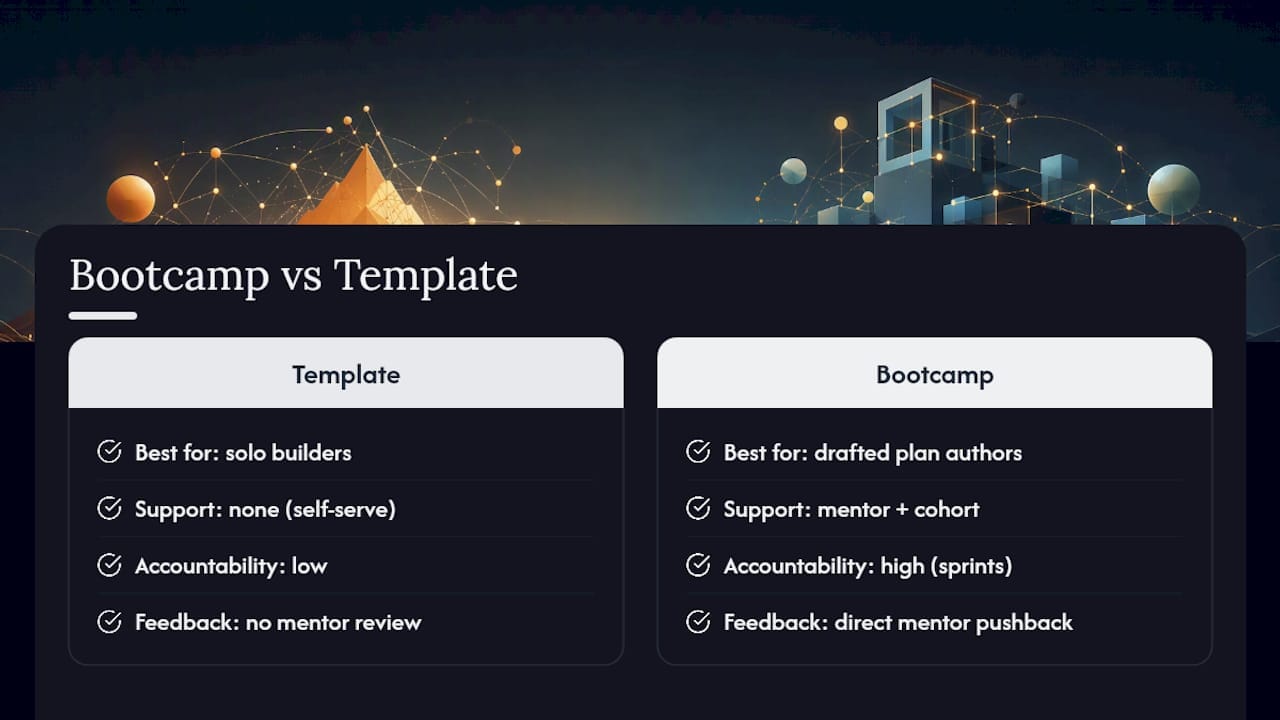
Templates and sample plans get you most of the way there, but they can’t argue with your assumptions, push back on your pricing, or tell you your customer acquisition cost is fantasy. That’s the gap Nomadexcel’s online entrepreneurship bootcamp closes: structured sprints, direct mentor feedback, and a peer cohort that stress-tests your plan while you still have time to fix it, instead of after a lender rejects it.
The program fits founders who’ve drafted a plan (or started one from a sample) but need outside pressure to finish the financials, validate the offer, and actually launch rather than keep revising in isolation. If you’re comfortable building alone and just need a reference document, a downloaded template works fine. If you want mentorship and accountability built into the process, see who benefits most from a bootcamp and check upcoming program dates to find your next cohort.
Sources
The SBA’s official business plan guide remains the most reliable free source for standard templates and sample plans built around funding conversations. For industry-specific inspiration, LivePlan’s sample library covers hundreds of business types with worked examples. When you need real market numbers rather than estimates, Census NAICS data gives you the industry codes and figures that make your market analysis section defensible instead of guessed. Each source solves a different problem: structure, inspiration, or proof.
- Write your business plan | U.S. Small Business Administration
- 550+ Sample Business Plan Examples to Inspire Your Own – LivePlan
- Business Plan Template for a Startup Business – SCORE
- Financial forecasting methods — HBS Online
Comments are closed.