
Startup Retreat: What It Is and Why Your Team Needs One
A startup retreat is a planned offsite gathering where a founding team steps away from daily operations to focus on strategic planning, trust-building, and creative collaboration. It is not a vacation, and it is not a standard team lunch scaled up. The best retreats combine structured workshops, open-ended conversation, and genuine downtime in a way that produces clarity and momentum that a normal workweek simply cannot replicate.
What separates a retreat from a casual outing comes down to intent. A well-run retreat has a defined agenda, a chosen venue that removes the usual distractions, and a mix of structured sessions alongside informal interactions. The goal is to give your team the space to think beyond the next sprint and reconnect with the people they are building something with. For remote and hybrid teams especially, that face-to-face time is not optional. It is the connective tissue that holds distributed work together.
A startup retreat typically delivers on several core purposes:
- Break from daily operations to create mental space for long-term thinking
- Build trust and rapport among team members who may rarely meet in person
- Align the team around vision, priorities, and key decisions
- Spark innovation through uninterrupted collaboration and brainstorming
- Overcome remote communication barriers that video calls alone cannot resolve
Table of Contents
- How to organize a startup retreat that actually delivers results
- What actually happens at a startup retreat
- The real benefits of startup retreats, backed by research
- Tips and best practices that separate good retreats from great ones
- What Nomadexcel’s experience reveals about retreats that transform teams
- Key Takeaways
- Ready to run a retreat that actually moves your startup forward?
How to organize a startup retreat that actually delivers results
Planning a retreat that earns its cost requires more than booking a nice house and hoping for the best. The structure you build before the event determines what your team walks away with.
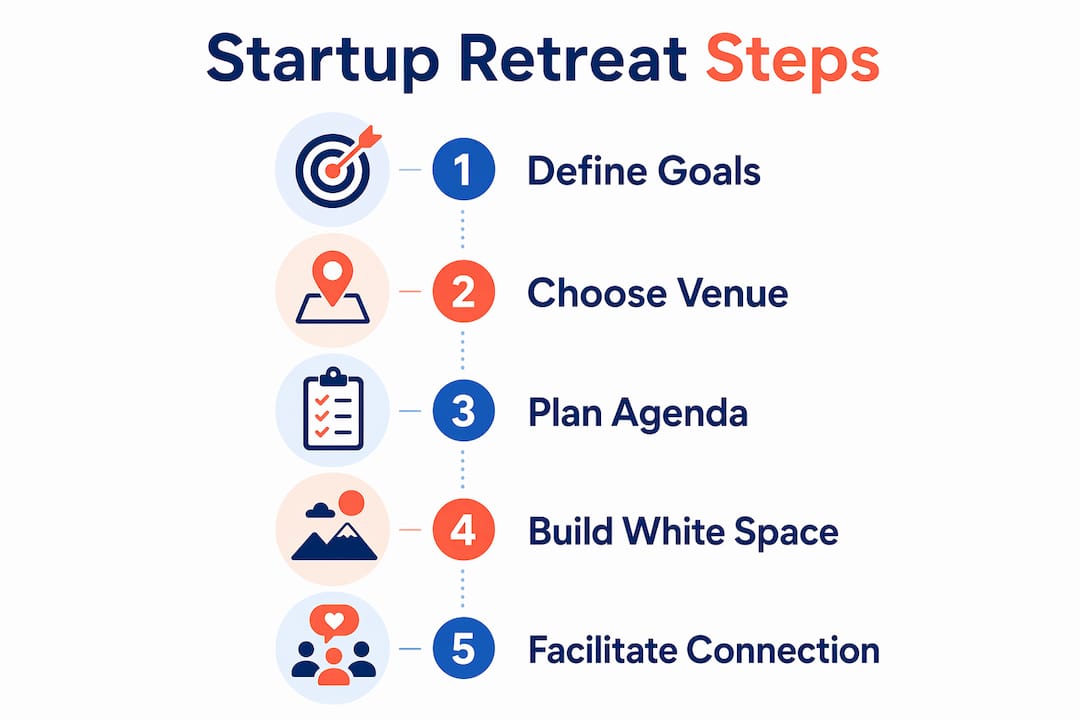
Set specific goals first. Decide what the retreat needs to accomplish before you choose a venue or draft an agenda. Are you aligning on a new product direction? Rebuilding trust after a rough quarter? Onboarding a wave of new hires? The answer shapes everything else.
Choose a venue that fits the work. Look for a space with large common areas where the whole team can gather, plus quieter breakout spots for smaller conversations. Proximity matters too. If people have to travel for hours just to reach the location, they arrive depleted rather than energized.
Set the right duration. For most early-stage teams, 2–5 days hits the sweet spot. Shorter than two days and you barely get past the icebreakers. Longer than a week and people start anxious about what they are missing back home. Remote teams often benefit from leaning toward the longer end of that range, since they have more relationship-building ground to cover.
Design a purposeful agenda. Mix strategic sessions with team-building activities and genuine downtime. Avoid the trap of scheduling every hour. Unstructured time consistently produces more spontaneous breakthroughs than back-to-back programming.
Assign clear roles. Designate someone to own logistics, someone to facilitate sessions, and someone to keep energy up throughout the event. Spreading that responsibility across the leadership team prevents any one person from burning out before the retreat even starts.
Budget realistically. Account for travel, accommodation, meals, activities, and facilitation materials. Retreats can feel expensive upfront, but the return on a well-run offsite compounds over months. Think of it as an investment in the team’s operating capacity, not a line item to minimize.
Communicate expectations clearly. Tell your team in advance that this is a work-focused event, not a vacation. When people know what to expect, they arrive prepared to engage rather than looking for the pool. As one experienced founder put it, setting that expectation upfront is what separates a productive retreat from an expensive team trip.
Handle logistics as a culture signal. The venue, the food, the travel arrangements — these choices communicate what you value. A thoughtful setup tells your team that their time and comfort matter. A chaotic one does the opposite.
Pro Tip: Build at least two to three hours of unscheduled “white space” into each day. The best ideas at a retreat rarely come from the agenda. They surface over coffee, during a walk, or in the conversation that starts after the formal session ends.
What actually happens at a startup retreat
The agenda varies by team size, goals, and duration, but most well-run startup retreats share a recognizable set of activities. Knowing what to expect helps you design a schedule that balances depth with energy.
- Strategic planning workshops where the team examines the company’s direction, sets quarterly or annual goals, and works through key decisions that have been stalled in the day-to-day
- Facilitated team-building exercises designed to build trust and surface how different team members think, communicate, and solve problems together
- Customer or user sessions where a real customer joins to share their experience with the product. Bringing customers in to speak at retreats creates alignment and drives faster execution than any internal meeting can
- Small-group brainstorming on specific challenges, broken out by function or cross-functionally depending on the problem
- Kickoff and retrospective sessions that frame the retreat’s purpose at the start and capture decisions and commitments at the close
- Informal meals and social time where the real relationship-building happens. Shared dinners, walks, and unplanned conversations reveal the person behind the Slack handle
- Physical or outdoor activities that refresh the group and create shared memories. A hike, a cooking class, or even a group walk changes the energy in a way that another workshop cannot
- Personal reflection time for founders and team members to process what they are hearing and think about their own role in what comes next
One thing the best retreats deliberately exclude: regular operational work. Answering emails, running standard standups, and handling customer support tickets during a retreat defeats the purpose. The value of the offsite comes from the break in routine, not from relocating the routine to a nicer setting.

The real benefits of startup retreats, backed by research
The case for retreats is not just anecdotal. Teams that meet in person periodically report up to 30% higher productivity and stronger collaboration than those that do not, according to a Harvard Business Review survey. That productivity lift is one reason retreats have moved from “nice to have” to a core part of how serious startups operate.
Beyond productivity, the relational returns are significant. Research from Babson College shows that startup retreats forge new collaborative working relationships that can last months to years after the event. People who meet at an offsite and find a reason to work together often continue doing so long after the retreat ends, building a network that compounds over time.
For remote teams, the benefits are even more pronounced. Face-to-face interaction reveals authentic traits that video calls simply cannot capture. Mannerisms, humor, how someone handles a disagreement, what lights them up — these details build a fuller picture of a colleague and make every future remote interaction warmer and more effective.
The other benefits worth naming:
- Faster decision-making. Offsite environments remove distractions so that decisions that drag for weeks in the office get resolved in hours.
- Reduced burnout risk. Good sleep, fresh air, and a break from reactive work give teams the mental reset that keeps people from quitting.
- Stronger company culture. Retreats signal that leadership values people, not just output. Candidates notice this. So do current employees deciding whether to stay.
- Cross-team network building. Retreats connect people who rarely interact through their normal work, especially at companies with distributed teams or multiple functions that operate in silos.
Retreats forge new collaborative relationships that last months to years after the event. For early-stage teams, that network becomes one of the most durable assets the company builds.
Tips and best practices that separate good retreats from great ones
Execution is where most retreats fall short. The concept is sound; the planning is where teams leave value on the table.
- Pick one unifying theme. A focused retreat theme helps every session point in the same direction and gives the team a shared frame for decisions made during the event. Without a theme, a multi-day retreat can feel like a collection of disconnected workshops.
- Protect the unstructured time. Back-to-back programming leads to participant burnout. Experienced organizers consistently find that the most memorable breakthroughs happen in the gaps, not the sessions.
- Use the location as a tool. Unusual venues and even mild travel inconvenience push teams outside their comfort zones, which makes people more open and more willing to have honest conversations. A slightly rustic or unfamiliar setting works in your favor.
- Bring in a real customer. If you can arrange for a customer to join for even an hour, do it. Hearing a customer describe their frustrations in their own words aligns a room faster than any internal presentation.
- Founders: show up as a person, not a presenter. Sincere behavior from founders during retreats significantly increases team trust and openness. When leadership is willing to be vulnerable, the rest of the team follows.
- Plan the follow-up before you leave. Capture decisions, assign owners, and schedule a check-in for four to six weeks after the retreat. Without a follow-up structure, the momentum fades within days of returning home.
Pro Tip: Try a “connection walk” where pairs walk side-by-side with a conversation prompt. Walking shoulder-to-shoulder without direct eye contact tends to produce more honest, open conversation than any boardroom discussion.
What Nomadexcel’s experience reveals about retreats that transform teams
The retreat industry has shifted. What once looked like a team perk has become essential strategic infrastructure for startups that want to move from reactive execution to long-term clarity. The teams that treat retreats as a recurring operating rhythm, not a one-off reward, are the ones that compound the benefits.

Founder-focused retreats operate on a specific logic: compress months of trust-building into three shared days so that founders leave knowing each other’s real challenges, not just their LinkedIn headlines. That compression is what makes the format so powerful for early-stage teams, where trust is the limiting factor on almost every decision.
The logistical choices matter more than most founders expect. Travel inconvenience, unfamiliar venues, and shared accommodations all increase team receptivity by removing the comfort-zone barriers that keep people performing rather than connecting. A slightly uncomfortable setting is not a planning failure. It is often the feature that makes the retreat work.
Nomadexcel’s retreat programs are built around this understanding. The entrepreneurship retreats Nomadexcel runs are designed to improve startup survival odds by 5–7% through the kind of trust-building, peer accountability, and strategic clarity that only comes from sustained in-person immersion. The structure balances facilitated programming with deliberate unstructured time, because the breakthroughs that matter most tend to happen when the agenda steps back and the people step forward.
Building a thriving company culture is not a passive outcome of good hiring. It is something founders actively construct, and retreats are one of the most direct tools available for doing that work. The teams that return from a well-run offsite do not just feel better. They make faster decisions, communicate more honestly, and stay longer.
Key Takeaways
A startup retreat is one of the highest-leverage investments an early-stage team can make, combining trust-building, strategic alignment, and creative collaboration in a format that daily operations cannot replicate.
| Point | Details |
|---|---|
| Define the purpose first | Set specific goals before booking anything — the agenda, venue, and duration all follow from what the retreat needs to accomplish. |
| Duration sweet spot | Most startup teams get the best results from a 2–5 day retreat, with remote teams benefiting from the longer end of that range. |
| Productivity uplift | Teams that meet in person periodically report up to 30% higher productivity than those that do not, per a Harvard Business Review survey. |
| Lasting relationships | Retreats forge collaborative relationships that last months to years, according to Babson College research on offsite events. |
| Unstructured time wins | Scheduling “white space” consistently produces more breakthroughs than back-to-back programming, making it a non-negotiable part of any agenda. |
Ready to run a retreat that actually moves your startup forward?
Nomadexcel designs and facilitates business retreats for remote teams that combine strategic programming with genuine team connection. Every retreat is built end-to-end, from facilitation and workshops to logistics and local experiences, so your team arrives focused and leaves with real momentum. If you are ready to invest in your team the way the best-run startups do, explore Nomadexcel’s retreat programs and find the format that fits where your team is right now.
Comments are closed.