
What are curated entrepreneurial cohorts and why they work
TL;DR:
- Curated entrepreneurial cohorts are selectively assembled groups designed to accelerate startup growth through mentorship, peer support, and structured learning.
- These programs, with outcomes like 188% revenue growth and high funding success, depend on rigorous selection and effective program design.
- Success is maximized when founders actively engage, choose fitting programs, and leverage the community and mentorship opportunities.
The popular image of an entrepreneur is a lone visionary grinding through late nights, fueled by coffee and sheer willpower. It’s romantic, but it’s rarely the most effective path. Curated entrepreneurial cohorts are selectively chosen groups of aspiring or early-stage entrepreneurs who participate together in structured, time-bound programs, and the evidence suggests they consistently outperform the solo approach. This guide breaks down exactly what curated cohorts are, how they’re built, what real outcomes look like, and how you can decide whether one is right for your entrepreneurial journey.
Table of Contents
- Defining curated entrepreneurial cohorts
- Types of programs and cohort experiences
- What the data says: Measured impact and outcomes
- Who gets the most out of curated cohorts?
- The hidden truth about entrepreneurial cohorts
- Ready to join a curated entrepreneurial cohort?
- Frequently asked questions
Key Takeaways
| Point | Details |
|---|---|
| Structured peer support | Curated cohorts create an immersive environment for mentorship, accountability, and real progress. |
| Proven outcome boosts | Empirical data shows selective programs can supercharge revenue and employment growth for founders. |
| Choose for fit, not fame | Matching your needs and experience to the right cohort type matters more than prestige. |
| Beware low-quality programs | Most programs fail due to poor operations, so rigorous selection and follow-up are critical. |
Defining curated entrepreneurial cohorts
The word “curation” carries real weight here. It’s not about filling seats with anyone who applies. It’s about assembling a group whose diverse experiences, goals, and drive create an environment where everyone accelerates faster together than they ever would alone. Think of it less like a classroom and more like a well-designed ecosystem, where every element, the participants, mentors, curriculum, and structure, is chosen with intention.
At its core, a curated entrepreneurial cohort provides immersive experiences with mentorship, peer support, workshops, and networking to accelerate business development. These programs are almost always time-bound, running anywhere from two weeks to six months, which creates a productive urgency that keeps participants focused and moving forward.
“A well-designed cohort isn’t just a program — it’s a carefully constructed environment where the right people, the right challenges, and the right support collide to produce outcomes none of them could manufacture alone.”
The key features that distinguish curated programs from general courses or self-paced learning include selective admission, structured curriculum, and deliberate peer pairing. You can learn more about how bootcamp structures are designed to support these goals, or explore the specifics of a startup bootcamp structure if you want a deeper look at how these programs operate day to day.
Here’s a side-by-side comparison to show how cohort-based learning stacks up against going it alone:
| Feature | Curated cohort | Solo/self-paced learning |
|---|---|---|
| Accountability | Daily and peer-driven | Self-managed only |
| Mentorship | Direct, structured access | Optional, rarely consistent |
| Community | Handpicked peers | None built in |
| Feedback loops | Real-time and ongoing | Delayed or absent |
| Program duration | Defined, time-bound | Indefinite |
| Outcome tracking | Structured milestones | No benchmarks |
Most curated programs include four essential building blocks:
- Expert mentorship: Access to entrepreneurs, operators, and investors who give direct, unfiltered feedback
- Group accountability: Scheduled check-ins, daily sprints, and peer pressure in the best possible sense
- Skill workshops: Hands-on sessions covering sales, marketing, product development, and business modeling
- Community connection: A network of peers who become collaborators, clients, and lifelong supporters
The result is a learning environment that rewards action over theory, which is exactly what early-stage entrepreneurs need most.
Types of programs and cohort experiences
With the basics defined, it’s essential to understand the range of curated cohort programs available and how their experiences differ. Not every program is built the same way, and the format you choose will have a significant impact on what you get out of it.
The four main program types are accelerators, bootcamps, fellowships, and retreats. Each serves a distinct purpose and targets a different stage of founder development.
| Program type | Duration | Intensity | Best for |
|---|---|---|---|
| Accelerator | 3–6 months | High | Startups seeking funding and scale |
| Bootcamp | 1–4 weeks | Very high | Aspiring and early-stage founders |
| Fellowship | 6–12 months | Moderate | Purpose-driven entrepreneurs |
| Retreat | 3–7 days | Focused | Teams and experienced founders resetting |
Understanding the differences helps you match the format to where you are right now, not where you hope to be in two years. Research consistently shows that novice founders benefit more from structured generalist programs, while experienced founders tend to thrive in flexible specialized ones. If you’re just getting started, a program that walks you through every step is far more valuable than one that assumes you already know the fundamentals.
Here’s what you can typically expect when you join a well-run curated cohort program:
- Selective admissions process: Applications, interviews, and sometimes a pitch or writing exercise to ensure program fit
- Orientation and cohort building: Early sessions designed to build trust, establish norms, and align goals across participants
- Structured curriculum delivery: Weekly themes or sprints covering core business skills, led by facilitators and guest experts
- Mentorship sessions: One-on-one and group mentorship with experienced founders and operators at regular intervals
- Peer accountability systems: Structured check-ins, progress updates, and mutual challenge built into the schedule
- Final presentation or demo day: A moment to synthesize learnings, present progress, and often connect with investors or partners
- Alumni network integration: Post-program access to a community that continues beyond the formal experience
The programs worth joining as an entrepreneurship bootcamp participant are the ones that take every one of these stages seriously, especially the community and post-program support. The bootcamp benefits extend far beyond the weeks you spend in the room.

Pro Tip: Don’t choose a cohort program based on name recognition alone. Match the intensity, format, and curriculum to your current experience level. A beginner who joins an advanced accelerator will struggle to keep up, while an experienced founder in a generalist bootcamp may feel underchallenged. Fit is everything.
What the data says: Measured impact and outcomes
Understanding the types of curated cohorts is just the start. Let’s look at what the evidence says about who benefits, by how much, and what the potential risks are. Because while curated cohorts can produce remarkable results, the outcomes are far from guaranteed for every participant in every program.
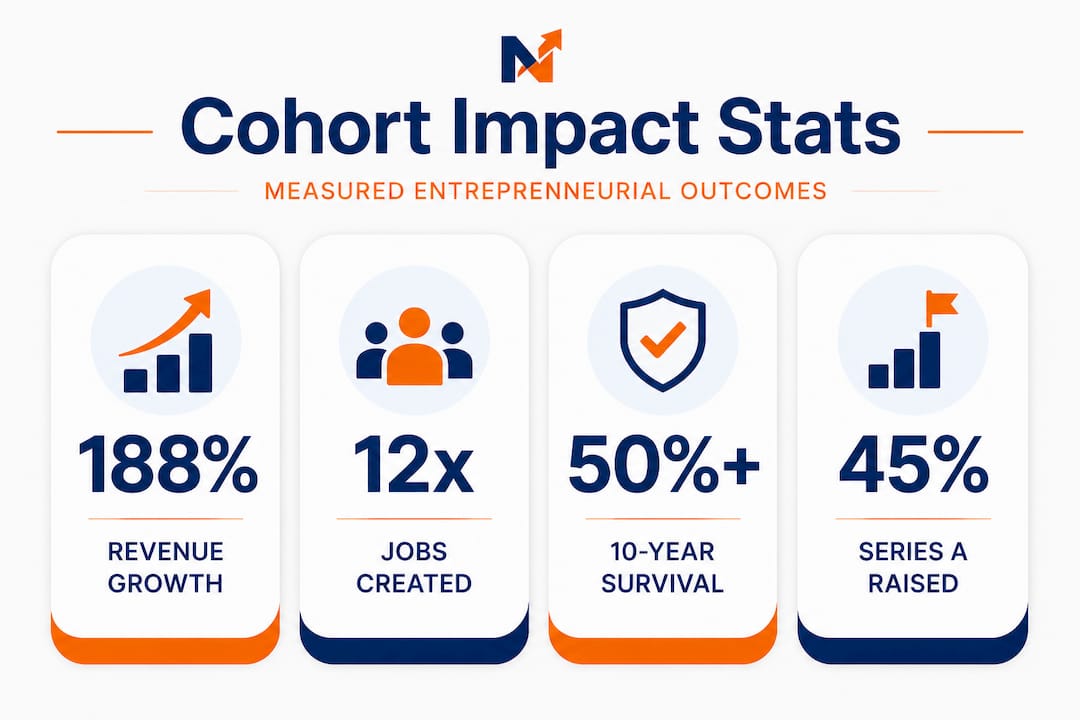
The numbers from top-tier programs are genuinely striking. Founders with strong pre-entry knowledge who complete rigorous programs have seen 188% revenue growth and 12x employment growth after completing their programs. Y Combinator alumni show a 50% or higher survival rate at the 10-year mark, and 45% of them successfully raise a Series A round. Techstars alumni demonstrate that 74% raise follow-on funding within three years of completing the program. These are not average outcomes across all programs — they reflect the performance of high-quality programs with rigorous selection criteria and strong ecosystem support.
“The data is clear: the right cohort program, combined with the right founder, doesn’t just improve outcomes — it multiplies them in ways that solo learning simply cannot replicate.”
Here’s a snapshot of how outcomes compare across program tiers:
| Program benchmark | Key outcome |
|---|---|
| Y Combinator | 50%+ survive 10 years; 45% raise Series A |
| Techstars | 74% of alumni raise follow-on within 3 years |
| High-knowledge cohort founders | 188% revenue growth; 12x employment growth |
| General cohort average | Outcomes vary widely by program quality |
However, the picture is not uniformly positive. Research shows that 90% of accelerators fail after just three cohorts due to poor operations, and some studies point to a higher bankruptcy risk among cohort participants despite their employment gains. This speaks directly to the importance of selecting a program that is well-run, not just well-branded.
When evaluating a cohort program based on its track record, look for:
- Rigorous participant selection: Programs with acceptance rates below 10% tend to produce stronger cohort dynamics
- Clear post-program pathways: Alumni networks, follow-on funding connections, and continued mentorship access
- Transparent outcome data: Reputable programs share their numbers; be skeptical of those that don’t
- Strong operational infrastructure: Consistent facilitators, structured curriculum, and post-cohort community investment
- Evidence of community longevity: Are alumni still active and connected five years after graduation?
You can explore real bootcamp outcomes and what participants have experienced firsthand, which offers a grounded view of what quality programs look like in practice.
Who gets the most out of curated cohorts?
Equipped with outcomes data, you may wonder if joining a curated cohort is the right move for you. Let’s break down who stands to gain the most and why selectivity matters as much for participants as it does for program designers.
The honest answer is that program design matching founder experience is the single biggest driver of success, and elite programs succeed precisely because of rigorous filtering, some with acceptance rates under 3%, combined with deep ecosystem investment. This means that if you choose a program thoughtfully and meet its criteria, you’re already filtering for a high-probability outcome.
Here are strong indicators that you’re ready to benefit from a curated cohort:
- You’re actively seeking mentorship but don’t have consistent access to advisors with relevant experience
- You lack external accountability and find yourself drifting on your goals without structured deadlines
- You want a real peer network of fellow founders who understand your challenges and can collaborate over time
- You have a business idea or early venture that needs validation, refinement, or a faster path to execution
- You’ve hit a plateau and feel that solo effort alone isn’t breaking through your current ceiling
- You’re ready to invest time and energy fully, not dabble in learning while juggling everything else
Novice founders who join well-structured, generalist programs typically gain the most in terms of foundational skills, confidence, and clarity of direction. They benefit enormously from guided frameworks and the reassurance of expert mentorship. Experienced founders, on the other hand, often extract the most value from peer-level conversations, specialized workshops, and the opportunity to stress-test ideas with people who can give sophisticated pushback.
The right approach to types of mentorship programs also matters as much as the cohort format. Pairing cohort participation with the right mentorship model compounds your results significantly. If you want to understand how to navigate that combination, the mentorship program guide offers clear, practical guidance.
Pro Tip: Look for programs with selective admissions and explicit post-program pathways. A cohort that vets its participants seriously and stays invested in alumni success is almost always worth more than a popular program that takes anyone willing to pay.
The hidden truth about entrepreneurial cohorts
To close, let’s challenge some assumptions about what actually makes a curated cohort transformative — beyond mere access or brand.
Too many founders spend months researching which program has the most impressive name rather than asking which program fits who they are right now. That’s a costly mistake. Prestige can open doors, but fit is what determines whether you actually walk through them. A well-run regional bootcamp with tight community bonds and rigorous mentorship will deliver more lasting value than a famous accelerator where you’re lost in a crowd of two hundred participants who receive mostly automated support.
The programs worth avoiding have a recognizable pattern. They lead with hype and use glossy marketing to attract applicants, but show little evidence of ongoing community investment after the program ends. They have no structured alumni network. They offer mentorship in theory but deliver it inconsistently in practice. These are the programs that contribute to the statistic that 90% of accelerators fail within their first few cohorts, because they’re built for optics, not outcomes.
What actually creates transformation in a cohort? Three things, consistently: access to expert networks with real credibility and real relationships, peer accountability that holds you to commitments even when motivation fades, and a practical framework that channels your energy toward the right actions in the right order. Research confirms that novice founders benefit most from structured generalist programs, but the deeper insight is that every founder benefits most from a program designed explicitly for their stage.
The best cohort isn’t the most famous one. It’s the one you join with full intention, engage with completely, and stay connected to long after the formal program ends. The transformation doesn’t happen to you. It happens because of the choices you make inside the structure.
Ready to join a curated entrepreneurial cohort?
If this guide has sparked something for you, the next logical step is exploring programs that are designed with exactly this kind of intentionality. Nomad Excel’s essential guide to entrepreneurship bootcamps is a strong starting point for understanding what a well-designed program looks and feels like. If you’re ready to act, the online entrepreneurship bootcamp offers a structured, immersive experience built around hands-on learning, handpicked peer groups, and world-class mentorship. For those who want to understand the mentorship dimension more deeply before committing, the mentorship program guide offers clear, practical direction. Growth accelerates when you stop going it alone.
Frequently asked questions
What makes a cohort “curated”?
A curated cohort selectively admits participants based on fit, goals, and diversity to maximize peer learning and program effectiveness, rather than accepting anyone who applies.
Are curated entrepreneurial cohorts only for beginners?
No, both novice and experienced founders benefit, but the program type matters enormously. Novice founders gain more from structured generalist programs, while experienced founders do better in flexible, specialized ones.
What results can I expect from joining a curated program?
Top cohorts show strong performance gains, with some founders achieving 188% revenue growth and 12x employment growth, though outcomes vary based on program quality and participant readiness.
Are there risks or downsides to joining a cohort?
Yes. Some programs fail to deliver meaningful results, and data shows that 90% of accelerators don’t survive past three cohorts due to poor operations, making careful program selection essential.
How do I maximize my cohort experience?
Engage fully from day one, actively seek out mentorship, use peer accountability as a genuine tool, and invest in building your network throughout and after the program ends.
Comments are closed.